 Click main image to view in full screen.
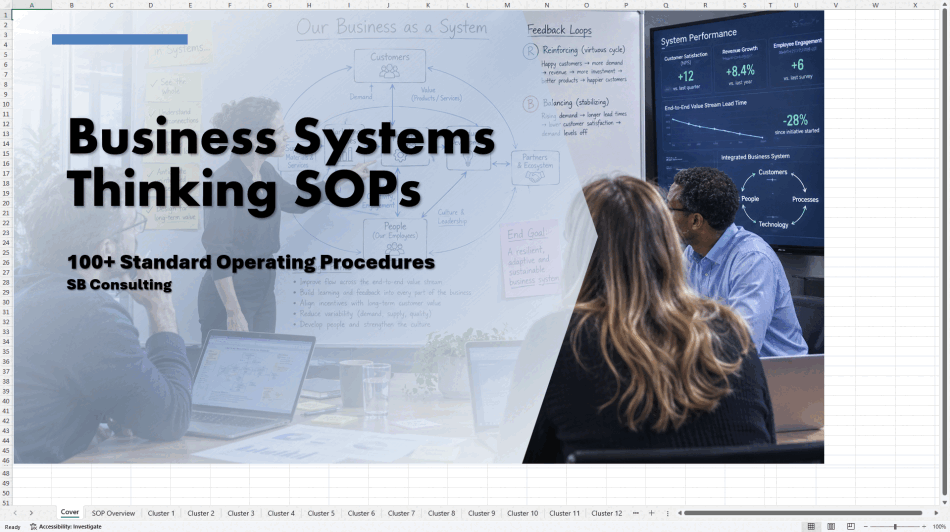
100+ Business Systems Thinking SOPs – Excel XLSX
Excel (XLSX)


BENEFITS OF THIS DOWNLOADABLE EXCEL DOCUMENT
- Provides a framework for implementing Enterprise Systems Thinking across your organization.
- Provides a framework for mapping business systems, improving strategic alignment, and optimizing cross-functional decision-making.
- Provides a framework for strengthening organizational resilience, continuous improvement, and enterprise-wide operational excellence.
SYSTEMS THINKING EXCEL DESCRIPTION
Curated by McKinsey-trained Executives
🚀 100+ BUSINESS SYSTEMS THINKING SOP LIBRARY 🚀
💣 THE ULTIMATE ENTERPRISE STRATEGY, SYSTEMS MAPPING EXCELLENCE, STAKEHOLDER ECOSYSTEM MASTERY, VALUE CHAIN OPTIMIZATION, ORGANIZATIONAL DESIGN LEADERSHIP, STRATEGIC DECISION-MAKING DOMINANCE, PERFORMANCE MEASUREMENT MASTERY, RISK & RESILIENCE SYSTEMS, INNOVATION & PROBLEM-SOLVING EXCELLENCE, DIGITAL TRANSFORMATION & AI SYSTEMS THINKING, SUPPLY CHAIN NETWORK RESILIENCE, CUSTOMER EXPERIENCE SYSTEMS, CHANGE MANAGEMENT LEADERSHIP, BUSINESS SIMULATION MASTERY & CONTINUOUS IMPROVEMENT OPERATING SYSTEM – DELIVERED AS A READY-TO-USE EXCEL TEMPLATE 💣
🔥 STOP MANAGING YOUR ENTERPRISE WITH FRAGMENTED STRATEGY, SILOED DEPARTMENTS, REACTIVE DECISION-MAKING, DISCONNECTED PERFORMANCE METRICS, MISSED INTERDEPENDENCIES, ORGANIZATIONAL MISALIGNMENT, SUPPLY CHAIN VULNERABILITIES, CUSTOMER EXPERIENCE GAPS, CHANGE MANAGEMENT CHAOS, UNTESTED SCENARIOS & STAGNANT IMPROVEMENT… AND START LEADING WITH A WORLD-CLASS ENTERPRISE SYSTEMS THINKING FRAMEWORK. 🔥
📊 THE HARD TRUTH ABOUT ENTERPRISE ORGANIZATIONS
Most enterprises fail to maximize strategic performance, operational excellence, and competitive advantage not because they lack talent, resources, or ambition.
They fail because they lack a STRUCTURED ENTERPRISE SYSTEMS THINKING EXECUTIVE LEADERSHIP FRAMEWORK.
• ❌ They develop strategy without understanding enterprise system interdependencies
• ❌ They make decisions without mapping cascading second- and third-order consequences
• ❌ They manage operations with siloed, disconnected processes
• ❌ They miss root causes because they don't see systemic feedback loops
• ❌ They invest in initiatives that create unintended organizational side effects
• ❌ They fail to anticipate how changes in one system ripple across the enterprise
• ❌ They struggle with cross-functional collaboration because roles & responsibilities lack systemic alignment
• ❌ They measure performance with disconnected metrics instead of balanced feedback systems
• ❌ They face recurring problems because they treat symptoms, not root causes
• ❌ They experience change resistance because they don't understand human systems dynamics
• ❌ They build organizational structures misaligned with business model interdependencies
• ❌ They underestimate ecosystem risks and stakeholder complexity
• ❌ They fail to optimize value chains across interconnected processes
• ❌ They miss innovation opportunities hidden in system constraints
• ❌ They don't leverage simulation & scenario planning for strategic testing
• ❌ They pursue improvement initiatives without understanding system interactions
❌ NO ENTERPRISE SYSTEMS THINKING FRAMEWORK
• ❌ No formalized systems thinking governance & executive disciplines
• ❌ No enterprise-wide system mapping or interdependency visibility
• ❌ No stakeholder & ecosystem analysis for strategic advantage
• ❌ No value chain systems optimization discipline
• ❌ No systems-aligned organizational design & operating model governance
• ❌ No scenario planning or systemic decision-making excellence
• ❌ No balanced performance measurement & feedback system frameworks
• ❌ No risk & resilience assessment against systemic cascading failures
• ❌ No structured innovation & complex problem-solving methodology
• ❌ No digital transformation roadmap aligned with systems thinking
• ❌ No supply chain network resilience or ecosystem risk management
• ❌ No customer experience systems optimization
• ❌ No change management discipline rooted in organizational systems dynamics
• ❌ No business simulation or scenario testing capabilities
• ❌ No continuous improvement governance aligned with systemic optimization
Let's be honest…
If your organization is operating through disconnected silos, reactive management, missed interdependencies, misaligned incentives, siloed performance metrics, and fragmented strategic planning…
You do not have an Enterprise Systems Thinking System.
You have organizational uncertainty.
One missed market opportunity.
One failed strategic initiative.
One organizational restructure that backfires.
One supply chain disruption.
One customer experience failure.
One change management disaster.
One competitive blind spot.
One cascading operational failure.
One margin erosion.
That's all it takes.
🚀 INTRODUCING: THE 150 BUSINESS SYSTEMS THINKING SOP LIBRARY
💥 A COMPLETE ENTERPRISE SYSTEMS THINKING STRATEGY, CORPORATE GOVERNANCE, ENTERPRISE SYSTEM MAPPING, STAKEHOLDER ECOSYSTEM ANALYSIS, VALUE CHAIN OPTIMIZATION, ORGANIZATIONAL DESIGN EXCELLENCE, STRATEGIC DECISION-MAKING MASTERY, PERFORMANCE MEASUREMENT SYSTEMS, RISK & RESILIENCE MANAGEMENT, INNOVATION & PROBLEM-SOLVING, DIGITAL TRANSFORMATION & AI SYSTEMS THINKING, SUPPLY CHAIN NETWORK SYSTEMS, CUSTOMER EXPERIENCE SYSTEMS, CHANGE MANAGEMENT & ORGANIZATIONAL LEARNING, BUSINESS SIMULATION & CONTINUOUS IMPROVEMENT OPERATING SYSTEM 💥
✅ 150 professionally structured Systems Thinking Leadership SOPs
✅ Delivered as a ready-to-use Excel Template
✅ Covers the complete enterprise systems thinking lifecycle
✅ Creates a standardized operational excellence framework across organizations, industries & geographies
✅ Supports strategic alignment, cross-functional collaboration, systems optimization, stakeholder alignment, adaptive leadership & sustainable competitive advantage
✅ Enables organizations to move from reactive management to proactive systems thinking leadership & market domination
🧠 PROFESSIONAL EXECUTIVE SOP FRAMEWORK
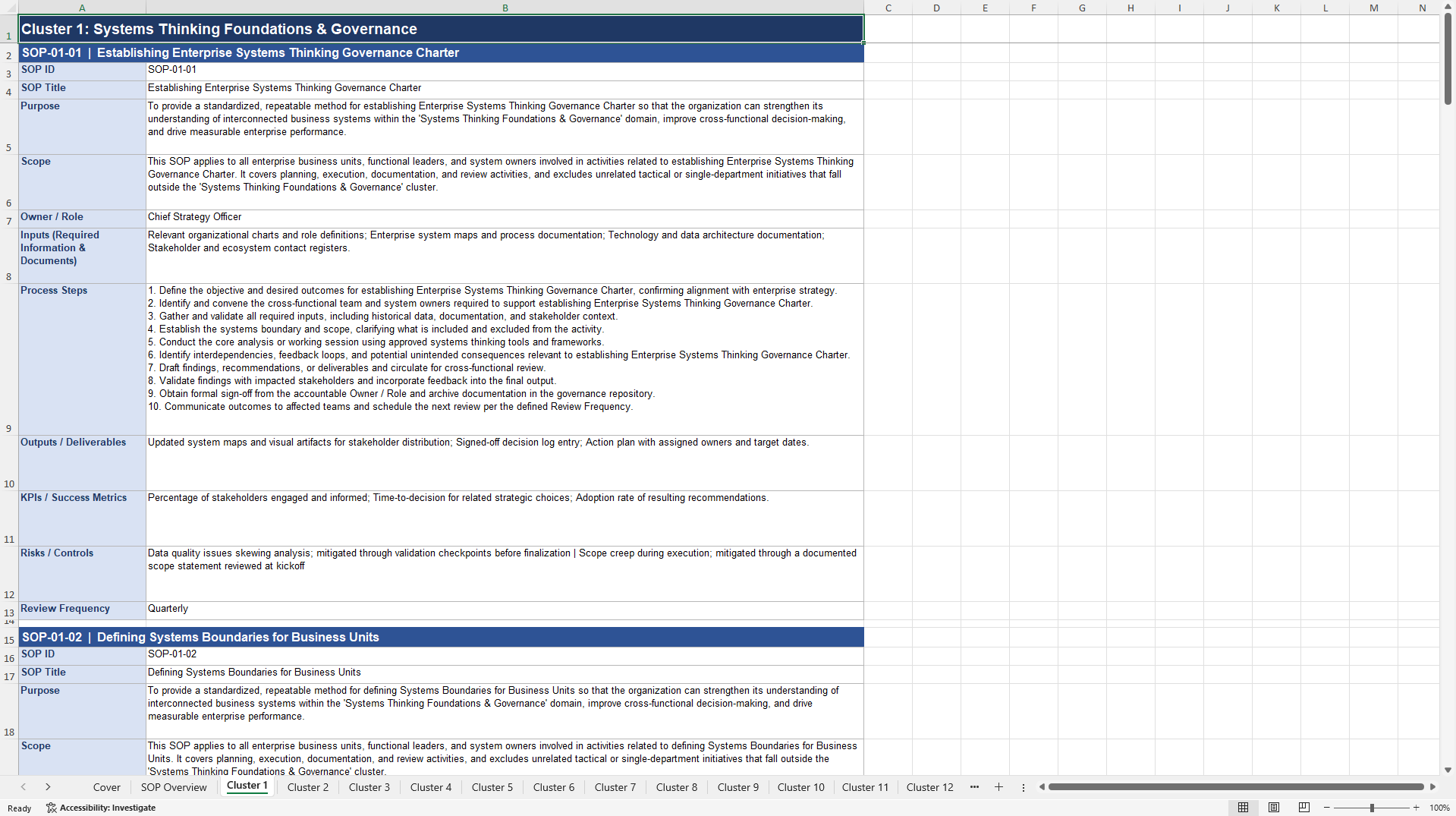
Every SOP follows a structured enterprise systems thinking leadership format:
✅ SOP ID & Executive Business Objective
✅ Purpose, Scope & Systemic Alignment
✅ Owner / Role & Accountability Authority
✅ Required Inputs & Critical Information Sources
✅ Executive Workflow & Governance Gates
✅ Process Outputs & Strategic Business Outcomes
✅ Step-by-Step Systemic Process (Exactly 10 Sequential Steps)
✅ Executive Deliverables & Quality Artifacts
✅ Enterprise KPIs & Success Metrics
✅ Risk Management & Control Frameworks
✅ Governance Review Cycle & Continuous Optimization
📋 ALL 150 BUSINESS SYSTEMS THINKING STRATEGIC MANAGEMENT SOPs – CLUSTERED BY DOMAIN
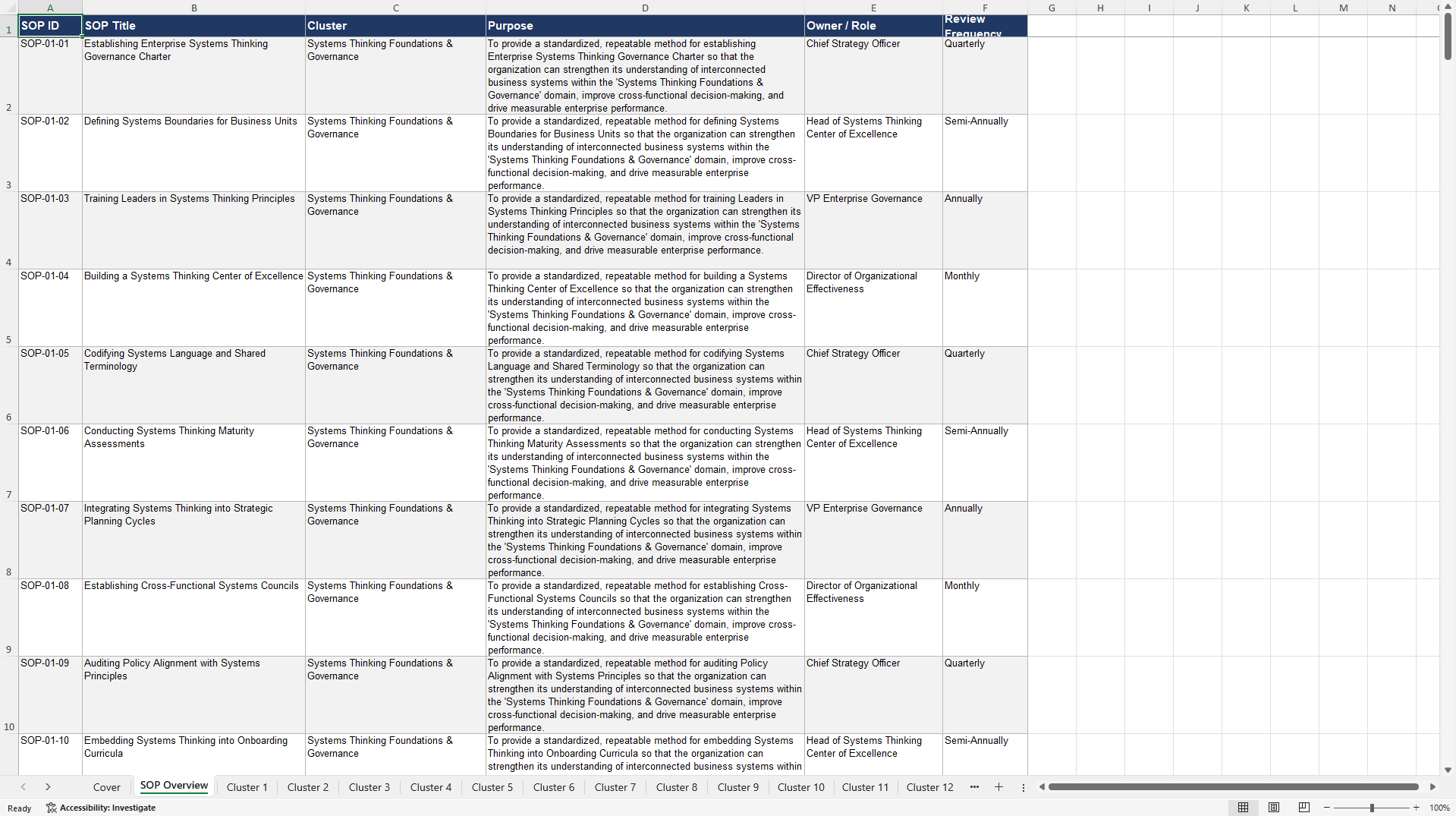
CLUSTER 1: SYSTEMS THINKING FOUNDATIONS & GOVERNANCE (10 SOPs)
• SOP-01-01 – Establishing Enterprise Systems Thinking Governance Charter
• SOP-01-02 – Defining Systems Boundaries for Business Units
• SOP-01-03 – Training Leaders in Systems Thinking Principles
• SOP-01-04 – Building a Systems Thinking Center of Excellence
• SOP-01-05 – Codifying Systems Language and Shared Terminology
• SOP-01-06 – Conducting Systems Thinking Maturity Assessments
• SOP-01-07 – Integrating Systems Thinking into Strategic Planning Cycles
• SOP-01-08 – Establishing Cross-Functional Systems Councils
• SOP-01-09 – Auditing Policy Alignment with Systems Principles
• SOP-01-10 – Embedding Systems Thinking into Onboarding Curricula
CLUSTER 2: ENTERPRISE SYSTEM MAPPING (10 SOPs)
• SOP-02-01 – Creating Enterprise-Wide System Maps
• SOP-02-02 – Mapping Interdependencies Between Business Functions
• SOP-02-03 – Developing Causal Loop Diagrams for Core Processes
• SOP-02-04 – Building Stock-and-Flow Models of Key Resources
• SOP-02-05 – Mapping Information Flow Across the Organization
• SOP-02-06 – Identifying Feedback Loops in Operational Systems
• SOP-02-07 – Constructing System Dynamics Models for Growth Levers
• SOP-02-08 – Mapping Decision Rights Across the Enterprise System
• SOP-02-09 – Visualizing Value Streams Across Organizational Boundaries
• SOP-02-10 – Maintaining and Updating the Enterprise System Map Repository
CLUSTER 3: STAKEHOLDER & ECOSYSTEM ANALYSIS (10 SOPs)
• SOP-03-01 – Mapping the Extended Business Ecosystem
• SOP-03-02 – Conducting Stakeholder Influence and Interest Analysis
• SOP-03-03 – Analyzing Partner and Supplier Ecosystem Dependencies
• SOP-03-04 – Assessing Regulatory Ecosystem Impacts on Operations
• SOP-03-05 – Mapping Competitive Ecosystem Dynamics
• SOP-03-06 – Evaluating Customer Ecosystem Touchpoints
• SOP-03-07 – Facilitating Multi-Stakeholder Systems Workshops
• SOP-03-08 – Assessing Ecosystem Health and Resilience Indicators
• SOP-03-09 – Managing Stakeholder Feedback Loops
• SOP-03-10 – Modeling Ecosystem Scenario Impacts on Strategy
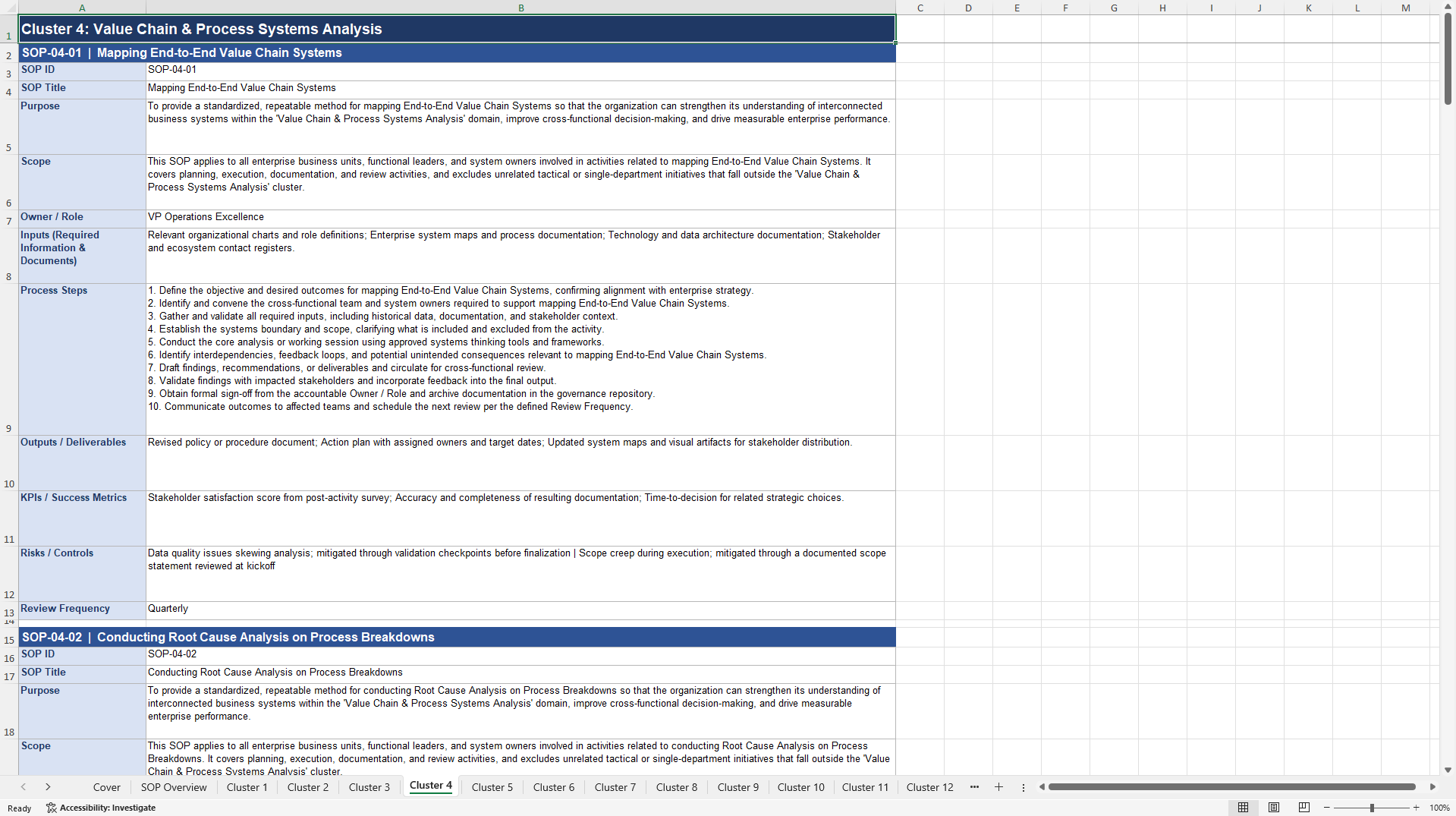
CLUSTER 4: VALUE CHAIN & PROCESS SYSTEMS ANALYSIS (10 SOPs)
• SOP-04-01 – Mapping End-to-End Value Chain Systems
• SOP-04-02 – Conducting Root Cause Analysis on Process Breakdowns
• SOP-04-03 – Analyzing Cross-Functional Process Handoffs
• SOP-04-04 – Identifying Bottlenecks Using Systems Diagnostics
• SOP-04-05 – Evaluating Value Chain Leakage Points
• SOP-04-06 – Standardizing Process Systems Documentation
• SOP-04-07 – Conducting Process Interdependency Impact Assessments
• SOP-04-08 – Benchmarking Value Chain Performance Against Systems Standards
• SOP-04-09 – Analyzing Non-Value-Added Activities in Process Systems
• SOP-04-10 – Redesigning Process Systems for Flow Optimization
CLUSTER 5: ORGANIZATIONAL STRUCTURE & OPERATING MODEL SYSTEMS (10 SOPs)
• SOP-05-01 – Designing Systems-Aligned Organizational Structures
• SOP-05-02 – Assessing Operating Model Fit-for-Purpose
• SOP-05-03 – Analyzing Span of Control Within Systemic Constraints
• SOP-05-04 – Evaluating Matrix Reporting System Effectiveness
• SOP-05-05 – Redesigning Governance Structures for Systemic Alignment
• SOP-05-06 – Conducting Role Clarity and Accountability Mapping
• SOP-05-07 – Assessing Centralization vs Decentralization Trade-offs
• SOP-05-08 – Aligning Incentive Systems with Organizational Design
• SOP-05-09 – Managing Organizational Design Change Requests
• SOP-05-10 – Reviewing Operating Model Performance Quarterly
CLUSTER 6: STRATEGIC DECISION-MAKING & SCENARIO PLANNING (10 SOPs)
• SOP-06-01 – Conducting Systems-Based Strategic Options Analysis
• SOP-06-02 – Facilitating Scenario Planning Workshops
• SOP-06-03 – Building Decision Trees for Complex Strategic Choices
• SOP-06-04 – Conducting Pre-Mortem Analysis on Strategic Initiatives
• SOP-06-05 – Evaluating Second- and Third-Order Consequences of Decisions
• SOP-06-06 – Running War-Gaming Simulations for Competitive Strategy
• SOP-06-07 – Facilitating Executive Systems-Thinking Decision Reviews
• SOP-06-08 – Conducting Trade-Off Analysis Across Interconnected Objectives
• SOP-06-09 – Documenting Strategic Assumptions and Testing Them
• SOP-06-10 – Reviewing Strategic Decisions Post-Implementation
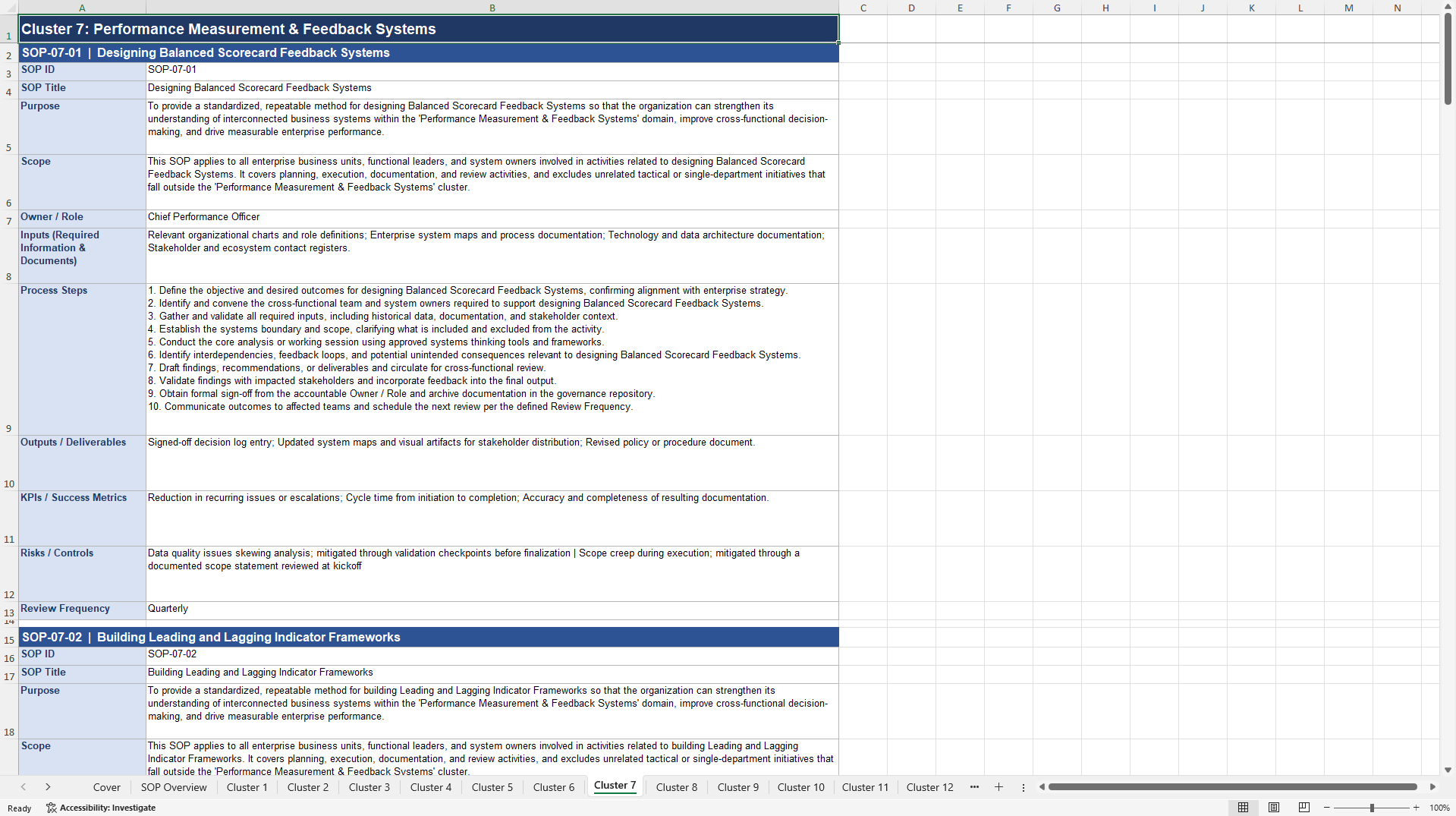
CLUSTER 7: PERFORMANCE MEASUREMENT & FEEDBACK SYSTEMS (10 SOPs)
• SOP-07-01 – Designing Balanced Scorecard Feedback Systems
• SOP-07-02 – Building Leading and Lagging Indicator Frameworks
• SOP-07-03 – Establishing Enterprise KPI Governance
• SOP-07-04 – Conducting Systemic Performance Variance Analysis
• SOP-07-05 – Designing Real-Time Performance Dashboards
• SOP-07-06 – Auditing Feedback Loop Integrity in Reporting Systems
• SOP-07-07 – Aligning Departmental Metrics with Enterprise Objectives
• SOP-07-08 – Conducting Root Cause Reviews of Missed Targets
• SOP-07-09 – Calibrating Metric Thresholds and Escalation Triggers
• SOP-07-10 – Reviewing and Retiring Obsolete Performance Metrics
CLUSTER 8: RISK, RESILIENCE & ADAPTIVE SYSTEMS (10 SOPs)
• SOP-08-01 – Conducting Enterprise Systemic Risk Assessments
• SOP-08-02 – Designing Business Continuity Systems
• SOP-08-03 – Mapping Single Points of Failure Across Systems
• SOP-08-04 – Building Adaptive Capacity Frameworks
• SOP-08-05 – Conducting Stress Testing on Critical Business Systems
• SOP-08-06 – Establishing Early Warning Indicator Systems
• SOP-08-07 – Managing Cascading Risk Interdependencies
• SOP-08-08 – Designing Redundancy and Buffer Strategies
• SOP-08-09 – Conducting Post-Incident Systemic Reviews
• SOP-08-10 – Reviewing Resilience Investments Against Risk Exposure
CLUSTER 9: INNOVATION & COMPLEX PROBLEM SOLVING (10 SOPs)
• SOP-09-01 – Facilitating Systems-Based Root Cause Problem Solving
• SOP-09-02 – Running Design Thinking Sessions for Complex Challenges
• SOP-09-03 – Conducting Ideation Sprints Using Systems Frameworks
• SOP-09-04 – Managing Cross-Functional Innovation Pipelines
• SOP-09-05 – Prototyping Solutions to Systemic Business Problems
• SOP-09-06 – Conducting Leverage Point Analysis for Interventions
• SOP-09-07 – Facilitating Structured Problem Definition Workshops
• SOP-09-08 – Evaluating Innovation Portfolio System Interactions
• SOP-09-09 – Piloting and Scaling Systemic Interventions
• SOP-09-10 – Capturing and Codifying Innovation Learnings
CLUSTER 10: DIGITAL TRANSFORMATION & AI SYSTEMS THINKING (10 SOPs)
• SOP-10-01 – Assessing Digital Ecosystem Readiness
• SOP-10-02 – Mapping AI Use Cases Against Enterprise Systems
• SOP-10-03 – Governing AI Model Integration Across Business Systems
• SOP-10-04 – Conducting Data Flow and Integration Systems Analysis
• SOP-10-05 – Managing Technology Debt as a Systemic Risk
• SOP-10-06 – Aligning Digital Transformation Roadmaps with Systems Priorities
• SOP-10-07 – Evaluating Automation Impact on Interconnected Processes
• SOP-10-08 – Establishing AI Governance and Oversight Committees
• SOP-10-09 – Monitoring AI System Performance and Drift
• SOP-10-10 – Reviewing Digital Transformation Outcomes Against Systemic Goals
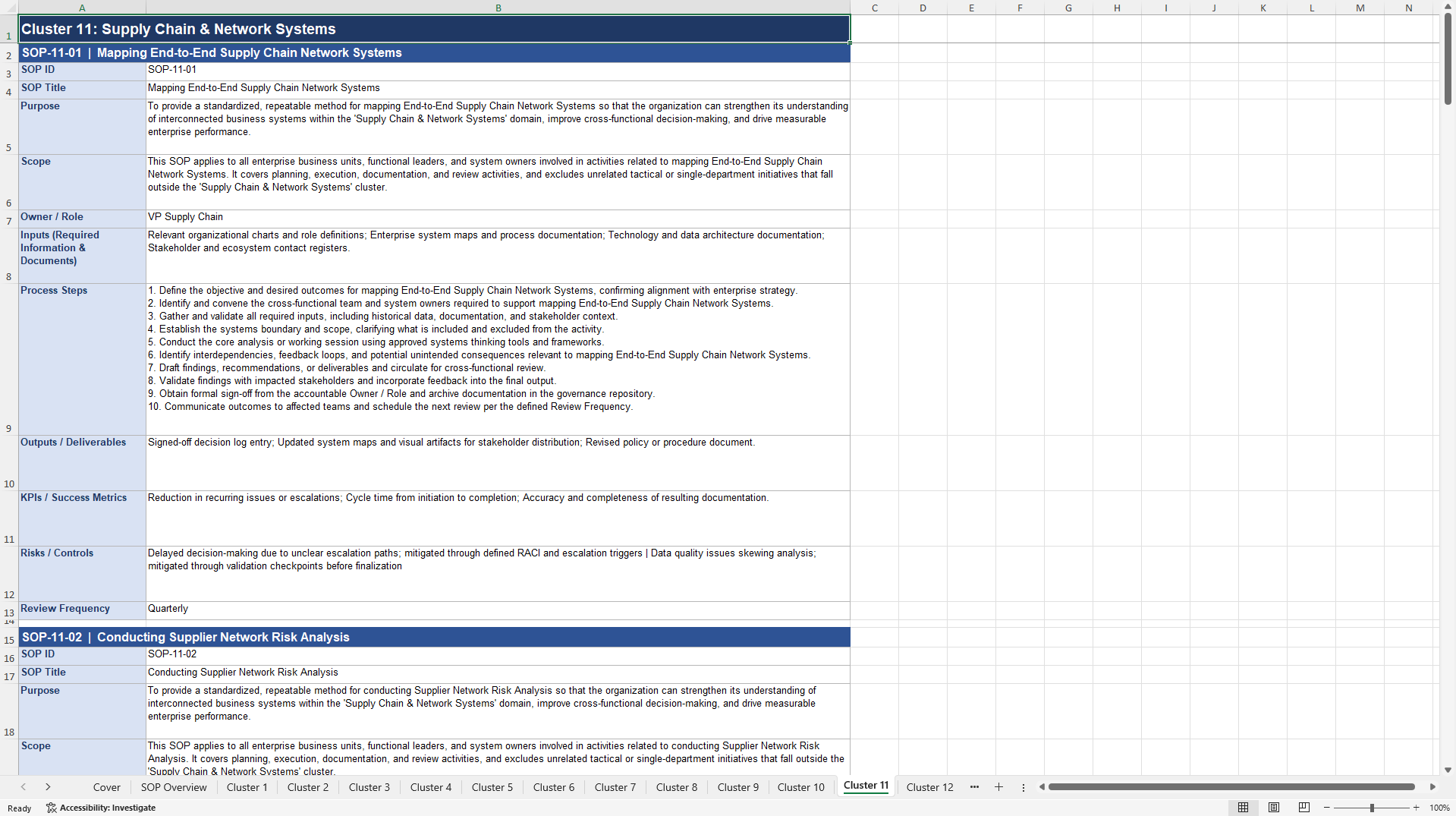
CLUSTER 11: SUPPLY CHAIN & NETWORK SYSTEMS (10 SOPs)
• SOP-11-01 – Mapping End-to-End Supply Chain Network Systems
• SOP-11-02 – Conducting Supplier Network Risk Analysis
• SOP-11-03 – Optimizing Inventory Flow Using Systems Modeling
• SOP-11-04 – Analyzing Demand-Supply Feedback Loops
• SOP-11-05 – Managing Multi-Tier Supplier Interdependencies
• SOP-11-06 – Conducting Network Resilience Simulations
• SOP-11-07 – Evaluating Logistics Network Systemic Efficiency
• SOP-11-08 – Managing Supply Chain Disruption Response Systems
• SOP-11-09 – Aligning Supply Chain KPIs with Enterprise Systems Goals
• SOP-11-10 – Reviewing Supply Network Design Quarterly
CLUSTER 12: CUSTOMER EXPERIENCE & SERVICE SYSTEMS (10 SOPs)
• SOP-12-01 – Mapping Customer Journey Systems End-to-End
• SOP-12-02 – Analyzing Service Delivery System Interdependencies
• SOP-12-03 – Conducting Voice-of-Customer Feedback Loop Analysis
• SOP-12-04 – Designing Omnichannel Experience Systems
• SOP-12-05 – Managing Service Recovery as a Systemic Process
• SOP-12-06 – Evaluating Customer Churn Root Causes Systemically
• SOP-12-07 – Aligning Service-Level Systems Across Departments
• SOP-12-08 – Conducting Customer Ecosystem Value Mapping
• SOP-12-09 – Optimizing Complaint Handling Feedback Systems
• SOP-12-10 – Reviewing Customer Experience Metrics Against Systems Goals
CLUSTER 13: CHANGE MANAGEMENT & ORGANIZATIONAL LEARNING (10 SOPs)
• SOP-13-01 – Designing Systemic Change Management Frameworks
• SOP-13-02 – Conducting Organizational Readiness Assessments
• SOP-13-03 – Managing Resistance as a Systems Feedback Signal
• SOP-13-04 – Building Communication Cascade Systems for Change
• SOP-13-05 – Establishing Organizational Learning Loops
• SOP-13-06 – Conducting After-Action Reviews for Change Initiatives
• SOP-13-07 – Managing Change Portfolio Interdependencies
• SOP-13-08 – Embedding Learning Systems into Daily Operations
• SOP-13-09 – Measuring Change Adoption Through Systemic Indicators
• SOP-13-10 – Sustaining Change Through Reinforcement Systems
CLUSTER 14: BUSINESS SIMULATION & SYSTEMS MODELING (10 SOPs)
• SOP-14-01 – Building Enterprise Simulation Models for Strategic Testing
• SOP-14-02 – Conducting Monte Carlo Analysis on Business Systems
• SOP-14-03 – Developing Agent-Based Models of Organizational Behavior
• SOP-14-04 – Running Sensitivity Analysis on Systems Model Variables
• SOP-14-05 – Validating Systems Models Against Historical Data
• SOP-14-06 – Facilitating Simulation-Based Decision Workshops
• SOP-14-07 – Managing the Systems Modeling Toolset and Standards
• SOP-14-08 – Conducting What-If Scenario Simulations for Operations
• SOP-14-09 – Documenting Model Assumptions and Limitations
• SOP-14-10 – Reviewing and Updating Simulation Models Periodically
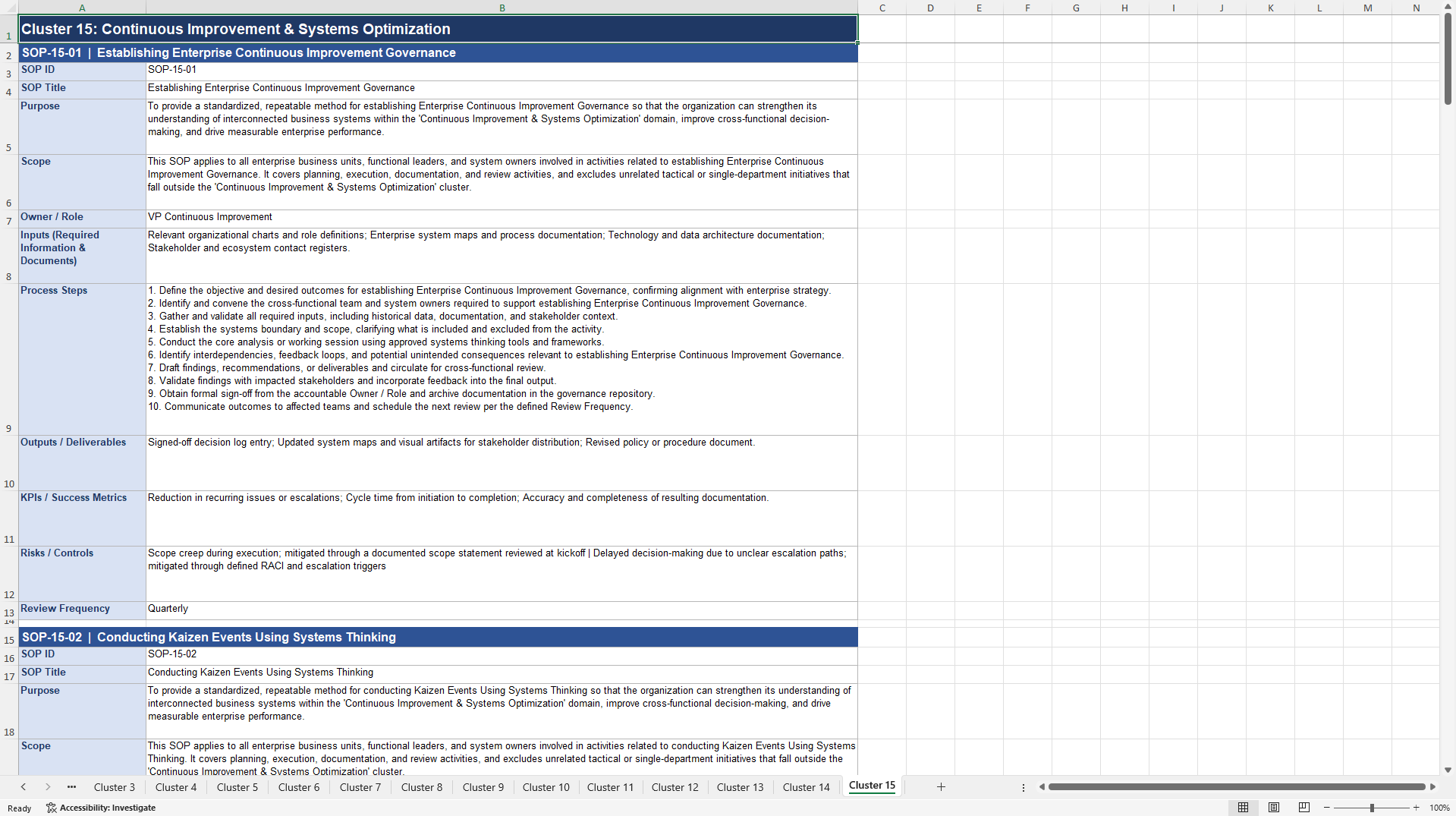
CLUSTER 15: CONTINUOUS IMPROVEMENT & SYSTEMS OPTIMIZATION (10 SOPs)
• SOP-15-01 – Establishing Enterprise Continuous Improvement Governance
• SOP-15-02 – Conducting Kaizen Events Using Systems Thinking
• SOP-15-03 – Managing the Systemic Improvement Idea Pipeline
• SOP-15-04 – Applying Theory of Constraints to Enterprise Bottlenecks
• SOP-15-05 – Conducting Systems-Level Waste Elimination Reviews
• SOP-15-06 – Standardizing Continuous Improvement Documentation
• SOP-15-07 – Measuring Improvement Impact on Interconnected Systems
• SOP-15-08 – Facilitating Cross-Functional Improvement Retrospectives
• SOP-15-09 – Sustaining Improvements Through Control Systems
• SOP-15-10 – Reviewing Enterprise Optimization Roadmap Annually
💥 150 BUSINESS SYSTEMS THINKING SOP LIBRARY
💥 ONE POWERFUL EXCEL TEMPLATE
💥 THE COMPLETE ENTERPRISE SYSTEMS THINKING STRATEGY, GOVERNANCE, MAPPING, ANALYSIS, OPTIMIZATION, DECISION-MAKING, MEASUREMENT, RESILIENCE, INNOVATION, DIGITAL TRANSFORMATION, NETWORK SYSTEMS, CUSTOMER EXPERIENCE, CHANGE MANAGEMENT, SIMULATION & CONTINUOUS IMPROVEMENT SYSTEM FOR MODERN ENTERPRISES.
🎯 KEY BENEFITS & OUTCOMES
✅ Enterprise Alignment – Unified systems thinking strategy across the entire organization
✅ Systems Visibility – Complete understanding of enterprise interdependencies & feedback loops
✅ Strategic Excellence – Proactive scenario planning & systemic decision-making mastery
✅ Cross-Functional Collaboration – Dissolved silos through systems-aligned structures & accountability
✅ Performance Optimization – Balanced KPI systems that drive enterprise-wide performance
✅ Risk Mastery – Systemic risk identification & resilience against cascading failures
✅ Innovation Acceleration – Structured problem-solving & leverage point identification
✅ Digital Leadership – AI/ML strategy aligned with enterprise systems thinking
✅ Supply Chain Resilience – Network-wide visibility & proactive disruption management
✅ Customer Excellence – Seamless omnichannel experience systems & loyalty optimization
✅ Change Agility – Adaptive organizational learning & sustainable transformation
✅ Competitive Dominance – Industry-leading systems thinking & operational excellence
✅ Continuous Improvement – Perpetual optimization through systems governance discipline
✅ Investor Confidence – Transparent reporting & superior strategic positioning
👥 WHO SHOULD USE THIS LIBRARY?
• Chief Executive Officers (CEOs)
• Chief Operating Officers (COOs)
• Chief Strategy Officers (CSOs)
• Chief Innovation Officers (CIOs)
• Chief Financial Officers (CFOs)
• Chief Information Officers (CIOs)
• Chief Digital Officers (CDOs)
• Chief Risk Officers (CROs)
• Chief Customer Officers (CCOs)
• Vice Presidents of Strategy & Planning
• Vice Presidents of Operations Excellence
• Vice Presidents of Enterprise Architecture
• Vice Presidents of Business Transformation
• Vice Presidents of Supply Chain & Logistics
• Vice Presidents of Commercial Operations
• Vice Presidents of Digital Transformation
• Vice Presidents of Portfolio Management
• Directors of Strategic Planning
• Directors of Systems Architecture
• Directors of Organizational Effectiveness
• Directors of Process Improvement
• Directors of Enterprise Risk Management
• Heads of Continuous Improvement
• Executive Leadership Teams
• Board of Directors & Strategic Advisors
• Consulting & Advisory Professionals
• Business Transformation Leaders
• Organizational Development Professionals
• Strategic Planning Professionals
• Enterprise Architects
• Innovation Leaders & Program Managers
⚡ IMMEDIATE IMPACT
🎯 Week 1-2: Establish systems thinking governance charter & executive alignment
🎯 Week 3-4: Conduct enterprise system mapping & interdependency analysis
🎯 Month 2: Complete stakeholder ecosystem & value chain systems assessment
🎯 Month 3: Implement systems-aligned organizational design & operating model
🎯 Month 4: Launch strategic decision-making & scenario planning program
🎯 Month 5-6: Deploy performance measurement feedback systems & KPI governance
🎯 Month 6-12: Execute supply chain network optimization & digital transformation roadmap; measure systems thinking maturity & competitive positioning
🚀 DOWNLOAD NOW – YOUR BUSINESS SYSTEMS THINKING SOP LIBRARY IS READY 🚀
Everything you need to transform enterprise operations.
Everything you need to align organizational strategy.
Everything you need to lead the systems thinking revolution.
Download the 150 Business Systems Thinking SOP Library.
Your complete enterprise systems thinking operating system. Ready. Professional. Implemented. Download now.
Enterprise Systems Thinking Starts Here. Download Your SOP Library Today. Build the Future of Strategic Leadership. Lead Your Market. Transform Operations. Achieve Sustainable Growth. Download Now.
Transform Your Enterprise Today. Establish world-class systems thinking discipline. Build sustainable competitive advantage. Download the 150 Business Systems Thinking SOP Library now. The time for enterprise leadership is now. The framework is ready. The path is clear. Download and lead.
Get your Business Systems Thinking SOP Library Excel. Create operational excellence. Master strategic alignment. Optimize cross-functional collaboration. Accelerate digital transformation. Enable continuous improvement. Achieve enterprise systems leadership. Download today.
🔥 THE 150 BUSINESS SYSTEMS THINKING SOP LIBRARY – YOUR COMPETITIVE ADVANTAGE IS READY. 🔥
DOWNLOAD YOUR COMPLETE ENTERPRISE SYSTEMS THINKING EXCELLENCE SYSTEM NOW.
Keywords: GenAI deployment SOPs, generative AI operating model, enterprise AI governance framework, AI Center of Excellence, responsible AI, AI risk management, AI use case prioritization, GenAI implementation roadmap, AI vendor selection, prompt engineering standards, AI compliance, AI adoption strategy, generative AI across value chain, AI strategy, enterprise transformation, AI implementation, AI scaling framework
Strategy & Transformation, Growth Strategy, Strategic Planning, Strategy Frameworks, Innovation Management, Pricing Strategy, Core Competencies, Strategy Development, Business Transformation, Marketing Plan Development, Product Strategy, Breakout Strategy, Competitive Advantage, Mission, Vision, Values, Strategy Deployment & Execution, Innovation, Vision Statement, Core Competencies Analysis, Corporate Strategy, Product Launch Strategy, BMI, Blue Ocean Strategy, Breakthrough Strategy, Business Model Innovation, Business Strategy Example, Corporate Transformation, Critical Success Factors, Customer Segmentation, Customer Value Proposition, Distinctive Capabilities, Enterprise Performance Management, KPI, Key Performance Indicators, Market Analysis, Market Entry Example, Market Entry Plan, Market Intelligence, Market Research, Market Segmentation, Market Sizing, Marketing, Michael Porter's Value Chain, Organizational Transformation, Performance Management, Performance Measurement, Platform Strategy, Product Go-to-Market Strategy, Reorganization, Restructuring, SWOT, SWOT Analysis, Service 4.0, Service Strategy, Service Transformation, Strategic Analysis, Strategic Plan Example, Strategy Deployment, Strategy Execution, Strategy Frameworks Compilation, Strategy Methodologies, Strategy Report Example, Value Chain, Value Chain Analysis, Value Innovation, Value Proposition, Vision Statement, Corporate Strategy, Business Development, Business plan pdf, business plan, PDF, Business Plan DOC, Business Plan Template, PPT, Market strategy playbook, strategic market planning, competitive analysis tools, market segmentation frameworks, growth strategy templates, product positioning strategy, market execution toolkit, strategic alignment playbook, KPI and OKR frameworks, business growth strategy guide, cross-functional strategy templates, market risk management, market strategy PowerPoint doc, guide, ebook, e-book ,McKinsey Change Playbook, Organizational change management toolkit, Change management frameworks 2025, Influence model for change, Change leadership strategies, Behavioral change in organizations, Change management PowerPoint templates, Transformational leadership in change, supply chain KPIs, supply chain KPI toolkit, supply chain PowerPoint template, logistics KPIs, procurement KPIs, inventory management KPIs, supply chain performance metrics, manufacturing KPIs, supply chain dashboard, supply chain strategy KPIs, reverse logistics KPIs, sustainability KPIs in supply chain, financial supply chain KPIs, warehouse KPIs, digital supply chain KPIs, 1200 KPIs, supply chain scorecard, KPI examples, supply chain templates, Corporate Finance SOPs, Finance SOP Excel Template, CFO Toolkit, Finance Department Procedures, Financial Planning SOPs, Treasury SOPs, Accounts Payable SOPs, Accounts Receivable SOPs, General Ledger SOPs, Accounting Policies Template, Internal Controls SOPs, Finance Process Standardization, Finance Operating Procedures, Finance Department Excel Template, FP&A Process Documentation, Corporate Finance Template, Finance SOP Toolkit, CFO Process Templates, Accounting SOP Package, Tax Compliance SOPs, Financial Risk Management Procedures.
NOTE: Our digital products are sold on an "as is" basis, making returns and refunds unavailable post-download. Please preview and inquire before purchasing. Please contact us before purchasing if you have any questions! This policy aligns with the standard Flevy Terms of Usage.
Got a question about the product? Email us at support@flevy.com or ask the author directly by using the "Ask the Author a Question" form. If you cannot view the preview above this document description, go here to view the large preview instead.
Source: Best Practices in Systems Thinking Excel: 100+ Business Systems Thinking SOPs Excel (XLSX) Spreadsheet, SB Consulting
ABOUT THE AUTHOR
SB Consulting is dedicated to empowering businesses to communicate their ideas with impact. This consulting firm specializes in teaching organizations how to create effective corporate and management presentations. With training from top-tier global consulting firms, including McKinsey, BCG, and Porsche Consulting, extensive expertise in presentation design and ... [read more]
Ask the Author a Question
You must be logged in to contact the author.




























