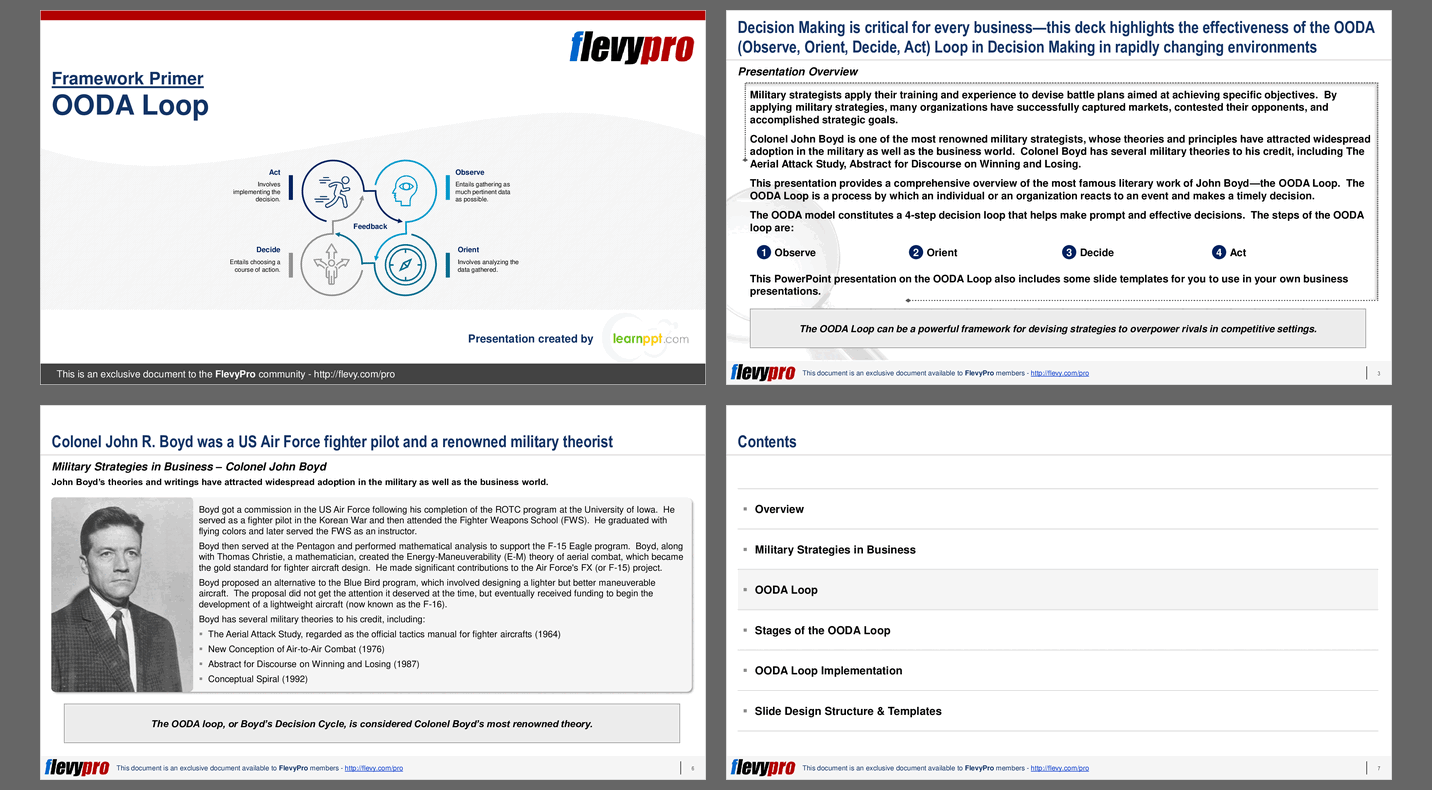
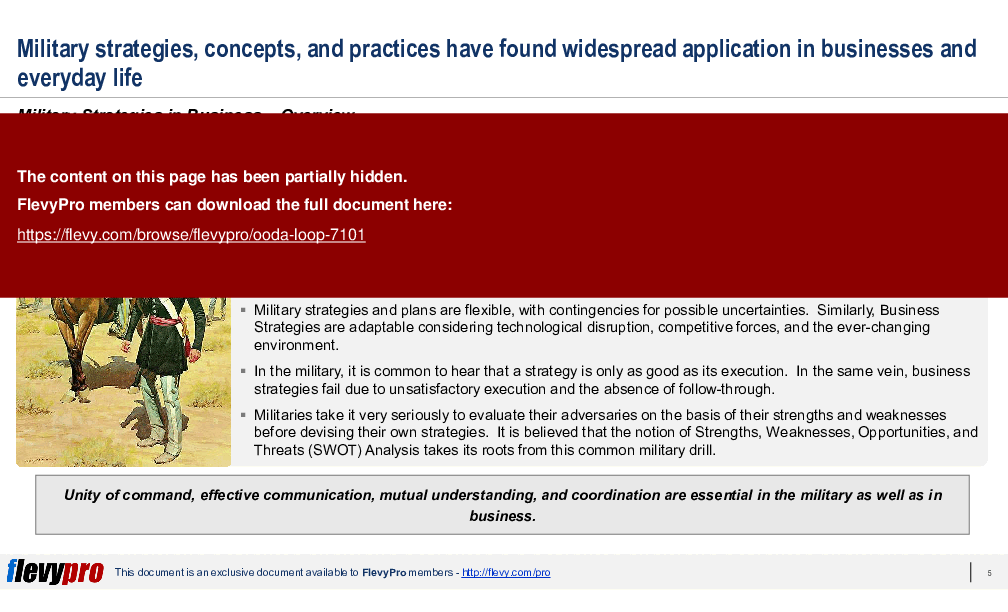

Military strategists apply their training and experience to devise battle plans aimed at achieving specific objectives. By applying military strategies, many organizations have successfully captured markets, contested their opponents, and accomplished strategic goals.
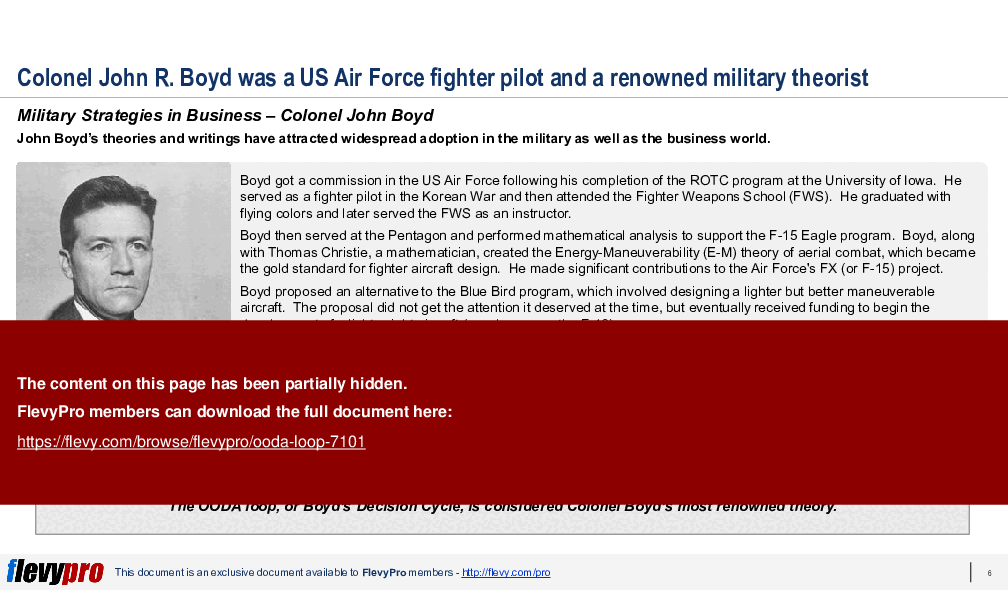
Colonel John Boyd is one of the most renowned military strategists, whose theories and principles have attracted widespread adoption in the military as well as the business world. Colonel Boyd has several military theories to his credit, including The Aerial Attack Study, Abstract for Discourse on Winning and Losing.
This presentation provides a comprehensive overview of the most famous literary work of John Boyd—the OODA Loop. The OODA Loop is a process by which an individual or an organization reacts to an event and makes a timely decision.
The OODA model constitutes a 4-step decision loop that helps make prompt and effective decisions. The steps of the OODA loop are:
1. Observe – entails gathering as much pertinent data as possible.
2. Orient – involves analyzing the data gathered.
3. Decide – entails choosing a course of action.
4. Act – involves implementing the decision.
The Decision Making process, according to John Boyd, works as a recurring cycle of observe, orient, decide, and act. Practice and preparation are at the heart of the OODA Loop and integral to succeeding in a scenario. The OODA Loop can also be a powerful framework for devising strategies to overpower rivals in competitive settings.
This PowerPoint presentation on the OODA Loop also includes some slide templates for you to use in your own business presentations.
Got a question about this document? Email us at flevypro@flevy.com.
Executive Summary
The OODA Loop presentation is a strategic decision-making framework designed to enhance responsiveness in rapidly changing environments. Developed by Colonel John Boyd, this model emphasizes a four-step iterative process: Observe, Orient, Decide, and Act. It enables organizations to react effectively to competitive pressures and make timely decisions. This deck provides insights into the OODA Loop's implementation, advantages, and practical applications, making it an essential tool for executives and consultants seeking to improve decision-making processes.
Who This Is For and When to Use
• Corporate executives seeking to enhance strategic decision-making capabilities
• Business consultants advising clients on competitive strategy
• Project managers looking to implement agile decision-making frameworks
• Teams involved in operational planning and execution
• Leaders in fast-paced industries requiring rapid response strategies
Best-fit moments to use this deck:
• During strategic planning sessions to integrate the OODA Loop into decision-making processes
• In workshops focused on improving team responsiveness to market changes
• When analyzing competitive strategies and developing action plans
• For training sessions aimed at enhancing organizational agility
Learning Objectives
• Define the OODA Loop framework and its significance in decision-making
• Build a comprehensive understanding of each stage: Observe, Orient, Decide, Act
• Establish methods for implementing the OODA Loop in organizational contexts
• Analyze the advantages and disadvantages of the OODA Loop compared to other frameworks
• Develop strategies for continuous learning and adaptation within the OODA Loop
• Apply the OODA Loop to real-world business scenarios for improved outcomes
Table of Contents
• Overview (page 3)
• Military Strategies in Business (page 5)
• OODA Loop (page 8)
• Stages of the OODA Loop (page 12)
• OODA Loop Implementation (page 17)
• Slide Design Structure & Templates (page 20)
Primary Topics Covered
• Overview of the OODA Loop - An introduction to the OODA Loop as a strategic decision-making tool that enhances responsiveness in competitive environments.
• Stages of the OODA Loop - Detailed exploration of the 4 stages: Observe, Orient, Decide, and Act, emphasizing their interconnectivity and iterative nature.
• Implementation Guidelines - Best practices for effectively integrating the OODA Loop into organizational decision-making processes.
• Advantages and Disadvantages - A balanced view of the benefits and potential drawbacks of using the OODA Loop compared to other decision-making frameworks.
• Continuous Learning - Strategies for fostering a culture of learning and adaptation within the OODA Loop framework.
• Military Strategies in Business - Insights on how military strategies inform business practices, particularly in competitive contexts.
Deliverables, Templates, and Tools
• OODA Loop framework template for strategic decision-making
• Implementation checklist for integrating the OODA Loop into business processes
• Slide templates for presenting the OODA Loop in organizational settings
• Case study examples illustrating successful application of the OODA Loop
• Feedback mechanisms for assessing decision outcomes and refining processes
• Training materials for workshops on the OODA Loop and decision-making agility
Slide Highlights
• Overview slide detailing the OODA Loop's 4 stages and their significance
• Diagram illustrating the iterative nature of the OODA Loop
• Advantages and disadvantages slide comparing the OODA Loop with other frameworks
• Implementation guidelines slide outlining key principles for effective use
• Case study slide showcasing real-world applications of the OODA Loop
Potential Workshop Agenda
Introduction to the OODA Loop (30 minutes)
• Overview of the OODA Loop framework and its relevance
• Discussion on the importance of agile decision-making in business
OODA Loop Stages Deep Dive (60 minutes)
• Exploration of each stage: Observe, Orient, Decide, Act
• Group exercises to apply the OODA Loop to hypothetical scenarios
Implementation Strategies (45 minutes)
• Best practices for integrating the OODA Loop into organizational processes
• Identifying potential challenges and solutions
Continuous Learning and Adaptation (30 minutes)
• Strategies for fostering a culture of learning within the OODA Loop
• Discussion on feedback mechanisms and iterative improvement
Customization Guidance
• Tailor the OODA Loop framework to specific industry contexts by integrating relevant examples.
• Adjust the implementation checklist to align with organizational goals and processes.
• Incorporate company-specific terminology and metrics into the presentation materials.
Secondary Topics Covered
• Historical context of military strategies in business
• The role of situational awareness in decision-making
• Techniques for effective data gathering and analysis
• The impact of organizational culture on decision-making processes
• Tools for measuring the effectiveness of decisions made using the OODA Loop
Topic FAQ
Document FAQ
These are questions addressed within this presentation.
What is the OODA Loop?
The OODA Loop is a strategic decision-making framework consisting of 4 stages: Observe, Orient, Decide, and Act, designed to enhance responsiveness in competitive environments.
How can the OODA Loop be applied in business?
It can be applied to improve decision-making processes, enhance team responsiveness, and develop agile strategies in rapidly changing markets.
What are the key benefits of using the OODA Loop?
Benefits include improved reaction times, better alignment among stakeholders, and enhanced situational awareness, leading to more effective decision-making.
What are the potential drawbacks of the OODA Loop?
Drawbacks may include oversimplification of complex decisions and the risk of erroneous decisions if not executed properly.
How does the OODA Loop compare to other decision-making frameworks?
The OODA Loop emphasizes agility and responsiveness, while other frameworks may focus more on structured analysis and long-term planning.
What role does feedback play in the OODA Loop?
Feedback is critical for refining decisions and actions, allowing organizations to learn from outcomes and improve future iterations of the OODA Loop.
Can the OODA Loop be used in team settings?
Yes,, but it requires careful consideration of collaboration and communication to ensure all team members are aligned in their decision-making processes.
How can organizations foster a culture of continuous learning within the OODA Loop?
By encouraging open communication, regular feedback, and iterative improvement, organizations can enhance their decision-making capabilities.
Glossary
• OODA Loop - A four-step decision-making framework: Observe, Orient, Decide, Act.
• Observe - The stage of gathering relevant information to inform decisions.
• Orient - The phase of analyzing data and developing a comprehensive understanding of the situation.
• Decide - The step where a course of action is chosen based on analysis.
• Act - The implementation of the decision made.
• Feedback - Information gathered from actions taken, used to refine future decisions.
• Situational Awareness - Understanding the current environment and conditions affecting decision-making.
• Agility - The ability to respond quickly and effectively to changing circumstances.
• Continuous Learning - The process of ongoing improvement and adaptation based on experiences and outcomes.
• Military Strategy - Techniques and principles derived from military operations applied to business contexts.
• Decision-Making Framework - A structured approach to making choices based on available information and analysis.
• Stakeholders - Individuals or groups with an interest in the outcome of decisions made by an organization.
• Iterative Process - A cyclical approach to decision-making that allows for continuous refinement and improvement.
Source: Best Practices in Decision Making PowerPoint Slides: OODA Loop PowerPoint (PPTX) Presentation Slide Deck, LearnPPT Consulting
Did you need more documents?
Consider a FlevyPro subscription from $39/month. View plans here.
For $10.00 more, you can download this document plus 2 more FlevyPro documents. That's just $13 each.
|
Download our FREE Strategy & Transformation Framework Templates
Download our free compilation of 50+ Strategy & Transformation slides and templates. Frameworks include McKinsey 7-S, Balanced Scorecard, Disruptive Innovation, BCG Curve, and many more. |