Browse our library of 11 A3 templates, frameworks, and toolkits—available in PowerPoint, Excel, and Word formats.
These documents are of the same caliber as those produced by top-tier management consulting firms, like McKinsey, BCG, Bain, Booz, AT Kearney, Deloitte, and Accenture. Most were developed by seasoned executives and consultants with 20+ years of experience and have been used by Fortune 100 companies.
Scroll down for A3 case studies, FAQs, and additional resources.
A3 is a problem-solving tool rooted in Lean methodology, focusing on continuous improvement through concise documentation and analysis. It drives accountability by distilling complex issues into a single page. Effective A3s align teams on root causes and actionable solutions.
DRILL DOWN BY SECONDARY TOPIC
DRILL DOWN BY FILE TYPE
Open all 11 documents in separate browser tabs.
Add all 11 documents to your shopping cart.
The A3 Management Process gives teams a structured container for problem-solving that forces intellectual rigor before action. Work gets printed on a single A3 sheet, roughly 11 by 17 inches, which creates natural boundaries around scope and forces clarity. This constraint eliminates meandering analysis. Teams document the current state, identify root causes, propose countermeasures, and track follow-up all in one visual space that enables rapid discussion and alignment. The method originated in Toyota's production system and has become the foundational problem-solving discipline across continuous improvement organizations worldwide.

What distinguishes A3 thinking from casual problem-solving is the discipline of root cause diagnosis before proposing solutions. Many teams jump to countermeasures without understanding why a problem exists. The A3 process enforces separate phases for data gathering, analysis, and response. Research from McKinsey shows that organizations implementing structured problem-solving methodologies can achieve efficiency improvements of up to 40% within 6 months, particularly when combined with disciplined execution cadences. This is why the method works: it prevents teams from solving the wrong problem faster.
For effective implementation, take a look at these A3 templates:
An effective A3 report moves through distinct sections that build a logical case. The top half typically shows the current state and background, while the bottom half presents analysis, target conditions, and action plans. This spatial organization creates a visual narrative that stakeholders can follow in seconds. Templates and A3 frameworks available on Flevy provide proven layouts that teams can adopt immediately, avoiding the false start many organizations experience when they attempt to design their own structure without understanding how analysis flows into action.
The investigation phase separates average A3s from high-quality ones. This is where teams apply root cause analysis rigor. The 5 Whys technique, Fishbone Diagrams, and Pareto Analysis help practitioners move beyond surface symptoms. A manufacturing team might observe late deliveries, but investigation reveals that setup times are the constraint, not production speed. Retail organizations discover that stockouts stem not from forecasting but from inventory visibility gaps in certain locations. Teams that rush the investigation phase waste the entire A3 process.
Beyond the structured format, A3 becomes powerful when organizations embed it into decision-making culture. Teams present findings to leaders on a regular cadence. This creates visibility into what problems exist and how thoroughly teams are investigating them. The discipline of defending your analysis on paper before presenting it verbally eliminates vague thinking. Playbooks and governance templates available on Flevy define how often A3 reports should be reviewed, who owns which decisions, and how countermeasures get tracked post-implementation.
The follow-up phase prevents the common failure where improvements are implemented and then abandoned. A3 discipline requires teams to verify that countermeasures achieved their intended results. If they didn't, root cause investigation continues. If they did, the same discipline applies to preventing backsliding. This iterative approach transforms individual problem-solving events into an embedded organizational capability, where teams naturally apply systematic thinking to recurring challenges rather than cycling through the same issues annually.
Organizations beginning A3 practice typically start in operations or manufacturing where the method originated. The discipline then spreads to supply chain, quality, maintenance, and eventually to service delivery and support functions. Cross-functional A3s emerge when problems span multiple departments. These require explicit governance around data access, approval authority, and implementation accountability. Without clear RACI matrices, cross-functional A3s stall in finger-pointing rather than progressing to solutions.
Portfolio-level dashboards and KPI libraries available on Flevy help organizations track multiple A3 initiatives simultaneously and measure their cumulative impact on operations. This visibility prevents the common trap where teams solve problems locally without seeing whether those solutions conflict with other initiatives or create unintended consequences elsewhere. Mature A3 organizations maintain a visual pipeline showing which problems are under investigation, which countermeasures are being tested, and what results have been verified and sustained.
Here are our top-ranked questions that relate to A3.
The editorial content of this page was overseen by Joseph Robinson. Joseph is the VP of Strategy at Flevy with expertise in Corporate Strategy and Operational Excellence. Prior to Flevy, Joseph worked at the Boston Consulting Group. He also has an MBA from MIT Sloan.
Last updated: April 15, 2026
Strategic Digital Transformation for Defense Sector Consultancy
Scenario: The organization is a specialized consultancy within the defense industry grappling with outdated A3 processes that hamper operational efficiency and competitive edge.
Revenue Growth Strategy for Boutique Hotel Chain in Competitive Market
Scenario: The organization in focus operates a boutique hotel chain and is grappling with stagnant revenue growth amidst a highly competitive hospitality landscape.
Human-Centered Design Revamp in Aerospace
Scenario: The organization, a leading aerospace components manufacturer, is grappling with outdated design processes that have led to a decline in product innovation and customer satisfaction.
Lean Transformation Project for Health Care Firm
Scenario: A health care firm is grappling with issues related to its Lean Thinking transformation program.
Quality Function Deployment Initiative for Aerospace Manufacturer in North America
Scenario: A leading aerospace firm in North America is facing challenges in aligning its product development processes with customer expectations.
Explore all Flevy Management Case Studies
Find documents of the same caliber as those used by top-tier consulting firms, like McKinsey, BCG, Bain, Deloitte, Accenture.
Our PowerPoint presentations, Excel workbooks, and Word documents are completely customizable, including rebrandable.
Save yourself and your employees countless hours. Use that time to work on more value-added and fulfilling activities.
|
Receive our FREE presentation on Operational Excellence
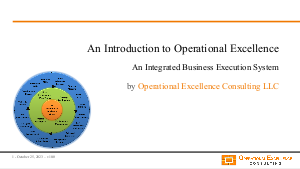
This 50-slide presentation provides a high-level introduction to the 4 Building Blocks of Operational Excellence. Achieving OpEx requires the implementation of a Business Execution System that integrates these 4 building blocks. |