
 Click main image to view in full screen. Unlock all 20 preview images:
Stablecoin Issuer Reserve & Liquidity Financial Model – Excel XLSX
Excel (XLSX) + supplemental PDF


BENEFITS OF THIS DOWNLOADABLE EXCEL DOCUMENT
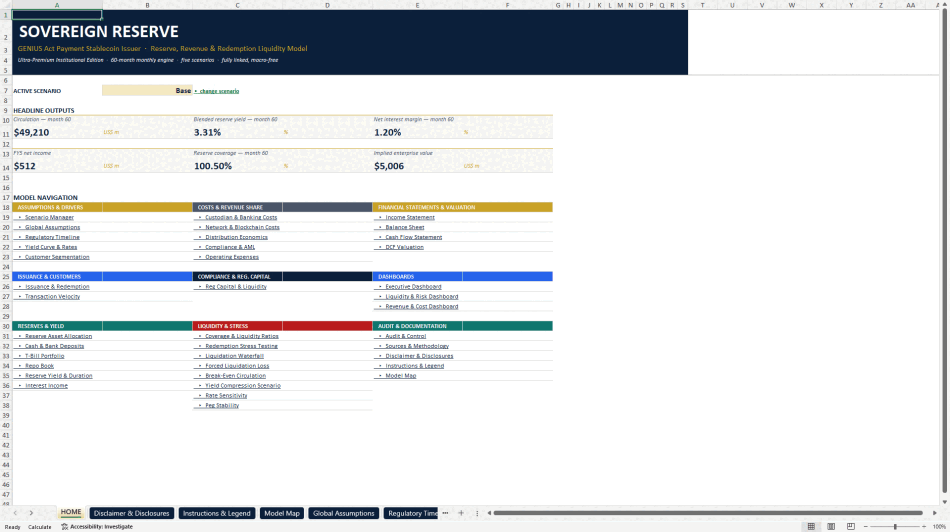
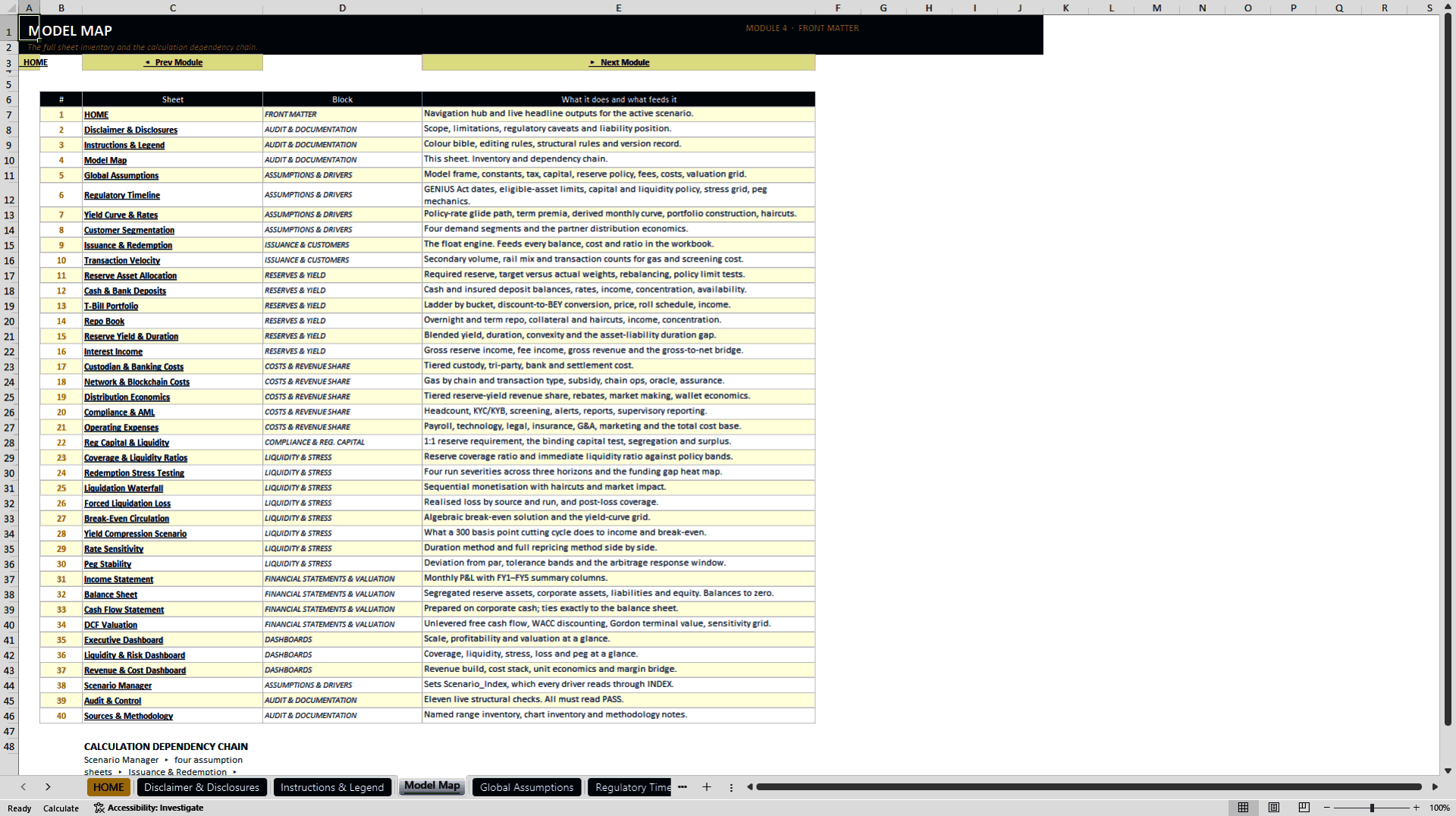
- Connects a 60-month circulation and transaction forecast to reserve allocation, reserve income, partner economics, operating costs, three financial statements, and DCF valuation.
- Quantifies liquidity resilience through reserve coverage, run stress testing, funding gaps, liquidation waterfall, forced liquidation loss, peg stability, and capital coverage.
- Enables five-scenario decision-making with dedicated executive, liquidity-and-risk, and revenue-and-cost dashboards plus rate and valuation sensitivities.
FINANCIAL MODELING EXCEL DESCRIPTION
Stablecoin Issuer Reserve & Liquidity Financial Model
This Excel model is designed for finance, treasury, risk, strategy, and investment teams that need to understand the economics of a payment-stablecoin issuer beyond a simple token-growth forecast. It links customer adoption and circulation to the reserve portfolio, reserve yield, partner economics, operating costs, regulatory capital, redemption liquidity, financial statements, and enterprise value over a 60-month monthly forecast with FY1-FY5 summaries.
Seller-supplied and already tested; no Studio workbook audit was performed.
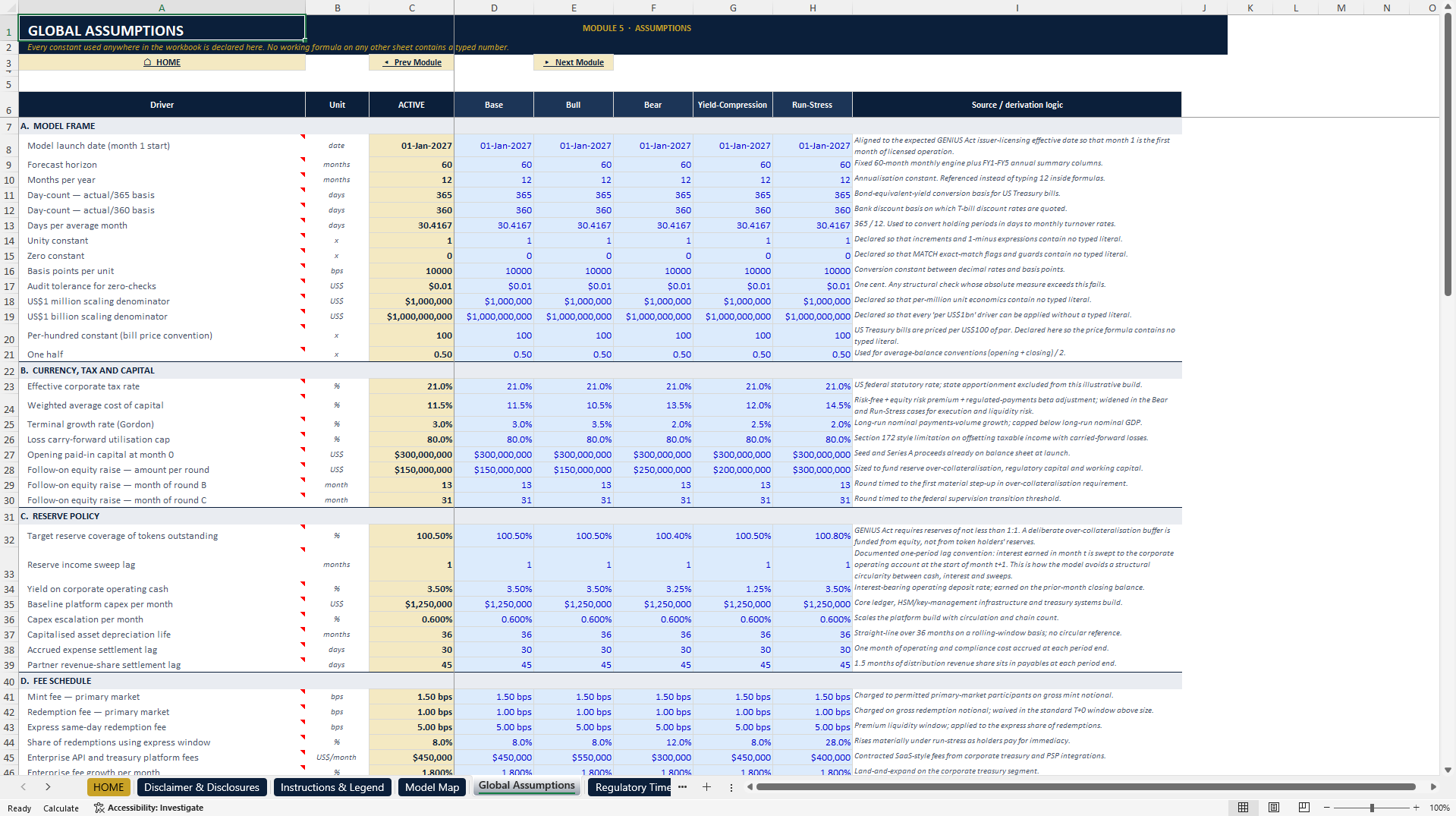
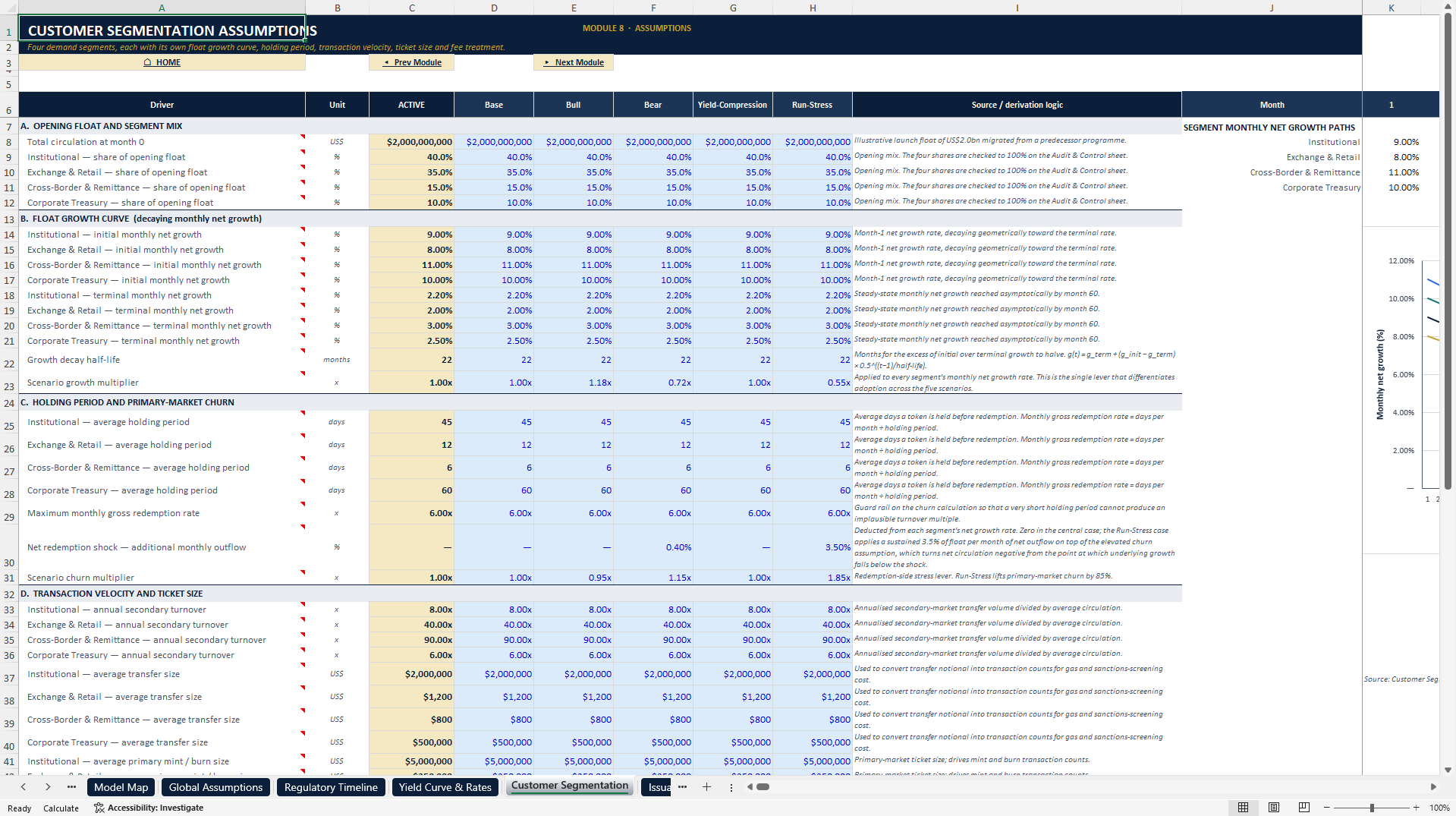
The model starts with an active scenario selected from Base, Bull, Bear, Yield-Compression, and Run-Stress. Editable driver sheets cover global assumptions, expected regulatory timing, policy-rate and yield-curve paths, customer segmentation, float growth, holding periods, transaction velocity, fee treatment, cost drivers, capital assumptions, and valuation inputs. The selected scenario then flows through the workbook's operating and financial schedules.
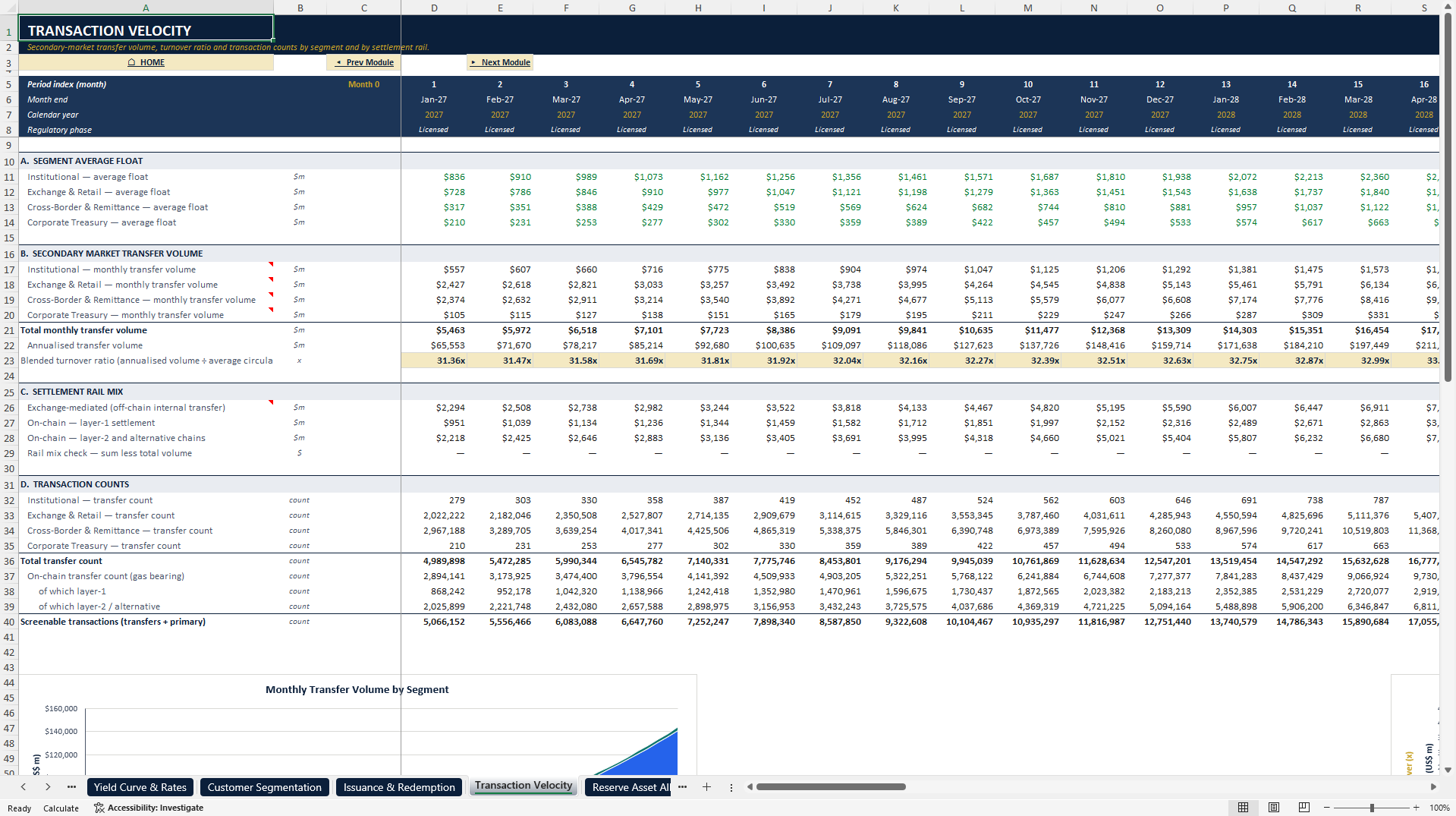
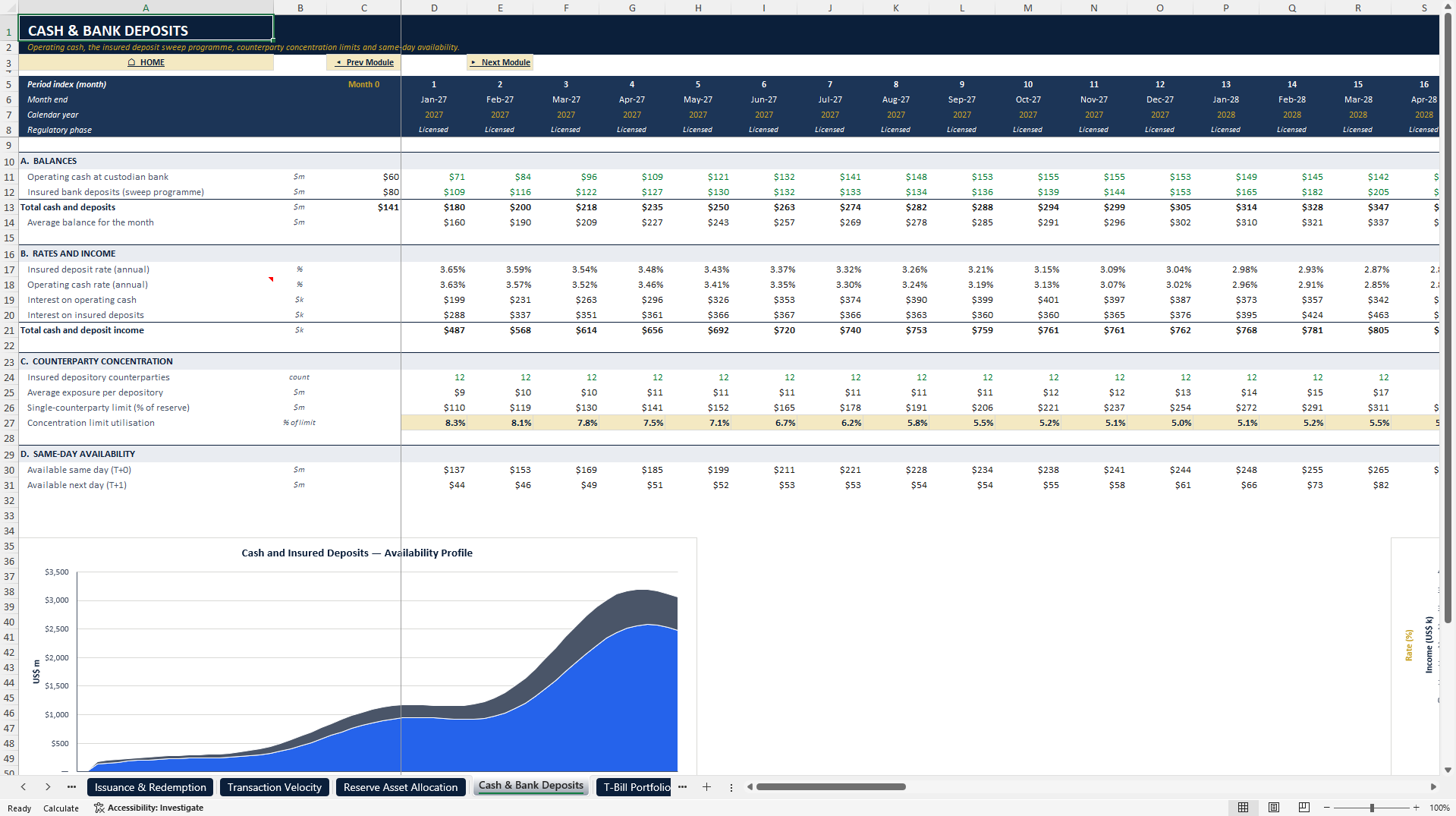
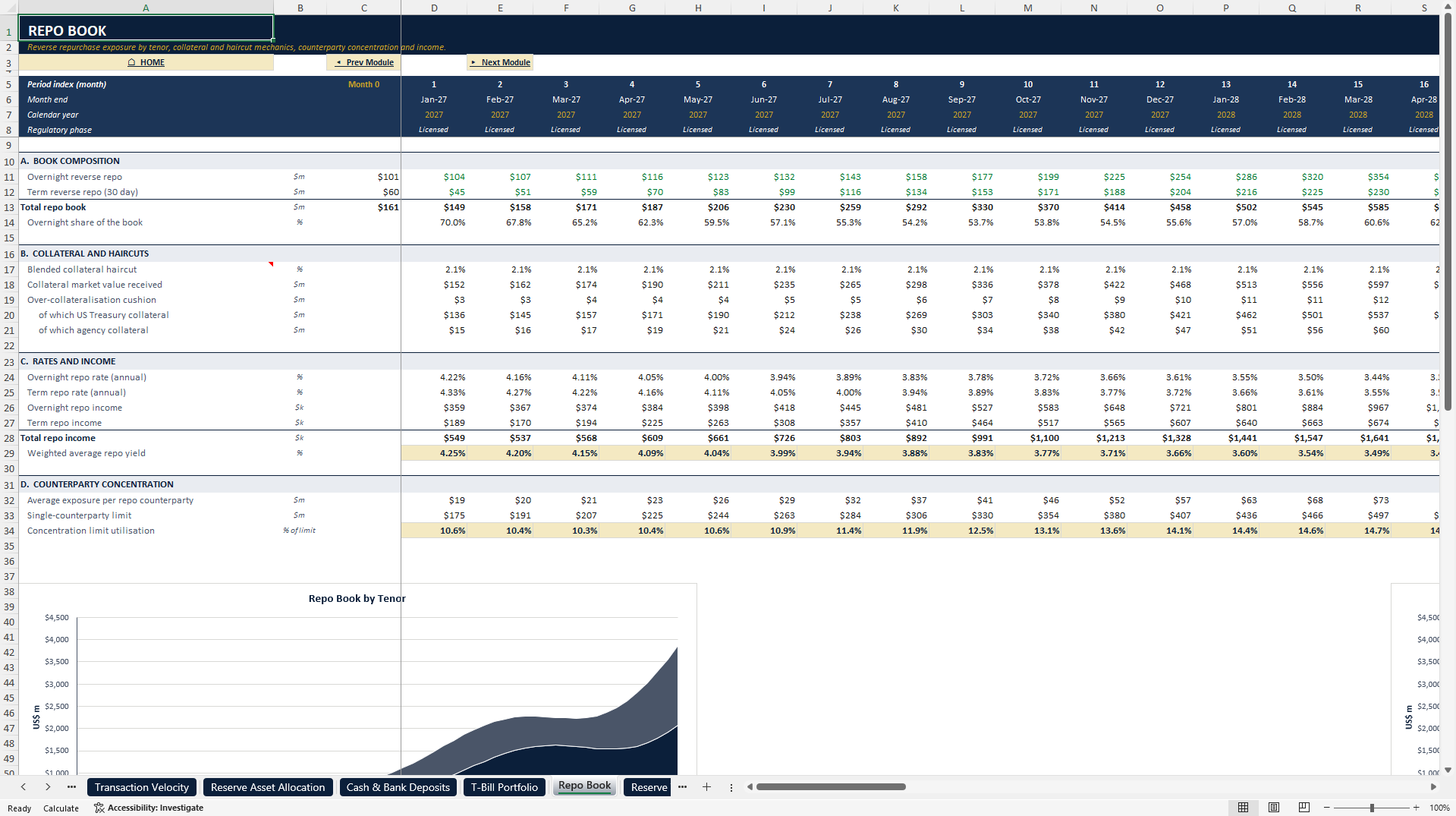
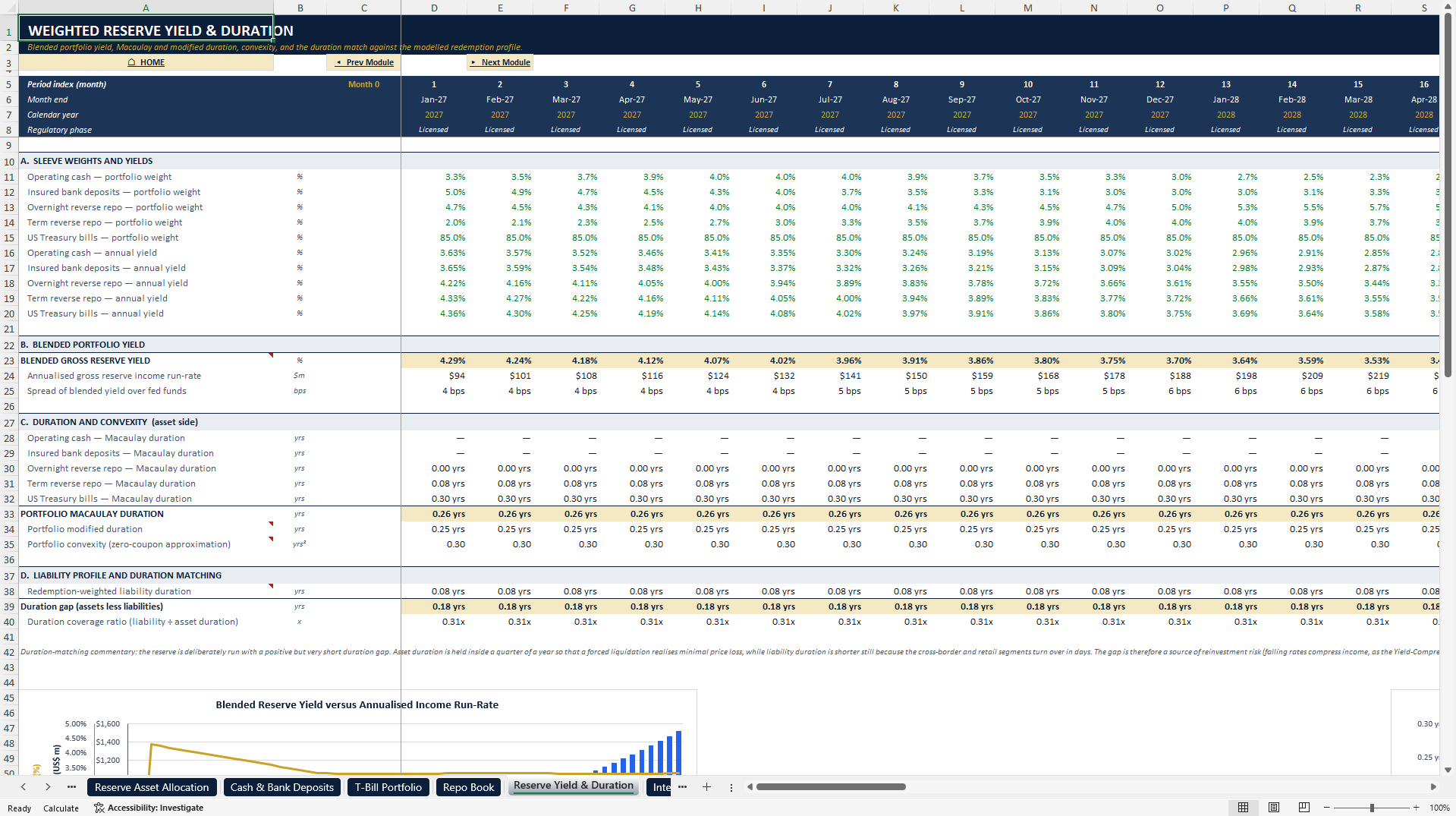
The issuance and redemption engine forecasts opening float, gross primary issuance, gross redemptions, net change, and closing circulation by customer segment. Transaction schedules translate the customer base into transfer volume, turnover, and transaction counts. The reserve engine determines required reserves, target and actual asset allocation, operating cash, insured deposits, Treasury-bill laddering, reverse-repo exposure, blended reserve yield, duration, convexity, and interest income.
The cost stack includes custody and banking, repo-agent fees, settlement expense, blockchain and network costs, distribution and wallet economics, partner reserve-yield sharing, compliance and AML/KYC, sanctions screening, and wider operating expenses. Regulatory and liquidity modules calculate reserve coverage, capital coverage, segregation, capital surplus, and immediate liquidity.
Stress testing is a major part of the workbook. It evaluates multiple redemption-run severities across settlement horizons, measures funding gaps, applies a liquidation waterfall, calculates forced-sale losses, evaluates yield compression, compares interest-rate sensitivity methods, and models peg stability. A break-even schedule solves for the circulation required to cover the fixed cost base.
The model also includes a linked income statement, balance sheet, and cash flow statement. DCF valuation converts forecast performance into unlevered free cash flow, terminal value, and implied enterprise value, with a two-way WACC and terminal-growth sensitivity. Executive, liquidity-and-risk, and revenue-and-cost dashboards bring together the principal KPIs, trends, and scenario outputs for management and decision-making.
The workbook is suitable for business planning, treasury and reserve strategy, profitability analysis, liquidity-risk assessment, scenario planning, stress testing, partner-economics review, capital planning, valuation work, and investment or transaction analysis. The product file is a client-ready XLSX workbook; the seller package also contains a full-sheet 40-page PDF preview and curated PNG screenshots for marketplace presentation.
Got a question about the product? Email us at support@flevy.com or ask the author directly by using the "Ask the Author a Question" form. If you cannot view the preview above this document description, go here to view the large preview instead.
Source: Best Practices in Financial Modeling, Bitcoin Excel: Stablecoin Issuer Reserve & Liquidity Financial Model Excel (XLSX) Spreadsheet, PDMM Financial Models
ABOUT THE AUTHOR

PDMM Financial Models develops professional, decision-ready Excel models for business owners, entrepreneurs, investors, consultants, analysts, and finance teams. Our objective is to transform complex business assumptions into clear, structured analysis that supports better planning and investment decisions.
Our models cover business planning, forecasting, budgeting, feasibility analysis,
... [read more]
Ask the Author a Question
You must be logged in to contact the author.




























