 Click main image to view in full screen. Unlock all 12 preview images:
Shipping Vessels Portfolio Financial Model – Excel XLSX
Excel (XLSX)


BENEFITS OF THIS DOWNLOADABLE EXCEL DOCUMENT
- Presents an investment scenario of a Shipping Vessels Portfolio including a fleet of up to 20 Ships, which are purchased and then leased using a Time Charter Method.
SHIPPING INDUSTRY EXCEL DESCRIPTION
Ships, boats and other recreational vessels are owned by a large number of individuals who often purchase them as assets. Usually they do not use these vessels for shipping goods or for ferrying passengers, instead they often lend them out to third party organizations who use them for a variety of purposes. In maritime legal terms, this lending process is known as chartering.
This Financial Model presents an investment scenario of a Shipping Vessels Portfolio including a fleet of up to 20 Ships, which are purchased and then leased using a Time Charter Method.
A time charter is a time-bound agreement under which the shipowner leases a vessel to a charterer for a fixed period of time, and they are free to sail to any port and transport any cargo. Under a Time Charter agreement, the charterer controls the ship but the maintenance of the vessel falls under the purview of the owner.
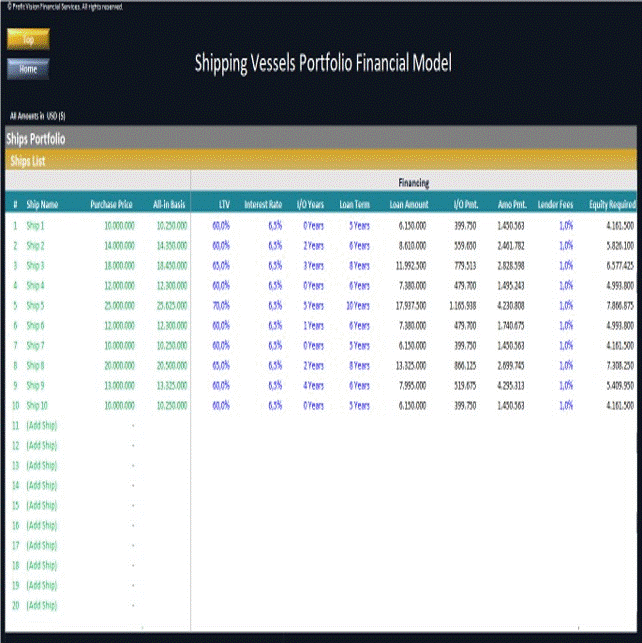
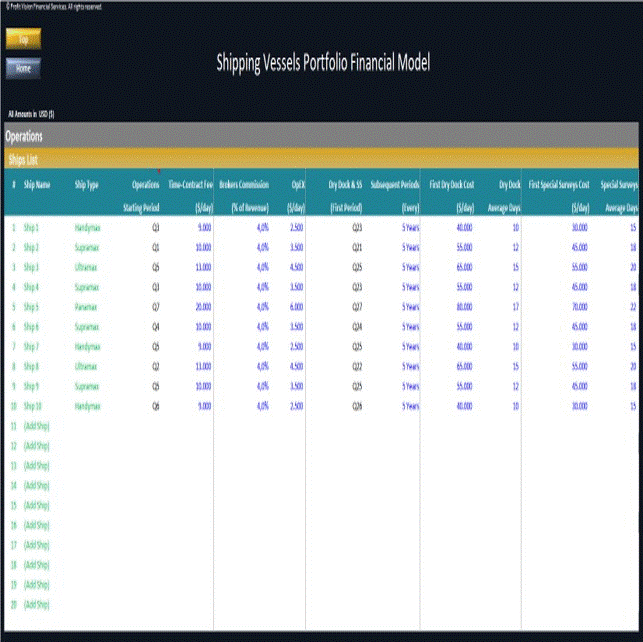
The model includes purchase and disposition assumptions for up to 20 ships, financing assumptions (Debt & Equity Share), Operating Assumptions (Time Charter Fee, Operating Expenses and Ships Service Costs) and portfolio valuation assumptions.
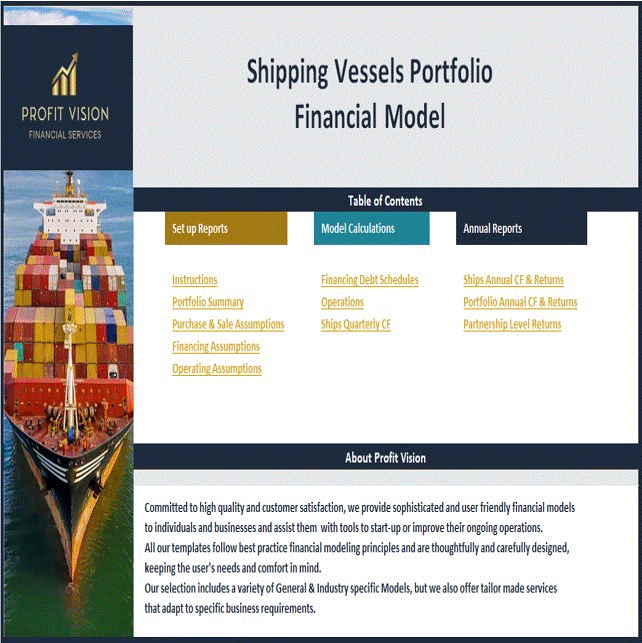
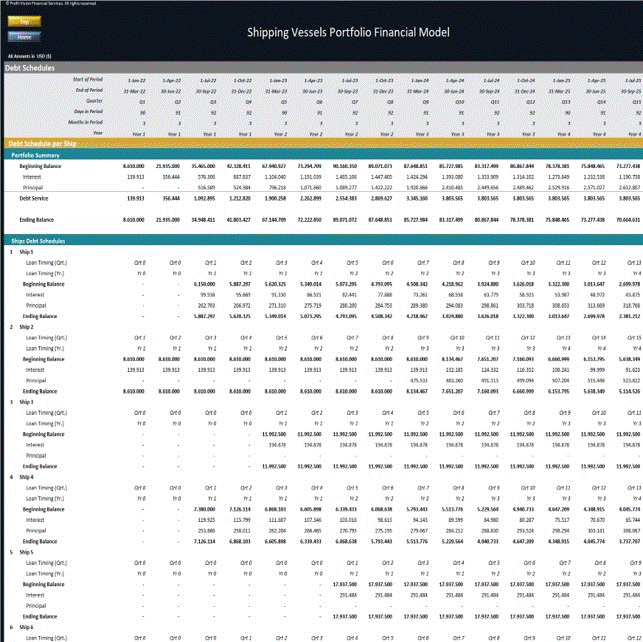
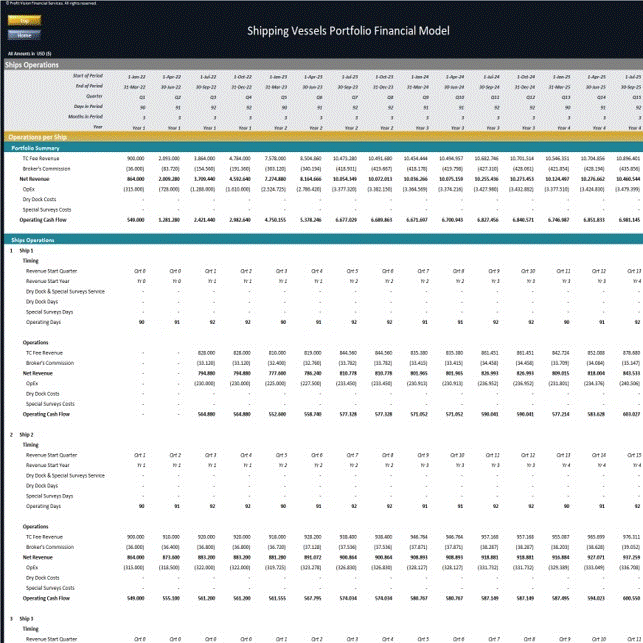
Outputs of the model include Financing Debt Schedules, Ships Quarterly Operations Analysis, Quarterly and Annual Cash Flow per Ship, Total Portfolio Annual Cash Flow & Returns, Partnerships Cash Flow and a professional Executive Summary presenting portfolio performance and key metrics.
The structure of the template follows Financial Modeling Best Practices principles and is fully customizable.
Inputs:
• Portfolio and Reporting Assumptions including Timing, Partnership Distribution, Portfolio Expenses (Asset Management Fees, ships Purchase & Disposition Fees)
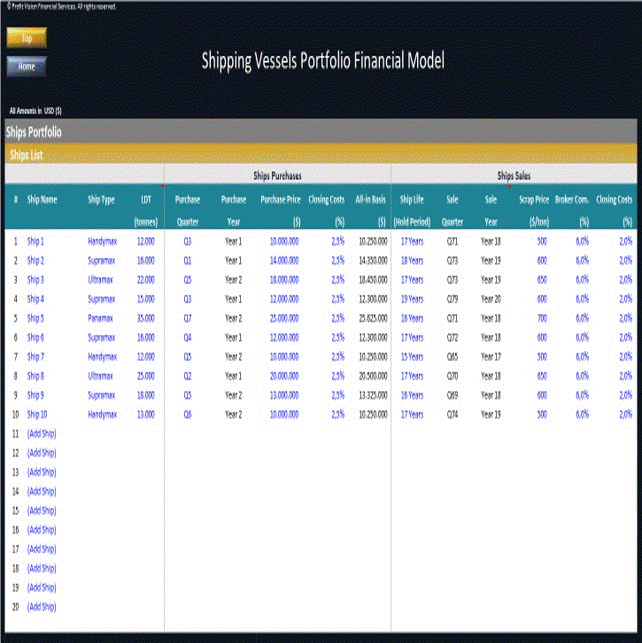
• Ships Portfolio supporting up to 20 different ships (incl. Ship type, LDT, etc.)
• Ships Acquisition & Disposition Assumptions (Purchase Price, Closing Fees, Ship Life, Scrap Price, Selling Costs)
• Ships Revenue & Costs Assumptions (Time Charter Fee, Operating Expenses, Dry Dock & Special Surveys Timing and Costs)
• Financing Assumptions per Ship (Loan to Value, Interest Only period, Interest Rates, Loan Term, Lender Fees)
Outputs:
• Debt Schedule per Ship
• Operations Analysis per Ship (Timing, Revenue, Opex, Service Costs, Net Cash Flow)
• Quarterly Cash Flow per Ship including Acquisition, Operating Cash Flow, Debt Service, Cash Proceeds from Ship Sale and Unlevered and Levered Cash Flow
• Annual Cash Flow & Returns per Ship (roll up of quarterly cash flow into annual periods used to evaluate the overall investment of each ship)
• Portfolio Annual Cash Flows (Unlevered, Levered) & Returns (IRR, MOIC)
• Partnership Cash Flows (a standard 4-tier IRR hurdle waterfall model to distribute proceeds between investors)
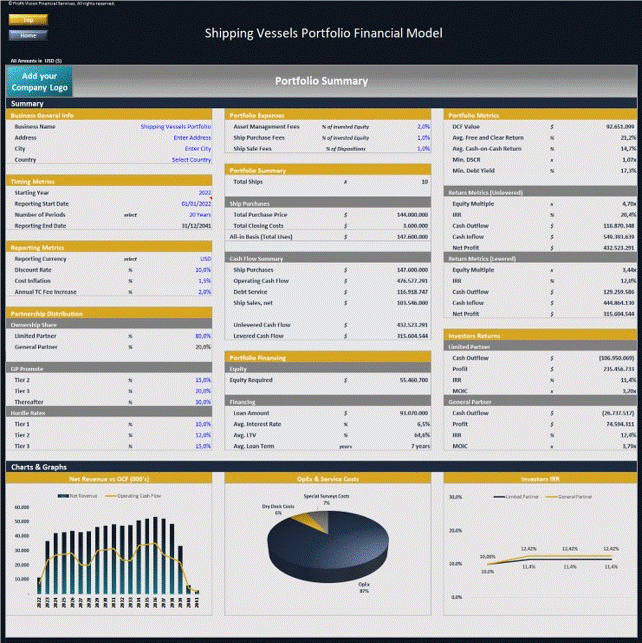
• Executive Summary presenting portfolio performance and key metrics.
Detailed instructions on the use of the model are included in the Excel file.
Help & Support
Committed to high quality and customer satisfaction, all our templates follow best practice financial modeling principles and are thoughtfully and carefully designed, keeping the user's needs and comfort in mind.
No matter if you have no experience or you are well versed in finance, accounting, and the use of Microsoft Excel, our professional financial models are the right tools to boost your business operations!
If you however experience any difficulty while using this template and you are not able to find the appropriate guidance in the provided instructions, please feel free to contact us for assistance.
If you need a template customized for your business requirements, please e-mail us and provide a brief explanation of your specific needs.
The model is designed with a comprehensive portfolio summary that includes key metrics such as Net Revenue, Operating Cash Flow, and Investor IRR. Detailed charts and graphs provide visual insights into revenue trends and operational costs, ensuring you have a clear picture of your investment's performance.
Got a question about the product? Email us at support@flevy.com or ask the author directly by using the "Ask the Author a Question" form. If you cannot view the preview above this document description, go here to view the large preview instead.
TOPIC FAQ
What is a time charter and how does it affect revenue and cost lines in a vessel investment model?
A time charter is a time-bound lease where the charterer controls operations while the owner retains maintenance obligations. In modeling, revenue is captured as Time Charter Fee, while owner-borne costs include operating expenses and ship service/dry-dock costs; the template models these separately as Time Charter Fee, Operating Expenses, and Ship Service Costs.What specific inputs are required to model a shipping vessels portfolio?
Key inputs include portfolio/reporting assumptions (timing, partnership splits, portfolio expenses), ship-specific attributes (type, LDT), acquisition/disposition assumptions (purchase price, scrap price, selling costs), revenue and cost schedules (time charter fees, dry-dock timing), and financing terms per ship (LTV, interest rates). The model supports up to 20 ships.How are ship-level financing assumptions captured and reported in a portfolio model?
Financing inputs are entered per ship and include Loan-to-Value, interest-only periods, interest rates, loan term, and lender fees; the model converts these into a Debt Schedule per ship and aggregates debt service into quarterly cash flow analysis, with separate leveraged and unlevered cash flow outputs.What should I look for in a commercial Excel template if my team is small and timeline tight?
Look for clear built-in instructions, modular sheets for per-asset inputs, automated debt schedules, pre-built cash flow roll-ups, and vendor support for questions or customization. The Shipping Vessels Portfolio Financial Model includes detailed instructions and offers support, and it models up to 20 ships.How does buying a vessel-portfolio model add value compared with building one from scratch?
A purchased template provides pre-built mechanics for common shipping inputs (acquisition, dry-dock, time-charter revenue), standardized debt schedules, and investor reporting outputs, reducing build time and errors. For example, this model supplies a partnership distribution engine including a 4-tier IRR hurdle waterfall.Which model outputs help evaluate proceeds from selling a ship or its scrap value?
The model requires acquisition and disposition assumptions—purchase price, selling costs, and scrap price—and reflects sale proceeds in the Quarterly Cash Flow per Ship. Quarterly outputs show cash proceeds from ship sale alongside acquisition cash flows and debt payoff impacts.How can I model distributions to multiple investors in a shipping portfolio structure?
Use an IRR-hurdle waterfall structure to allocate proceeds by achievement tiers; the template includes a standard partnership cash flow module that models a 4-tier IRR hurdle waterfall to distribute returns between investors and partners.What investor-facing summary and visual outputs should a robust ship portfolio model produce?
A robust model should roll up ship-level cash flows into Portfolio Annual Cash Flows (levered and unlevered), compute investor returns (IRR, MOIC), and present a concise Executive Summary with charts showing Net Revenue, Operating Cash Flow, and Investor IRR for investor presentations.Source: Best Practices in Shipping Industry, Integrated Financial Model Excel: Shipping Vessels Portfolio Financial Model Excel (XLSX) Spreadsheet, Profit Vision
ABOUT THE AUTHOR

Profit Vision provides Consulting & Outsourced Financial Services as well as Financial Planning & Performance analysis to small and mid-size businesses by implementing efficient and effective tools to assist them with start-up business plans or improve their ongoing operations.
Our range of services include Financial & Operational Analysis, Business Planning, Budgeting & Forecasting, Cash Flow
... [read more]
Ask the Author a Question
You must be logged in to contact the author.