
 Click main image to view in full screen. Unlock all 13 preview images:
Payment Fraud & Scam Loss Analyzer Financial Model – Excel XLSX
Excel (XLSX) + supplemental PDF


BENEFITS OF THIS DOWNLOADABLE EXCEL DOCUMENT
- Connects fraud scoring and alert thresholds to true/false positive performance, prevented losses, retained losses and net economic benefit.
- Converts fraud alerts into investigator hours, FTE capacity, backlog, annual control costs and a five-year ROI / NPV business case.
- Supports ACH, instant-payment, APP and card/VAMP-style analysis with Downside, Base and Upside scenarios plus two-way sensitivities.
FINANCIAL MODELING EXCEL DESCRIPTION
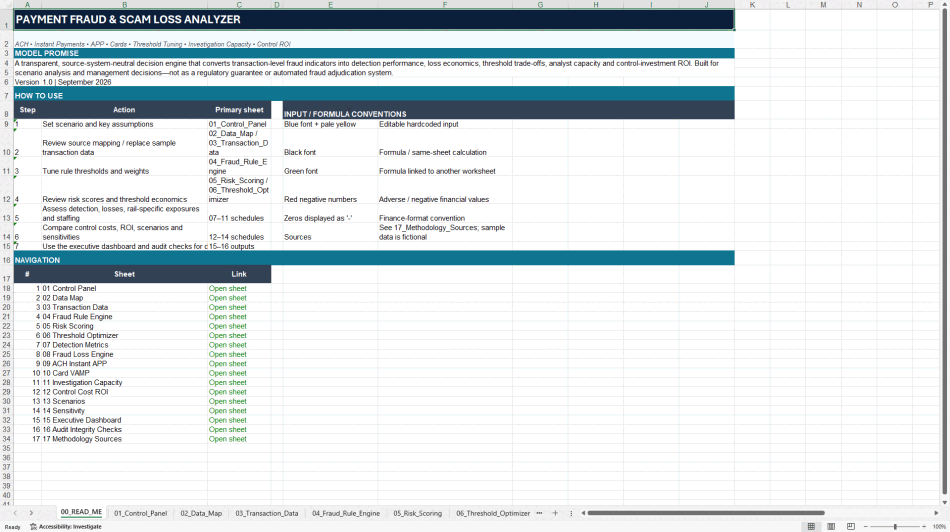
Payment Fraud & Scam Loss Analyzer Financial Model is a decision-focused Excel workbook for financial institutions and payment businesses that need to connect fraud detection activity with loss economics, operational capacity and control investment decisions.
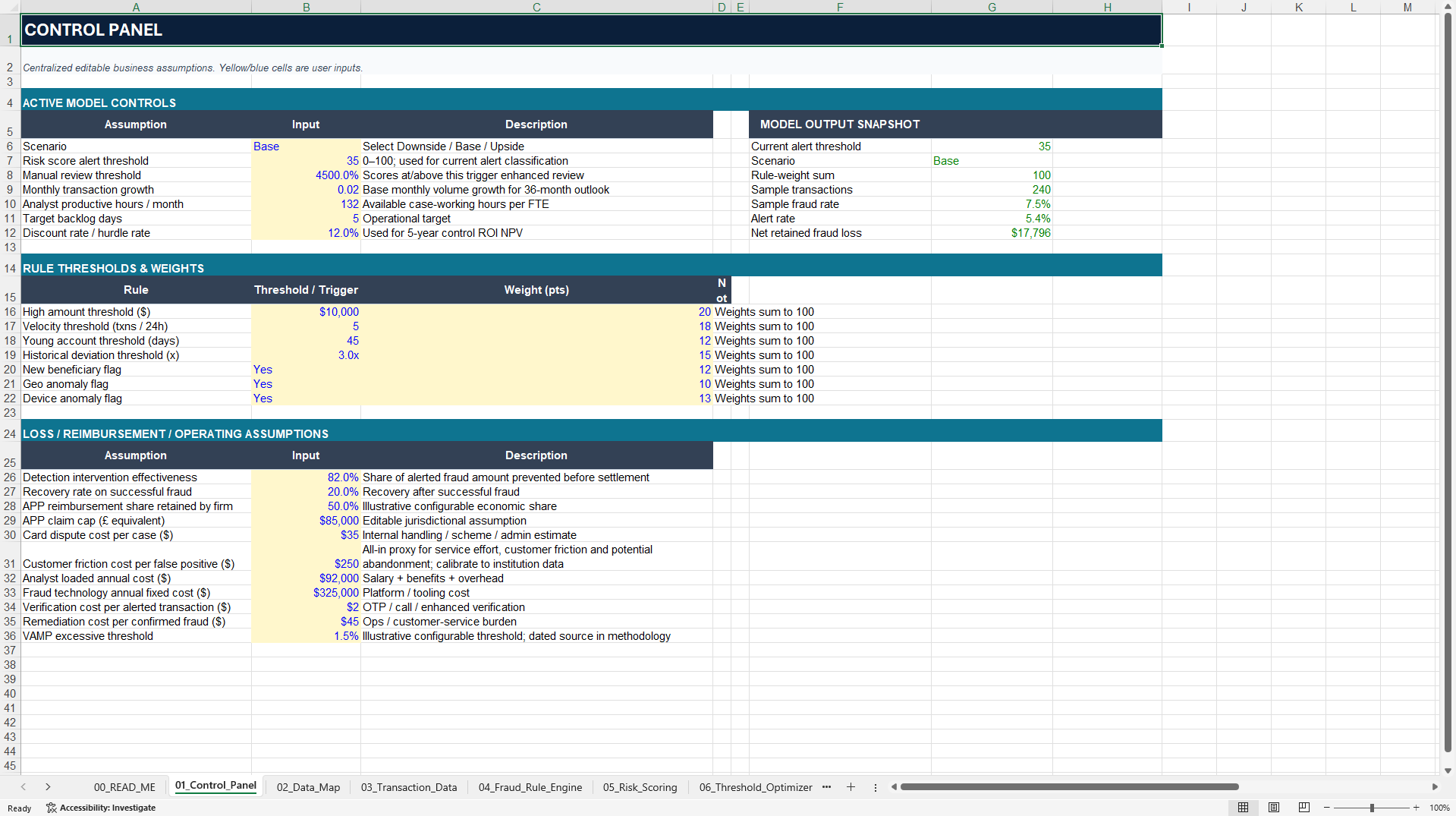
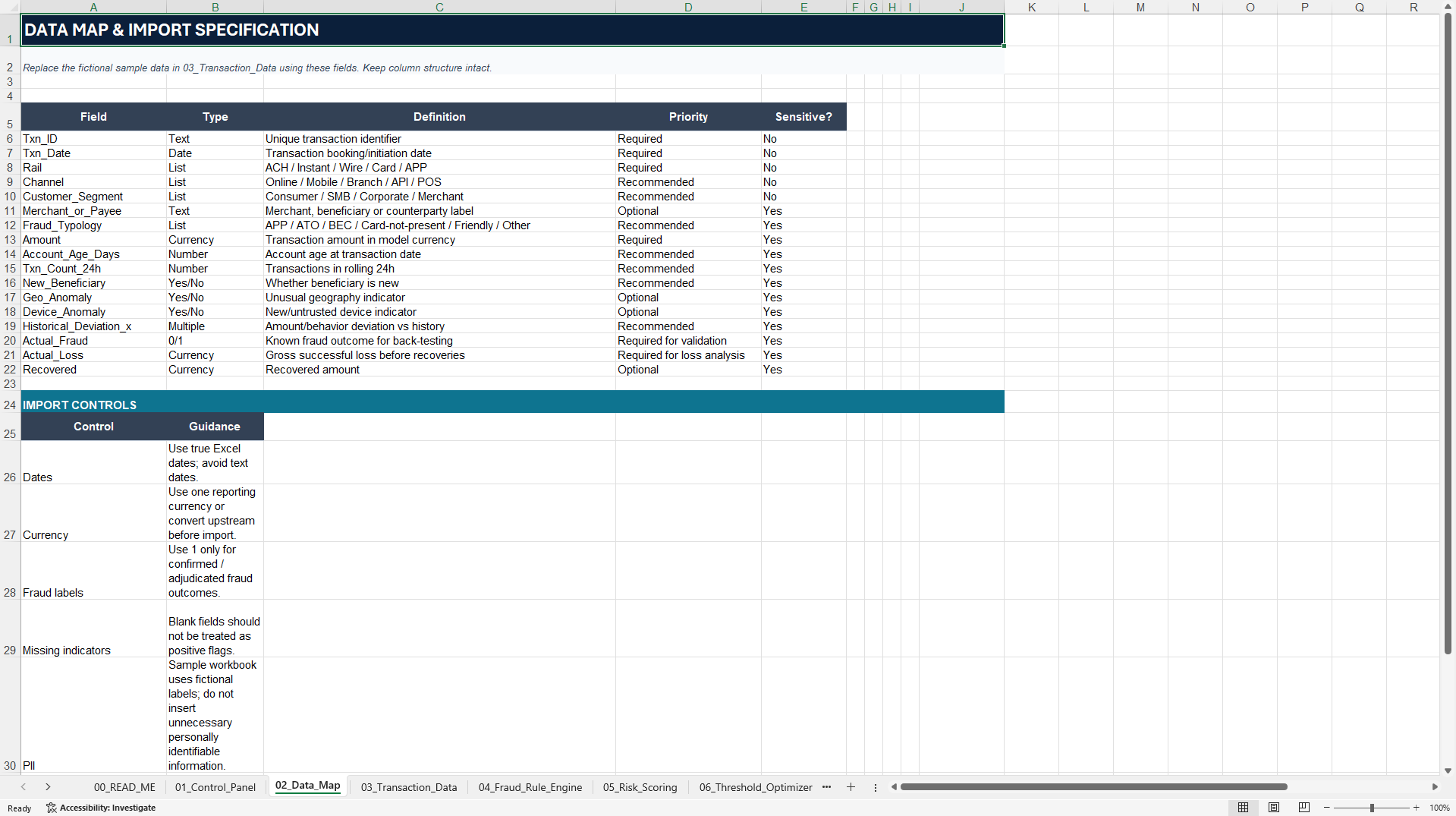
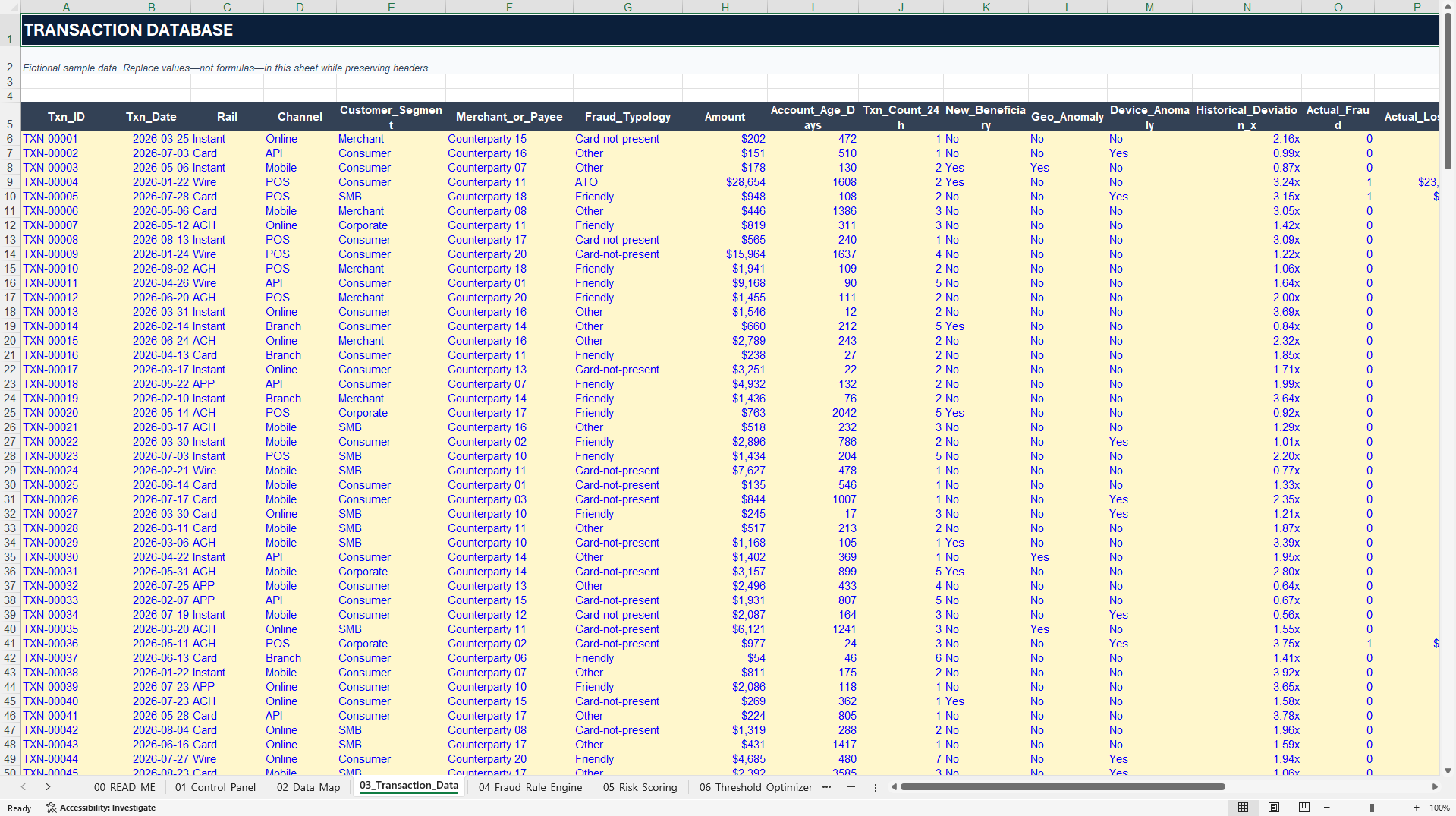
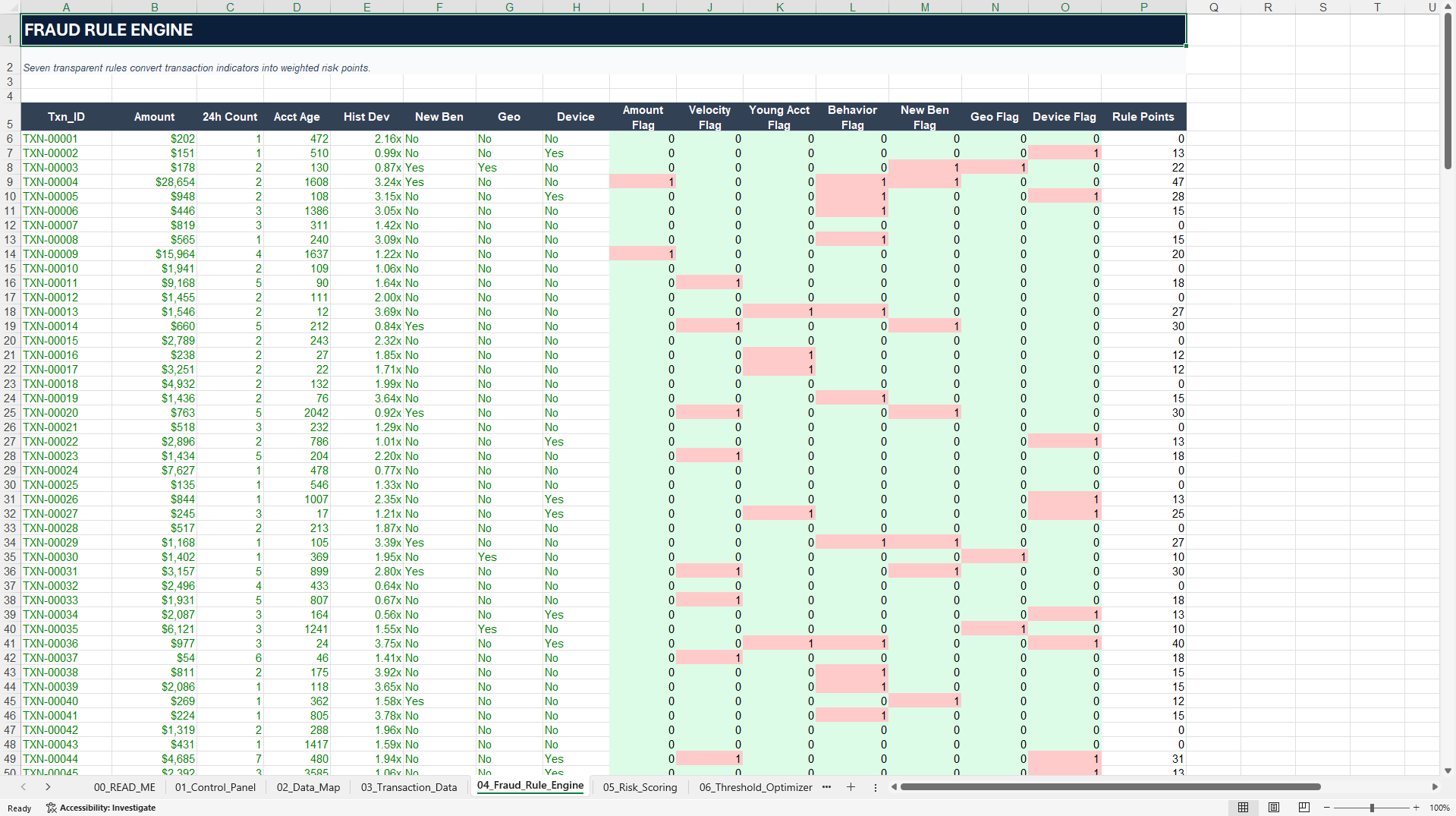
The model starts with a structured transaction database and transparent rule engine. Users can work with the included fictional sample or replace it with institution-specific transaction data. Fraud indicators cover transaction amount, short-term velocity, account age, historical deviation, new-beneficiary activity, geography and device anomalies. Editable rule weights feed a 0-100 risk score and drive alert and enhanced-review classifications.
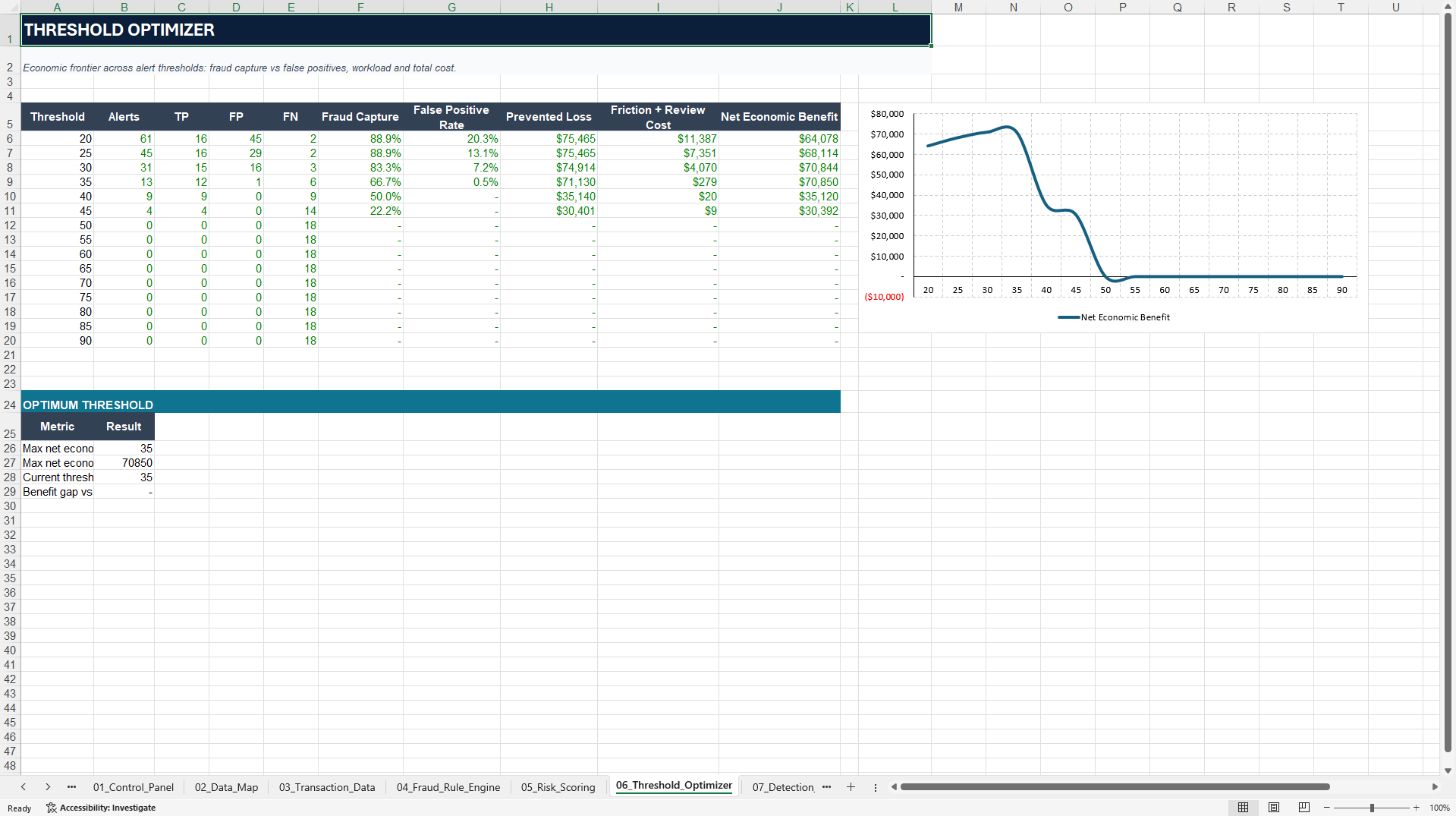
A threshold optimizer tests multiple alert cut-offs and measures alert volume, true positives, false positives, false negatives, fraud capture, false-positive rate, prevented loss, review and friction costs, and net economic benefit. This helps management evaluate whether an alert threshold is economically efficient rather than judging it only from model accuracy.
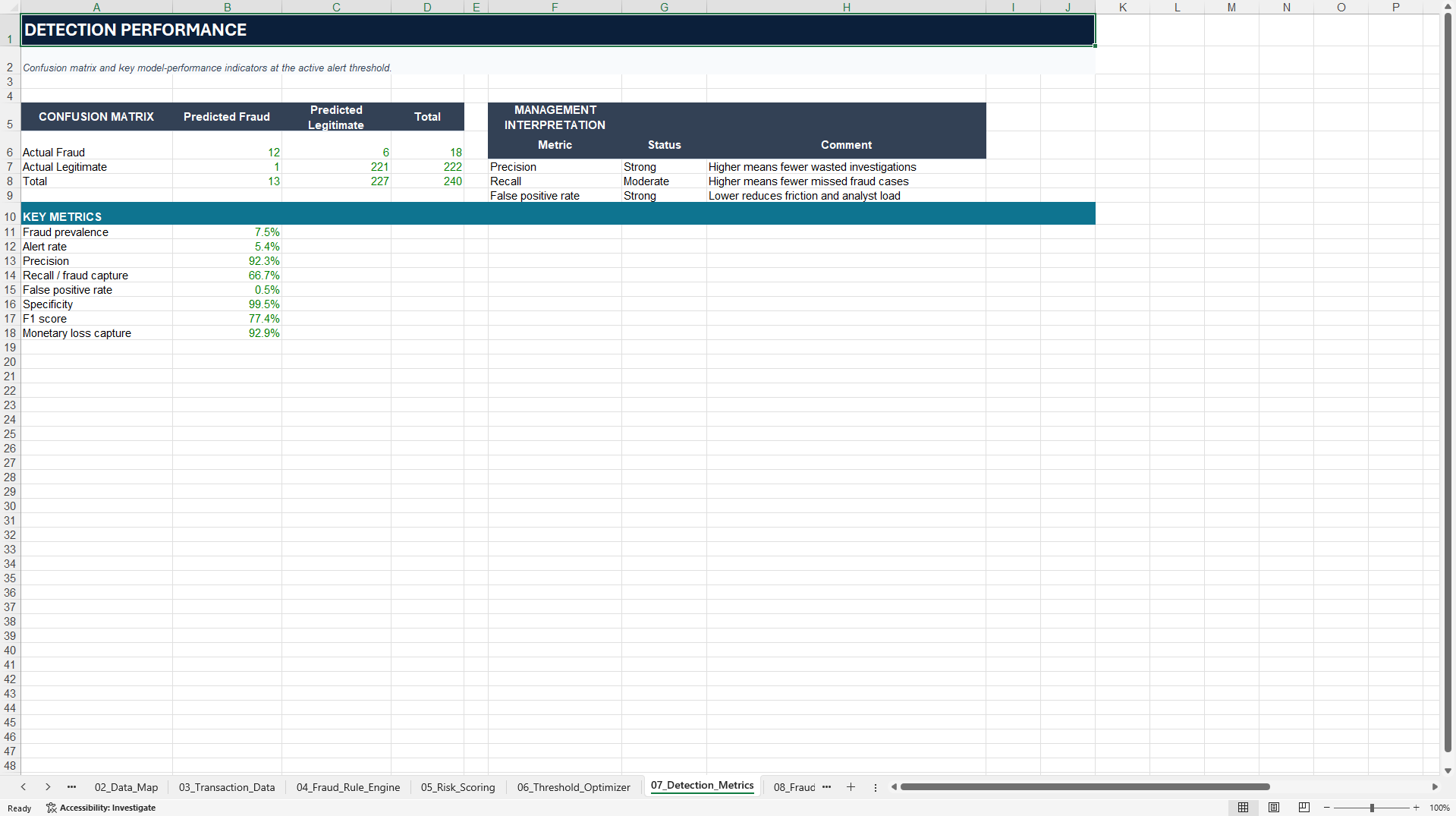
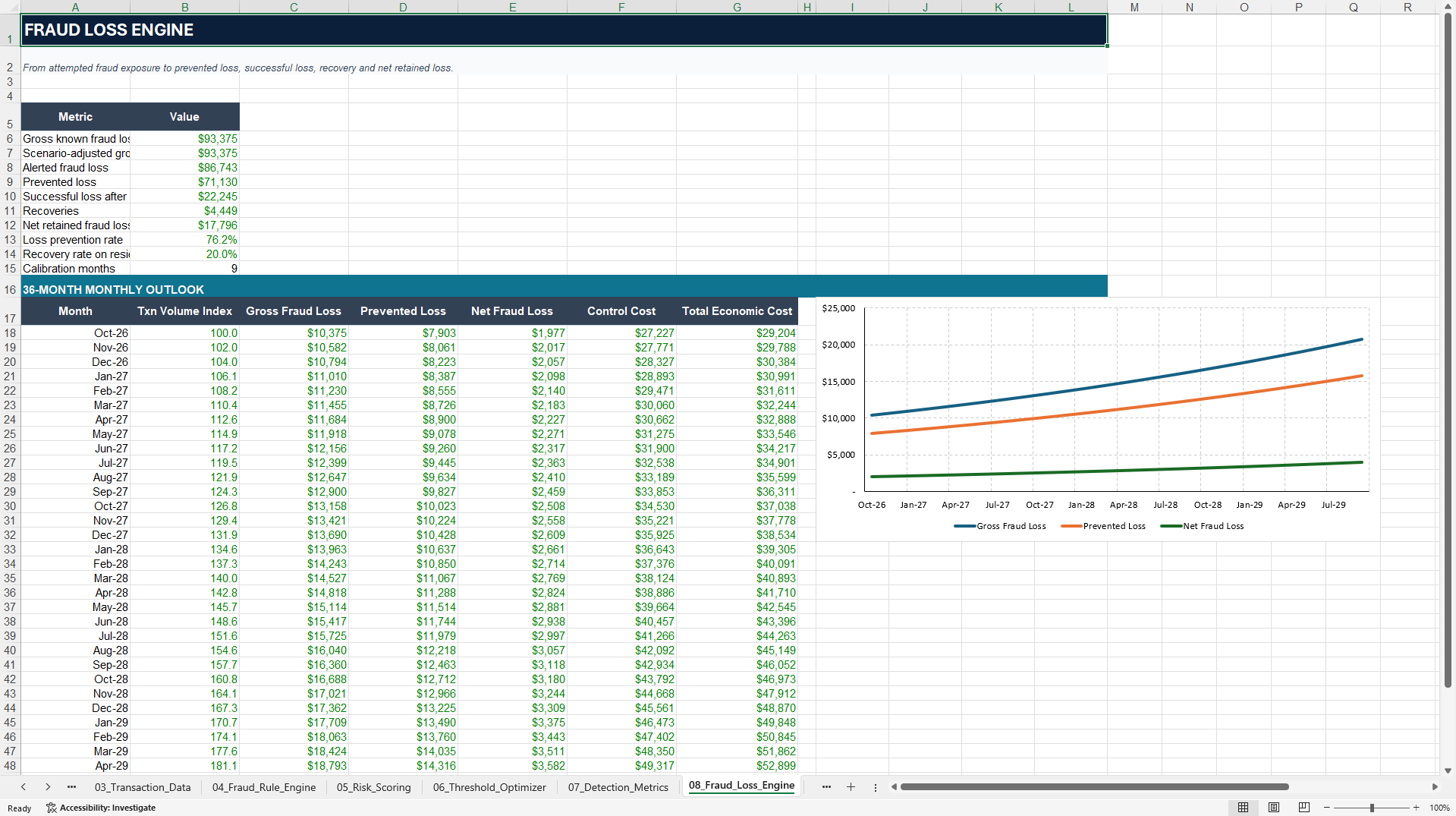
Detection performance is summarized through a confusion matrix and KPIs including prevalence, alert rate, precision, recall, specificity, F1 score and monetary loss capture. The fraud-loss engine then bridges gross known fraud loss to alerted fraud, prevented loss, successful fraud, recoveries and net retained fraud loss. A 36-month monthly outlook extends gross fraud loss, prevented loss, retained loss, control cost and total economic cost under growth and scenario assumptions.
The workbook contains dedicated payment-rail analysis for ACH, instant payments, APP and wire activity, including fraud cases, gross loss, alerted loss, prevented loss, residual loss and net retained loss. APP economics include editable reimbursement-sharing and claim-cap assumptions. A separate card monitor calculates fraud and dispute counts, a VAMP-style monitoring ratio, configured threshold, headroom or breach status and dispute-handling cost.
Operational planning is built into the investigation-capacity schedule. Alerts and enhanced reviews are converted into review hours, productive capacity, required FTEs, utilization, excess or surplus hours, backlog days and SLA status, with a monthly capacity outlook. This allows fraud teams to test whether stronger controls create a staffing bottleneck.
The control-cost and ROI schedule quantifies analyst cost, technology cost, verification cost, remediation cost, false-positive friction, total annual control cost, annual prevented loss, net benefit, ROI and payback. A five-year outlook provides gross fraud exposure, prevented loss, control cost, friction cost, net benefit and discounted net benefit for management investment decisions.
Downside, Base and Upside scenarios stress fraud prevalence, severity, detection effectiveness, recovery rates, alert volumes, analyst costs, technology costs and transaction growth. Two sensitivity grids test fraud prevalence versus detection effectiveness and alert thresholds versus false-positive cost. The executive dashboard consolidates retained fraud loss, fraud capture, false-positive rate, optimal threshold, required FTE, capacity utilization, annual control ROI and five-year NPV with decision charts and a management action panel.
The workbook also includes built-in integrity checks that reconcile rule weights, score bounds, classification totals, fraud cases, losses, recovery constraints, threshold bounds, scenario multipliers, sensitivities and optimizer results. A methodology and sources sheet documents the model approach and dated references.
This model is suitable for banks, credit unions, fintechs, payment processors, merchant acquirers, fraud-risk teams, payment operations teams, financial-crime functions, CFO and COO teams, and advisors seeking a transparent Excel-based fraud economics and decision-support tool. The package includes the client-ready Excel model and a full 18-page worksheet preview.
Got a question about the product? Email us at support@flevy.com or ask the author directly by using the "Ask the Author a Question" form. If you cannot view the preview above this document description, go here to view the large preview instead.
Source: Best Practices in Financial Modeling, Fraud Excel: Payment Fraud & Scam Loss Analyzer Financial Model Excel (XLSX) Spreadsheet, PDMM Financial Models
ABOUT THE AUTHOR

PDMM Financial Models develops professional, decision-ready Excel models for business owners, entrepreneurs, investors, consultants, analysts, and finance teams. Our objective is to transform complex business assumptions into clear, structured analysis that supports better planning and investment decisions.
Our models cover business planning, forecasting, budgeting, feasibility analysis,
... [read more]
Ask the Author a Question
You must be logged in to contact the author.




























