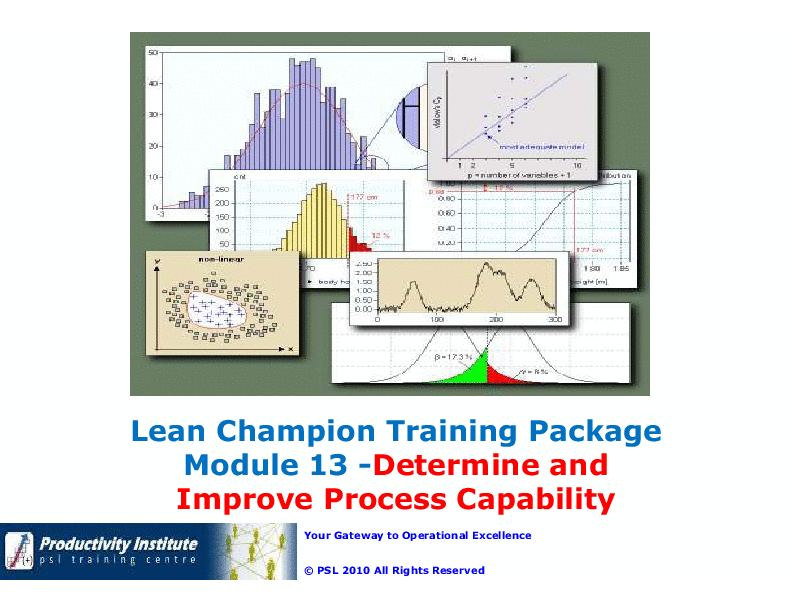

Lean BB Champ 13 - Determine and Improve Process Capability   60-slide PPT PowerPoint presentation slide deck (PPTX)
$49.00

Lean BB Champ 13 - Determine and Improve Process Capability (60-slide PPT PowerPoint presentation slide deck (PPTX)) Preview Image
Log in to unlock full preview.
Lean BB Champ 13 - Determine and Improve Process Capability (60-slide PPT PowerPoint presentation slide deck (PPTX)) Preview Image
Arrow   Click main image to view in full screen.

Lean BB Champ 13 - Determine and Improve Process Capability (PowerPoint PPTX Slide Deck)

PowerPoint (PPTX) 60 Slides

$49.00
This presentation is developed by a pioneer in Lean and certified LSS Master Black Belt who has trained over 5,000+ students globally, from Directors, CEOs, GMs, to shop floor staff. He's endorsed by CMI Consortium, NZTE, HERA, NZPICS, CBAFF.
Add to Cart


Immediate download
Fully editable PowerPoint
Free lifetime updates

BENEFITS OF THIS POWERPOINT DOCUMENT

  1. Understand Process Capability and Find out how to Improve

LEAN SIX SIGMA BLACK BELT PPT DESCRIPTION

Editor Summary Lean BB Champ 13 - Determine and Improve Process Capability is a 60-slide PowerPoint training module by OpEx Academy NZ, developed by a certified Lean Six Sigma Master Black Belt. Read more

The Lean Champion Black Belt Series are designed and developed specifically for Manager and above roles. These series are at the highest standard among the enterprise series. When a person completes all the 15 modules he / she can be awarded a "Lean Champion" certificate which is equivalent to a Black Belt and can lead groups of team in successfully developing strategies and implementation of various Lean principles.

The 15 modules are:
1. Intro 2 Lean Manufacturing – 113 slides
2. Map a Value Stream – 112 slides
3. Hoshin Kanri Policy Deployment – 50 slides
4. Develop a Lean Culture – 46 slides
5. Develop a Balanced Scorecard – 70 slides
6. Develop a Continuous Improvement System – 72
7. Optimize Product Cost – 67 slides
8. Manage 5S – 48 slides
9. Develop Quick Changeovers – 71 slides
10. Develop JIT – 47 slides
11. Implement a TPM – 58 slides
12. Determine & Establish Information Collection Requirements – 96 slides
13. Determine and Improve Process Capability – 60 slides
14. Apply Six Sigma to Process Control & Improvement – 79 slides
15. Process Optimization using Six Sigma – 94 slides

The 13th Module "Determine and Improve Process Capability" covers the following topics:
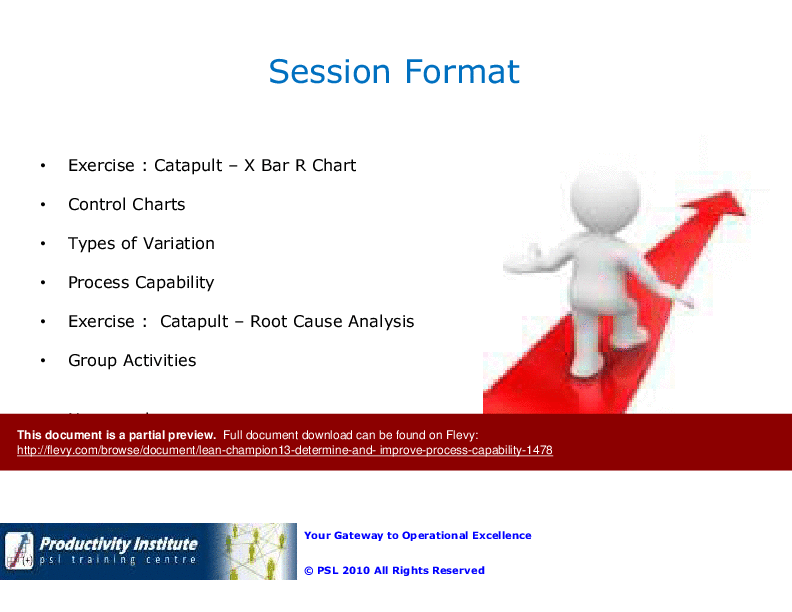
•  Process Model
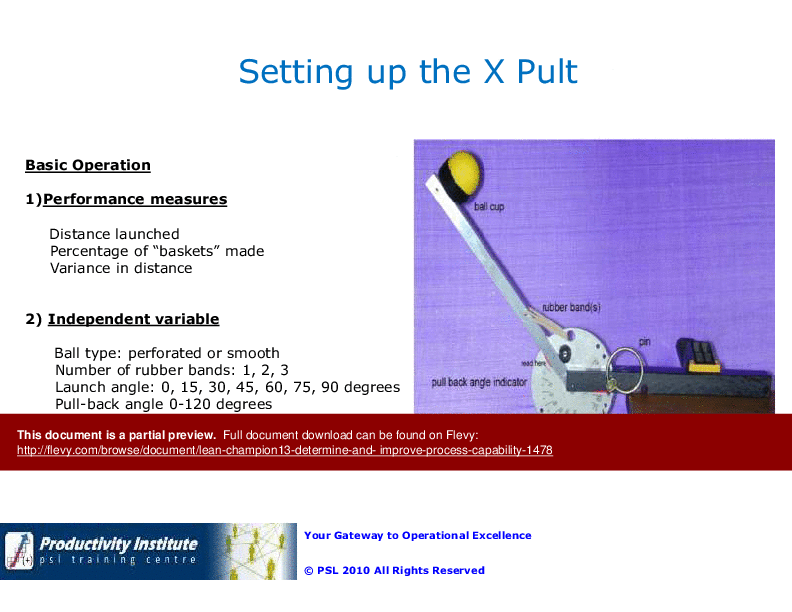
•  Exercise : Catapult – Identifying Process Variables
•  KPIV & KPOV relationship
•  Measurements
•  Exercise: Catapult – Collecting and Displaying Data
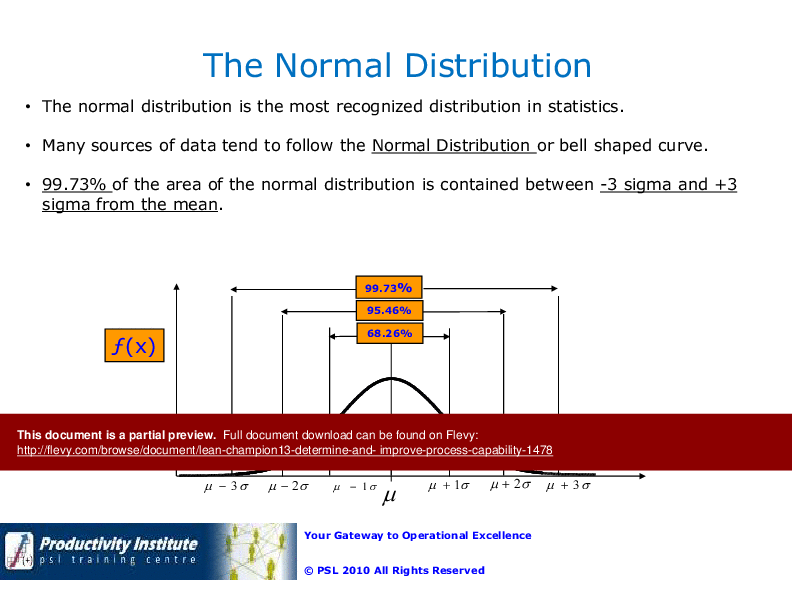
•  Normal Distribution
•  3 Sigma vs 6 Sigma process performance
•  Initiate workplace project
•  Exercise : Catapult ? X Bar R Chart
•  Control Charts
•  Types of Variation
•  Process Capability
•  Exercise: Catapult – Root Cause Analysis
•  Group Activities

You can also buy all the 15 modules at a 25% discounted as a bundled product.
Also add other presentations depending on your requirements, such as Kanban Implementation, Heijunka Implementation, Site Review Check List, Lean Assessment, Lean Leader and Lean Culture Surveys and BSC Assessment.

Got a question about the product? Email us at support@flevy.com or ask the author directly by using the "Ask the Author a Question" form. If you cannot view the preview above this document description, go here to view the large preview instead.

MARCUS OVERVIEW

This synopsis was written by Marcus [?] based on the analysis of the full 60-slide presentation.


Executive Summary
The "Lean Champion Training Package: Module 13 - Determine and Improve Process Capability" presentation equips participants with essential skills to assess and enhance process capability using Lean Six Sigma methodologies. Developed by a certified LSS Master Black Belt, this training focuses on practical exercises, including the use of control charts and root cause analysis. Participants will learn to identify key process input and output variables (KPIV & KPOV), collect and analyze data, and implement improvement plans. This comprehensive approach ensures that teams can effectively drive operational excellence.

Who This Is For and When to Use
•  Lean Six Sigma practitioners and champions
•  Quality assurance teams focused on process improvement
•  Operations managers overseeing production efficiency
•  Project leaders implementing Lean methodologies

Best-fit moments to use this deck:
•  During training sessions aimed at enhancing process capability
•  When initiating workplace projects focused on operational improvement
•  For workshops that require hands-on exercises in data collection and analysis

Learning Objectives
•  Define key process input and output variables (KPIV & KPOV)
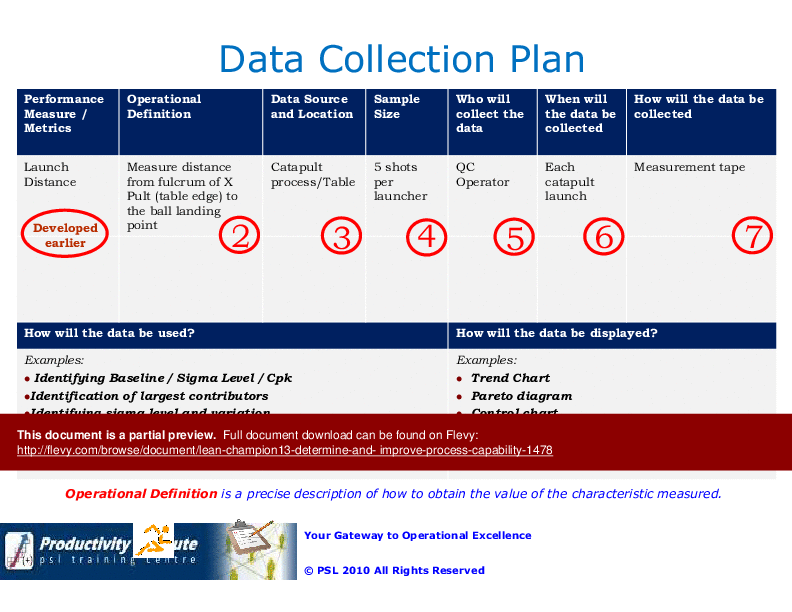
•  Develop a comprehensive data collection plan
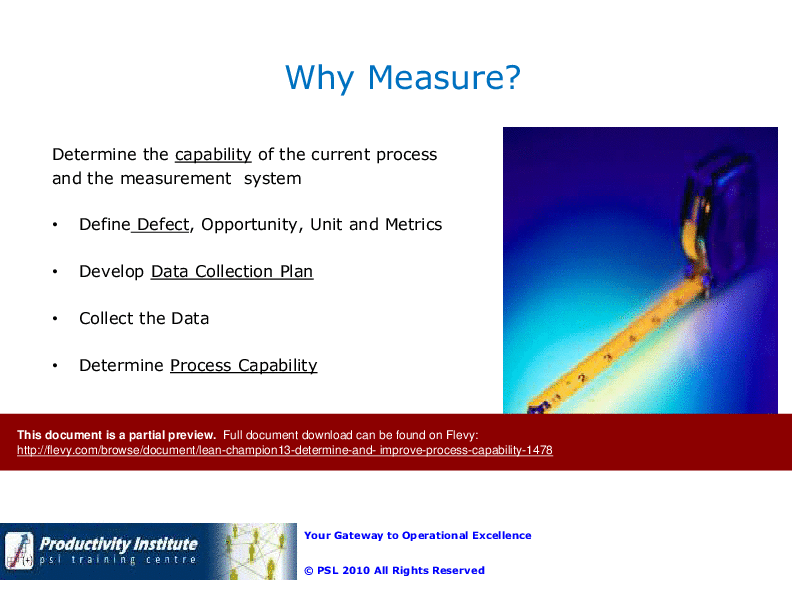
•  Collect and analyze data to determine process capability
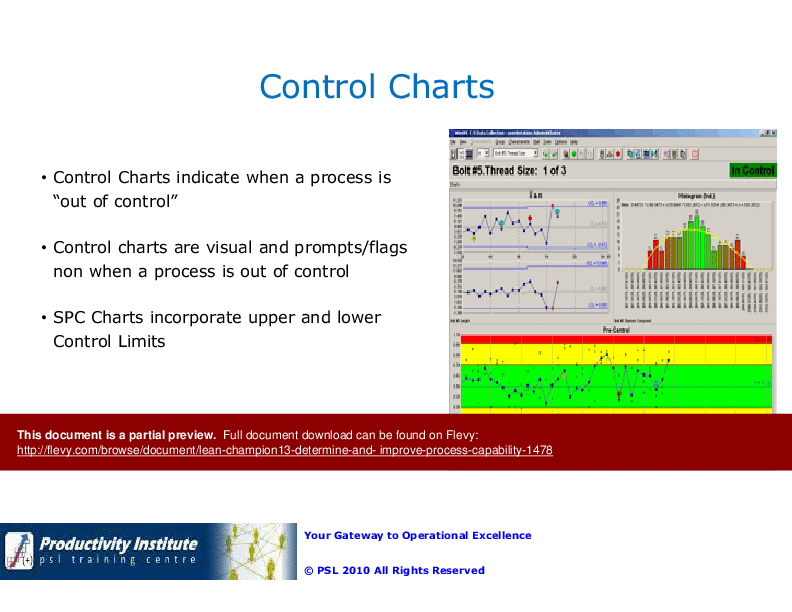
•  Utilize control charts to monitor process performance
•  Implement root cause analysis for continuous improvement
•  Generate and interpret X bar R charts for process capability

Table of Contents
•  Session Format (page 3)
•  Process Model (page 4)
•  Exercise: Catapult - Identifying Process Variables (page 5)
•  KPIV & KPOV Relationship (page 6)
•  Data Collection Plan (page 11)
•  Control Charts (page 22)
•  Process Capability Analysis (page 28)
•  Improvement Action Plan (page 34)

Primary Topics Covered
•  Process Capability - Understanding the extent to which a process meets its specifications and requirements.
•  Control Charts - Tools used to monitor process stability and identify variations.
•  Data Collection Plan - A structured approach to gathering relevant data for analysis.
•  Root Cause Analysis - Techniques to identify underlying causes of process inefficiencies.
•  X Bar R Chart - A statistical tool for tracking process performance over time.
•  KPIV & KPOV - Key variables that influence process outcomes and performance.

Deliverables, Templates, and Tools
•  Data collection plan template
•  X Pult tally checklist
•  Frequency plot template
•  X bar R chart (Excel file and A3 sized hardcopy)
•  Process capability calculator (Excel file)
•  Improvement action plan template

Slide Highlights
•  Visual representation of the normal distribution and its significance in process capability
•  Example of a control chart illustrating process stability
•  Overview of the KPIV & KPOV relationship and its impact on process outcomes
•  Step-by-step guide for generating an X bar R chart
•  Root cause analysis diagram for identifying factors affecting process performance

Potential Workshop Agenda
Introduction to Process Capability (30 minutes)
•  Overview of process capability concepts
•  Discussion on KPIV & KPOV relationships

Hands-On Data Collection Exercise (60 minutes)
•  Participants conduct the catapult exercise
•  Collect and analyze data using provided templates

Control Chart Workshop (45 minutes)
•  Generate control charts based on collected data
•  Discuss findings and implications for process improvement

Customization Guidance
•  Tailor the data collection plan to specific operational contexts and requirements
•  Adjust KPIV & KPOV variables based on the unique processes being analyzed
•  Incorporate organizational terminology and metrics into templates and tools

Secondary Topics Covered
•  Types of variation in processes: common cause vs. special cause
•  Statistical process control (SPC) fundamentals
•  Improvement action planning and implementation strategies
•  Process performance metrics and their significance

Topic FAQ

What are the typical phases of a process capability assessment?

A process capability assessment typically defines KPIVs and KPOVs, develops a structured data collection plan, collects and analyzes data, uses control charts to assess stability, calculates capability indices like Cpk, and implements improvement actions using root cause analysis and documented plans, ending with an improvement action plan.

How do control charts and capability indices complement each other in process improvement?

Control charts monitor process stability over time and help distinguish common-cause from special-cause variation, while capability indices like Cpk quantify how well a stable process meets specification limits. Both are used together to first ensure stability with control charts and then evaluate capability with Cpk.

What data is required to create an X bar R chart during a workshop exercise?

To create an X bar R chart you need repeated subgroup measurements collected consistently over time, a defined subgroup sampling plan and recorded sample values for each subgroup, plus a plan for plotting means and ranges to evaluate process variation using an X bar R chart.

How should I evaluate the cost versus value of buying process capability templates and decks?

Assess value by comparing time saved on lesson design and analysis, relevance to your team’s training needs, and included tools such as templates and calculators; check for deliverables like a process capability calculator (Excel file), X bar R chart templates, and a data collection plan template when evaluating purchase value.

What key content should I expect in a training deck on determining process capability?

A training deck should cover KPIV & KPOV relationships, a data collection plan, control chart theory and examples, X bar R chart generation, root cause analysis techniques, and practical exercises; look for included artifacts such as a data collection plan template and X bar R chart templates.

How can I structure a half-day workshop to teach control charts and capability analysis?

Structure a session with an introduction to process capability and KPIV/KPOV, a hands-on data collection exercise, a control chart generation segment, and a facilitated root cause and improvement planning activity; a suggested agenda includes a 30-minute intro, 60-minute data exercise, and a 45-minute Control Chart Workshop.

After a merger we see increased process variation—what steps help identify the causes?

Begin by mapping KPIVs and KPOVs for affected processes, implement a tailored data collection plan, use control charts to separate common and special causes, and apply root cause analysis diagrams to identify factors, then validate findings with an X bar R chart and targeted improvement actions.

How does mapping KPIVs to KPOVs improve the focus of improvement projects?

Mapping KPIVs to KPOVs clarifies which input variables drive output performance so teams can target measurement and interventions more effectively; the approach directs data collection and analysis toward the most influential variables, as taught in the module’s KPIV & KPOV relationship content.

Document FAQ
These are questions addressed within this presentation.

What is the purpose of a data collection plan?
A data collection plan outlines how data will be gathered, ensuring that relevant metrics are captured for effective analysis.

How do control charts help in process improvement?
Control charts visually represent process stability, allowing teams to identify variations and take corrective actions when necessary.

What is the significance of KPIV and KPOV?
KPIV (Key Process Input Variables) and KPOV (Key Process Output Variables) are critical for understanding how inputs affect outputs and overall process performance.

How can I implement root cause analysis effectively?
Root cause analysis can be implemented by using tools like cause and effect diagrams to identify and categorize potential causes of process issues.

What is an X bar R chart?
An X bar R chart is a statistical tool used to monitor the mean and variability of a process over time, helping to assess process capability.

How do I calculate process capability?
Process capability can be calculated using the Cpk index, which measures how well a process meets its specifications relative to its variability.

What are common causes of variation in processes?
Common causes of variation are inherent to the process and can include factors like machine wear, material inconsistencies, and environmental conditions.

What is the difference between common cause and special cause variation?
Common cause variation is inherent to the process, while special cause variation arises from external factors that can be identified and addressed.

Glossary
•  KPIV - Key Process Input Variable
•  KPOV - Key Process Output Variable
•  Cpk - Process Capability Index
•  Control Chart - A graphical representation used to monitor process stability
•  Root Cause Analysis - A method for identifying the underlying causes of issues
•  X Bar R Chart - A control chart that tracks the mean and range of a process
•  Data Collection Plan - A structured approach for gathering relevant data
•  Common Cause Variation - Variation inherent to the process
•  Special Cause Variation - Variation caused by external factors
•  Normal Distribution - A statistical distribution that describes how data points are spread
•  Process Capability - The ability of a process to produce output within specified limits
•  Statistical Process Control (SPC) - A method for monitoring and controlling processes using statistical methods
•  Improvement Action Plan - A plan outlining steps to enhance process performance
•  Frequency Plot - A graphical representation of data distribution
•  Variance - A measure of the dispersion of a set of data points
•  Defect - A failure to meet a specified requirement
•  Opportunity - A chance for improvement in a process
•  Unit - A single item or entity being measured in a process
•  Metrics - Quantitative measures used to assess performance

Source: Best Practices in Lean Six Sigma Black Belt PowerPoint Slides: Lean BB Champ 13 - Determine and Improve Process Capability PowerPoint (PPTX) Presentation Slide Deck, OpEx Academy NZ


$49.00
This presentation is developed by a pioneer in Lean and certified LSS Master Black Belt who has trained over 5,000+ students globally, from Directors, CEOs, GMs, to shop floor staff. He's endorsed by CMI Consortium, NZTE, HERA, NZPICS, CBAFF.
Add to Cart
  

ABOUT THE AUTHOR

Author image
Additional documents from author: 88

Vishnu Rayapeddi is an experienced management consultant and trainer specializing in implementing continuous process improvements. Vishnu is a pioneer in Lean Management which combines the power of Lean Thinking, TOC, Six Sigma, TQM, TWI, Balanced Scorecard, cGMP and other best-class methodologies such as, DMAIC, Value Stream Mapping, Root Cause Analysis, 5S, Quick Changeovers, Quality and ... [read more]

Ask the Author a Question

You must be logged in to contact the author.

Click here to log in Click here register

Did you know?
The average daily rate of a McKinsey consultant is $6,625 (not including expenses). The average price of a Flevy document is $65.

Bundle and save! You can save up to % with bundles!

View bundle(s)


Trusted by over 10,000+ Client Organizations
Since 2012, we have provided business templates to over 10,000 businesses and organizations of all sizes, from startups and small businesses to the Fortune 100, in over 130 countries.
AT&T GE Cisco Intel IBM Coke Dell Toyota HP Nike Samsung Microsoft Astrazeneca JP Morgan KPMG Walgreens Walmart 3M Kaiser Oracle SAP Google E&Y Volvo Bosch Merck Fedex Shell Amgen Eli Lilly Roche AIG Abbott Amazon PwC T-Mobile Broadcom Bayer Pearson Titleist ConEd Pfizer NTT Data Schwab


Read Customer Testimonials

 
"I have used FlevyPro for several business applications. It is a great complement to working with expensive consultants. The quality and effectiveness of the tools are of the highest standards."

– Moritz Bernhoerster, Global Sourcing Director at Fortune 500
 
"FlevyPro provides business frameworks from many of the global giants in management consulting that allow you to provide best in class solutions for your clients."

– David Harris, Managing Director at Futures Strategy
 
"Flevy is now a part of my business routine. I visit Flevy at least 3 times each month.

Flevy has become my preferred learning source, because what it provides is practical, current, and useful in this era where the business world is being rewritten.

In today's environment where there are so "

– Omar Hernán Montes Parra, CEO at Quantum SFE
 
"I like your product. I'm frequently designing PowerPoint presentations for my company and your product has given me so many great ideas on the use of charts, layouts, tools, and frameworks. I really think the templates are a valuable asset to the job."

– Roberto Fuentes Martinez, Senior Executive Director at Technology Transformation Advisory
 
"I have used Flevy services for a number of years and have never, ever been disappointed. As a matter of fact, David and his team continue, time after time, to impress me with their willingness to assist and in the real sense of the word. I have concluded in fact "

– Roberto Pelliccia, Senior Executive in International Hospitality
 
"I have found Flevy to be an amazing resource and library of useful presentations for lean sigma, change management and so many other topics. This has reduced the time I need to spend on preparing for my performance consultation. The library is easily accessible and updates are regularly provided. A wealth of great information."

– Cynthia Howard RN, PhD, Executive Coach at Ei Leadership
 
"[Flevy] produces some great work that has been/continues to be of immense help not only to myself, but as I seek to provide professional services to my clients, it gives me a large "tool box" of resources that are critical to provide them with the quality of service and outcomes they are expecting."

– Royston Knowles, Executive with 50+ Years of Board Level Experience
 
"As a small business owner, the resource material available from FlevyPro has proven to be invaluable. The ability to search for material on demand based our project events and client requirements was great for me and proved very beneficial to my clients. Importantly, being able to easily edit and tailor "

– Michael Duff, Managing Director at Change Strategy (UK)


Save with Bundles

This document is available as part of the following discounted bundle(s):

Save %!
Lean Champion Black Belt Training Series - 15 Modules

This bundle contains 15 total documents. See all the documents to the right.

$528.00


Add Bundle & Save


Customers Also Like These Documents

Explore Related Management Topics


Your Recently Viewed Documents
Receive our FREE presentation on Operational Excellence

This 50-slide presentation provides a high-level introduction to the 4 Building Blocks of Operational Excellence. Achieving OpEx requires the implementation of a Business Execution System that integrates these 4 building blocks.