
 Click main image to view in full screen. Unlock all 20 preview images:
IFRS Fixed Asset and Depreciation Model – Excel XLSX
Excel (XLSX) + supplemental PDF


BENEFITS OF THIS DOWNLOADABLE EXCEL DOCUMENT
- Brings asset recognition, four depreciation methods, revaluation, impairment, tax, deferred tax, journals, roll-forwards, and disclosures into one integrated IFRS-focused workbook.
- Improves year-end close and audit readiness through transparent formulas, linked reporting schedules, and 28 automated integrity controls.
- Replaces fragmented asset schedules with a centralized multi-entity workflow, ten-year daily pro-rata engine, scenario controls, and management reporting.
MANAGEMENT ACCOUNTING EXCEL DESCRIPTION
🏢 OVERVIEW
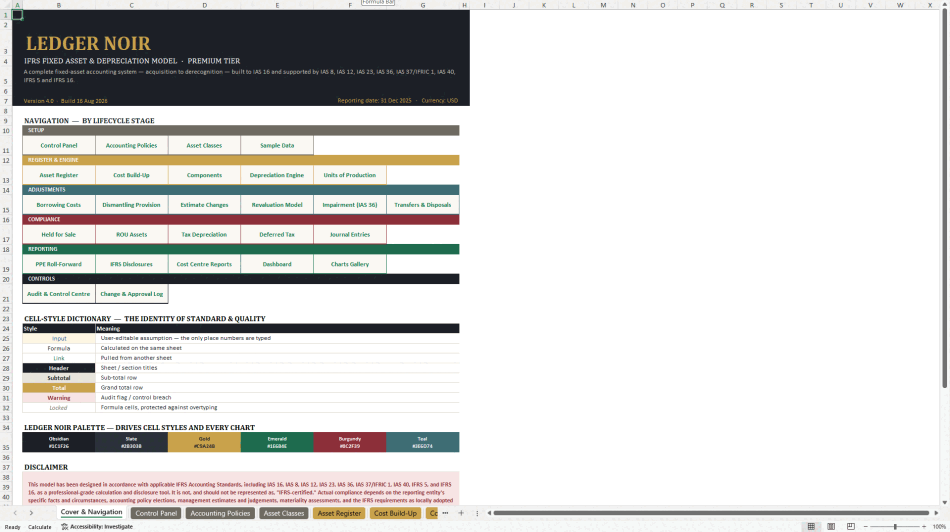
The Ledger Noir IFRS Fixed Asset and Depreciation Model is a premium Excel-based fixed-asset accounting, calculation, control, and reporting system. It covers the complete asset lifecycle—from acquisition and cost recognition through depreciation, revaluation, impairment, disposal, tax, journal entries, roll-forwards, disclosures, and management reporting.
📚 IFRS-FOCUSED FRAMEWORK
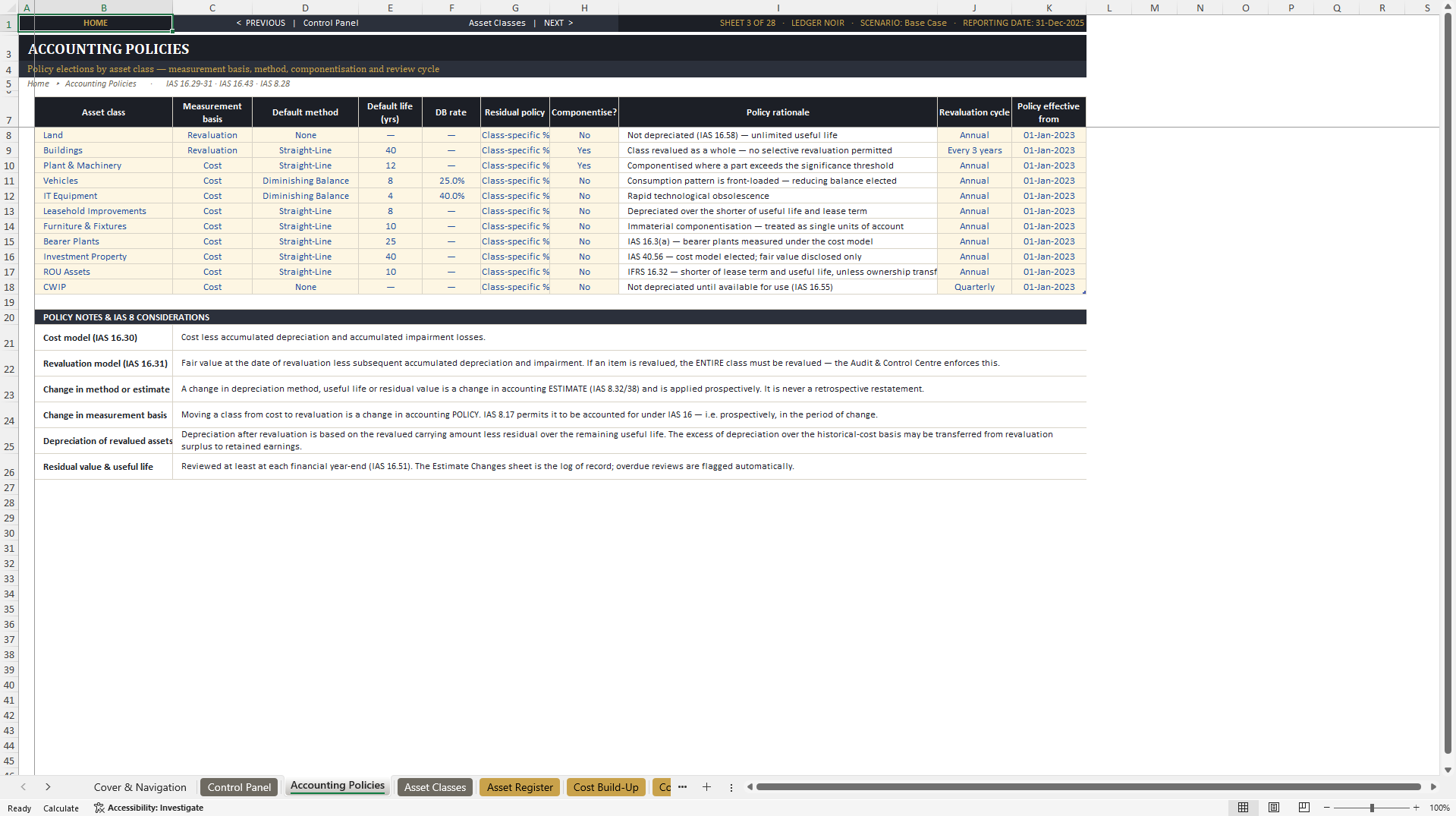
The workbook is built primarily around IAS 16 Property, Plant and Equipment and incorporates relevant mechanics from IAS 2, IAS 8, IAS 12, IAS 23, IAS 36, IAS 37 and IFRIC 1, IAS 40, IFRS 5, IFRS 13, and IFRS 16. It is designed as a professional calculation and reporting aid while preserving the need for entity-specific policies, estimates, judgments, evidence, materiality assessments, and professional review.
📊 MODEL SCALE AND STRUCTURE
• 28 integrated worksheets • More than 24,000 formulas • 36 charts • 396 defined names • Ten-year calculation grid • 45 illustrative assets • 11 asset classes • Multiple entities and currencies • 28 automated controls
⚙️ CENTRAL CONTROL PANEL
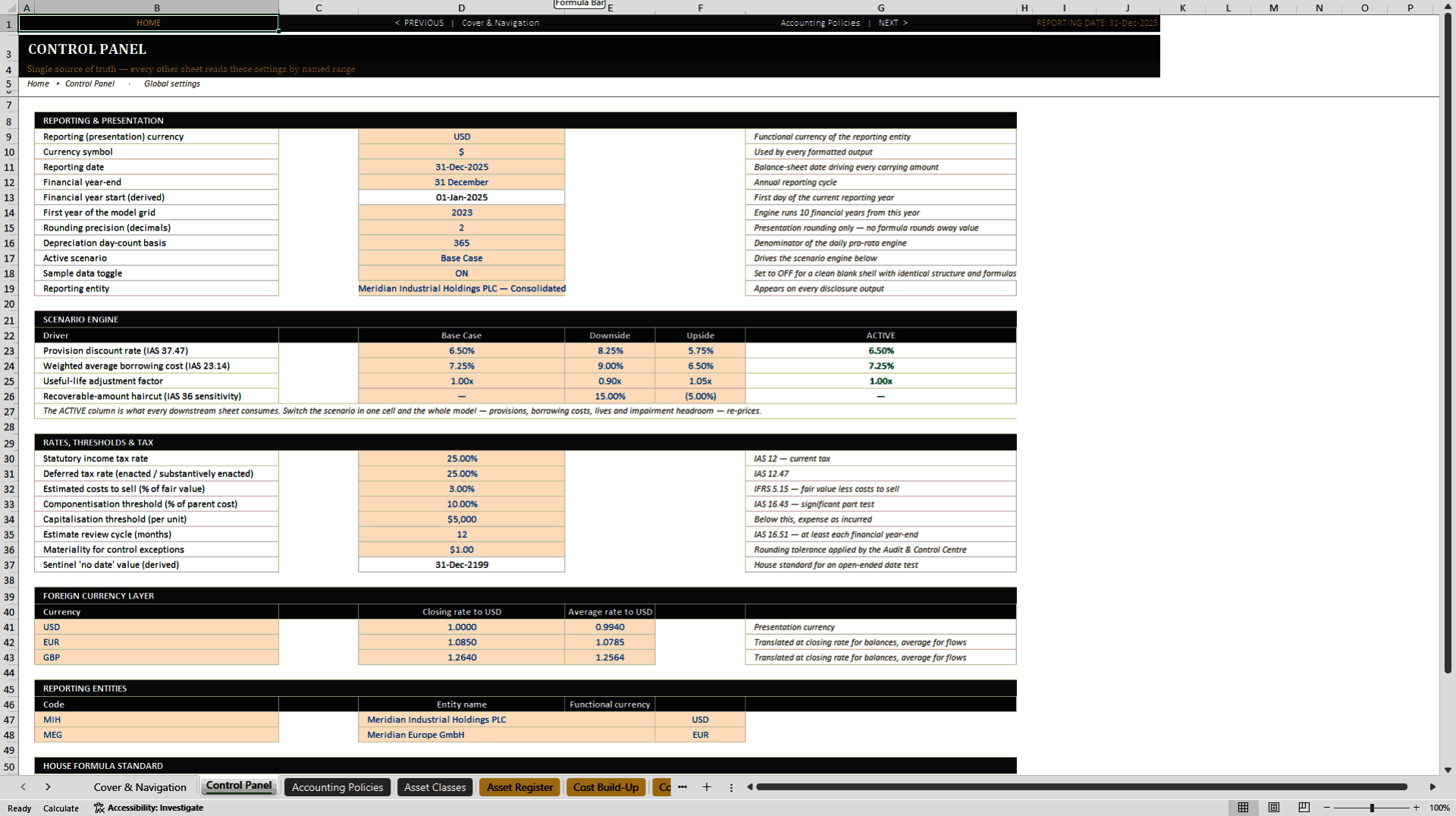
The Control Panel acts as the model's single source of truth. Users can configure the reporting date, financial year-end, presentation currency, depreciation day-count basis, reporting entities, FX rates, tax rates, capitalization and componentization thresholds, estimate-review cycle, control materiality, and other global settings.
The model includes Base, Downside, and Upside scenarios. Changing the active case updates the provision discount rate, weighted-average borrowing cost, useful-life adjustment factor, and impairment sensitivity throughout the linked schedules.
🧪 SAMPLE DATA AND CLEAN-SHELL MODE
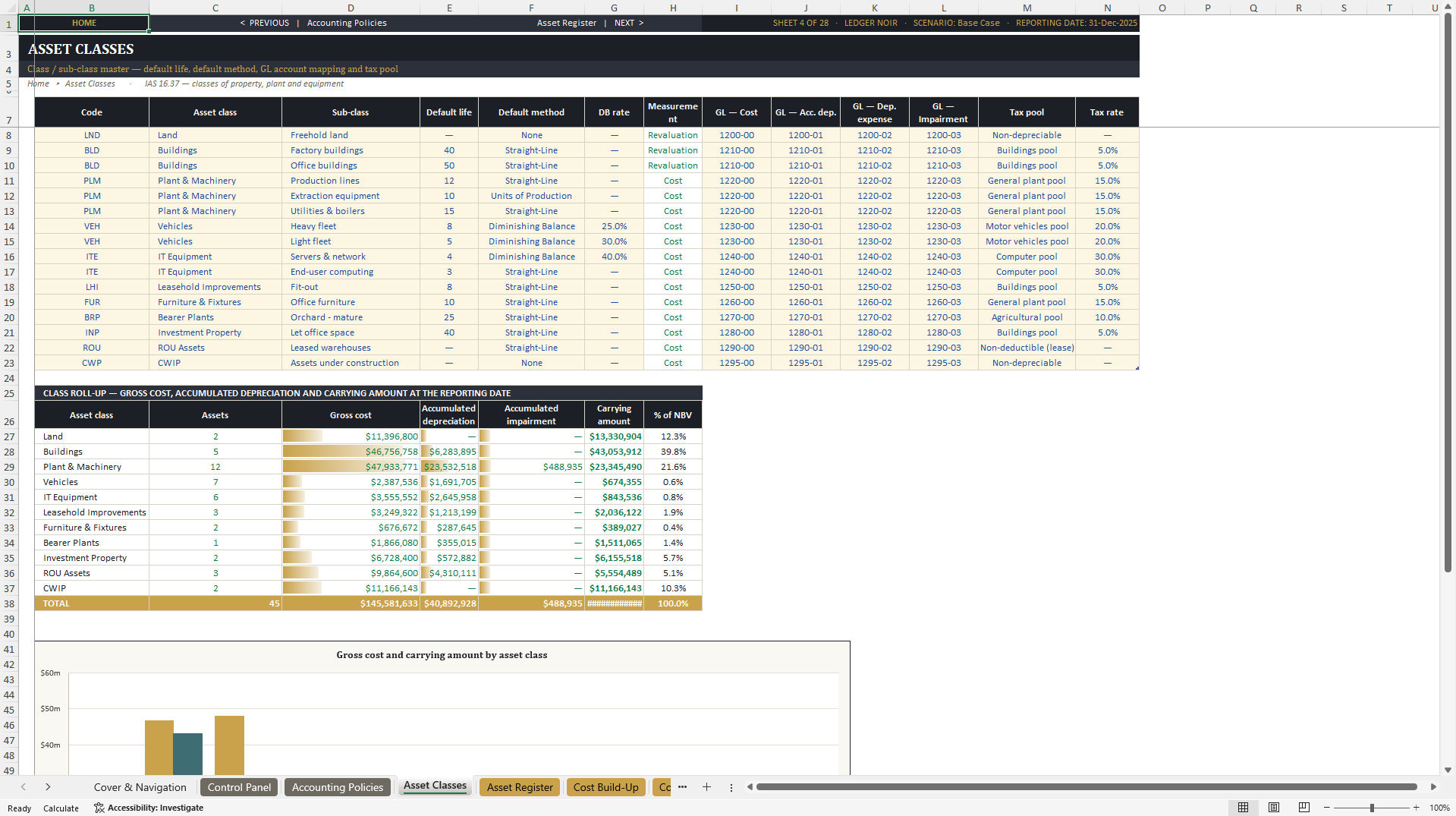
The workbook includes 45 fictional assets across 11 asset classes, two reporting entities, multiple currencies, sites, departments, cost centres, and functions. The sample exercises every major module and allows users to inspect the complete workflow.
Set the sample-data control to OFF to convert the demonstration case into a clean working shell while retaining the same formulas, schedules, controls, and reporting architecture.
🧾 DETAILED ASSET REGISTER
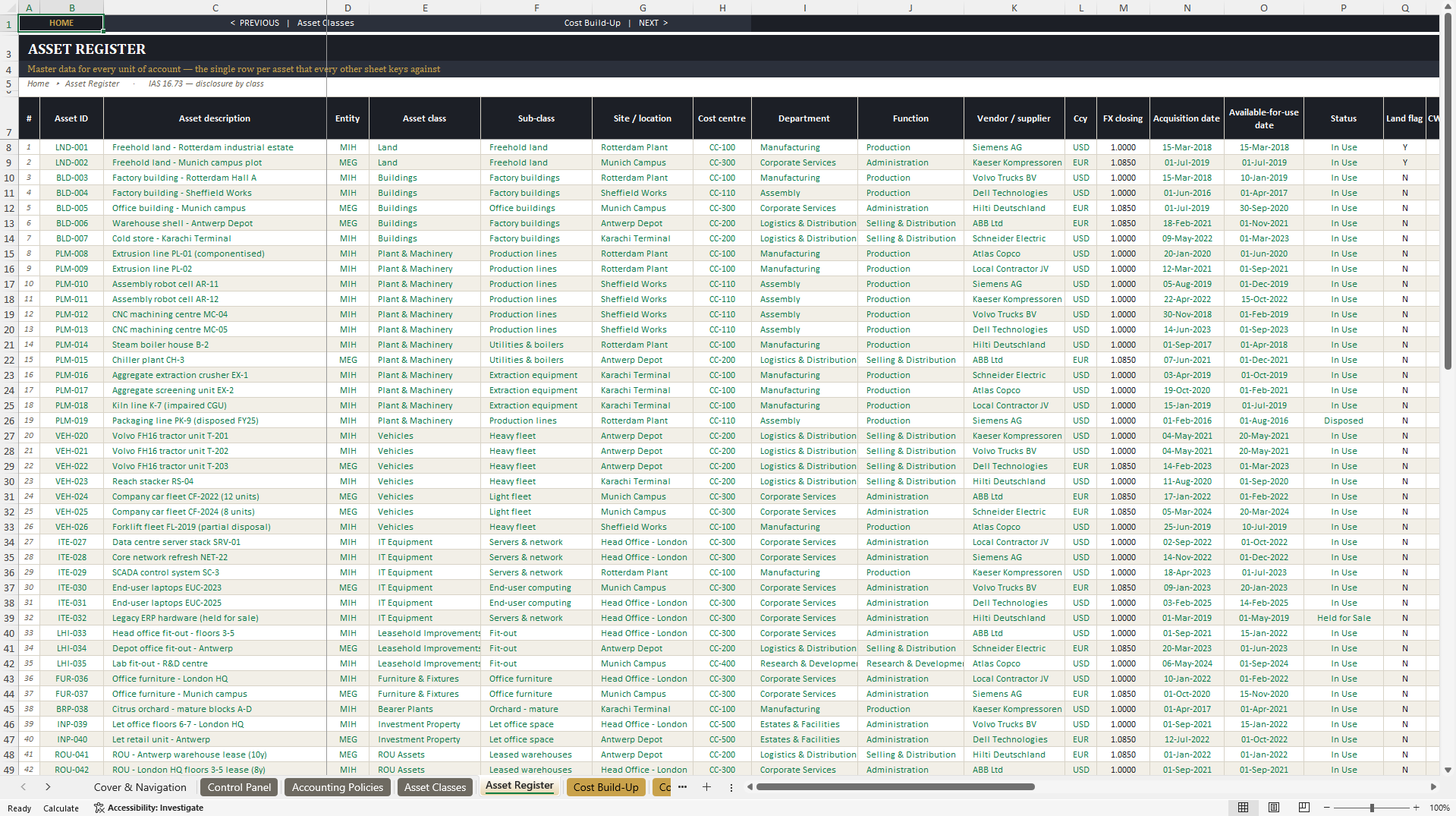
The register maintains one master record per unit of account and captures asset ID, description, entity, class, sub-class, site, cost centre, department, function, vendor, currency, FX rate, acquisition date, available-for-use date, depreciation method, useful life, residual value, gross cost, opening accumulated depreciation, opening tax written-down value, disposal information, held-for-sale date, componentization, pledged status, estimate-review status, measurement basis, carrying amount, and control status.
🏗️ IAS 16 COST BUILD-UP
The Cost Build-Up sheet separates capitalizable expenditure from costs recognized as incurred.
• Capitalizable items include purchase price, duties, site preparation, delivery, installation, directly attributable employee costs, testing, professional fees, major inspections, eligible borrowing costs, dismantling obligations, and subsequent expenditure.
• Excluded costs include training, advertising, relocation and reorganization, initial operating losses, and administration or general overhead.
• Capitalization-threshold and reconciliation checks help prevent inappropriate additions to the asset register.
🧩 COMPONENTS AND MAJOR INSPECTIONS
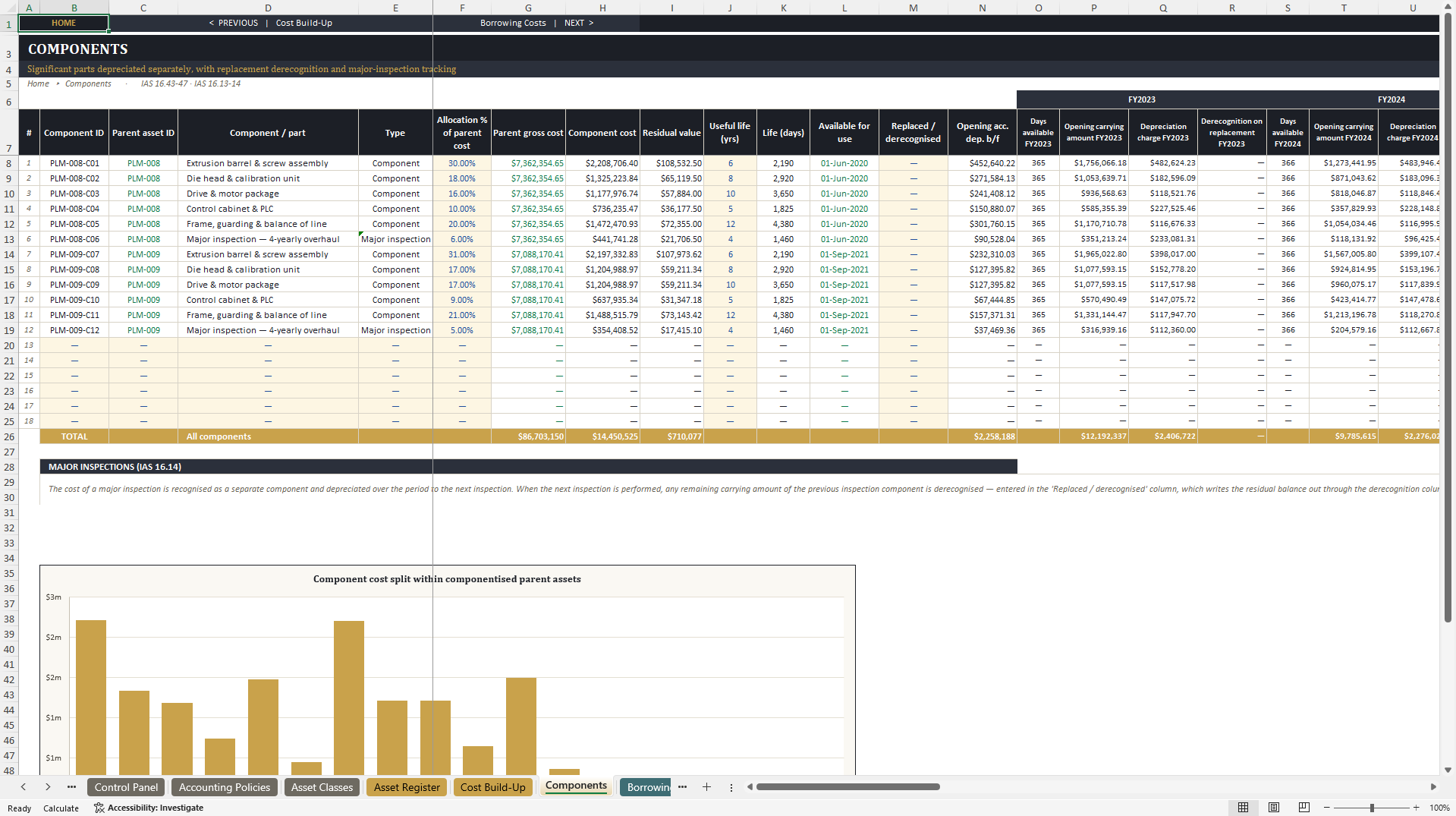
The Components schedule supports separate depreciation of significant parts and major inspections. It tracks component allocation, cost, residual value, useful life, available-for-use date, annual depreciation, replacement, derecognition, carrying amount, and reconciliation to the parent asset.
When a replacement component is recognized, the carrying amount of the replaced part can be derecognized so that old and new components are not carried simultaneously.
📅 TEN-YEAR DEPRECIATION ENGINE
The daily pro-rata engine supports four depreciation approaches:
• Straight-line depreciation • Diminishing-balance depreciation • Units-of-production depreciation • Approval-gated custom consumption patterns
The engine also handles non-depreciable land and construction work in progress, separate component depreciation, residual-value floors, monthly reporting-year charges, revaluation and impairment movements, disposal dates, and held-for-sale classification.
Depreciation is calculated from the opening carrying amount of each period, avoiding circular references. It does not begin before the asset is available for use, continues while an available asset is idle, and stops automatically on disposal or IFRS 5 classification.
Custom patterns require an identified approver, approval date, and written justification. A live control checks that an approved pattern does not consume more than the total depreciable amount.
⛏️ UNITS-OF-PRODUCTION SCHEDULE
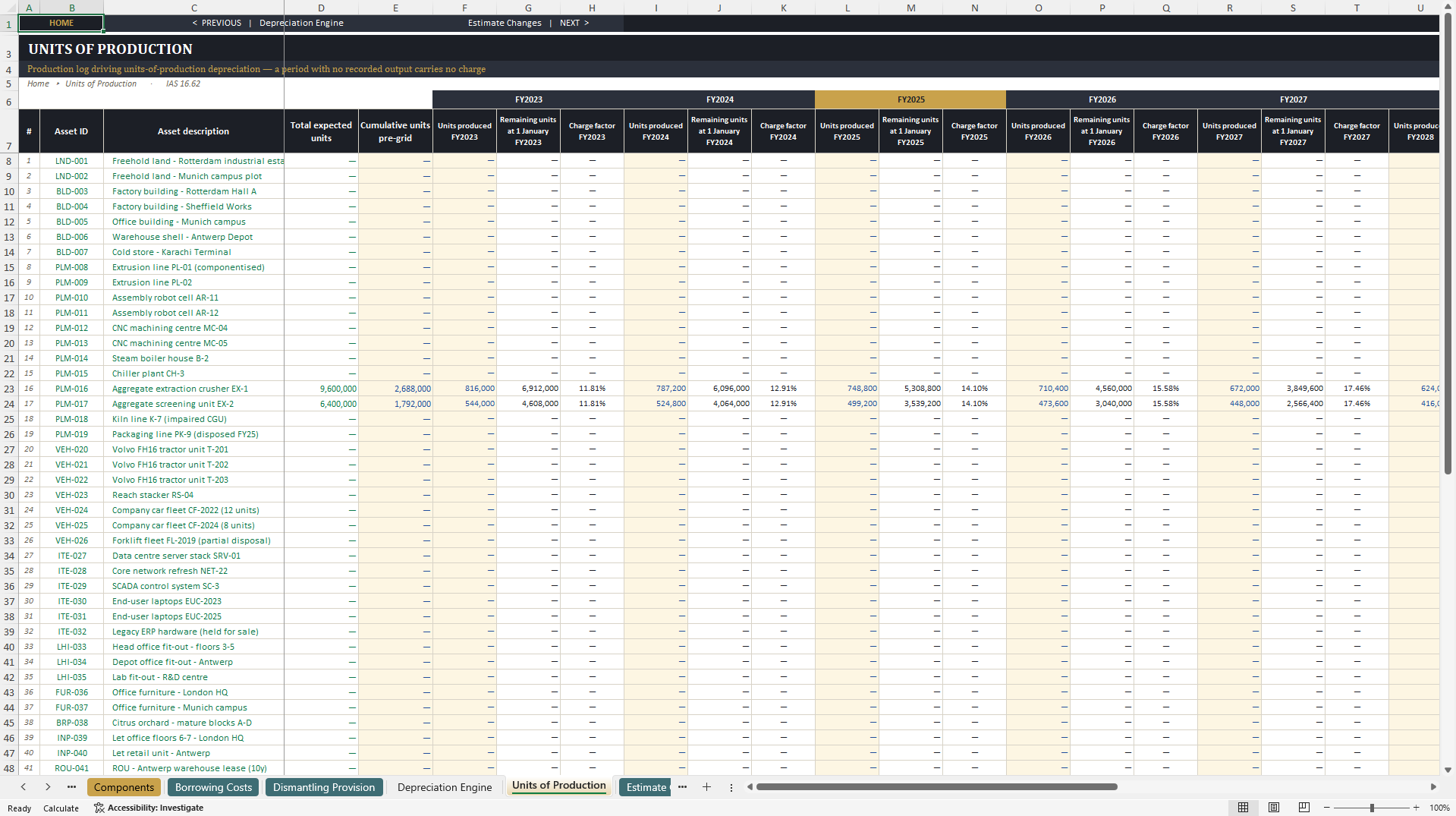
The dedicated production schedule tracks total expected units, cumulative production before the model grid, units produced in each financial year, remaining units at the beginning of each year, annual charge factors, and reconciliation to the central engine.
This allows production-driven assets to be depreciated using operational consumption rather than elapsed time.
💳 IAS 23 BORROWING COSTS
The Borrowing Costs schedule identifies qualifying assets and calculates qualifying expenditure, capitalization start and cessation dates, active construction periods, weighted-average expenditure, capitalization rates, borrowing costs capitalized, borrowing costs expensed, and asset-level status.
Capitalization ends when the asset is ready for its intended use, while non-qualifying borrowing costs remain expensed.
🏭 DISMANTLING AND RESTORATION PROVISIONS
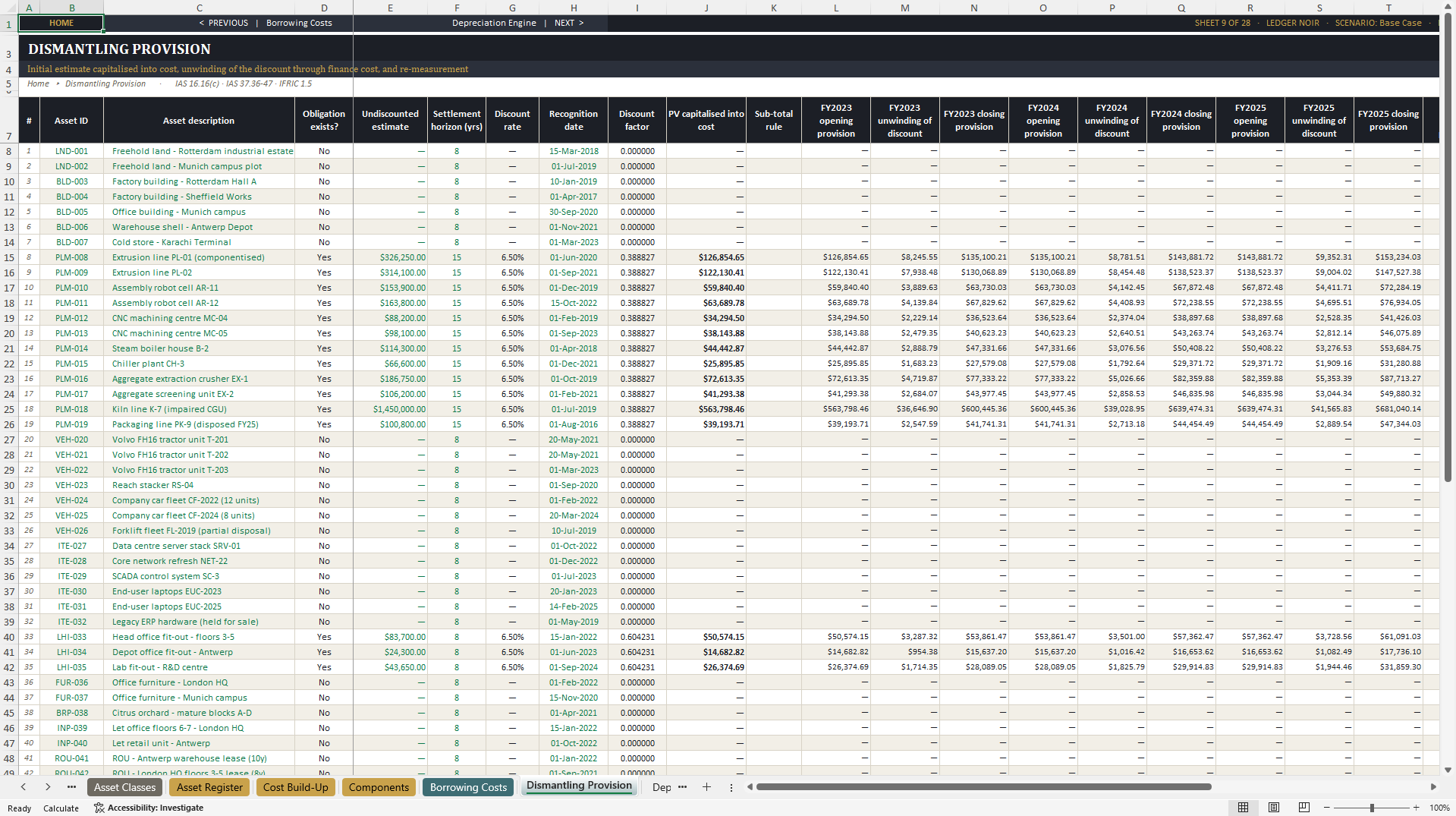
The Dismantling Provision module calculates the present value of eligible decommissioning or restoration obligations and capitalizes the corresponding initial amount into asset cost.
It tracks the obligation estimate, settlement horizon, scenario-linked discount rate, recognition date, present value, annual opening and closing provision, discount unwinding through finance cost, and IFRIC 1 remeasurement support.
🔄 IAS 8 ESTIMATE CHANGES
The Estimate Changes sheet records revisions to useful life, residual value, and depreciation method. It compares the previous and revised charges, quantifies the prospective impact, records the approver and supporting rationale, and flags overdue or undocumented reviews.
Estimate changes are applied prospectively; the model does not automatically restate prior-period depreciation.
📈 REVALUATION MODEL
The Revaluation Model supports class-wide fair-value accounting and calculates:
• Gross and accumulated-depreciation restatement • Revaluation surplus in other comprehensive income • Reversals of prior deficits • Revaluation deficits • Use of existing surplus • Deferred tax recognized in OCI • Historical-cost carrying amount • Excess-depreciation transfer to retained earnings • Class-completeness control
The class-completeness check helps identify selective revaluation within a class.
🧪 IAS 36 IMPAIRMENT
The impairment module supports individual assets and cash-generating units. It compares value in use with fair value less costs of disposal, determines recoverable amount, calculates impairment losses and reversals, applies the depreciated-historical-cost ceiling, and presents the net profit-or-loss effect.
The model organizes and calculates results from user-provided inputs. It does not replace a complete value-in-use forecast, independent valuation, or supporting valuation evidence.
🔁 TRANSFERS, DISPOSALS, AND DERECOGNITION
The disposal schedule supports full and partial derecognition, gross cost removed, accumulated depreciation removed, carrying amount derecognized, proceeds, disposal costs, gain or loss, revaluation-surplus transfer, and insurance recovery.
Insurance compensation remains separate from disposal proceeds, and revaluation-surplus transfers remain within equity.
🏷️ IFRS 5 HELD FOR SALE
The Held for Sale module includes a six-condition classification checklist, classification date, carrying amount, fair value, costs to sell, fair value less costs to sell, lower-of measurement, write-down, PPE reclassification, reclassification-back support, and automatic depreciation cessation.
🏢 IFRS 16 ROU ASSETS
The ROU Assets schedule tracks lease commencement, lease term, useful life of the underlying asset, ownership-transfer or purchase-option assessment, depreciation period, initial ROU cost, accumulated amortization, carrying amount, current-year charge, modification adjustment, and impairment.
The schedule covers ROU-asset depreciation. It is not a complete lease-liability amortization, lease-payment, reassessment, or contract-management system.
🧮 TAX DEPRECIATION
The tax schedule runs independently from book depreciation using user-defined pools, rates, first-allowance dates, opening and closing tax written-down values, annual allowances, balancing allowances or charges, and temporary differences.
Tax rules are jurisdiction-specific. All illustrative pools, rates, and assumptions must be replaced and validated for the applicable jurisdiction.
💰 IAS 12 DEFERRED TAX
The Deferred Tax sheet compares each asset's book carrying amount with its tax base and calculates taxable and deductible temporary differences, deferred-tax liabilities, deferred-tax assets subject to recoverability, comparative balances, movements through profit or loss, revaluation-related movements through OCI, and the closing net deferred-tax position.
🧾 AUTO-GENERATED JOURNAL ENTRIES
The workbook generates balanced double entry for:
• Acquisition and capitalized borrowing costs • Initial dismantling provisions • Transfers from CWIP • Annual depreciation • Inventory absorption • Component replacement • Impairment losses and reversals • Revaluation increases and decreases • Deferred tax on revaluation • Disposals • Insurance recovery • Held-for-sale movements • Provision unwinding • Deferred-tax movements
Each line includes the journal identifier, date, transaction type, GL account, account name, cost centre, asset or class reference, debit or credit, amount, and narrative. A per-journal control verifies that debits equal credits.
📑 PPE ROLL-FORWARD
The PPE Roll-Forward reconciles opening and closing gross carrying amount, accumulated depreciation, accumulated impairment, and net carrying amount by asset class for both the current and comparative reporting periods.
📋 IFRS DISCLOSURE NOTE
The disclosure sheet presents movements by class, measurement bases, depreciation methods, useful lives, pledged assets, capital commitments, compensation, fully depreciated assets still in use, revalued amounts, historical-cost comparisons, impairment, ROU assets, held-for-sale assets, capitalized borrowing costs, and dismantling obligations.
The disclosure note is linked to the PPE Roll-Forward, which is reconciled to the central engine, reducing the risk that disclosure figures drift from the accounting schedules.
🏬 COST-CENTRE AND FUNCTIONAL REPORTING
Management reports analyze carrying amount and depreciation by entity, department, cost centre, function, and asset class. The model distinguishes production, selling and distribution, administration, and research and development.
It also identifies the portion of production-asset depreciation absorbed into inventory as a conversion cost and reflects the corresponding reclassification in the journal-entry layer.
📊 DASHBOARD AND CHARTS
The executive dashboard summarizes gross PPE, carrying amount, current-year depreciation, additions, disposals, net impairment, active scenario assumptions, movement drivers, and audit status.
The workbook contains 36 charts, while the dedicated Charts Gallery brings the principal analytical visuals together in one presentation layer.
✅ 28 AUTOMATED CONTROLS
The Audit and Control Centre tests asset identifiers, dates, useful lives, residual values, negative amounts, depreciation timing, land and CWIP treatment, fully depreciated assets, components, custom-pattern approval, current and comparative roll-forwards, journal balancing, class-wide revaluation, estimate reviews, tax reconciliation, cost build-up, register-to-engine agreement, opening-balance continuity, formula errors, table blanks, and chart labels.
The supplied demonstration case reports all 28 controls passing with zero exceptions.
🎯 BEST SUITED FOR
• Financial controllers • Fixed-asset accountants • Group-reporting teams • IFRS reporting professionals • Audit and accounting-advisory teams • Manufacturing businesses • Construction and infrastructure groups • Energy, utility, mining, transport, and logistics companies • Asset-intensive service organizations • Finance transformation projects • IFRS training
📦 DELIVERY
• One fully editable Microsoft Excel workbook • Approximate file size of 0.81 MB • 28 worksheets • Ten-year engine • More than 24,000 formulas • 36 charts • 396 defined names • 28 automated checks • No macros • No external links • No data connections
Got a question about the product? Email us at support@flevy.com or ask the author directly by using the "Ask the Author a Question" form. If you cannot view the preview above this document description, go here to view the large preview instead.
Source: Best Practices in Management Accounting Excel: IFRS Fixed Asset and Depreciation Model Excel (XLSX) Spreadsheet, PDMM Financial Models
ABOUT THE AUTHOR

PDMM Financial Models develops professional, decision-ready Excel models for business owners, entrepreneurs, investors, consultants, analysts, and finance teams. Our objective is to transform complex business assumptions into clear, structured analysis that supports better planning and investment decisions.
Our models cover business planning, forecasting, budgeting, feasibility analysis,
... [read more]
Ask the Author a Question
You must be logged in to contact the author.




























