
 Click main image to view in full screen. Unlock all 17 preview images:
Coworking & Flexible Office Financial Model – Excel XLSX
Excel (XLSX) + supplemental PDF


BENEFITS OF THIS DOWNLOADABLE EXCEL DOCUMENT
- Connects coworking space mix, workstation capacity, member acquisition, churn, pricing, and ancillary revenue to a 60-month integrated financial forecast.
- Compares Fixed Lease, Management Agreement, and Revenue Share economics for the operator and landlord, including break-even occupancy and operator capital intensity.
- Tests second-site expansion through occupancy, EBITDA-margin, liquidity, scenario, and sensitivity analysis before capital is committed.
REAL ESTATE EXCEL DESCRIPTION
Coworking & Flexible Office Financial Model is a five-year Excel operating and financial planning tool for entrepreneurs, independent coworking operators, flexible-office businesses, landlords, franchisees, advisers, lenders, and investors evaluating site economics and expansion.
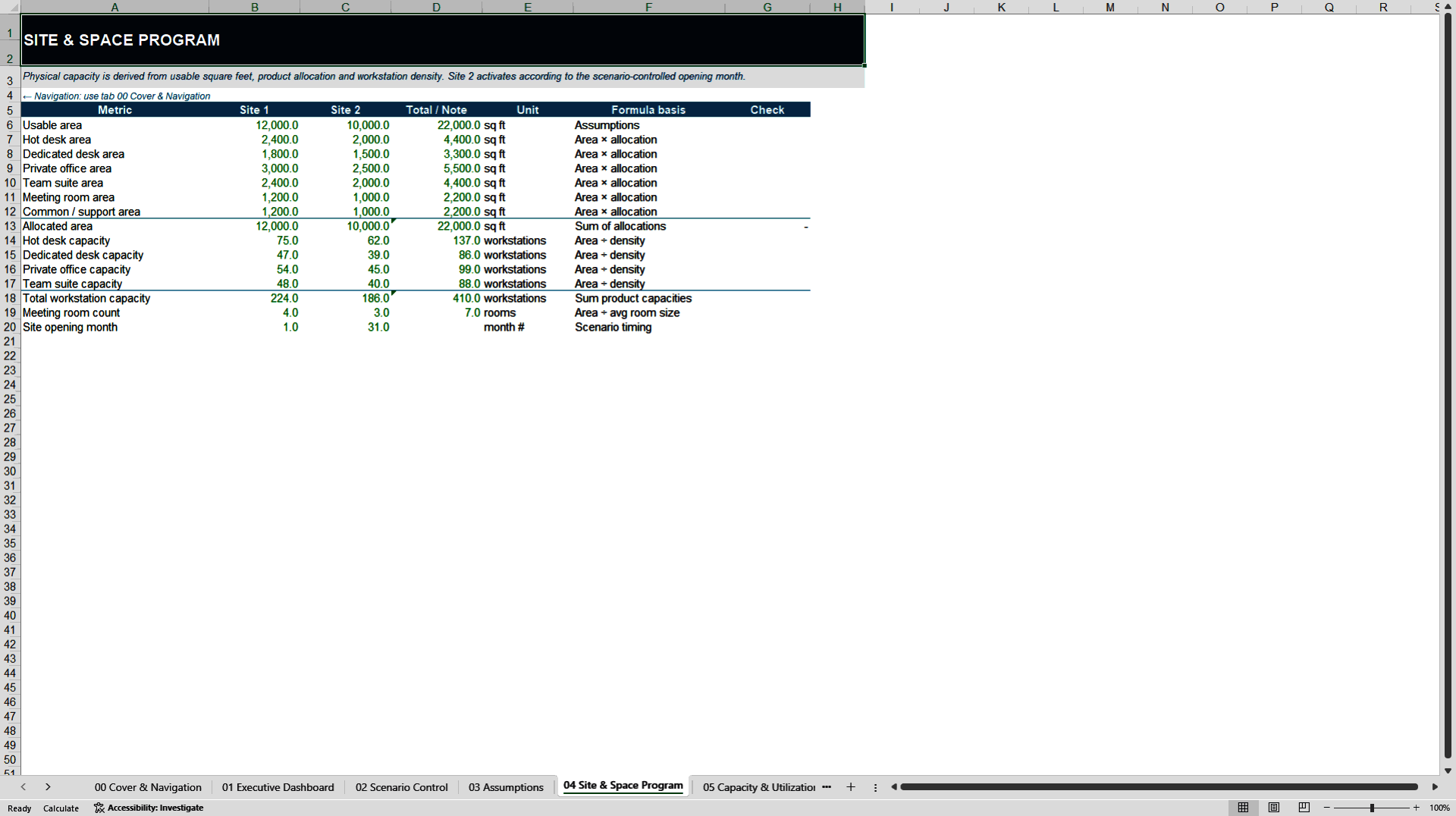
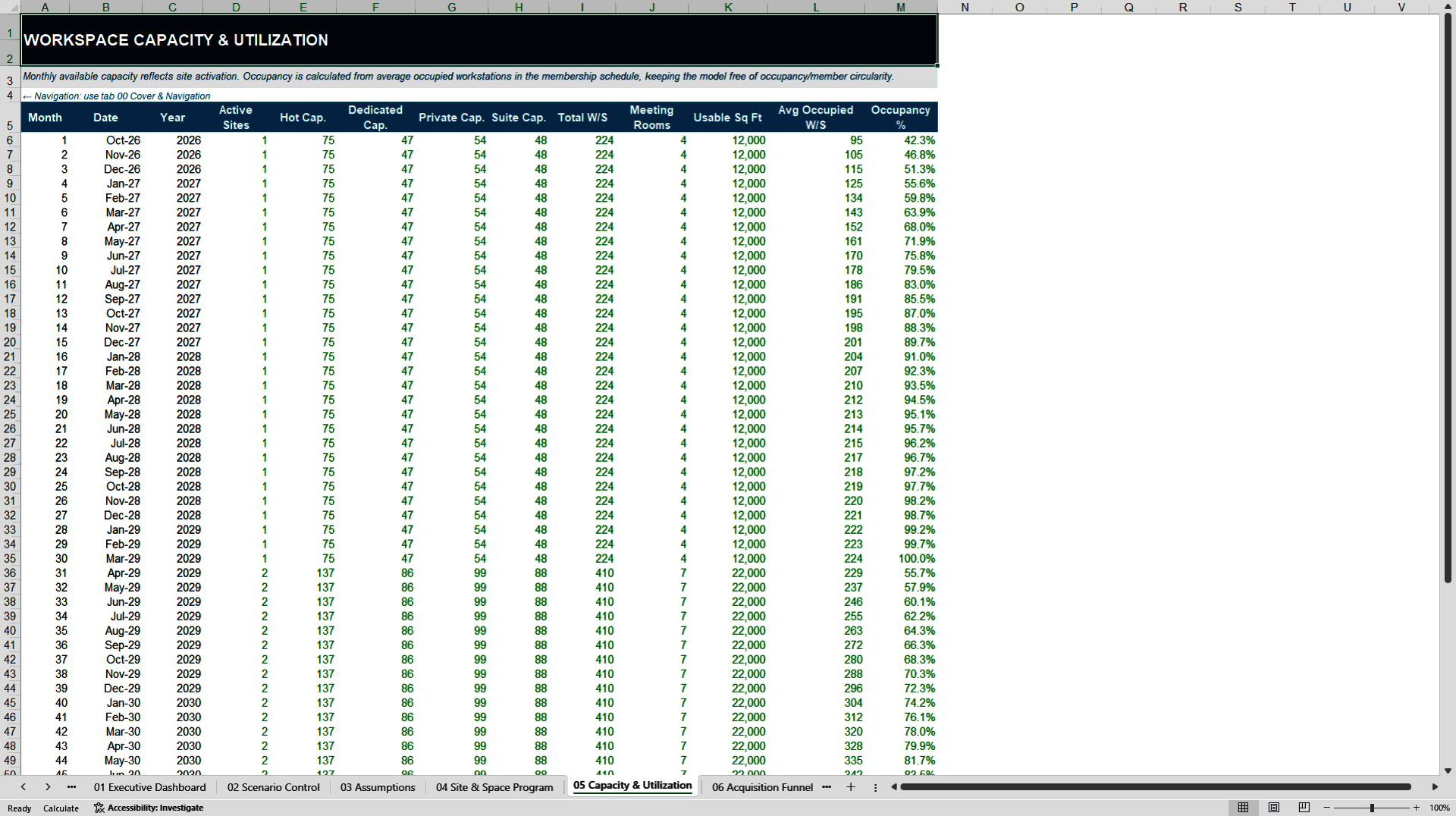
The model goes beyond a generic revenue forecast by linking the physical layout of a workspace to membership behavior and financial performance. Usable square feet are allocated across hot desks, dedicated desks, private offices, team suites, meeting rooms, and common/support areas. Workstation density then determines physical capacity, which feeds monthly occupancy, member growth, product-level churn, pricing, and recurring revenue.
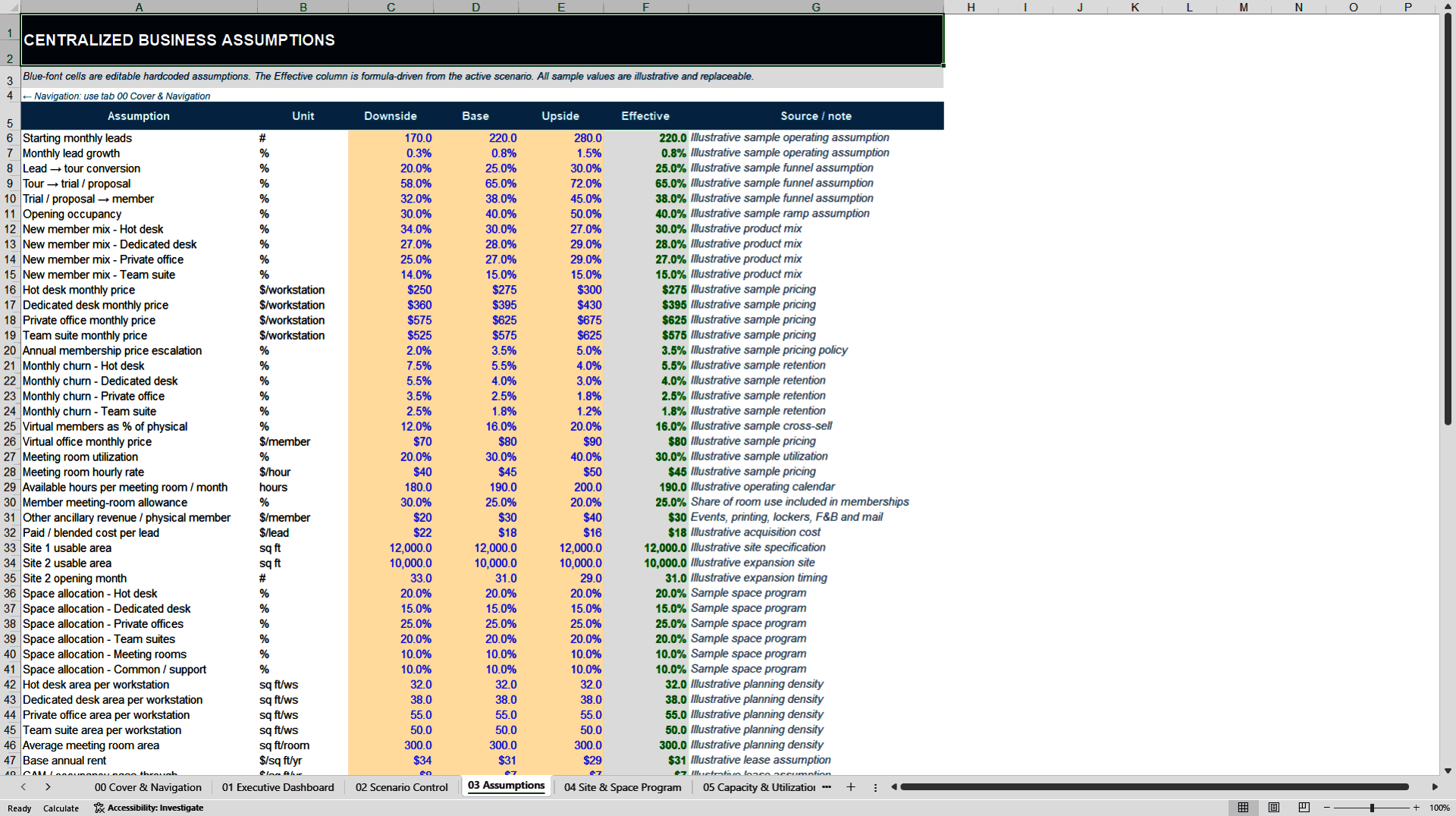
The workbook includes a 60-month operating forecast and five annual financial statement summaries. Users can replace the centralized sample assumptions for lead generation, conversion rates, member mix, churn, membership prices, pricing escalation, virtual-office cross-sell, meeting-room utilization, ancillary revenue, marketing cost, area, Site 2 timing, rent, CAM, fit-out costs, landlord contributions, staffing, facility expenses, inflation, debt, working capital, tax, and expansion thresholds.
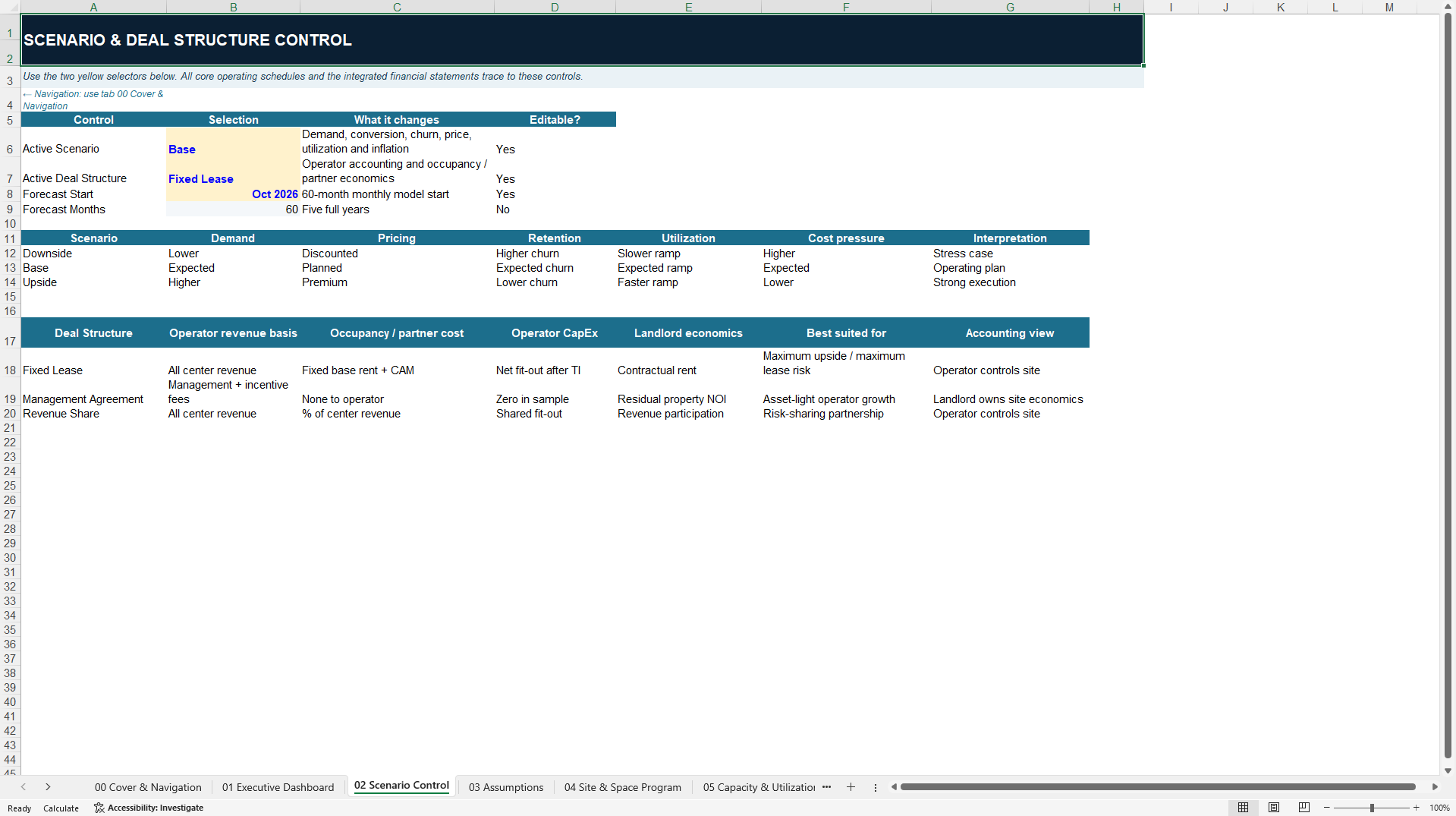
A key feature is the comparison of three coworking real-estate structures. Fixed Lease models the operator retaining center revenue while bearing rent, CAM, and fit-out economics. Management Agreement models management and incentive fee revenue with an asset-light sample operator CapEx profile. Revenue Share models center revenue retained by the operator while sharing revenue and fit-out economics with the landlord. The dedicated comparison dashboard shows Year 5 operator EBITDA, five-year cumulative operator EBITDA, landlord NOI or rent, operator CapEx, break-even occupancy, and EBITDA-to-CapEx economics for the three structures.
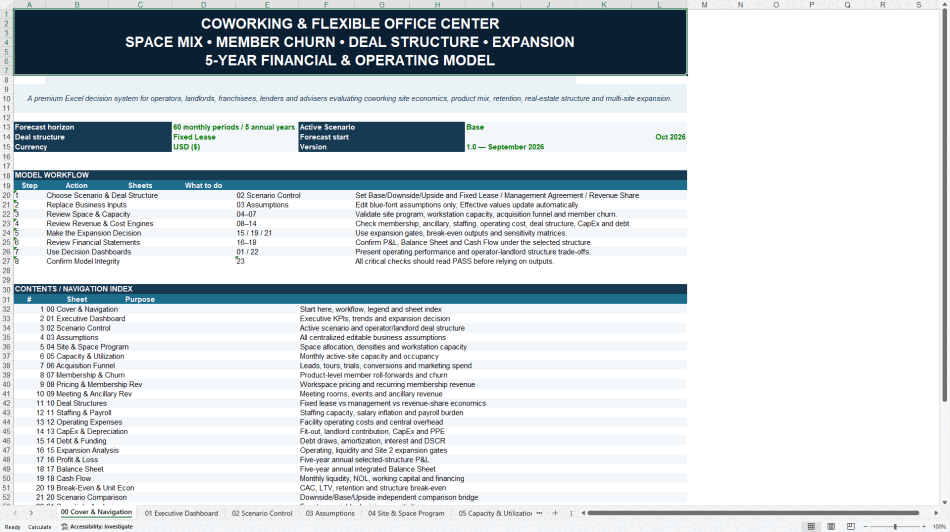
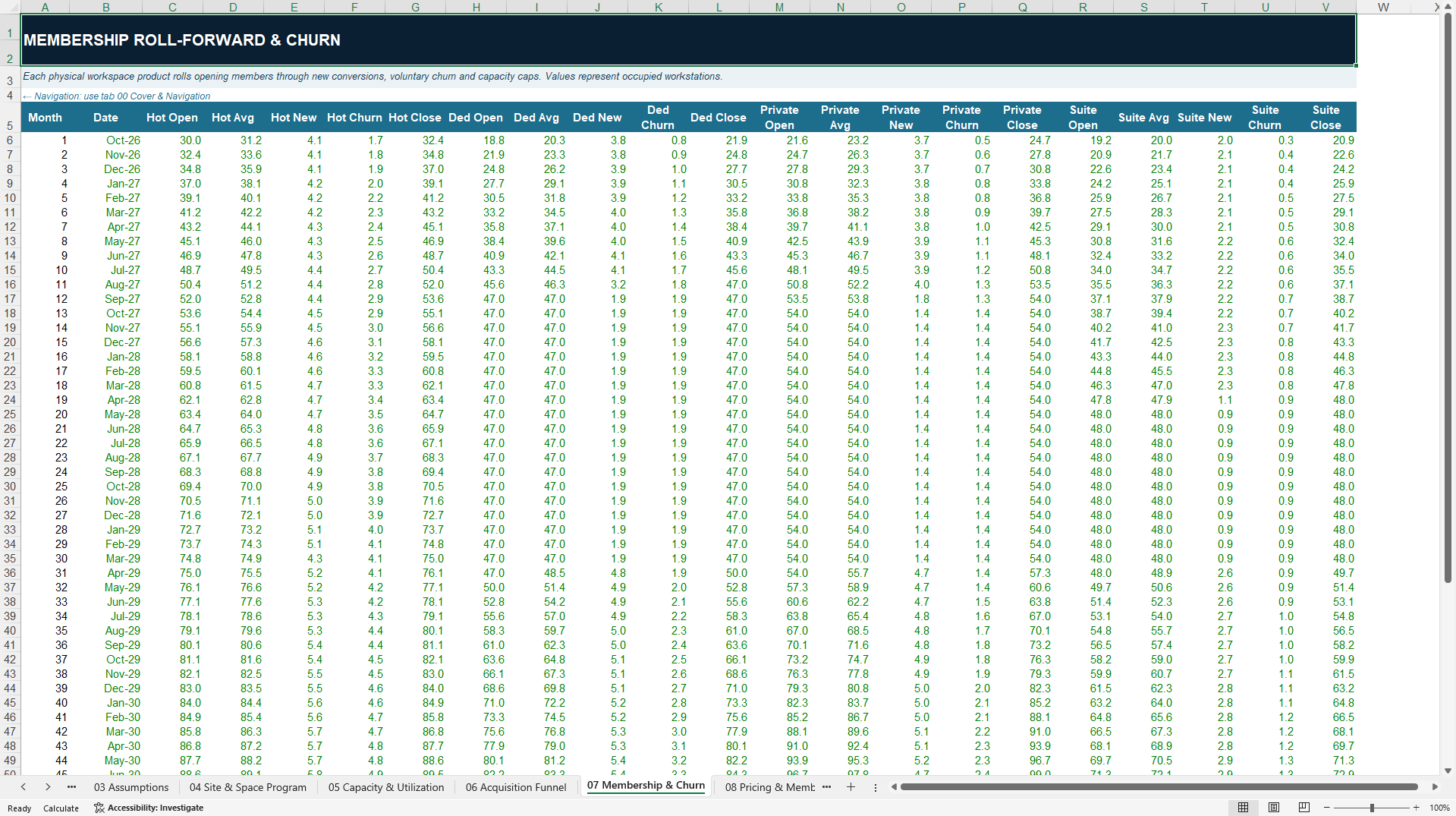
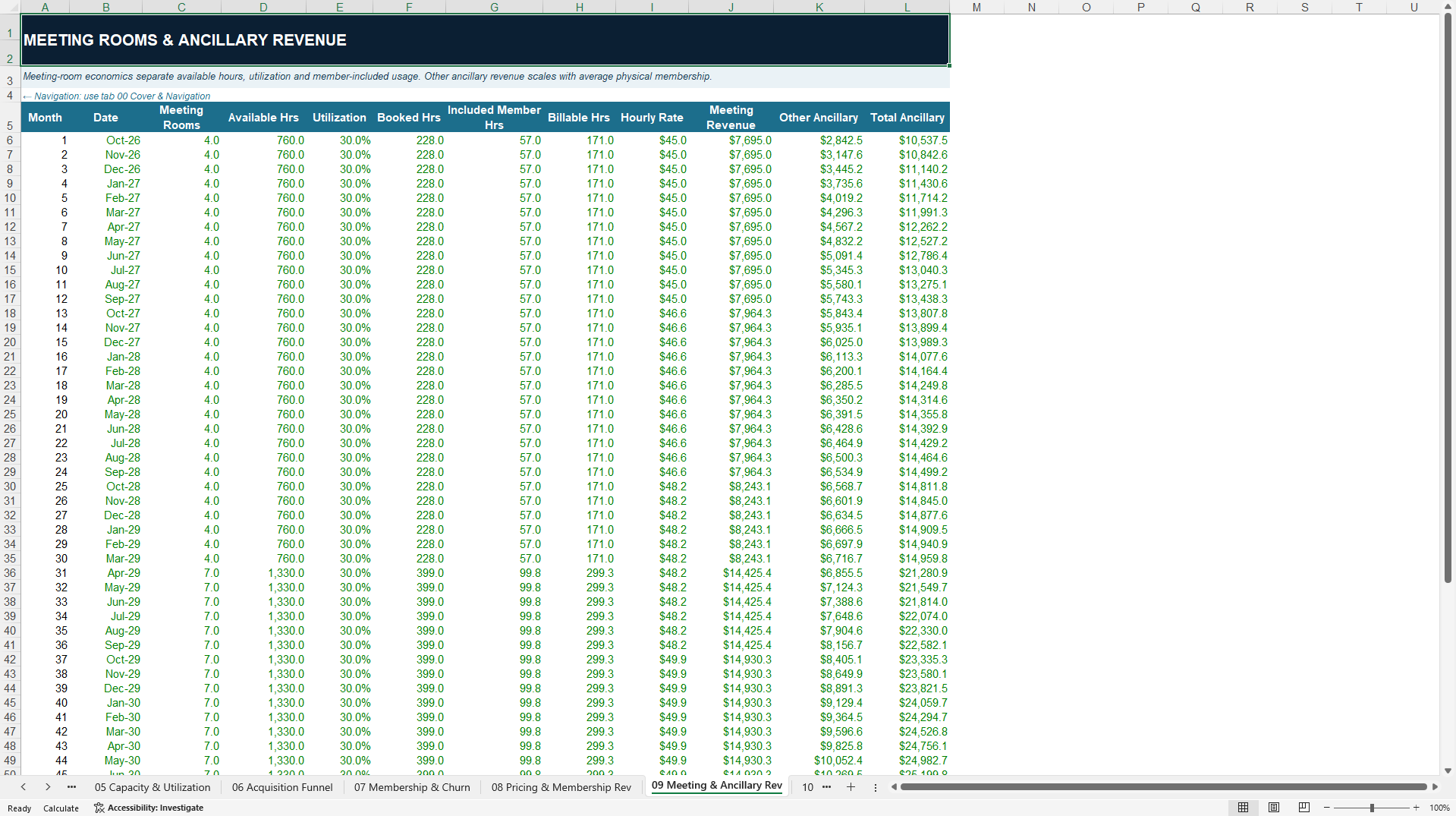
Operating schedules include site and space planning, capacity and utilization, acquisition funnel, product-level membership and churn, membership pricing and revenue, meeting-room and ancillary revenue, staffing and payroll, operating expenses, CapEx and depreciation, and debt and funding. These schedules feed an integrated Profit & Loss, Balance Sheet, and monthly Cash Flow model.
The model also contains an expansion decision engine for a second site. Four gates test six-month occupancy, six-month EBITDA margin, cash before expansion, and pro-forma cash after Site 2 funding. Stabilized Site 2 economics, incremental operator EBITDA, operator CapEx, and simple payback are shown alongside the proceed/hold decision.
Three scenarios are included: Downside, Base, and Upside. The scenarios change demand, pricing, retention, utilization, and cost pressure. Four two-variable sensitivities test Year 5 EBITDA against occupancy and pricing, churn and acquisition, rent and occupancy, plus Year 5 ending cash against Site 2 fit-out and opening utilization.
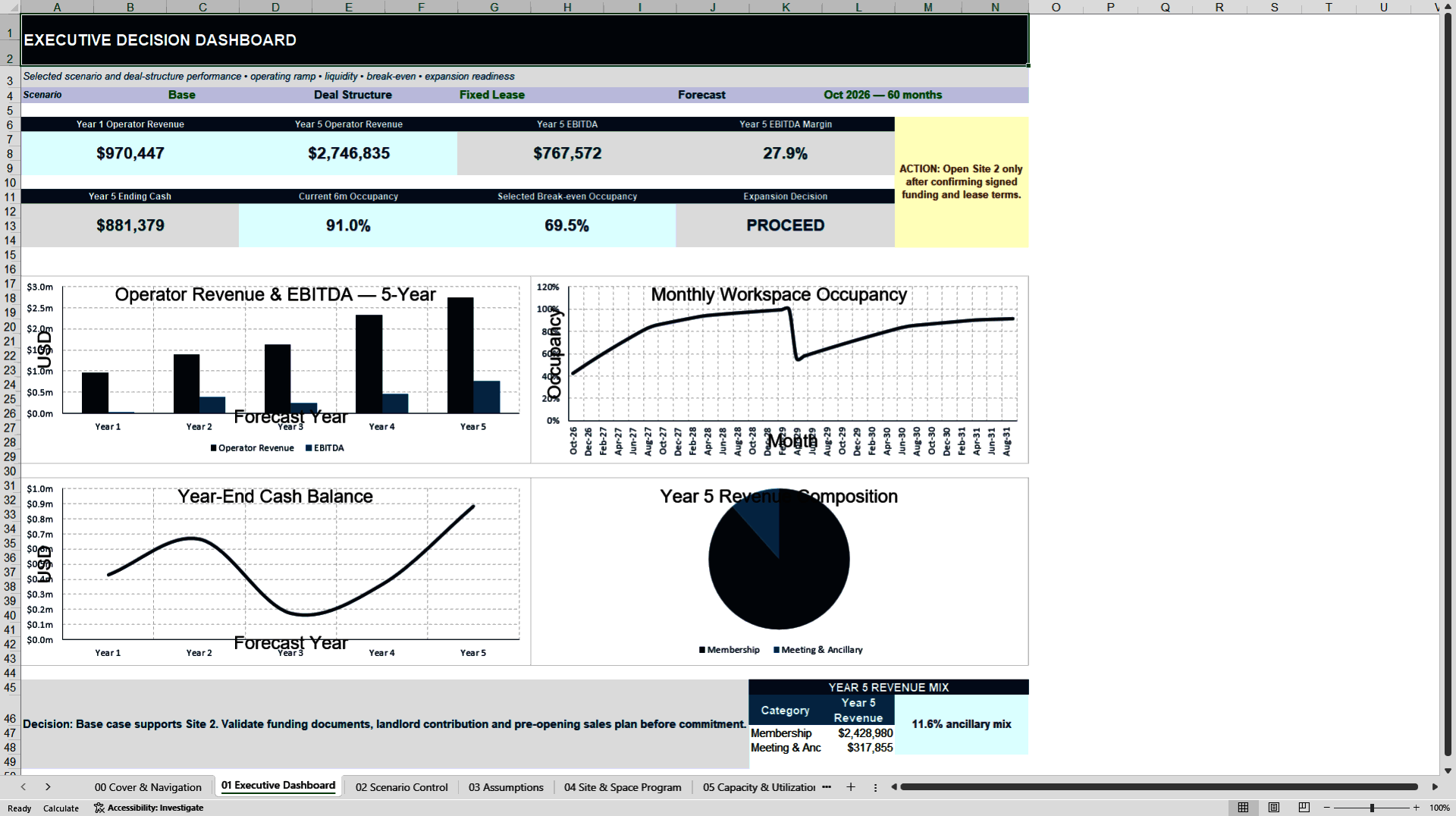
The Executive Dashboard presents revenue, EBITDA, EBITDA margin, ending cash, recent occupancy, selected break-even occupancy, expansion status, revenue composition, annual EBITDA, monthly workspace occupancy, and cash-balance trends. A separate Break-Even and Unit Economics sheet calculates weighted membership pricing, other revenue per occupied workstation, all-in revenue per occupied workstation, weighted churn, annualized gross retention, average CAC, indicative LTV, LTV/CAC, and break-even occupancy by deal structure.
The workbook contains 25 worksheets with a premium cover and navigation page, centralized controls, editable assumptions, operating schedules, financial statements, dashboards, sensitivities, expansion analysis, integrity checks, and a methodology guide. Independent audit controls reconcile space allocation, member mix, site area, occupancy bounds, member balances, debt, cash, Balance Sheet, EBITDA, PPE, tax losses, liquidity, selectors, and expansion logic.
This model is particularly useful for preparing a coworking business plan, budgeting a new center, testing membership and pricing strategies, evaluating space mix, understanding churn and customer-acquisition economics, comparing landlord/operator structures, preparing funding discussions, forecasting liquidity, and deciding whether a second location is financially supportable.
All model inputs are editable in Excel, and the included sample data demonstrate the complete calculation flow immediately. The package also includes a full-workbook PDF preview and curated marketplace screenshots so buyers can review the model structure before purchase.
Got a question about the product? Email us at support@flevy.com or ask the author directly by using the "Ask the Author a Question" form. If you cannot view the preview above this document description, go here to view the large preview instead.
Source: Best Practices in Real Estate, Financial Modeling Excel: Coworking & Flexible Office Financial Model Excel (XLSX) Spreadsheet, PDMM Financial Models
ABOUT THE AUTHOR

PDMM Financial Models develops professional, decision-ready Excel models for business owners, entrepreneurs, investors, consultants, analysts, and finance teams. Our objective is to transform complex business assumptions into clear, structured analysis that supports better planning and investment decisions.
Our models cover business planning, forecasting, budgeting, feasibility analysis,
... [read more]
Ask the Author a Question
You must be logged in to contact the author.




























