
This is a one-day workshop for those who already are good writers. Our time will be devoted to writing letters of recommendation, of persuasion, of refusal, or of action, that reflect current word usage and up-to-date formats. You can also learn some basics about writing business cases, proposals, and reports.
Participants must complete Gafford Consulting Business Writing That Works course before taking this workshop.
This one-day workshop will help you teach participants how to:
• Make their writing clear, complete, concise, and correct.
• Improve sentence construction and paragraph development.
• Deal with specific business requests.
• Create effective business cases, proposals, and reports.
• Thoroughly document sources that they use in their writing.
Effective Writing is writing which has a logical flow of ideas and is cohesive. This means it holds together well because there are links between sentences and paragraphs. Writing which is cohesive works as a unified whole and is easy to follow because it uses language effectively to maintain a focus and to keep the reader 'on track'.
Gafford Consulting is an organization that inspires to improve every aspect of an organizations and individuals ability to navigate any and all changes. Being able to effective communicate those changes via compelling writing is extremely effective in helping others navigate change.
Got a question about the product? Email us at support@flevy.com or ask the author directly by using the "Ask the Author a Question" form. If you cannot view the preview above this document description, go here to view the large preview instead.
Executive Summary
The Advanced Writing Skills PPT is an essential resource for professionals seeking to enhance their business writing capabilities. This comprehensive workshop guide equips participants with the tools to create clear, concise, and effective business documents, including letters, proposals, and reports. By mastering the principles of good writing, attendees will be able to communicate more effectively, meet specific business requests, and thoroughly document their sources. This presentation serves as a structured roadmap for improving writing mechanics and techniques, ensuring that participants can produce high-quality business communications.
Who This Is For and When to Use
• Business professionals looking to enhance their writing skills
• Managers and team leaders responsible for creating reports and proposals
• Consultants tasked with drafting business cases and documentation
• Administrative staff involved in business communication
• Trainers and educators focusing on business writing skills
Best-fit moments to use this deck:
• During onboarding sessions for new employees
• As part of professional development workshops
• In team meetings focused on improving communication strategies
• When preparing for important presentations or reports
Learning Objectives
• Make your writing clear, complete, concise, and correct.
• Improve sentence construction and paragraph development.
• Deal with specific business requests effectively.
• Create impactful business cases, proposals, and reports.
• Thoroughly document sources used in writing.
• Utilize editing techniques to enhance written communication.
Table of Contents
• Course Overview (page 3)
• The C’s of Writing (page 5)
• Writing Mechanics (page 15)
• Dealing with Specific Requests (page 24)
• Preparing Business Documents (page 30)
• Editing Techniques (page 37)
Primary Topics Covered
• Course Overview - An introduction to the workshop’s goals, focusing on enhancing writing skills for business contexts.
• The C’s of Writing - A framework emphasizing clarity, conciseness, completeness, and correctness in writing.
• Writing Mechanics - Techniques for constructing effective sentences and paragraphs, including unity and coherence.
• Dealing with Specific Requests - Strategies for writing various types of letters, such as recommendations and refusals.
• Preparing Business Documents - Guidelines for creating business cases, proposals, and reports, including necessary components.
• Editing Techniques - Methods for reviewing and improving written documents to ensure clarity and effectiveness.
Deliverables, Templates, and Tools
• Business case template for structured proposals.
• Letter templates for various business scenarios (recommendations, refusals).
• Checklist for editing and reviewing documents.
• Guidelines for documenting sources in business writing.
• Framework for constructing effective paragraphs and sentences.
• Sample business reports for reference.
Slide Highlights
• Overview of the C’s of Writing, emphasizing clarity and simplicity.
• Examples of effective paragraph structures and sentence unity.
• Techniques for emphasizing key points in written communication.
• Guidelines for writing different types of letters tailored to specific requests.
• Best practices for preparing comprehensive business documents.
Potential Workshop Agenda
Introduction and Icebreaker (30 minutes)
• Overview of workshop objectives and participant introductions.
• Icebreaker activity to engage participants in writing discussions.
Session on The C’s of Writing (60 minutes)
• Discuss clarity, conciseness, completeness, and correctness.
• Group exercises focusing on improving writing style.
Session on Writing Mechanics (60 minutes)
• Explore sentence construction and paragraph development.
• Individual exercises to practice writing techniques.
Session on Preparing Business Documents (60 minutes)
• Discuss components of business cases and proposals.
• Group activity to draft a sample business document.
Customization Guidance
• Adapt templates to reflect your organization's branding and terminology.
• Modify examples to align with industry-specific requirements.
• Tailor the agenda based on participant skill levels and needs.
Secondary Topics Covered
• Importance of factual accuracy in business writing.
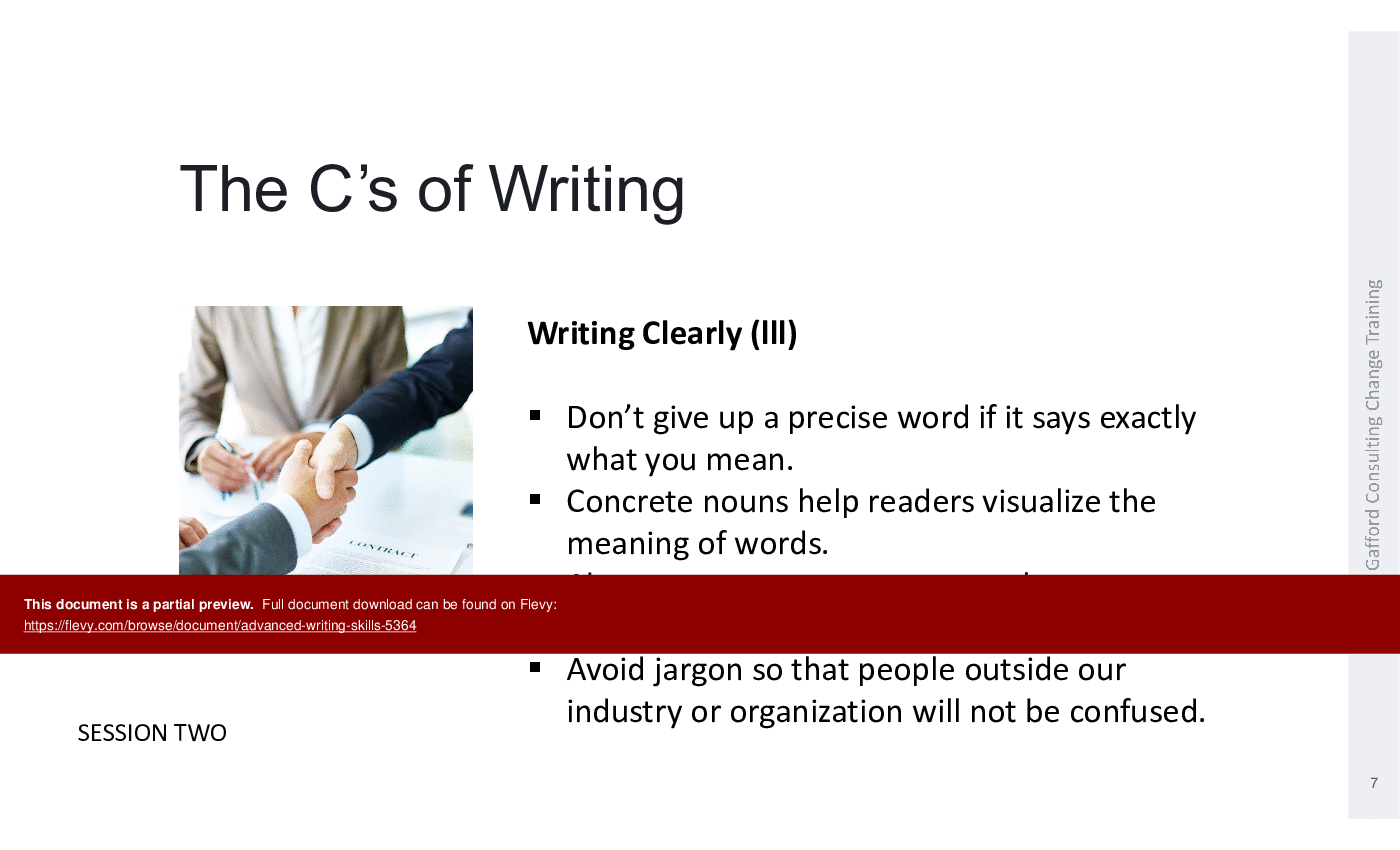
• Techniques for avoiding jargon and enhancing clarity.
• Strategies for effective editing and proofreading.
• The role of feedback in improving writing skills.
• Common pitfalls in business writing and how to avoid them.
Topic FAQ
Document FAQ
These are questions addressed within this presentation.
What are the key components of effective business writing?
Effective business writing should be clear, concise, complete, and correct, ensuring that the message is easily understood by the audience.
How can I improve my sentence structure?
Focus on using active voice, varying sentence lengths, and ensuring that each sentence conveys a single idea clearly.
What types of letters will I learn to write?
Participants will learn to write letters of recommendation, refusal, and persuasion, each tailored to specific business contexts.
How do I document sources in my writing?
Always list the sources used, refer back to the original material, and include excerpts as necessary to maintain credibility.
What is the importance of editing in business writing?
Editing is crucial for refining your message, correcting errors, and ensuring that the final document meets professional standards.
How can I make my writing more concise?
Eliminate redundant phrases, avoid unnecessary jargon, and use straightforward language to convey your message effectively.
What are the benefits of using templates for business documents?
Templates provide a structured approach to writing, ensuring that all necessary components are included and saving time during the drafting process.
How can I enhance the clarity of my writing?
Use plain language, avoid complex jargon, and ensure that your ideas are presented in a logical order to enhance understanding.
Glossary
• Clarity - The quality of being easily understood.
• Conciseness - The quality of expressing much in few words.
• Completeness - The state of containing all necessary information.
• Correctness - Adherence to factual accuracy and grammatical rules.
• Editing - The process of reviewing and revising written content.
• Paragraph Unity - The principle that a paragraph should focus on a single idea.
• Business Case - A document that justifies a proposed project or initiative.
• Recommendation Letter - A letter endorsing a person's qualifications or character.
• Proposal - A formal suggestion or plan presented for consideration.

• Documentation - The act of providing evidence or references for information used.
• Active Voice - A sentence structure where the subject performs the action.
• Jargon - Specialized language used by a particular group that may be confusing to outsiders.
• Factual Accuracy - The quality of being correct and true in information presented.
• Coherence - The quality of being logical and consistent in writing.
• Transitional Terms - Words or phrases that help connect ideas in writing.
• Emphasis - The importance placed on certain words or ideas in writing.
• Rhythm - The flow and pace of writing, contributing to its readability.
• Voice - The distinctive tone or style of the writer.
• Proposal Request (RFP) - A document soliciting proposals from potential vendors.
• Plagiarism - The act of using someone else's work or ideas without proper attribution.
• Style Guide - A set of standards for writing and formatting documents.
• Business Report - A structured document that presents information and analysis on a specific topic.
Source: Best Practices in Communications Strategy PowerPoint Slides: Advanced Writing Skills PowerPoint (PPT) Presentation Slide Deck, Gafford Consulting
|
Download our FREE Organization, Change, & Culture, Templates
Download our free compilation of 50+ slides and templates on Organizational Design, Change Management, and Corporate Culture. Methodologies include ADKAR, Burke-Litwin Change Model, McKinsey 7-S, Competing Values Framework, etc. |