 Click main image to view in full screen.
Small Business Month-End Close and Bookkeeping Kit – PDF
PDF document + Zip archive file (ZIP) 15 Pages


BENEFITS OF THIS DOWNLOADABLE PDF DOCUMENT
- Turns the close into a five-day sequence where every task names the evidence that closes it.
- Makes the bank, card, payroll and channel reconciliations prove themselves to zero before sign-off.
- Gives the accountant a complete pack in the order they ask for, with every exception written down.
SMALL BUSINESS PDF DESCRIPTION
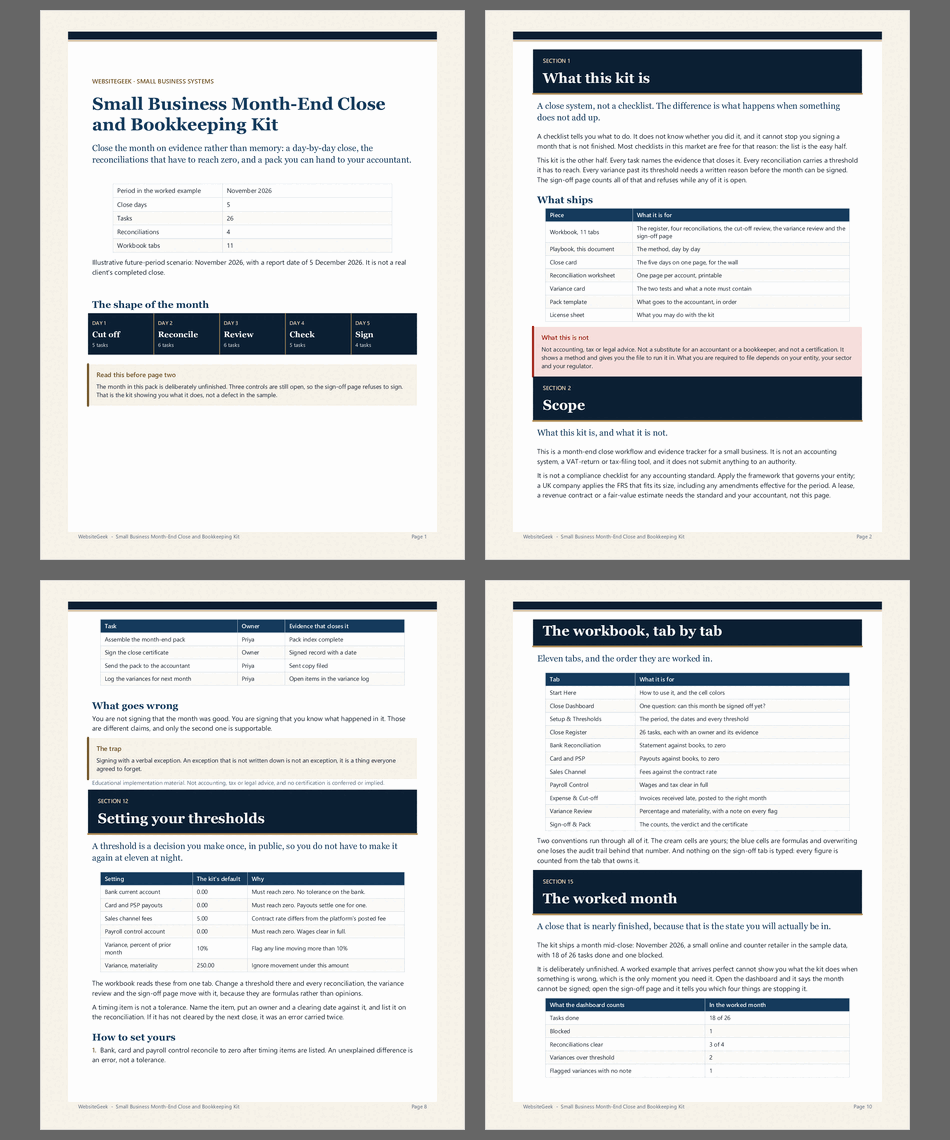
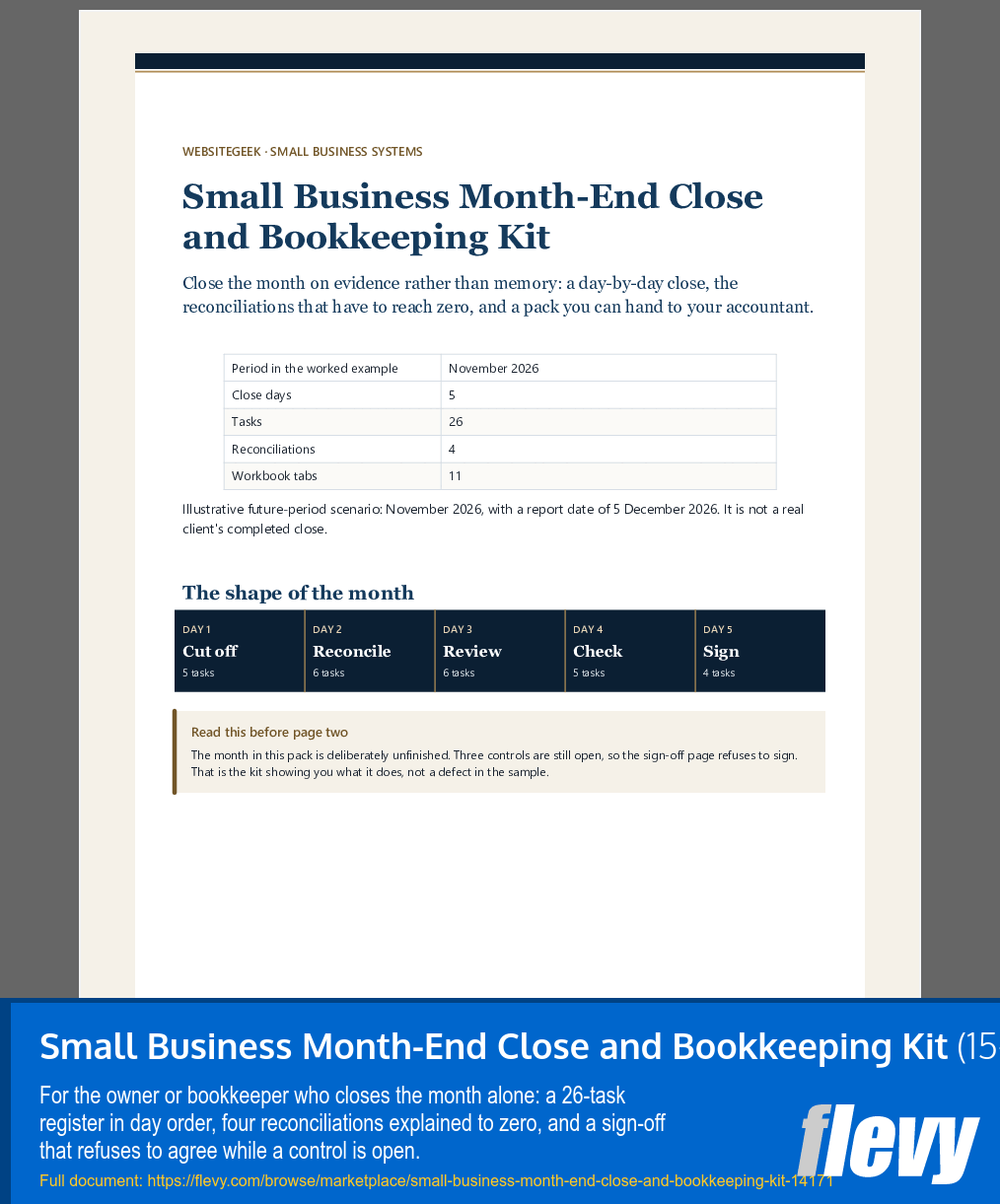
The month-end close is the part of bookkeeping that decides whether the numbers can be defended six months later. Most small businesses close on memory: the bank is forced to zero with a plug, a variance is explained out loud and then forgotten, and the accountant rebuilds the month from source documents. This kit replaces that with a sequence, a set of thresholds and a sign-off that refuses to say yes while a control is open.
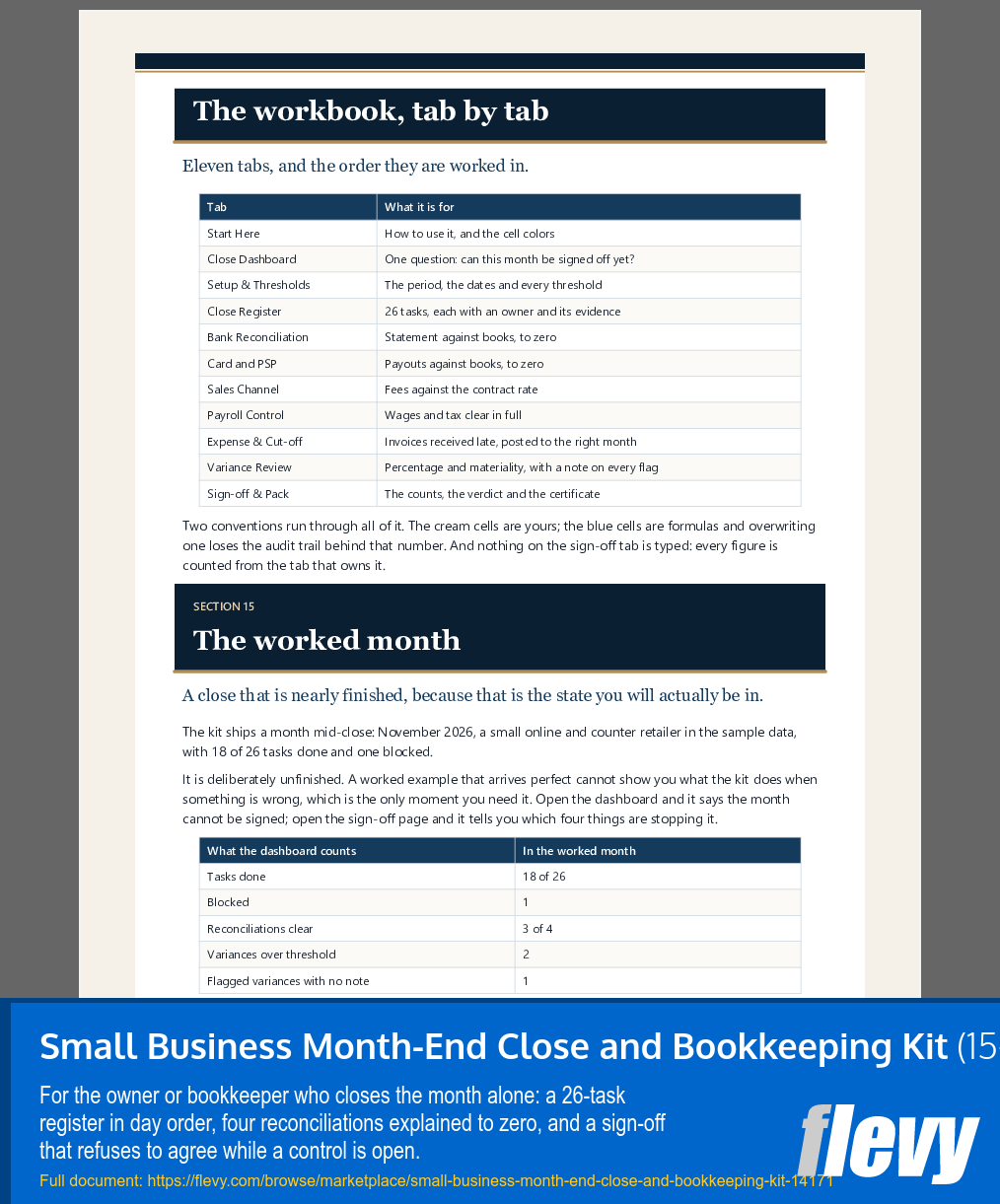
It is built around a worked month for Ridgeway Traders, a small retailer with six staff. The month is deliberately unfinished. Eighteen of the 26 tasks are done, one is blocked, one reconciliation line is over its tolerance, one variance has no note, and five cut-off items are still unposted. Open the workbook and the sign-off page reads Not yet – a control is still open. That is the product demonstrating how it behaves rather than describing it.
The 11-tab workbook carries a Start Here page, a dashboard with two native charts, a setup tab for the thresholds, the close register, four reconciliation tabs, an expense and cut-off review, a variance review and the sign-off and pack page. It holds 198 live formulas and no macros, so it opens in Excel and LibreOffice, and every tab prints landscape with the header row repeated.
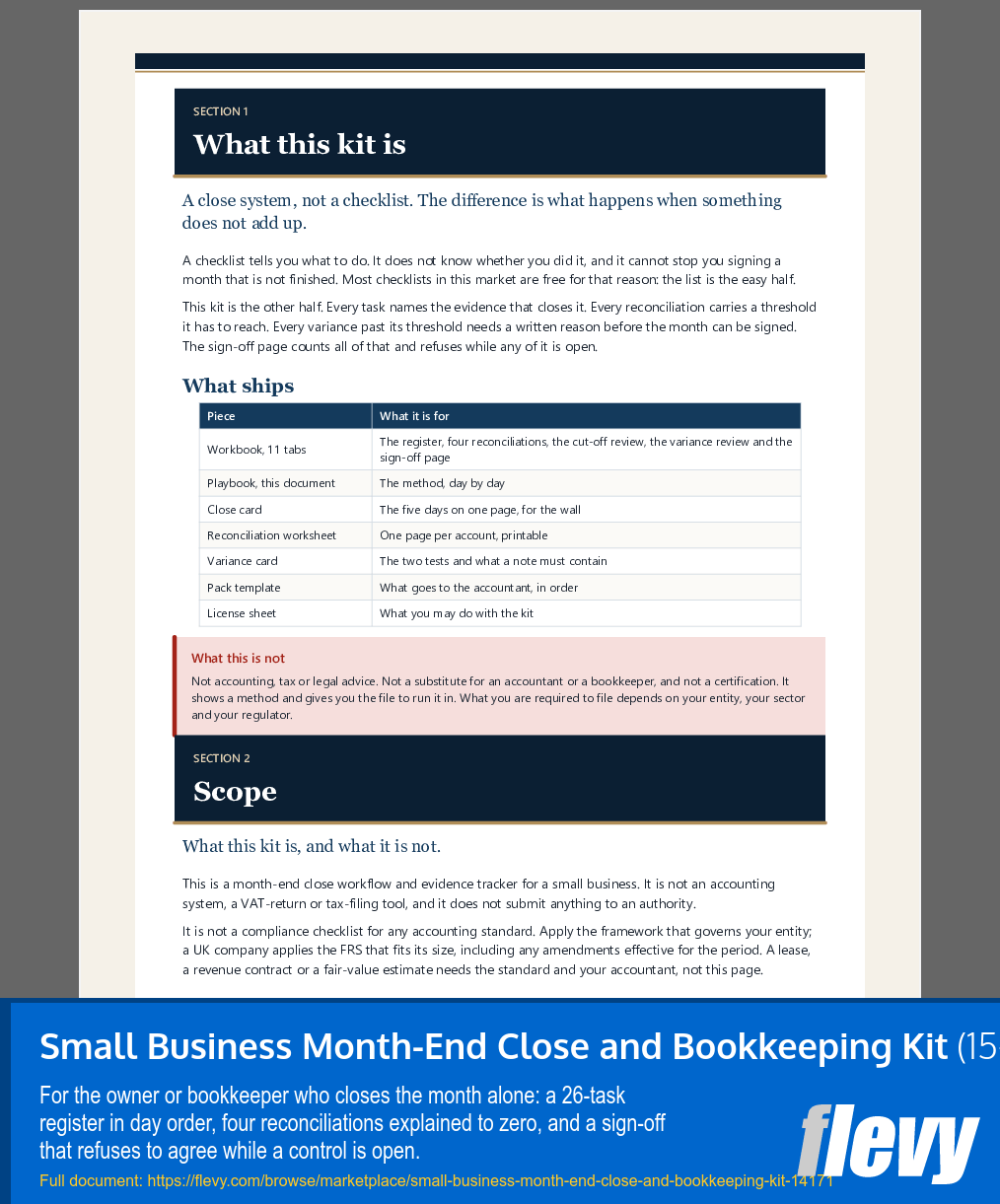
The six PDFs are the part you print and keep: a 15-page playbook, a one-page five-day close card, a reconciliation worksheet, a variance card, a ten-document pack template and the license sheet.
The Notion template mirrors the same system: seven databases for the tasks, the reconciliations, the variances, the sign-off, suppliers and cut-offs, the pack index and the standard procedures, with 17 saved views and three dashboards. Every task on every surface names the evidence that closes it, so a tick without a file is still an open item.
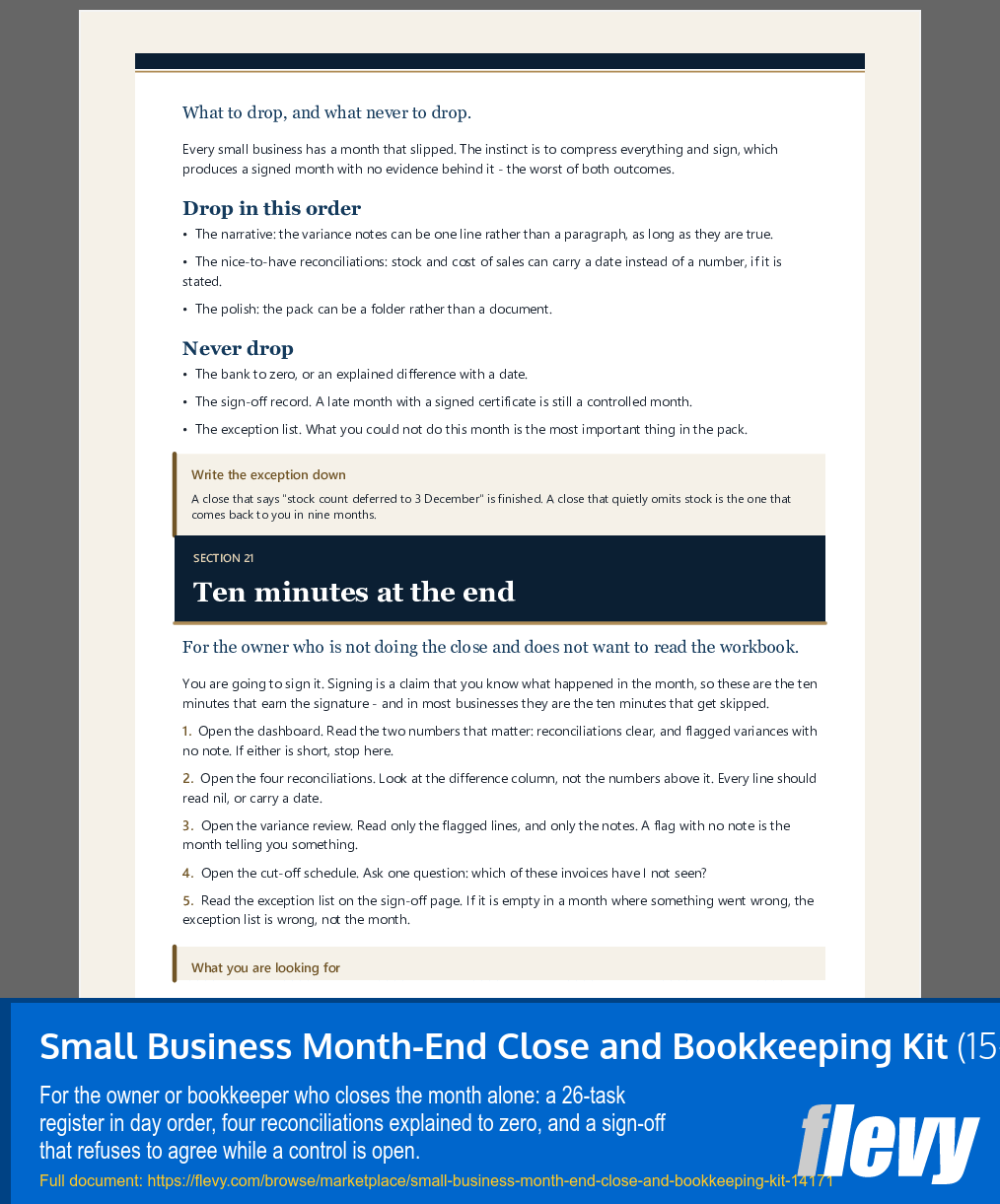
The five close days are cut off, reconcile, review, check and sign. Day one freezes the channels and collects the statements. Day two reconciles the bank, the card and payment provider, and the payroll control account, each to zero, and checks the sales tax control. Day three reviews the channel fees against the contract rate, the stock and cost of sales, and the accruals and prepayments. Day four runs the variance review, where any line moving more than ten percent and more than the materiality amount needs a written note. Day five assembles the pack and signs the certificate.
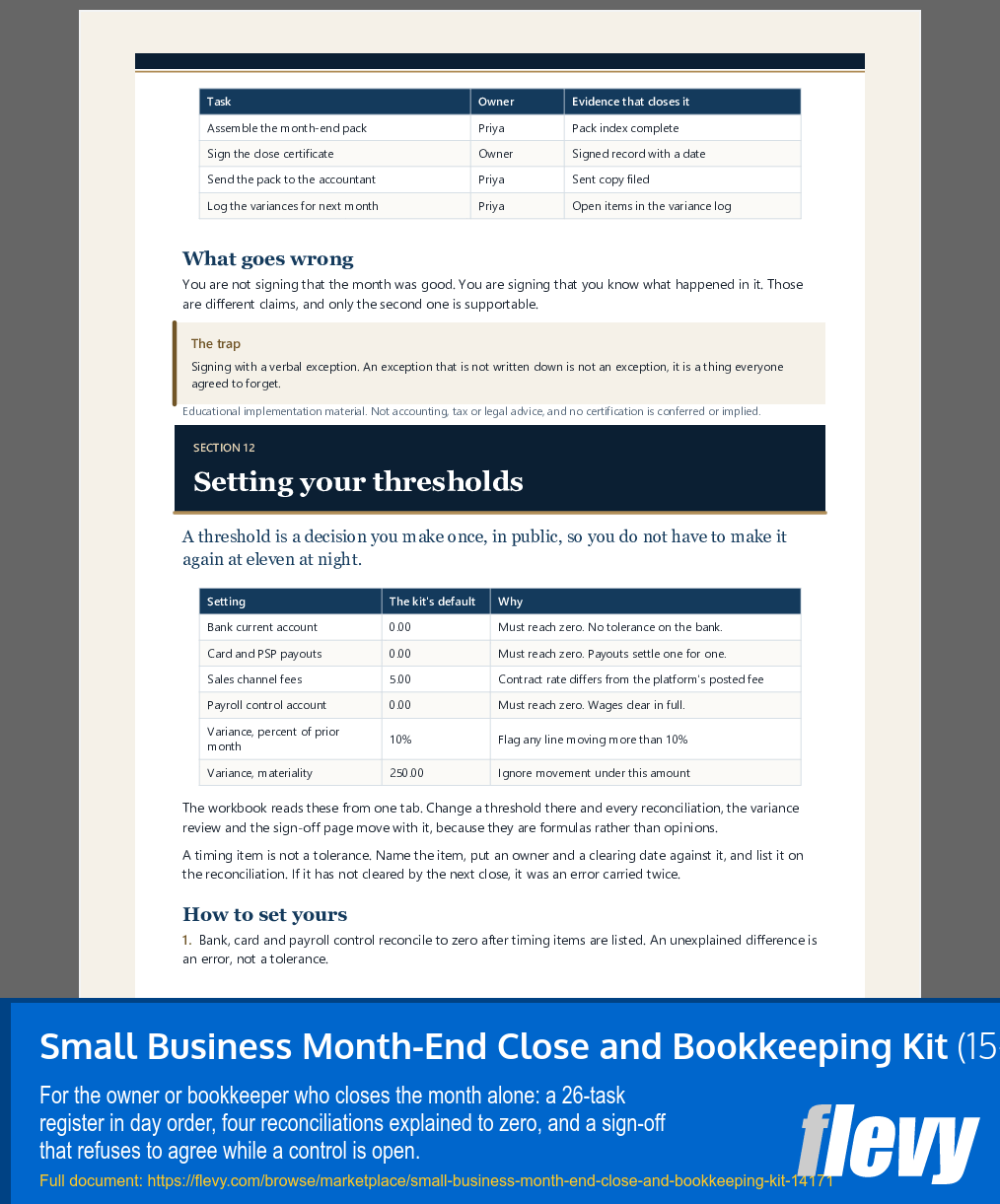
The thresholds are the part most templates skip. The bank, the card and payroll carry no tolerance at all. The sales channel fee carries a small one, because the contract rate and the platform's posted fee can differ. The variance review applies a percentage threshold and a materiality floor together, so a small balance moving a large percentage does not clutter the review.
This is educational implementation material for small businesses and their bookkeepers. It is not accounting, tax or legal advice, and it confers no certification. The sample data is illustrative, and every figure is invented for teaching.
Got a question about the product? Email us at support@flevy.com or ask the author directly by using the "Ask the Author a Question" form. If you cannot view the preview above this document description, go here to view the large preview instead.
Source: Best Practices in Small Business, Management Accounting PDF: Small Business Month-End Close and Bookkeeping Kit PDF (PDF) Document, WebsiteGeek
ABOUT THE AUTHOR

WebsiteGeek offers free website tools, SEO suites, file converters, browser extensions, calculators, and image utilities built to supercharge your productivity.
We also builds practical digital tools and templates for small business owners -- real formulas and sourced data.
Ask the Author a Question
You must be logged in to contact the author.