 Click main image to view in full screen. Unlock all 10 preview images:
Small Business Budget and Cash Flow Management Toolkit – Excel XLSX
Excel (XLSX) + Excel (XLSX)


BENEFITS OF THIS DOWNLOADABLE EXCEL DOCUMENT
- Integrates budgeting, income and expense tracking, profit analysis, tax reserves, invoice management, and cash-flow forecasting into a connected small-business financial management workbook.
- Provides monthly and annual financial dashboards with budget-versus-actual comparisons, profit margins, cash projections, receivables aging, and financial performance indicators.
- Helps business owners organize financial records, monitor spending, plan owner pay and tax reserves, and identify potential cash-flow pressure before it becomes a major problem.
CASH FLOW MANAGEMENT EXCEL DESCRIPTION
### Small Business Budget and Cash Flow Management Toolkit
Budgeting • Bookkeeping • Financial Dashboards • Cash Forecasting
Running a small business requires more than generating sales. Business owners need to understand where money comes from, where it goes, how much they actually keep, whether spending is under control, what obligations are approaching, and how much cash will remain available in the coming months.
Many small businesses operate with fragmented records. Income may be tracked in one spreadsheet, expenses in another, monthly budgets somewhere else, and tax obligations calculated manually. This creates gaps in financial visibility and makes it difficult to determine whether the business is genuinely profitable, financially stable, or heading toward a cash shortfall.
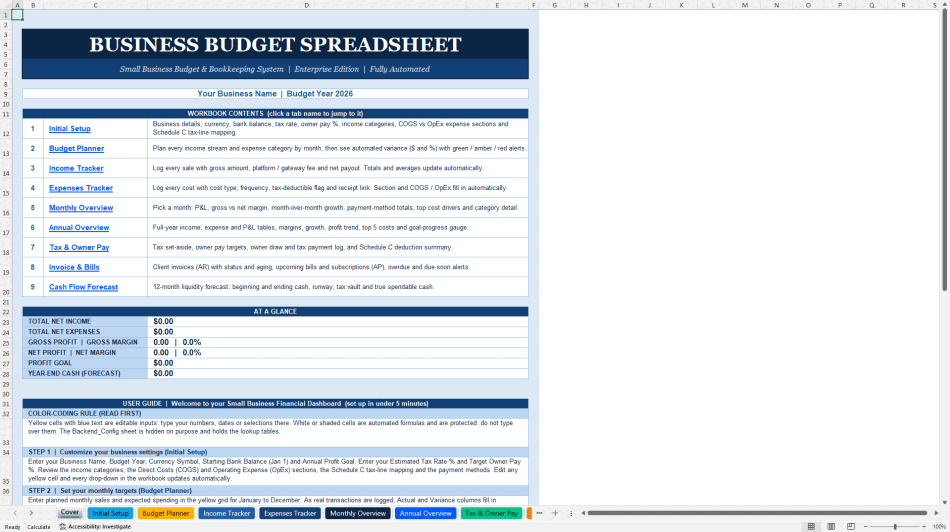
The Small Business Budget and Cash Flow Management Toolkit brings these essential financial activities together in one integrated, structured financial management workbook.
Designed for entrepreneurs, small-business owners, freelancers, consultants, online sellers, independent operators, and growing businesses, this toolkit helps transform scattered financial information into organized records, meaningful performance indicators, budget comparisons, and forward-looking financial insights.
Rather than relying on isolated calculations, the workbook connects budget planning, actual income, business expenses, cash flow, profitability, outstanding invoices, upcoming bills, tax reserves, and owner withdrawals. Its integrated structure provides a clearer picture of business performance throughout the year.
## A Complete Small-Business Financial Management System
This toolkit is designed to support the financial planning and monitoring activities that small businesses frequently need to manage.
It provides an organized framework for:
• Establishing an annual financial plan.
• Setting business income targets and profit goals.
• Planning monthly income and operating expenses.
• Tracking sales and payment processing fees.
• Recording business expenses and cost of goods sold.
• Monitoring actual performance against budget.
• Understanding gross profit, net profit, and profit margins.
• Monitoring outstanding customer invoices.
• Tracking vendor bills and payment obligations.
• Forecasting cash balances over the next 12 months.
• Planning tax reserves and recording tax payments.
• Monitoring owner pay and business cash retention.
• Reviewing financial performance through monthly and annual dashboards.
The workbook is structured so that the user can configure business information and financial assumptions, record transactions, and then use the connected reporting sheets to review the resulting financial picture.
## 1. Initial Setup and Business Configuration
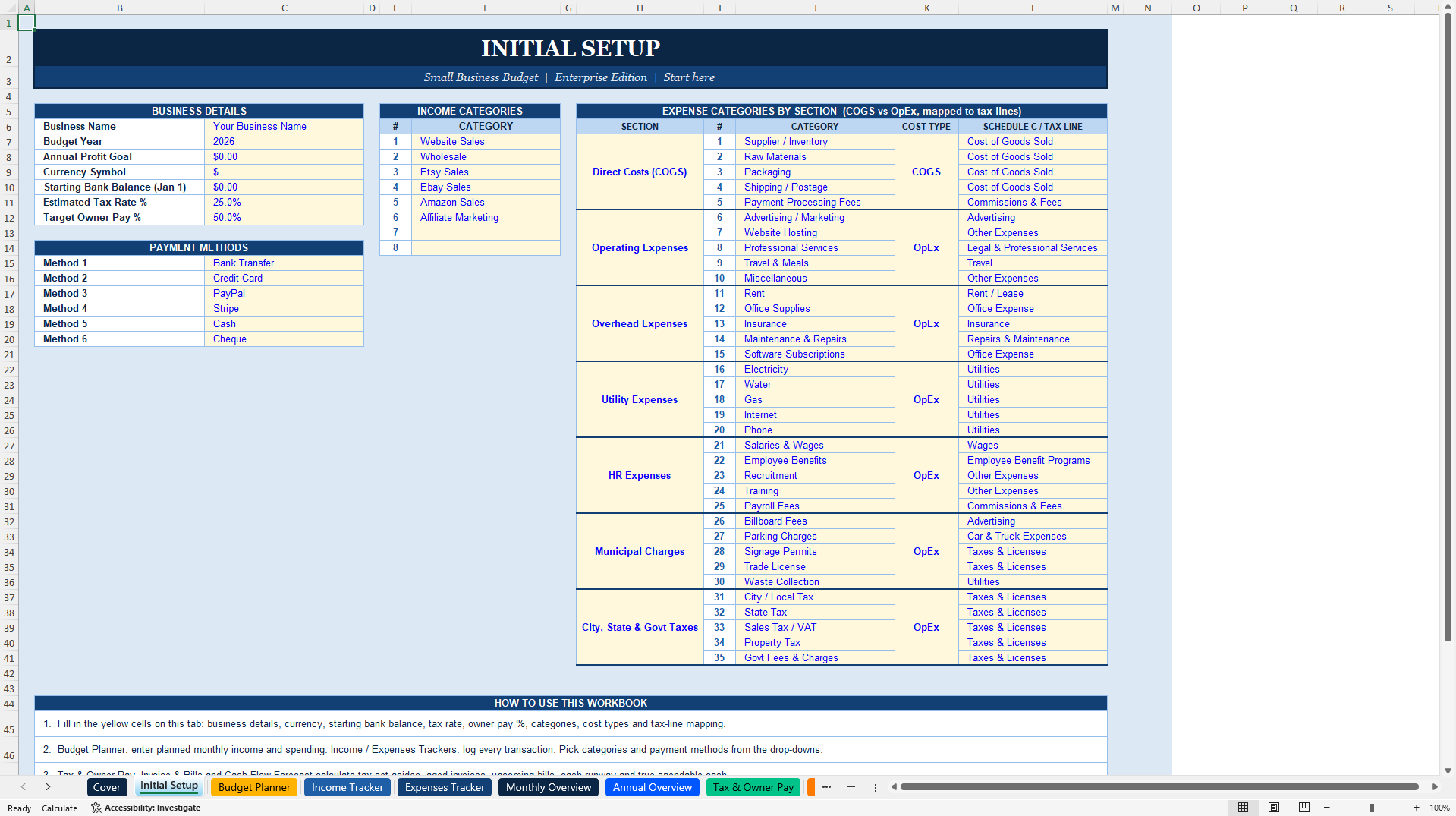
The Initial Setup sheet serves as the starting point for configuring the financial system.
Users can enter business information, establish the budget year, set an annual profit goal, select a currency symbol, and specify a starting bank balance. The setup area also includes estimated tax and target owner-pay percentages, which are used in related financial calculations.
Income categories and expense categories can be configured to reflect the nature of the business. The expense structure separates direct costs and Cost of Goods Sold (COGS) from operating expenses (OpEx), allowing users to distinguish the costs associated with producing or delivering goods from the broader expenses of running the business.
The setup system also includes payment-method selections and tax-line mapping for expense categories.
This configurable structure makes the workbook adaptable to different business models, including product-based businesses, service providers, independent professionals, online sellers, and businesses with multiple income channels.
## 2. Annual Budget Planner
Planning is an essential part of managing business finances. Without a budget, business owners may know what they spent but have little reference for whether those spending levels were reasonable or aligned with their financial objectives.
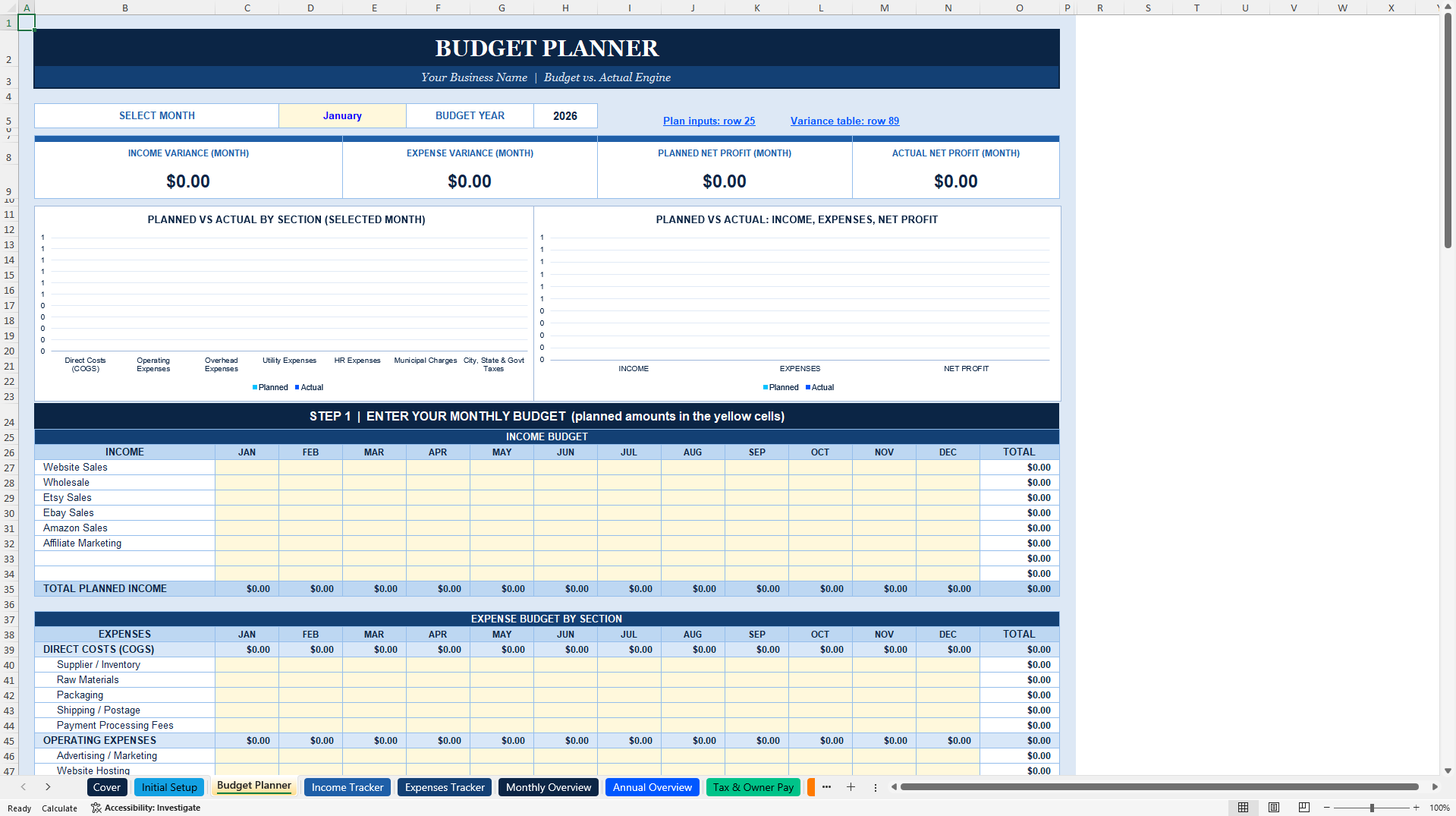
The Budget Planner provides a structured environment for planning income and expenses across the year.
Users can establish monthly budgets for income streams and expense categories, compare planned figures against actual results, and review the financial impact of deviations.
The budget-versus-actual engine helps identify:
• Income streams performing above or below plan.
• Expense categories exceeding budget.
• Monthly spending patterns that require attention.
• Variances between planned and actual financial results.
• Changes in expected business profitability.
The workbook includes automated dollar and percentage variance calculations with visual green, amber, and red indicators designed to make deviations easier to identify.
Rather than waiting until the end of the year to discover that expenses have increased or income has fallen below expectations, users can review their financial performance throughout the year and make adjustments to their operating plans.
## 3. Income Tracker and Sales Monitoring
Sales activity is the foundation of business financial performance, but gross sales alone do not necessarily represent the money a business receives.
Payment processors, marketplaces, gateways, and other selling platforms may deduct fees before transferring funds to the business.
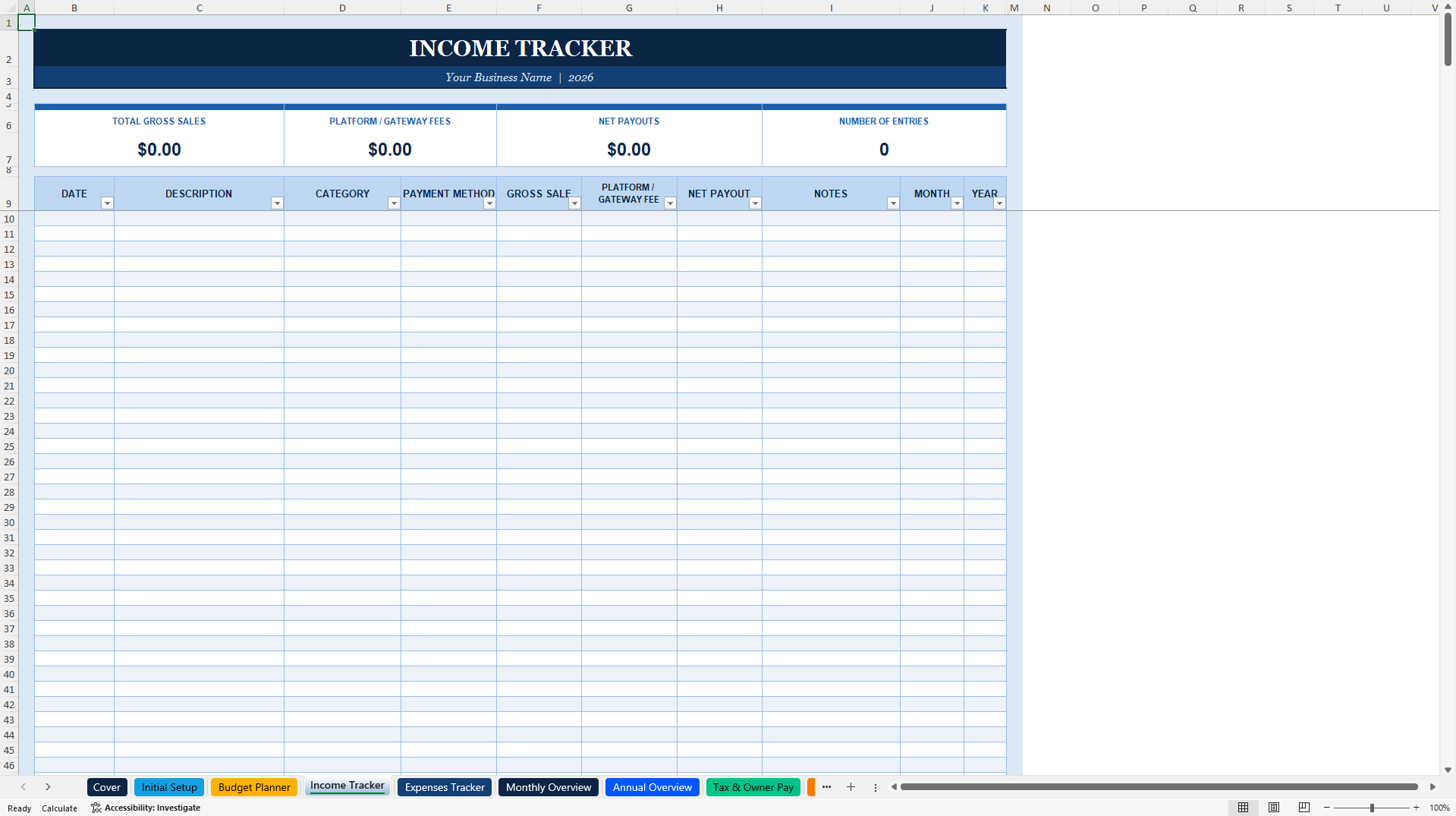
The Income Tracker is designed to capture individual income transactions with fields for:
• Date.
• Transaction description.
• Income category.
• Payment method.
• Gross sale amount.
• Platform or gateway fees.
• Net payout.
• Notes.
Net payout calculations are integrated into the transaction structure, helping users distinguish gross revenue from fees and the resulting net amount.
The tracker also supports automated totals, transaction counts, and average-related reporting.
Businesses with multiple sales channels can use categories such as website sales, wholesale, Etsy, eBay, Amazon, affiliate marketing, or other configured revenue streams.
This makes it easier to organize sales activity, review different income sources, and understand how selling fees affect the business's realized income.
## 4. Expenses Tracker and Cost Classification
Expenses can quickly become difficult to manage when they are recorded inconsistently or without meaningful categories.
The Expenses Tracker provides a structured transaction log designed to organize business spending and support financial review.
Expense entries include:
• Date.
• Description.
• Category.
• Expense section.
• Cost type.
• Payment method.
• Amount.
• Frequency.
• Tax-deductible indicator.
• Receipt reference or link.
Expense classification is connected to the category configuration in Initial Setup. Cost types and sections can be populated through category lookup logic, supporting a consistent separation between direct business costs and operating expenses.
This structure helps users review expenses across different parts of the business and identify how much they are spending on inventory, materials, shipping, marketing, rent, software, professional services, travel, insurance, and other configured expense categories.
The expense dashboard metrics include total expenses, direct costs, operating expenses, and expenses marked as tax-deductible.
The result is a more organized spending record that supports budget analysis, financial planning, and year-end review.
## 5. Monthly Financial Overview Dashboard
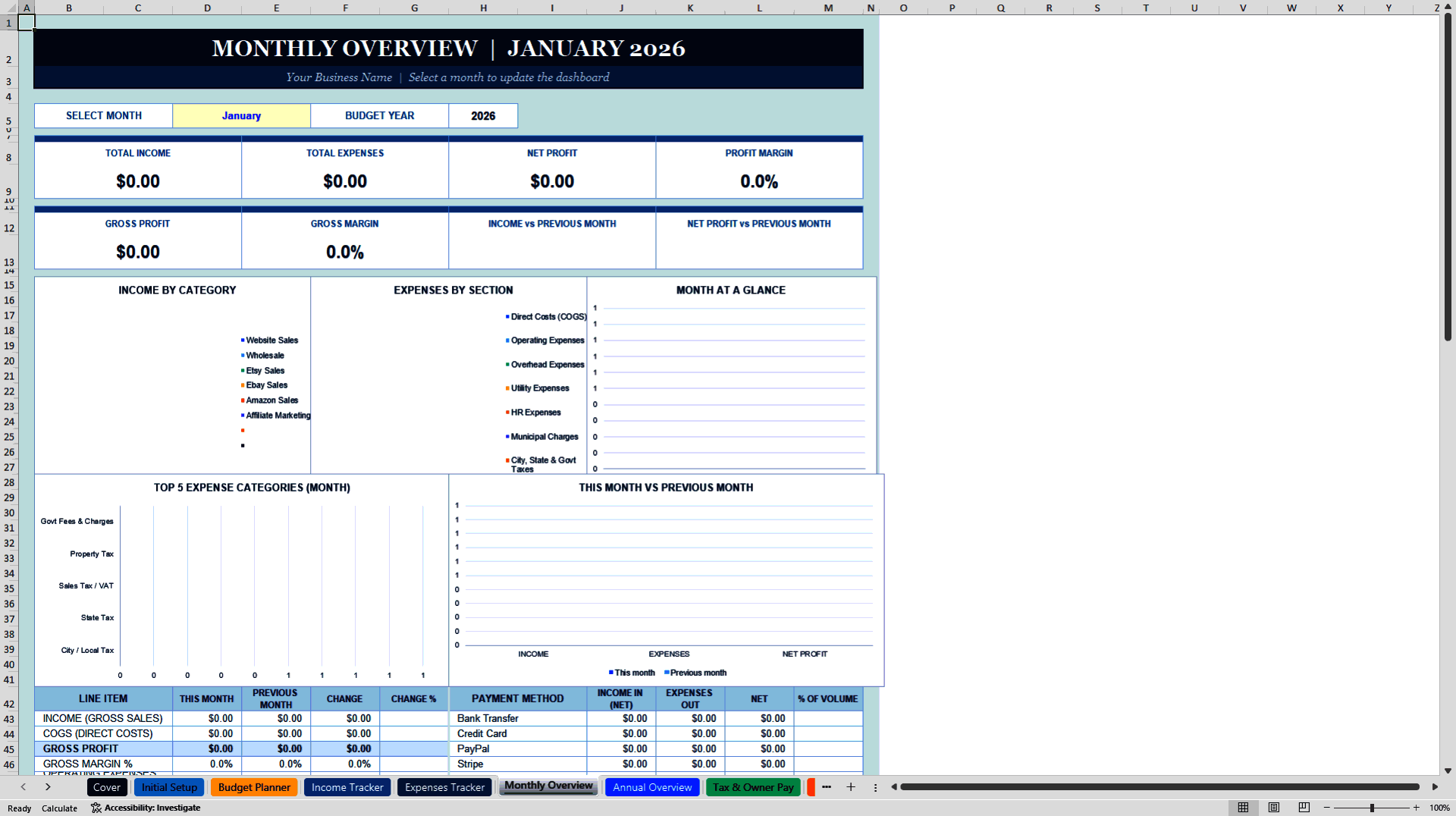
The Monthly Overview provides a focused review of the selected month.
Instead of manually assembling monthly figures from transaction logs, users can select a month and review connected financial metrics.
The dashboard includes key performance indicators such as:
• Total income.
• Total expenses.
• Net profit.
• Profit margin.
• Gross profit.
• Gross margin.
• Income compared with the previous month.
• Net profit compared with the previous month.
The dashboard is intended to make monthly financial review more practical. Business owners can quickly assess whether a month was profitable, whether costs are consuming too much revenue, and whether income or profit has changed relative to the previous month.
Monthly analysis is especially useful for businesses with seasonal sales patterns, fluctuating expenses, changing customer demand, or irregular income.
By reviewing the same metrics consistently, users can develop a better understanding of their operating performance and identify periods that may require closer attention.
## 6. Annual Financial Overview Dashboard
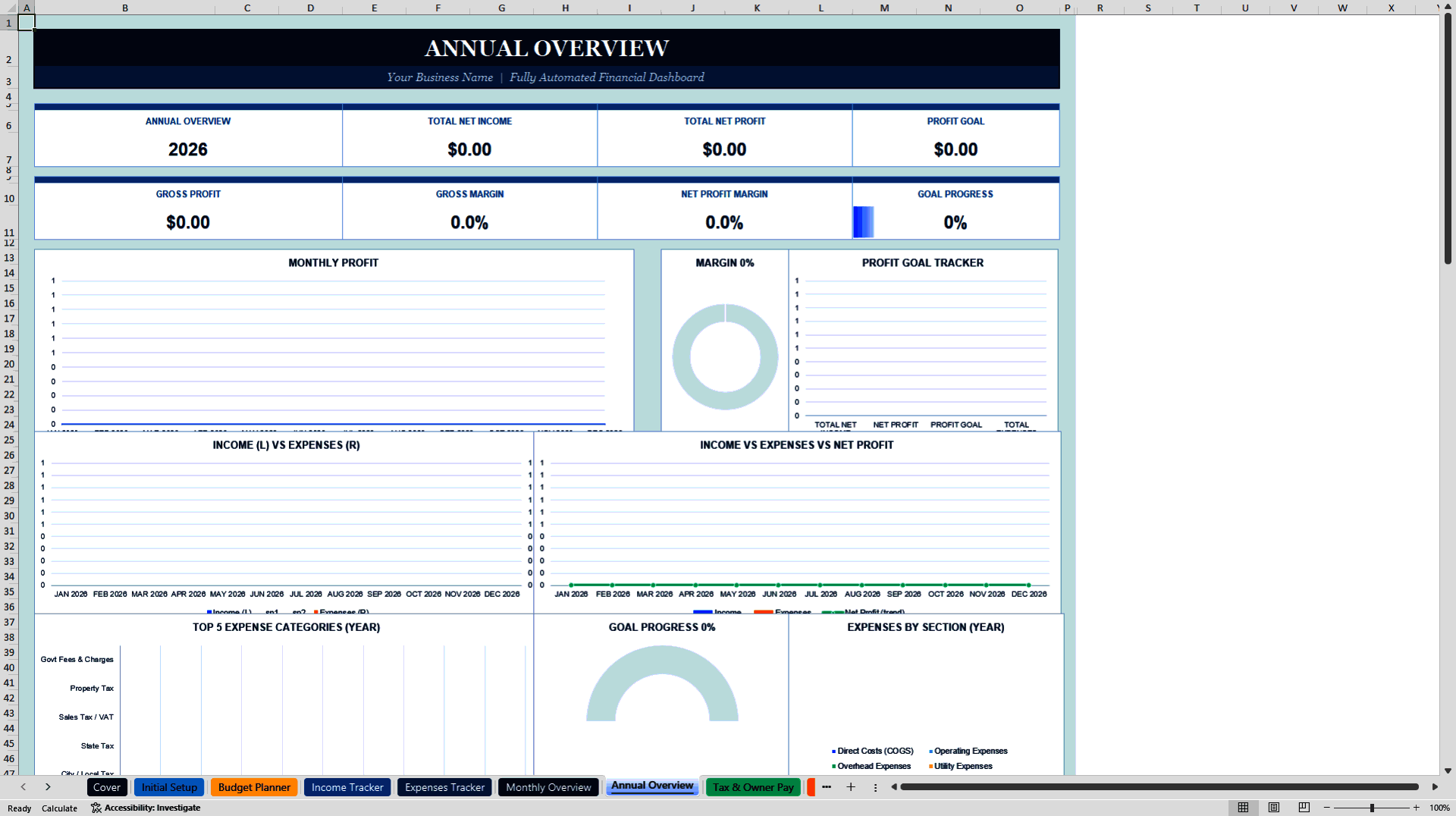
The Annual Overview consolidates full-year financial performance into a broader reporting view.
This dashboard is designed to help users evaluate their overall financial position and progress toward their business goals.
Key metrics include:
• Total net income.
• Total net profit.
• Annual profit goal.
• Gross profit.
• Gross margin.
• Net profit margin.
• Profit-goal progress.
The dashboard includes multiple charts and summary calculations to provide a visual overview of financial performance across the year.
Users can assess how revenue and expenses have developed, review profitability, and compare actual financial results with their annual objective.
The annual view is particularly valuable during business planning, quarterly reviews, year-end evaluation, and preparation for the next budget cycle.
## 7. Cash Flow Forecasting and Liquidity Planning
Profitability and cash availability are not always the same thing.
A business can generate accounting profit while experiencing cash pressure because customers have not paid, supplier payments are approaching, expenses occur before revenue arrives, or funds are tied up in inventory and other commitments.
The Cash Flow Forecast sheet addresses this important management issue by providing a 12-month cash-flow planning framework.
It includes metrics such as:
• Starting bank balance.
• Projected year-end cash.
• Lowest projected cash point.
• Estimated cash runway.
The forecast incorporates cash inflows and outflows and is designed to distinguish completed months from forecast periods, using actual financial data for completed periods and budget-based information for future months.
The forecast structure includes operating sales cash inflows, owner capital injections, and relevant cash outflow categories, helping users visualize how business cash may develop over the year.
The projected cash balance can help business owners identify periods when liquidity may become tight, plan spending more carefully, and consider whether additional capital, expense adjustments, or changes in timing may be necessary.
This forward-looking component is one of the most important features of the toolkit because it encourages users to consider future cash requirements rather than relying only on historical performance.
## 8. Tax Reserve and Owner Pay Planning
Small-business owners frequently face the challenge of balancing personal withdrawals, business reinvestment, and tax obligations.
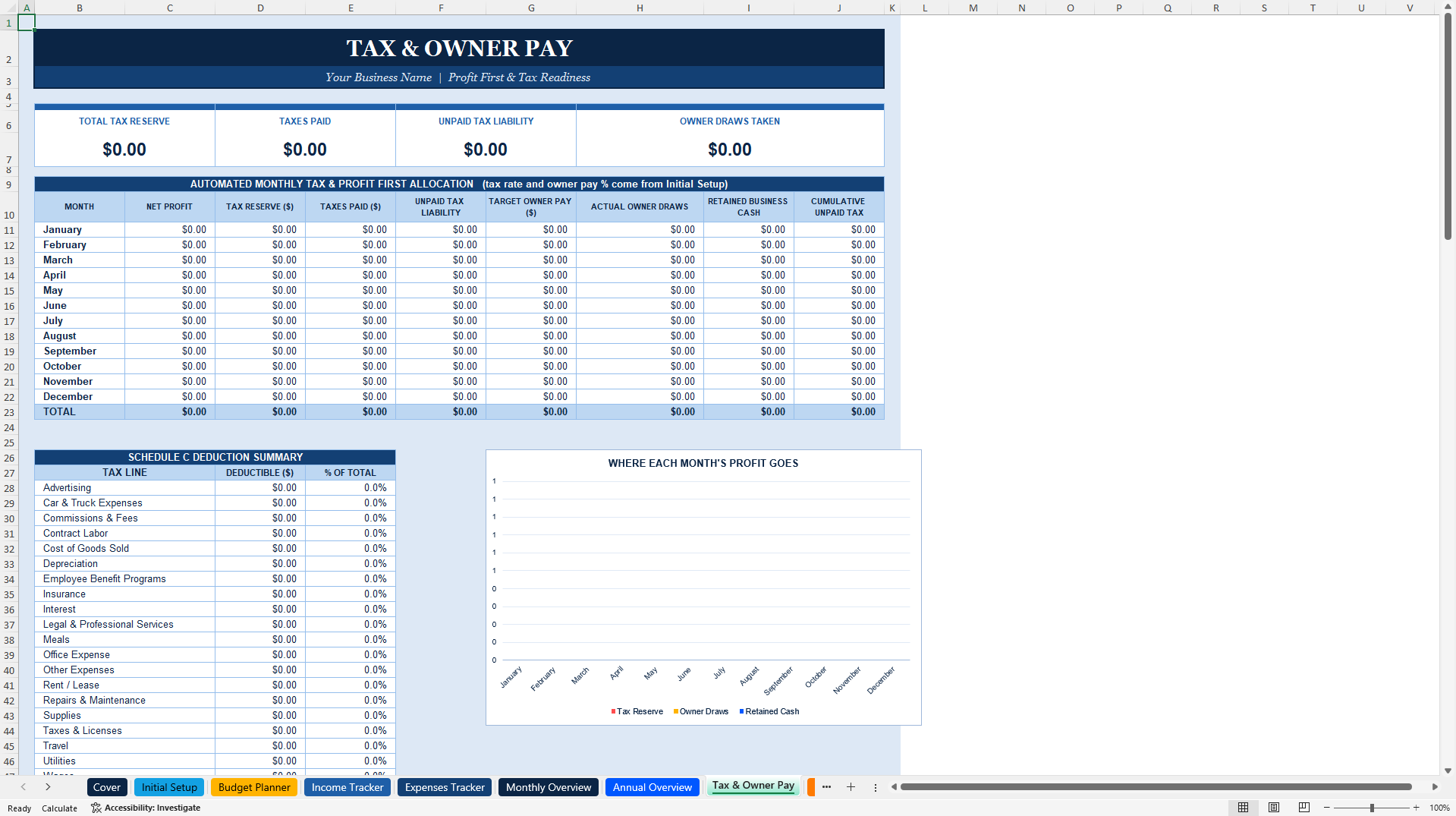
The Tax & Owner Pay sheet provides a structured framework for reviewing monthly profit allocations, estimated tax reserves, taxes paid, outstanding tax liability, owner draws, and retained business cash.
The system incorporates configured tax-rate and owner-pay assumptions from the Initial Setup sheet.
The monthly allocation structure includes:
• Net profit.
• Tax reserve calculations.
• Taxes paid.
• Unpaid tax liability.
• Target owner pay.
• Actual owner draws.
• Retained business cash.
• Cumulative unpaid tax reserves.
This structure can help business owners become more intentional about setting aside money for taxes and monitoring how much cash is being withdrawn from the business.
It also creates a practical framework for reviewing owner compensation alongside business profitability and retained cash.
The tax calculations are planning estimates based on the user's configured assumptions and transaction records. They are not a substitute for professional tax advice, tax filing software, or jurisdiction-specific tax calculations.
## 9. Invoice and Bills Tracker
Managing money owed by customers and money owed to suppliers is critical to maintaining healthy business cash flow.
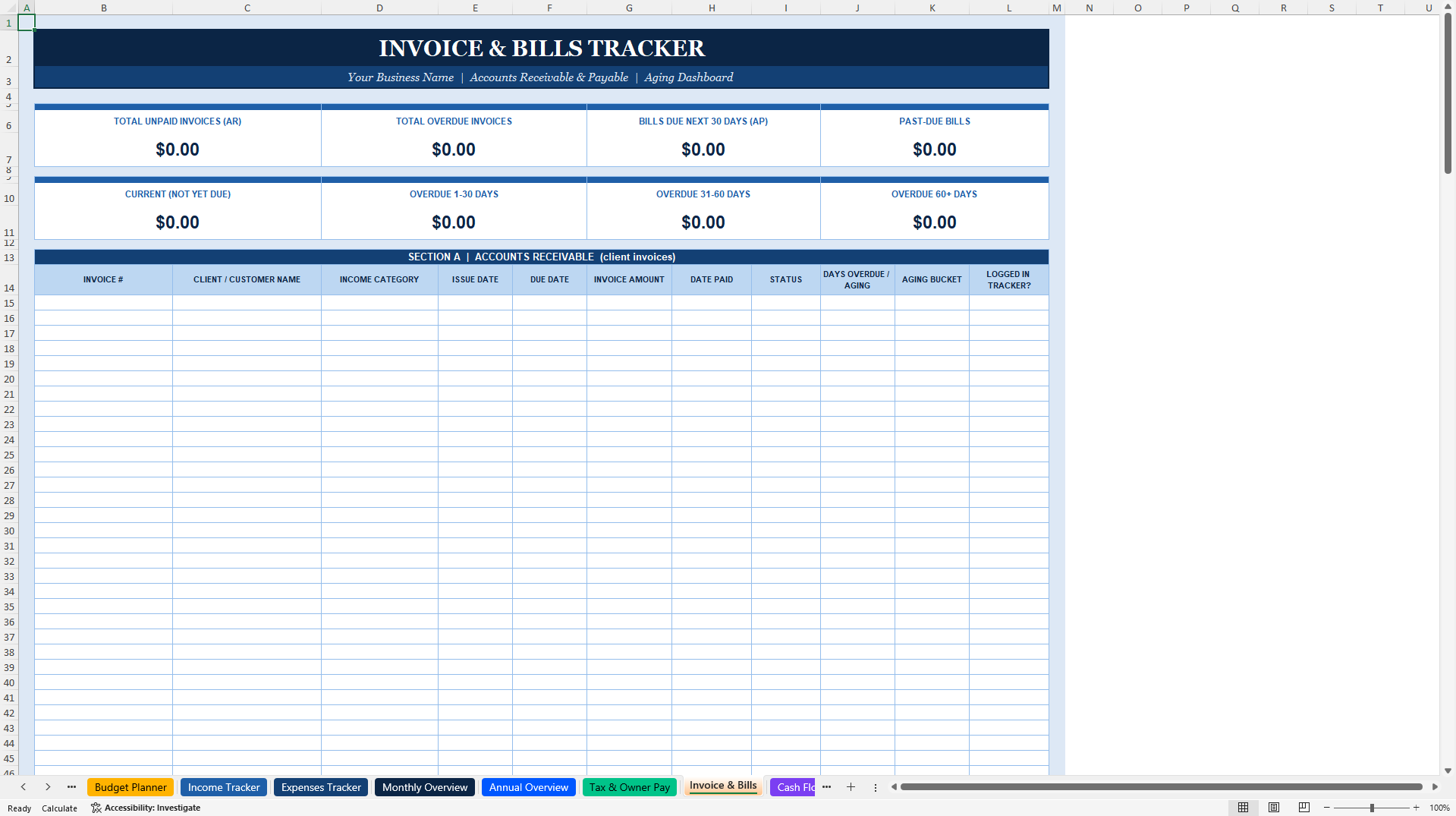
The Invoice & Bills Tracker combines accounts receivable and accounts payable monitoring within a structured sheet.
The accounts receivable section is designed to track customer invoices, including:
• Invoice number.
• Client or customer name.
• Income category.
• Issue date.
• Due date.
• Invoice amount.
• Date paid.
• Status.
• Days overdue.
• Aging bucket.
Automated status and aging logic helps distinguish paid, pending, overdue, and aging invoices.
The dashboard provides visibility into unpaid invoices, overdue invoices, and receivable aging categories, including current balances and overdue intervals.
The accounts payable section provides a complementary framework for recording vendor bills, due dates, amounts, and payment status, supporting visibility into upcoming obligations and past-due bills.
The sheet includes summary indicators for bills due within the next 30 days and past-due bills.
This combined view can help business owners prioritize collections, follow up with customers, prepare for vendor payments, and avoid overlooking financial commitments.
## 10. Integrated Financial Reporting
A major benefit of the workbook is that its reporting sheets are connected to the transaction and configuration structure.
The system is designed to bring together information from income tracking, expense tracking, budget planning, invoice and bill records, tax allocation, and cash-flow planning.
This integration reduces the need to repeatedly calculate or copy financial figures between disconnected spreadsheets.
The user can record business activity in the designated tracking sheets and use the connected reporting areas to review the resulting financial metrics.
The system supports a more consistent approach to financial recordkeeping and management review throughout the business year.
## 11. Practical Applications and Use Cases
The Small Business Budget and Cash Flow Management Toolkit can be useful in a range of business environments.
Small Business Owners: Maintain a consolidated view of business revenue, costs, profit, outstanding obligations, and cash planning.
Entrepreneurs and Startups: Establish an initial budget, set profit objectives, track spending, and evaluate financial performance as the business develops.
Freelancers and Consultants: Organize client income, recurring expenses, professional costs, owner withdrawals, and monthly profitability.
E-Commerce Sellers: Monitor income streams from multiple marketplaces, track selling fees, organize cost of goods sold, and compare actual results with budgets.
Independent Retailers: Review sales, inventory-related costs, operating expenses, seasonal fluctuations, and projected liquidity.
Service Businesses: Track service revenue, labor-related expenses, operating costs, monthly budgets, and cash availability.
Business Coaches and Consultants: Use a structured financial planning and monitoring framework when helping clients improve their financial organization and business discipline.
Financial Planning and Management: Support recurring monthly and annual reviews, budgeting exercises, profitability analysis, and cash-flow planning.
## 12. Financial KPIs and Management Indicators
The workbook includes multiple financial metrics that can help users evaluate business performance from different perspectives.
Revenue-related metrics help monitor income generated from business activities.
Expense-related metrics help assess spending levels and cost structure.
Profit-related metrics provide visibility into gross profit, net profit, margins, and profit-goal progress.
Liquidity-related metrics help evaluate cash balances, projected cash positions, minimum projected cash points, and estimated runway.
Receivables-related indicators support monitoring of unpaid and overdue customer invoices.
Payables-related indicators support reviewing upcoming and past-due bills.
Tax and owner-pay metrics provide visibility into reserve estimates, payments, outstanding tax liabilities, owner withdrawals, and retained cash.
Together, these indicators provide a more balanced financial review than focusing on revenue alone.
## 13. Designed for Recurring Financial Reviews
The workbook can be used as part of a recurring management routine.
A typical monthly review can include:
• Recording income transactions.
• Recording business expenses.
• Updating invoice and bill records.
• Reviewing budget variances.
• Evaluating monthly profit and margins.
• Checking cash-flow projections.
• Reviewing outstanding receivables and payables.
• Updating taxes paid and owner draws.
• Evaluating progress toward annual financial goals.
This process can help business owners build stronger financial habits and make more informed decisions about spending, pricing, cash management, and growth.
The workbook can also support quarterly reviews, annual planning, and financial discussions with accountants or business advisers.
## 14. What Is Included
The product includes two Excel workbook versions:
Enterprise Sample Version
A populated demonstration workbook containing illustrative transactions and financial entries. It allows users to explore the workbook's layout, connected sheets, dashboard reporting, and formulas using sample activity.
Blank Version
A clean working version intended for the buyer to configure and populate with their own business information, budgets, transactions, expenses, and financial records.
The workbook contains the following principal sheets:
1. Cover
2. Initial Setup
3. Budget Planner
4. Income Tracker
5. Expenses Tracker
6. Monthly Overview
7. Annual Overview
8. Tax & Owner Pay
9. Invoice & Bills
10. Cash Flow Forecast
11. Backend Configuration
The Backend Configuration sheet supports the workbook's calculations, category lists, lookup logic, and connected reporting structure.
## 15. Who Should Consider This Toolkit?
This toolkit is suited to business owners who want to improve their financial organization, develop more consistent budgeting habits, monitor performance throughout the year, and gain a better understanding of their business's cash position.
It is particularly relevant to businesses that currently use several separate spreadsheets or rely on manually reviewing bank statements and transaction lists without a consolidated management view.
It may also be useful to people starting a business who want to establish structured financial planning practices early.
## 16. Why Use an Integrated Financial Toolkit?
Financial decisions become easier to evaluate when income, expenses, budgets, profit, cash flow, and obligations are considered together.
A business owner deciding whether to increase marketing expenditure, hire assistance, purchase equipment, launch a new product, or withdraw additional funds needs a broader view of the financial impact.
An integrated financial workbook provides a practical place to organize this information, compare performance, and examine how different aspects of the business interact.
The Small Business Budget and Cash Flow Management Toolkit is designed to support this process with structured tracking, automated calculations, dashboard summaries, and forward-looking planning.
## Take Control of Your Business Finances
Whether you are managing an established small business, building a new venture, selling online, working independently, or trying to establish better financial discipline, this toolkit provides a comprehensive spreadsheet-based framework for organizing and reviewing your business finances.
Plan your year. Track income and expenses. Monitor profitability. Review budgets. Manage invoices and bills. Estimate tax reserves and owner pay. Forecast future cash.
Bring your essential financial management activities into one organized system and build a clearer foundation for informed business decisions.
A practical financial management toolkit for small businesses seeking better organization, financial visibility, and more disciplined planning.
Got a question about the product? Email us at support@flevy.com or ask the author directly by using the "Ask the Author a Question" form. If you cannot view the preview above this document description, go here to view the large preview instead.
Source: Best Practices in Cash Flow Management, Small Business Excel: Small Business Budget and Cash Flow Management Toolkit Excel (XLSX) Spreadsheet, MW & Digitelax Consulting
ABOUT THE AUTHOR

Welcome to the official enterprise resource hub of MW & Digitelax Consulting. Directed by a seasoned banking executive, corporate risk consultant, and financial content strategist with over 28 years of institutional leadership experience, our practice delivers deployment-ready frameworks designed to drive enterprise efficiency, enforce regulatory compliance, and eliminate systemic model risk. ... [read more]
Ask the Author a Question
You must be logged in to contact the author.