
 Click main image to view in full screen. Unlock all 12 preview images:
Investor-Ready Ecommerce Financial Model – Excel XLSX
Excel (XLSX)


BENEFITS OF THIS DOWNLOADABLE EXCEL DOCUMENT
- This ecommerce financial model translates key operating drivers--such as customer acquisition, AOV, pricing, and growth--into fully integrated financial statements and cash flow projections.
- It is structured using best-practice ecommerce modeling standards, with transparent logic and scalable design suitable for investor presentations, fundraising, and long-term planning.
- It includes a structured capitalization table and sources-and-uses analysis, helping founders and investors clearly understand ownership, dilution, and funding flows over time.
ECOMMERCE EXCEL DESCRIPTION
Ecommerce Financial Model Template – Build Investor-Ready Projections with Confidence
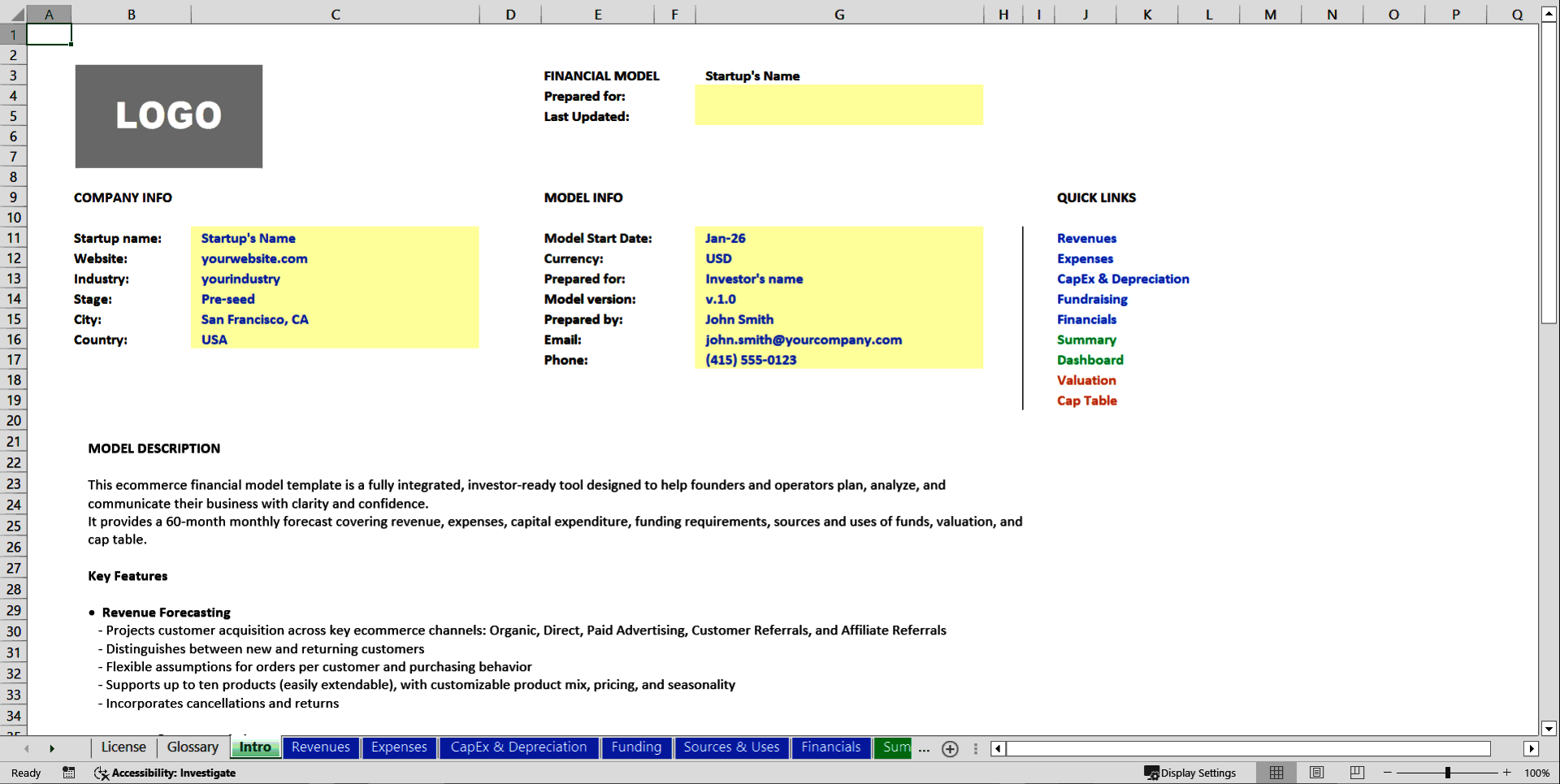
Building an ecommerce business is complex, but your financial model shouldn't be. This template helps founders create a professional, investor-ready financial model quickly and with confidence. Shaped by real-world feedback from venture investors and founders, it has already supported dozens of startups in securing funding.
The model combines clarity, flexibility, and investor credibility. Its structure is easy to follow, with all key drivers clearly separated, so you can adapt it to your business in under an hour. Whether preparing for a seed round or planning growth, this template ensures your financial story is compelling and consistent.
What's Inside
Customer Acquisition
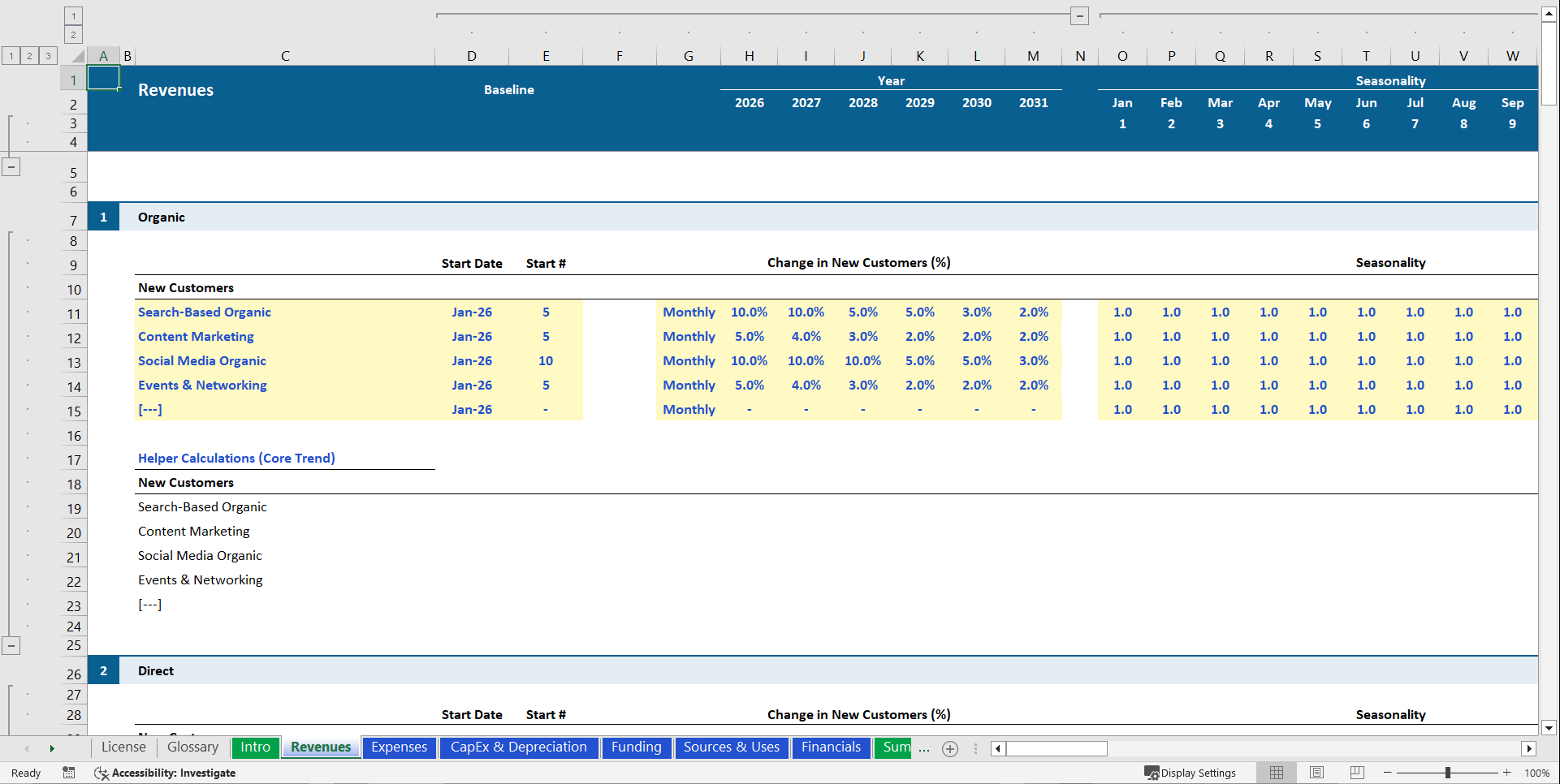
Understand and forecast how your business grows. The model projects customer acquisition across the most common ecommerce channels (organic, direct, paid advertising, referrals, affiliates), giving you a structured and realistic view of traffic and conversion into customers.
Orders, Repeat Purchases & Revenue
Revenue is driven the way ecommerce actually works:
• Separate tracking of new and returning customers
• Flexible assumptions for orders per customer and purchasing behavior
• Support for multiple products with customizable product mix, pricing, and seasonality
• Built-in handling of cancellations and returns
This allows you to move beyond simple assumptions and build realistic revenue projections.
Cost of Goods Sold (COGS)
Model product-level costs as a percentage of revenue, including allowances for defective products. This ensures your gross margin reflects real operational risks.
Team & Payroll
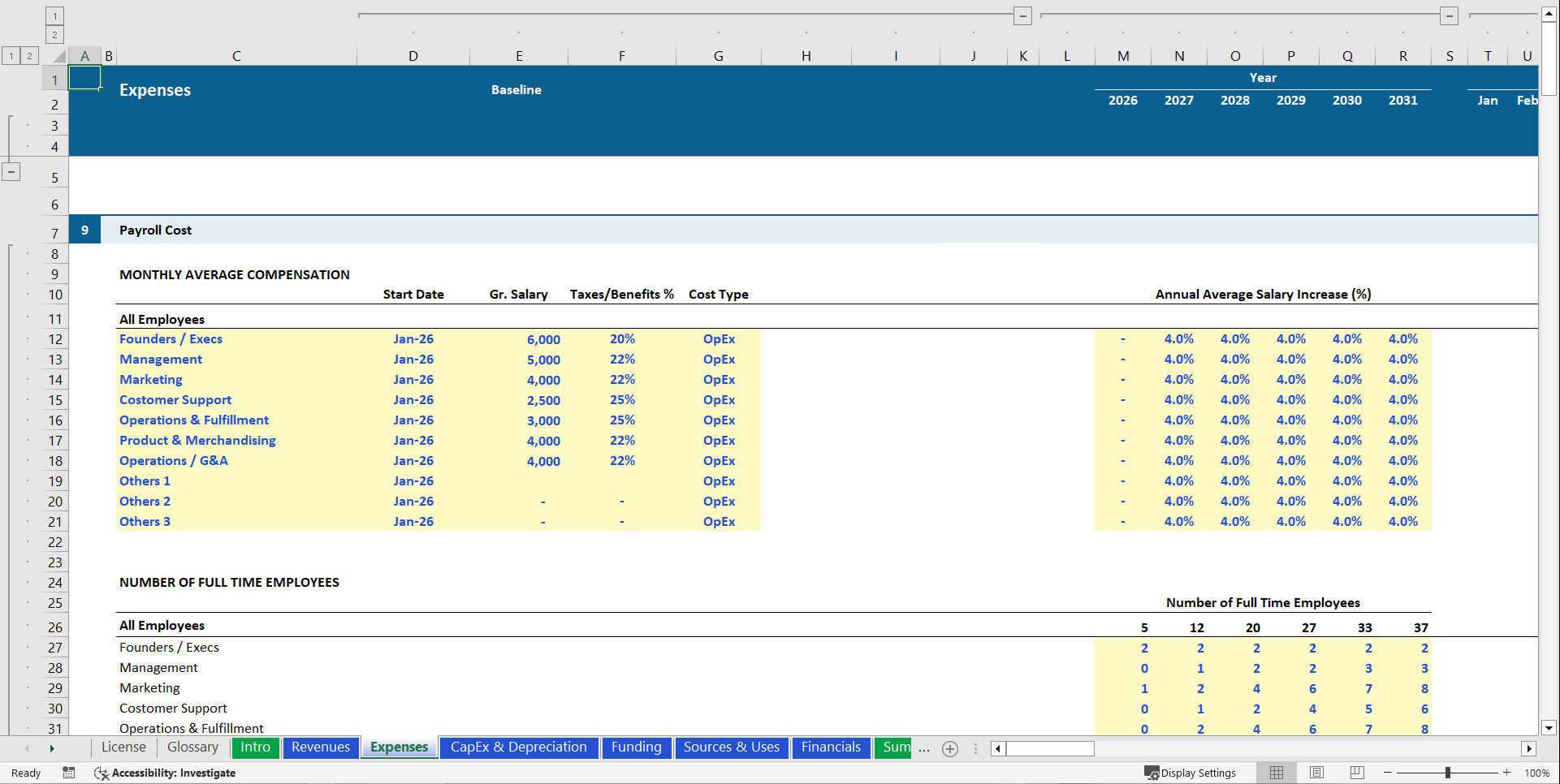
Plan your hiring roadmap with detailed control over headcount, salaries, timing, taxes, and benefits. Easily scale your team in line with growth.
Expenses
Forecast your cost structure with clarity:
• Clear separation of fixed and variable costs
• Variable costs can be modeled per order, as a % of revenue, or per employee
• Expenses categorized into COGS and OpEx
This structure helps you understand cost drivers and improve profitability.
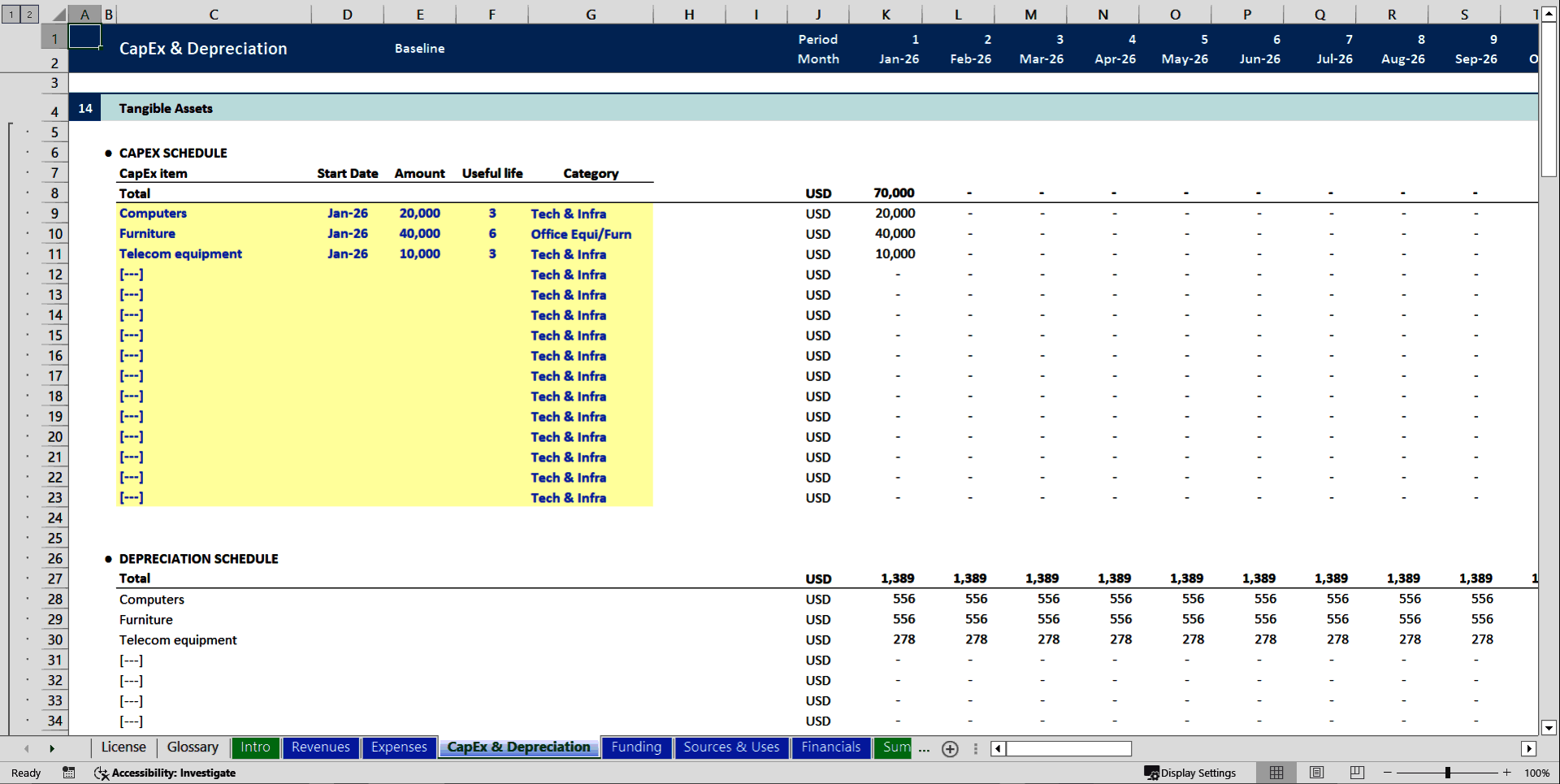
CapEx & Depreciation
Plan future asset purchases and automatically calculate depreciation and amortization based on their purchase price and useful lives for accurate financial reporting.
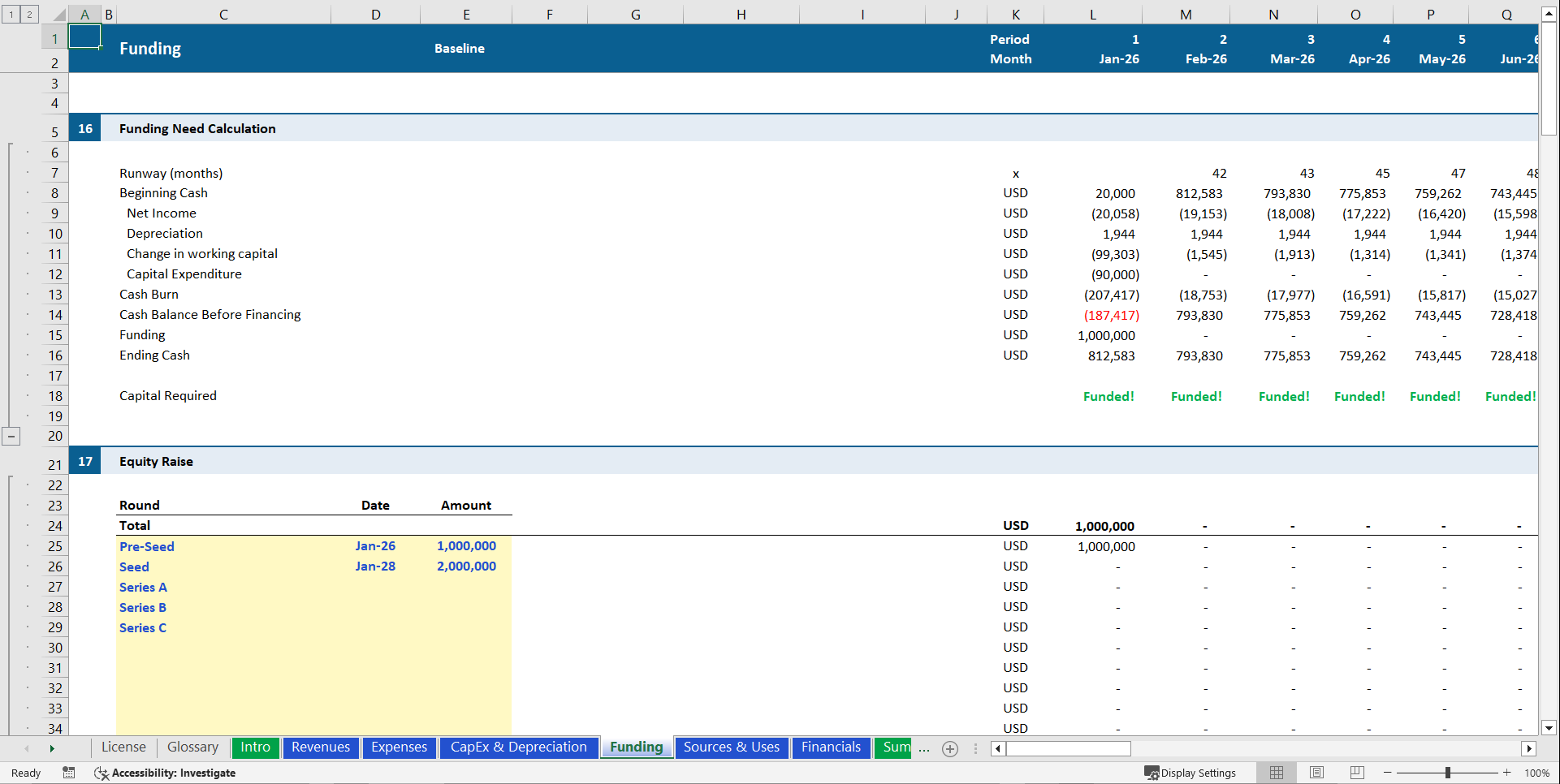
Funding & Cash Flow
The model takes a cash flow–focused approach to planning. It projects monthly cash balances over five years, helping you clearly identify:
• When you run out of cash
• How much funding you need
• How long your runway lasts
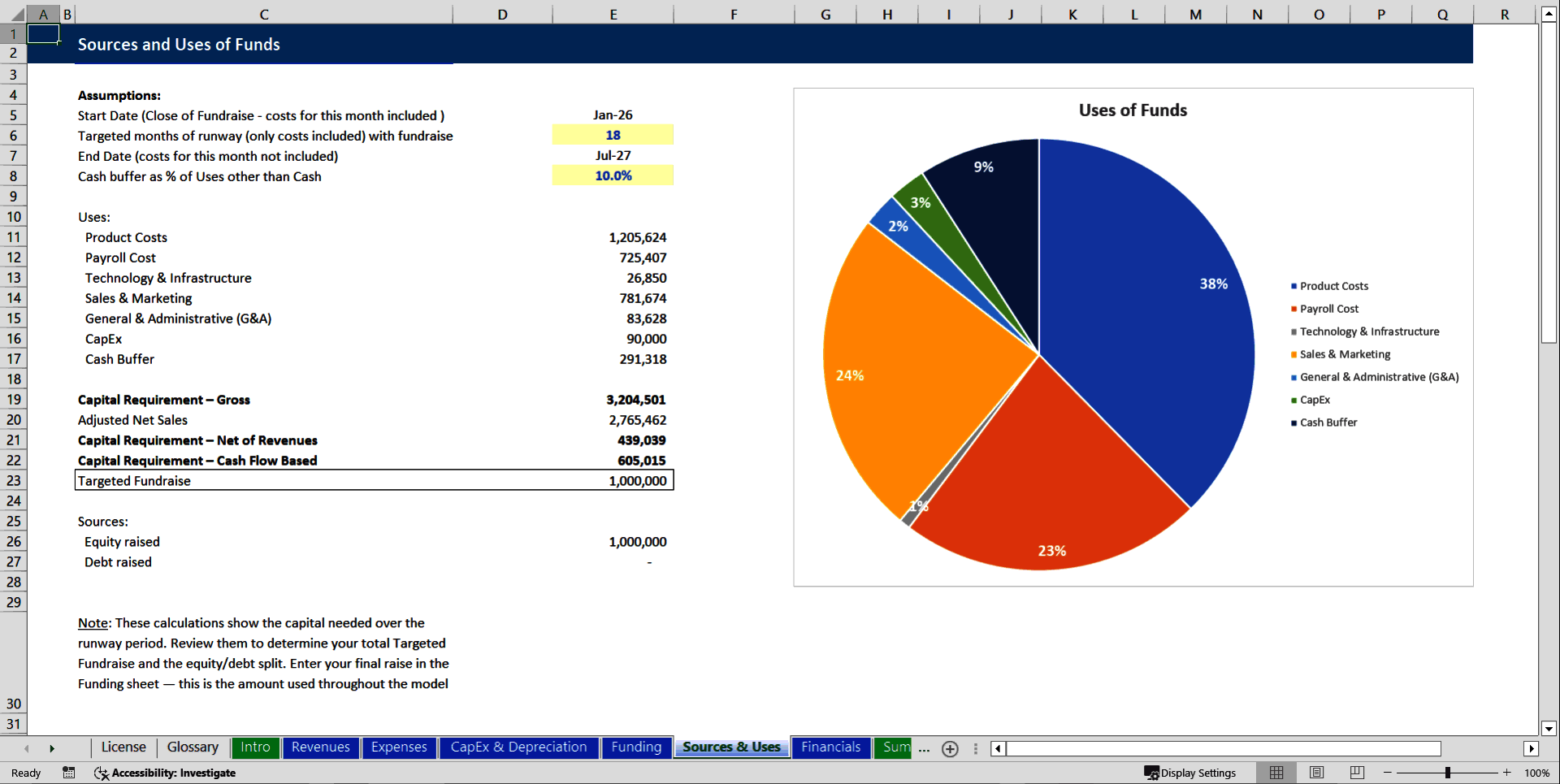
Sources & Uses of Funds
While the funding tab shows financing needs from your perspective, the Sources & Uses tab reframes it for investors. It clearly lays out how the capital raised will be allocated—across expenses, growth investments, capex, or cash reserves—providing a straightforward breakdown that investors expect to see.
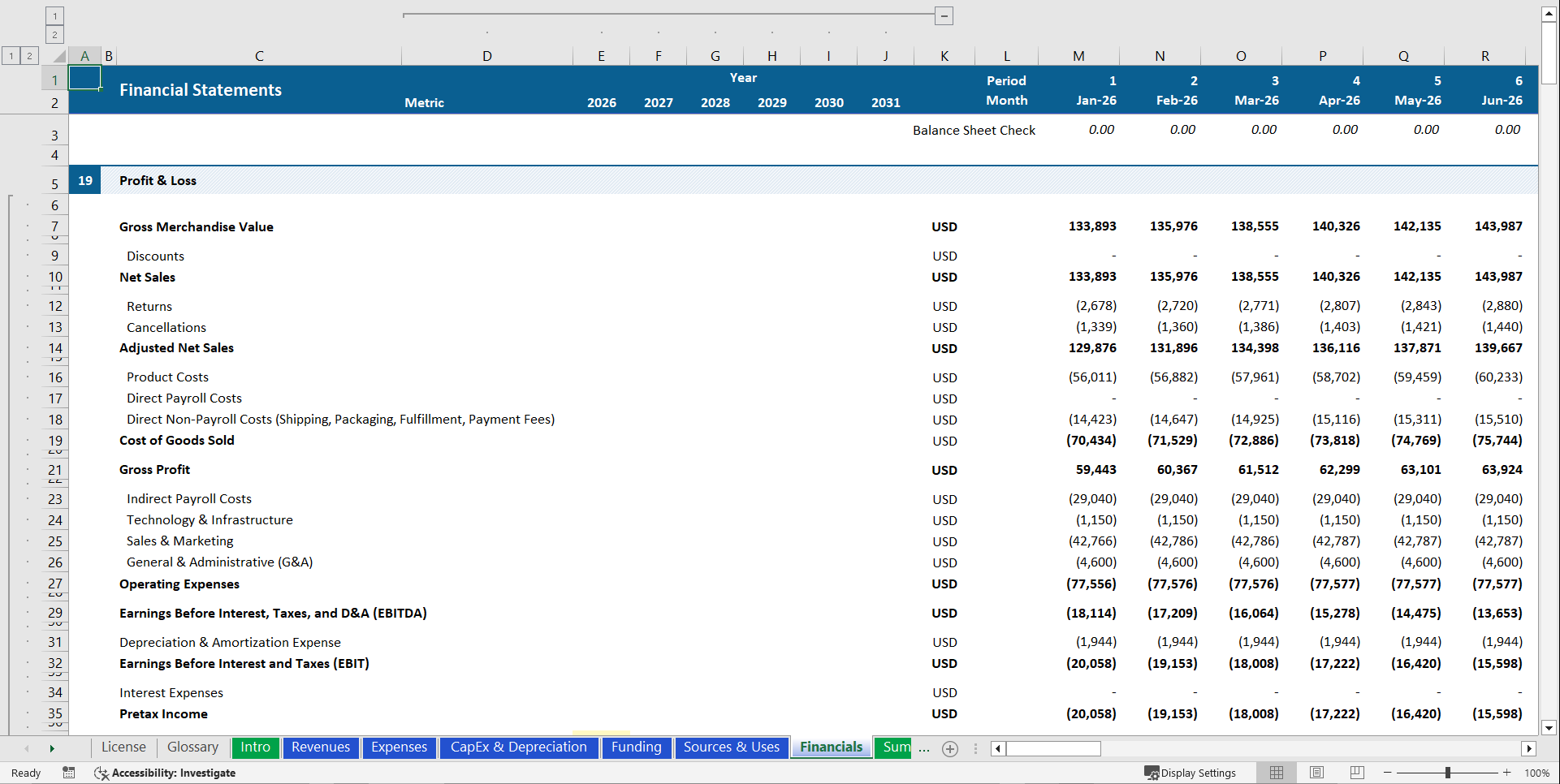
Financial Statements
Generate fully integrated P&L, Balance Sheet, and Cash Flow statements on a monthly basis for up to five years, in accordance with accounting standards, structured consistently, and ready for investor review.
Break-Even Analysis
See when your ecommerce business becomes profitable and how changes in key assumptions impact your path to profitability.
KPI Dashboard
Track the metrics that matter most in ecommerce, including:
• Average Order Value (AOV)
• Customer Acquisition Cost (CAC)
• Lifetime Value (LTV)
• Conversion-related metrics
• Cash runway and burn
All key indicators are automatically calculated and presented in one place.
Charts & Visuals
Includes clean, professional charts so you can easily use your outputs in presentations or investor decks.
Valuation & Sensitivity Analysis
Estimate your company's valuation using the Venture Capital Method, with sensitivity analysis to test different exit and return scenarios.
Integrated Cap Table
The model includes a fully integrated, multi-round cap table designed to clearly show the impact of each financing round on ownership and dilution. It supports up to five funding rounds and accommodates equity investments and SAFEs (Simple Agreements for Future Equity), including key terms such as valuation caps and discounts. Additionally, the model incorporates employee stock option pools (ESOPs).
Built to work seamlessly with the financial projections, the cap table provides a clear view of how the capital raised translates into ownership, helping you understand dilution dynamics and communicate them effectively to investors.
✅ Why founders choose this model:
• Reflects how ecommerce businesses actually operate (not simplified assumptions)
• Builds credibility with investors through structured, detailed forecasts
• Saves significant time with a ready-to-use, professional framework
• Flexible and easy to adapt to your specific business model
• Clear outputs and visuals for decision-making and fundraising
If you have any questions about how to use or customize the model, feel free to reach out, and I'm happy to help.
Got a question about the product? Email us at support@flevy.com or ask the author directly by using the "Ask the Author a Question" form. If you cannot view the preview above this document description, go here to view the large preview instead.
Source: Best Practices in Ecommerce, Integrated Financial Model Excel: Investor-Ready Ecommerce Financial Model Excel (XLSX) Spreadsheet, ValueTrail
ABOUT THE AUTHOR

At ValueTrail, we specialize in financial modeling, business valuation, and strategic finance, providing both consulting assignments and tailored analytical support to businesses and investors. Our experience spans complex valuation analyses and the development of structured, decision-oriented financial models used in real-world transactions and strategic planning.
Building on this expertise,
... [read more]
Ask the Author a Question
You must be logged in to contact the author.




























