
 Click main image to view in full screen. Unlock all 15 preview images:
Investment Holding Company NAV & Liquidity Model – Excel XLSX
Excel (XLSX) + supplemental PDF


BENEFITS OF THIS DOWNLOADABLE EXCEL DOCUMENT
- Connect NAV, liquidity, commitments, leverage and shareholder distributions in one integrated five-year decision model.
- Stress Downside, Base and Upside cases plus four sensitivity matrices without rebuilding formulas.
- Use integrated statements, liquidity waterfalls, concentration analysis and 22 integrity checks for decision-ready planning.
FINANCIAL MODELING EXCEL DESCRIPTION
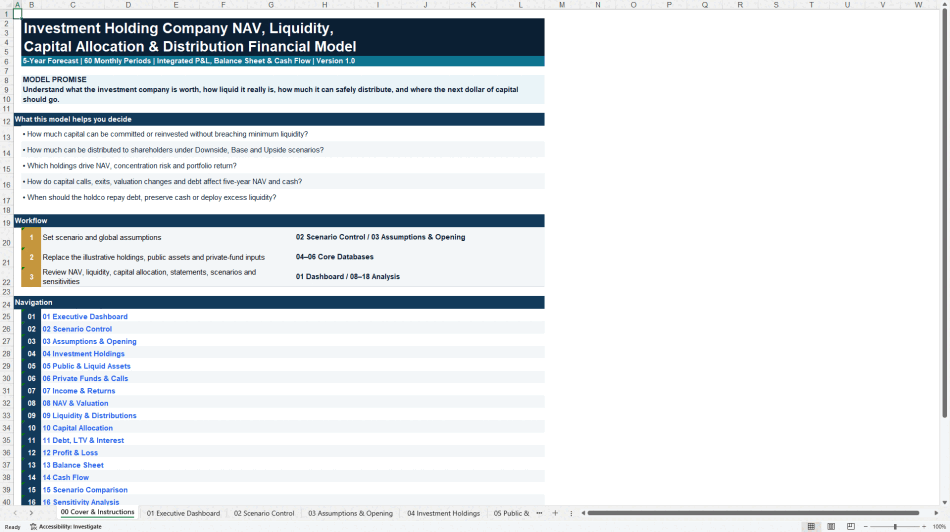
This Excel financial model is designed for owner-managed investment holding companies, entrepreneur investment vehicles, family investment companies and small family-office style structures that invest their own capital across private holdings, public securities, fixed income, private funds and cash.
The model addresses a practical problem that a simple three-statement forecast does not solve: an investment holding company can report a strong NAV while still facing limited distributable cash because of capital calls, follow-on investments, debt service, illiquid holdings and minimum liquidity requirements. The workbook therefore links portfolio value, liquidity, financing and shareholder distributions in one five-year decision model.
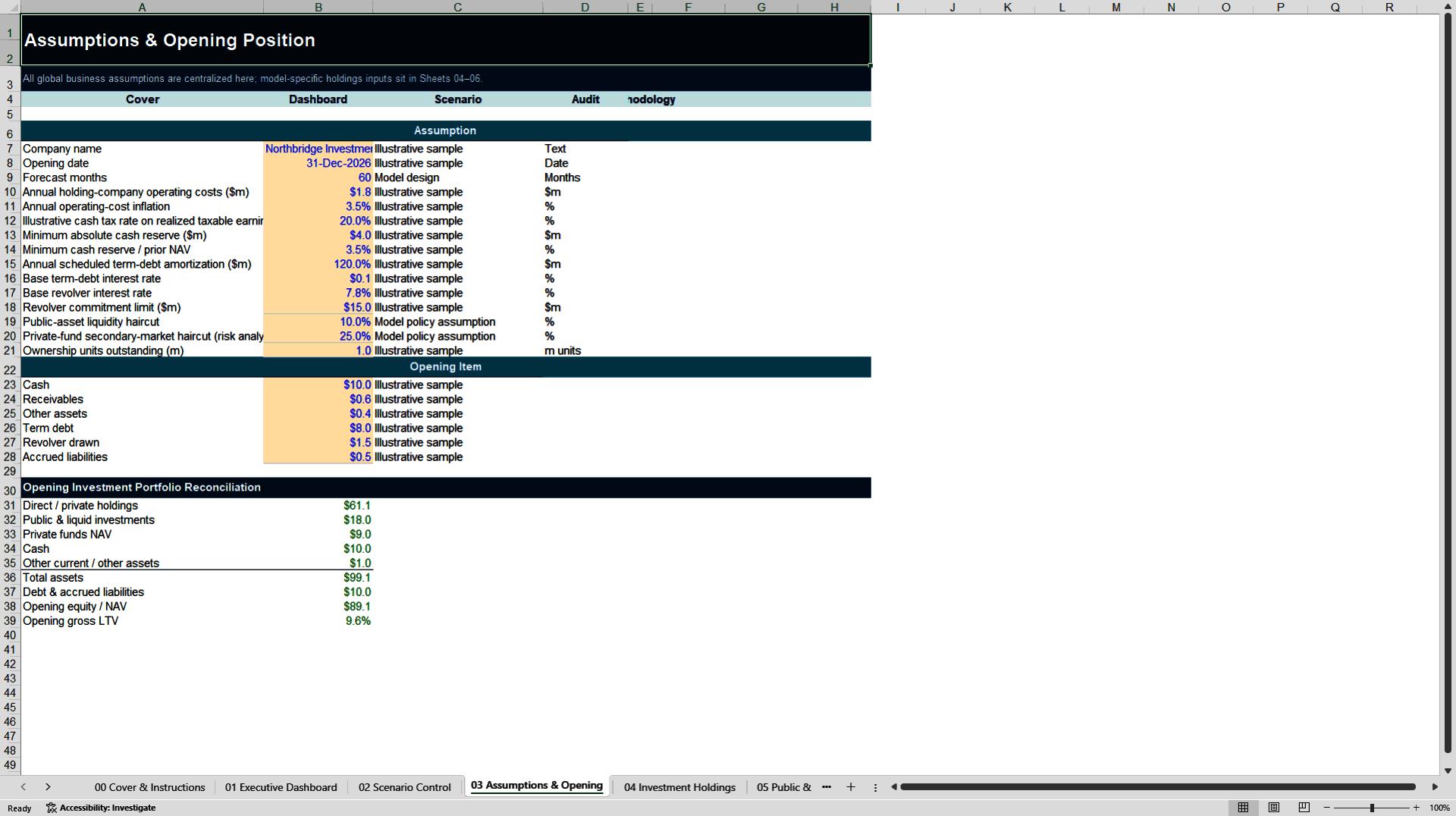
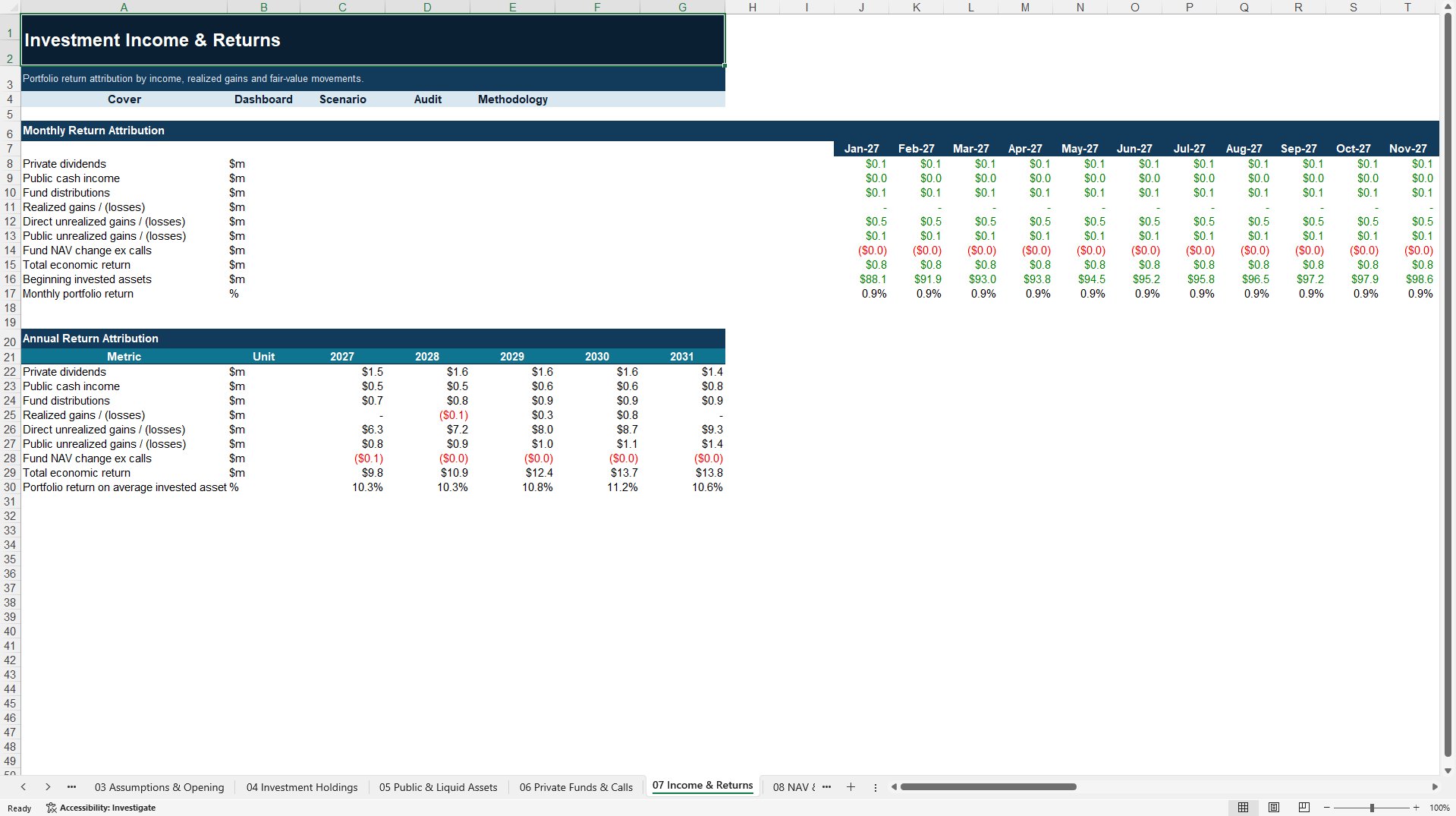
The forecast runs for 60 monthly periods from January 2027 through December 2031 and includes five annual summaries. The integrated financial statements cover Profit & Loss, Balance Sheet and Cash Flow. Dedicated schedules support direct/private holdings, public and liquid investments, private funds and capital calls, investment returns, NAV, liquidity, capital allocation, debt, scenario analysis, sensitivity analysis and concentration risk.
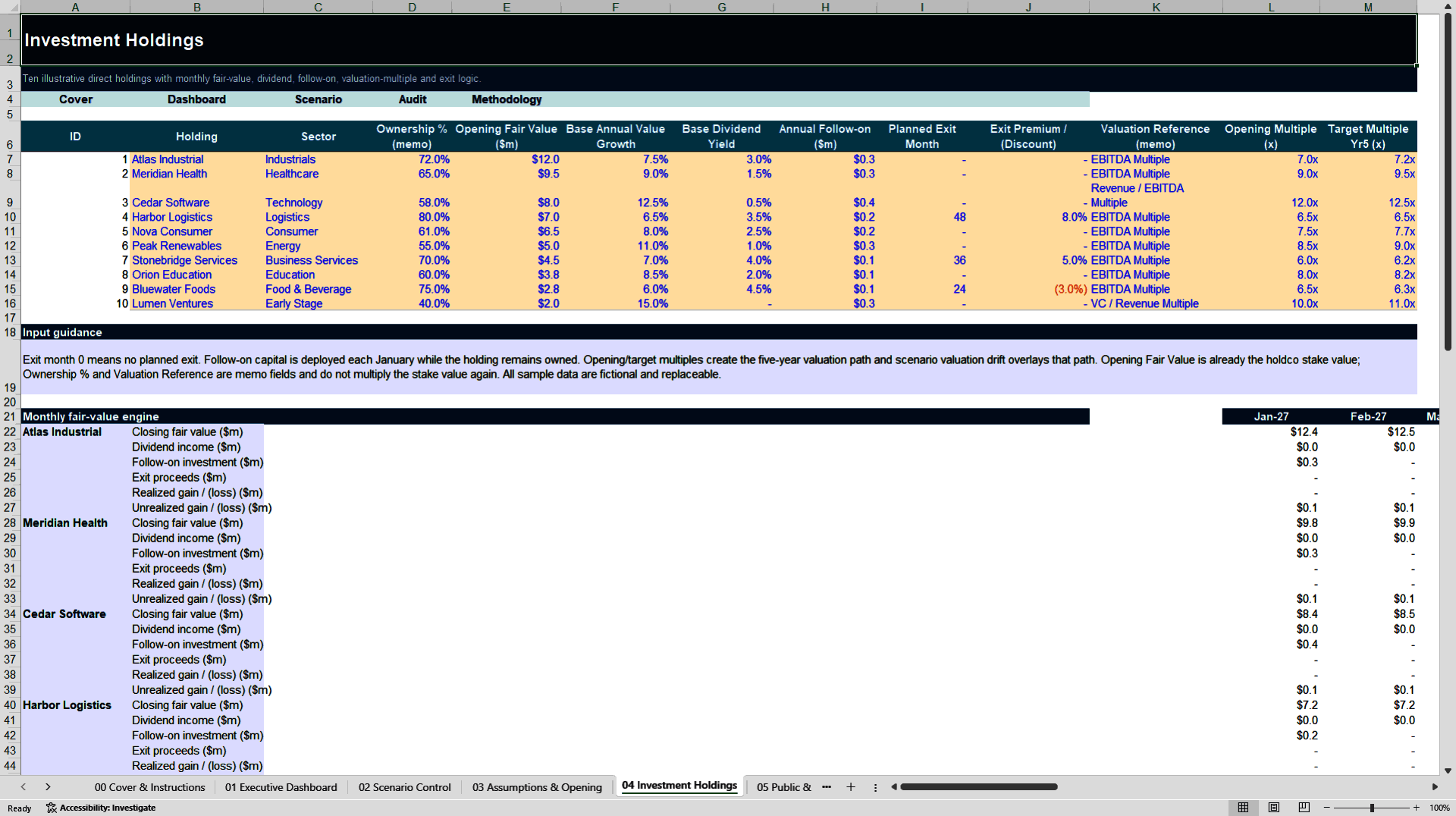
The illustrative direct-investment database contains ten holdings. Each holding can be updated for opening fair value, growth, dividend yield, follow-on investment, planned exit timing, exit premium or discount and an opening-to-target valuation-multiple path. The monthly calculation engine derives fair value, income, follow-ons, exit proceeds and realized and unrealized gains.
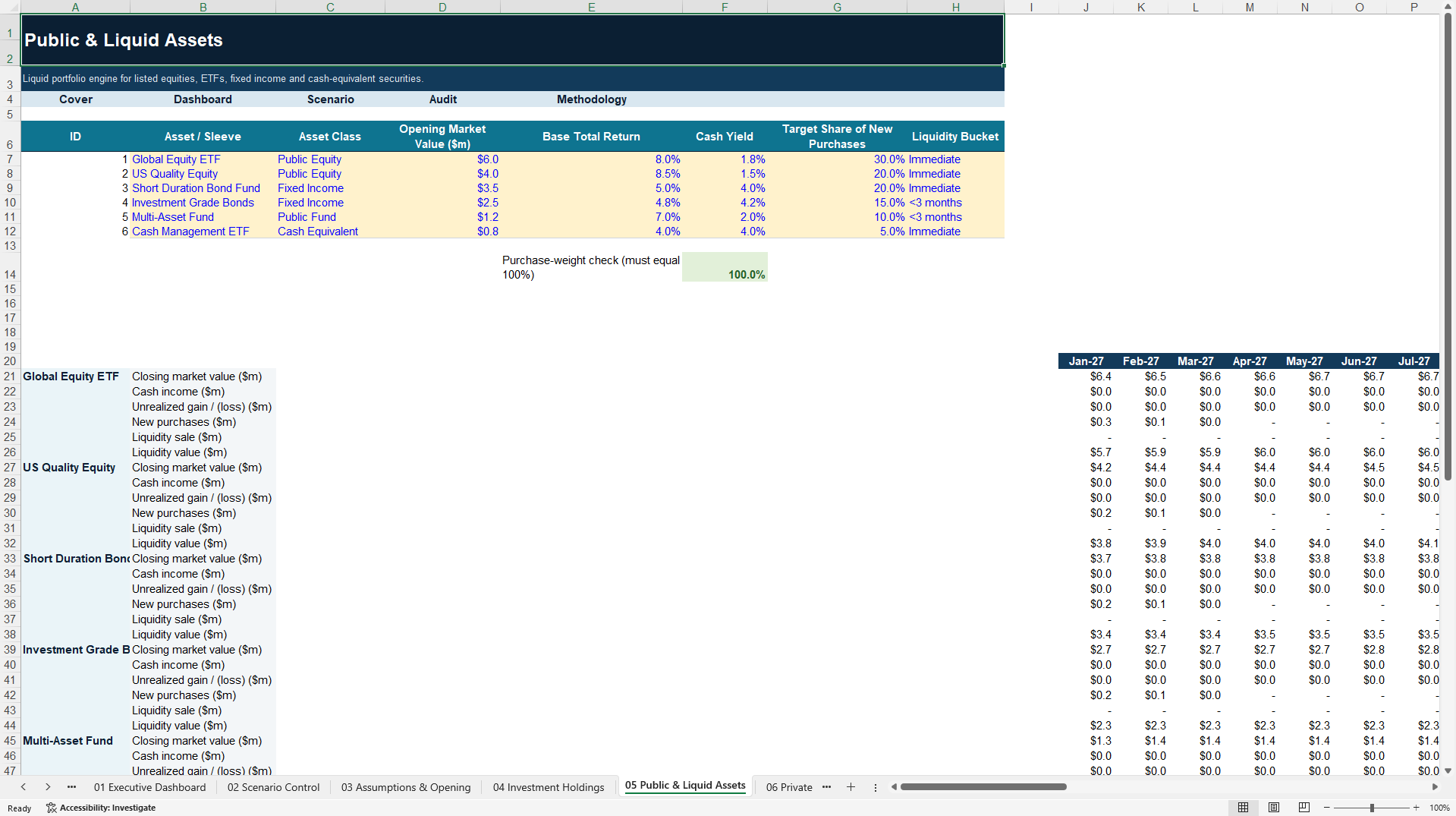
The public portfolio contains six editable investment sleeves with separate cash yield and market-return assumptions. The model can also use conservative liquid-asset sales when necessary to protect cash reserves. The private-fund schedule includes commitments, opening NAV, unfunded commitments, capital calls, distributions, return accrual and remaining unfunded capital.
A monthly capital-allocation waterfall prioritizes operating costs, taxes, follow-ons, capital calls, scheduled debt amortization and interest before discretionary public investment, optional debt repayment and shareholder distributions. Liquidity analysis combines cash, haircutted liquid public assets and remaining revolver capacity, while distribution capacity is calculated without treating new borrowing as distributable cash.
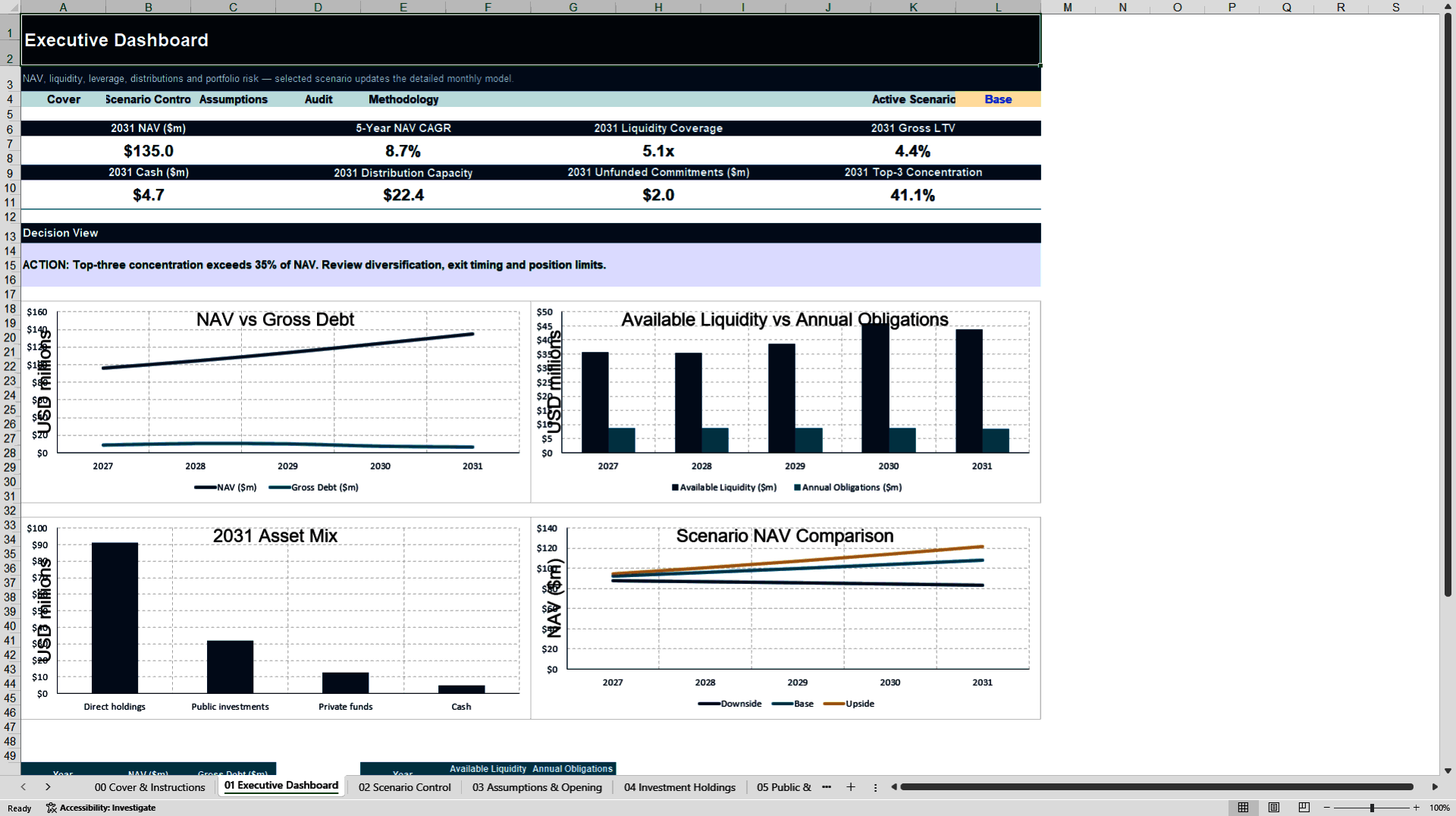
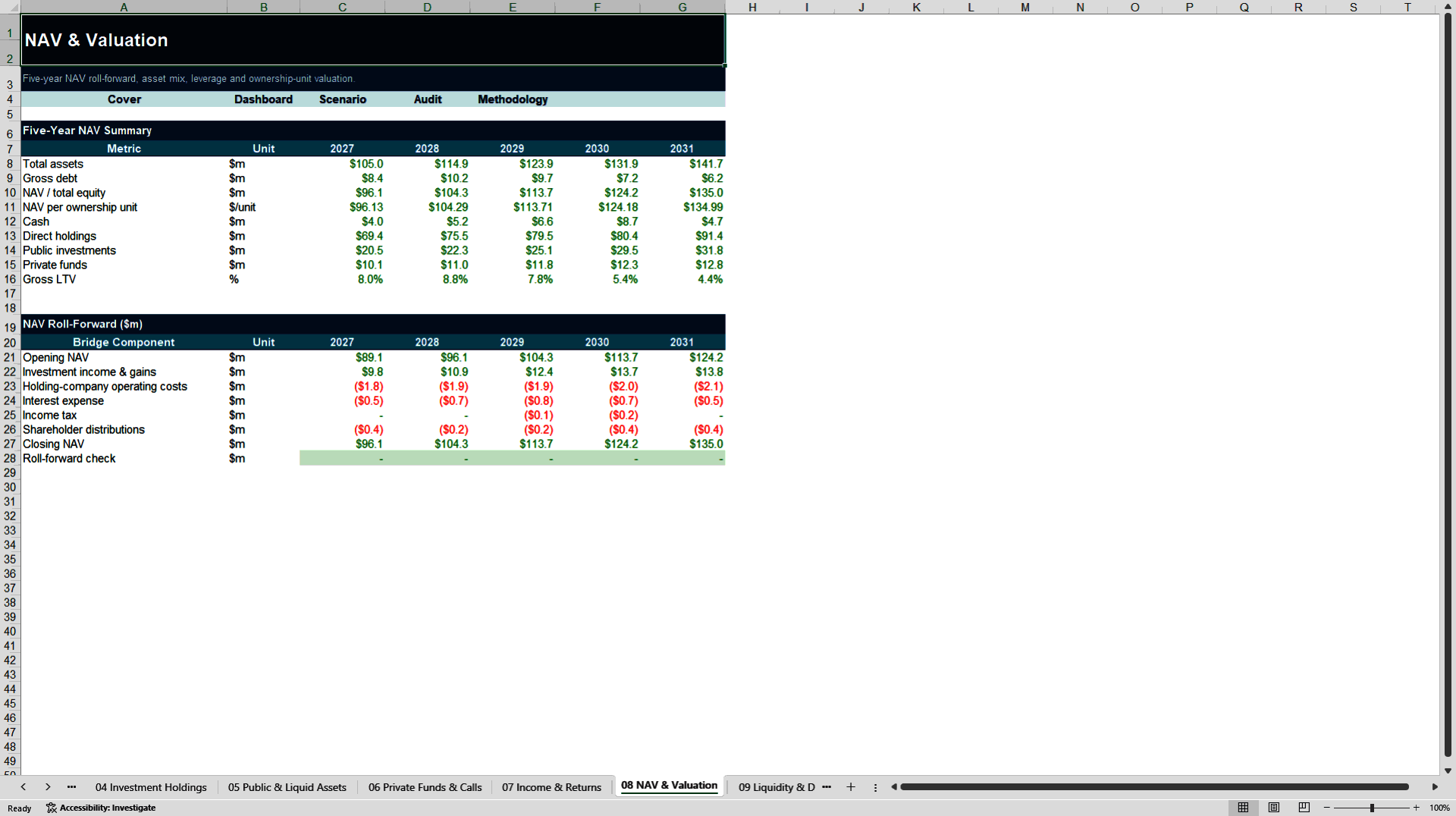
The Executive Dashboard summarizes NAV, five-year NAV CAGR, cash, liquidity coverage, gross LTV, unfunded commitments, distribution capacity and top-three concentration. Six native Excel charts show NAV versus debt, liquidity versus annual obligations, asset mix, scenario NAV, concentration and the liquidity ladder.
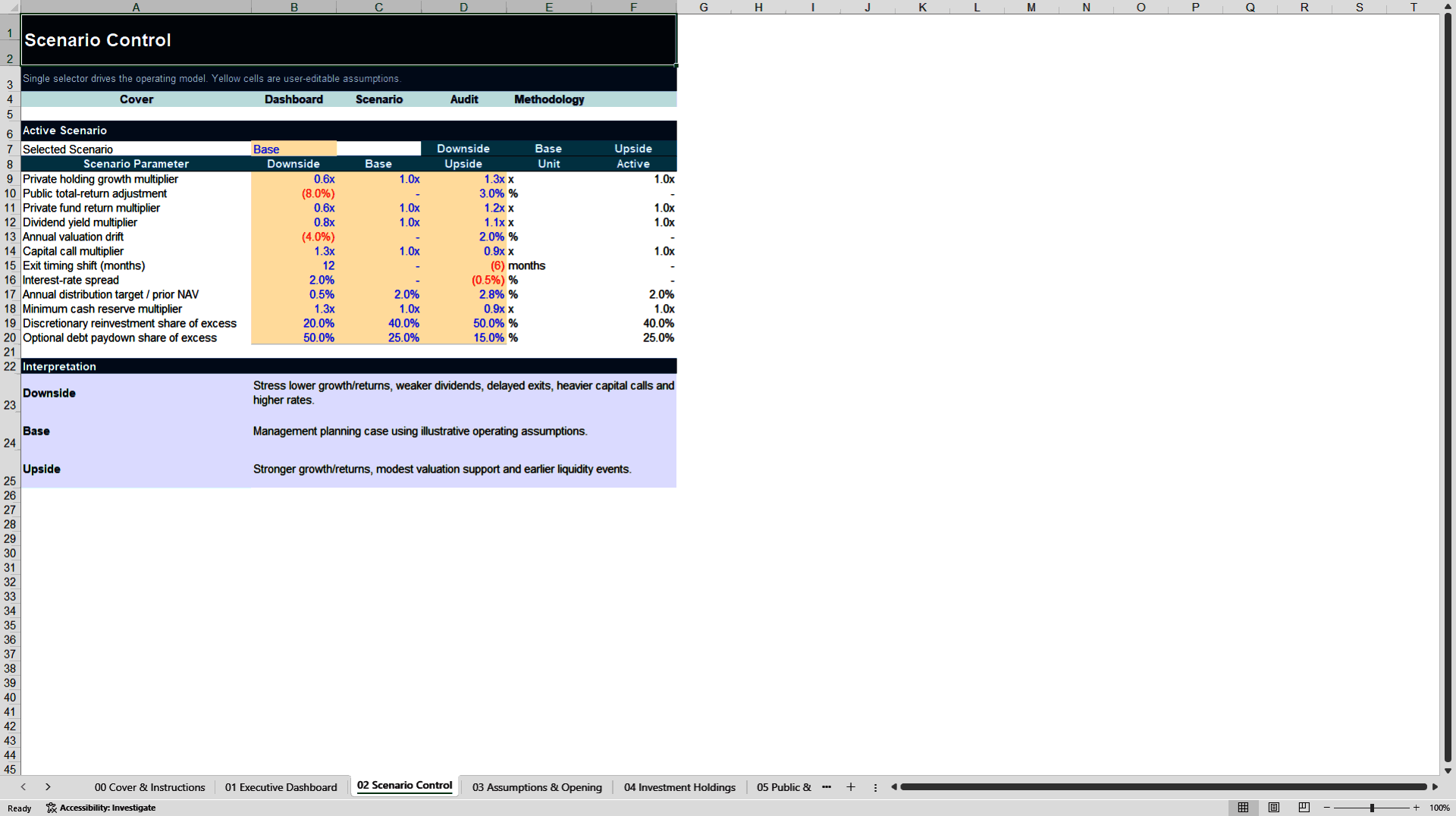
The model includes Downside, Base and Upside scenarios plus four sensitivity matrices covering NAV, distribution capacity, interest expense and exit proceeds. Twenty-two integrity checks test balance-sheet reconciliation, cash-flow reconciliation, NAV, debt limits, reserve protection, investment balances, commitments and valuation inputs.
Use this model for five-year planning, portfolio valuation, cash-flow forecasting, capital-call planning, leverage management, shareholder distribution decisions, scenario testing, sensitivity analysis and investment-committee or owner-level capital allocation. All sample data are illustrative and editable, allowing the workbook to be adapted to a specific investment holding company without rebuilding the model structure.
Got a question about the product? Email us at support@flevy.com or ask the author directly by using the "Ask the Author a Question" form. If you cannot view the preview above this document description, go here to view the large preview instead.
Source: Best Practices in Financial Modeling, Portfolio Management Excel: Investment Holding Company NAV & Liquidity Model Excel (XLSX) Spreadsheet, PDMM Financial Models
ABOUT THE AUTHOR

PDMM Financial Models develops professional, decision-ready Excel models for business owners, entrepreneurs, investors, consultants, analysts, and finance teams. Our objective is to transform complex business assumptions into clear, structured analysis that supports better planning and investment decisions.
Our models cover business planning, forecasting, budgeting, feasibility analysis,
... [read more]
Ask the Author a Question
You must be logged in to contact the author.




























