
 Click main image to view in full screen.
Investment Appraisal Model with Carbon Pricing – Excel XLSX
Excel (XLSX) + Excel (XLSX)


VIDEO DEMO
BENEFITS OF THIS DOWNLOADABLE EXCEL DOCUMENT
- User-friendly Excel model intended for the preparation of investment appraisals, including the impact of carbon pricing, for up to 3 investment options.
- The model helps to determine the financial viability and compare financial metrics for each investment option side by side, to assist the decision-making process.
ENERGY INDUSTRY EXCEL DESCRIPTION
An Investment Appraisal Model with Carbon Pricing is crucial for sustainable investments. It evaluates projects by incorporating carbon pricing, aiding in strategic planning and decision-making. This model supports investors in assessing the environmental impact and financial feasibility of projects. Accurate appraisals empower investors to make environmentally conscious decisions, adapt to carbon pricing mechanisms, and ensure sustainable profitability. It enhances financial stability, attracts eco-conscious investors, and supports long-term growth by aligning investment strategies with environmental objectives. This model is indispensable for both green investors and businesses, ensuring responsible and profitable investments in a carbon-constrained world.
PURPOSE OF MODEL
User-friendly Excel model intended for the preparation of investment appraisals, including the impact of carbon pricing, for up to 3 investment options. The model helps to determine the financial viability and compare financial metrics for each investment option side by side, to assist the decision-making process.
The model follows good practice financial modelling principles and includes instructions, checks and input validations.
KEY OUTPUTS
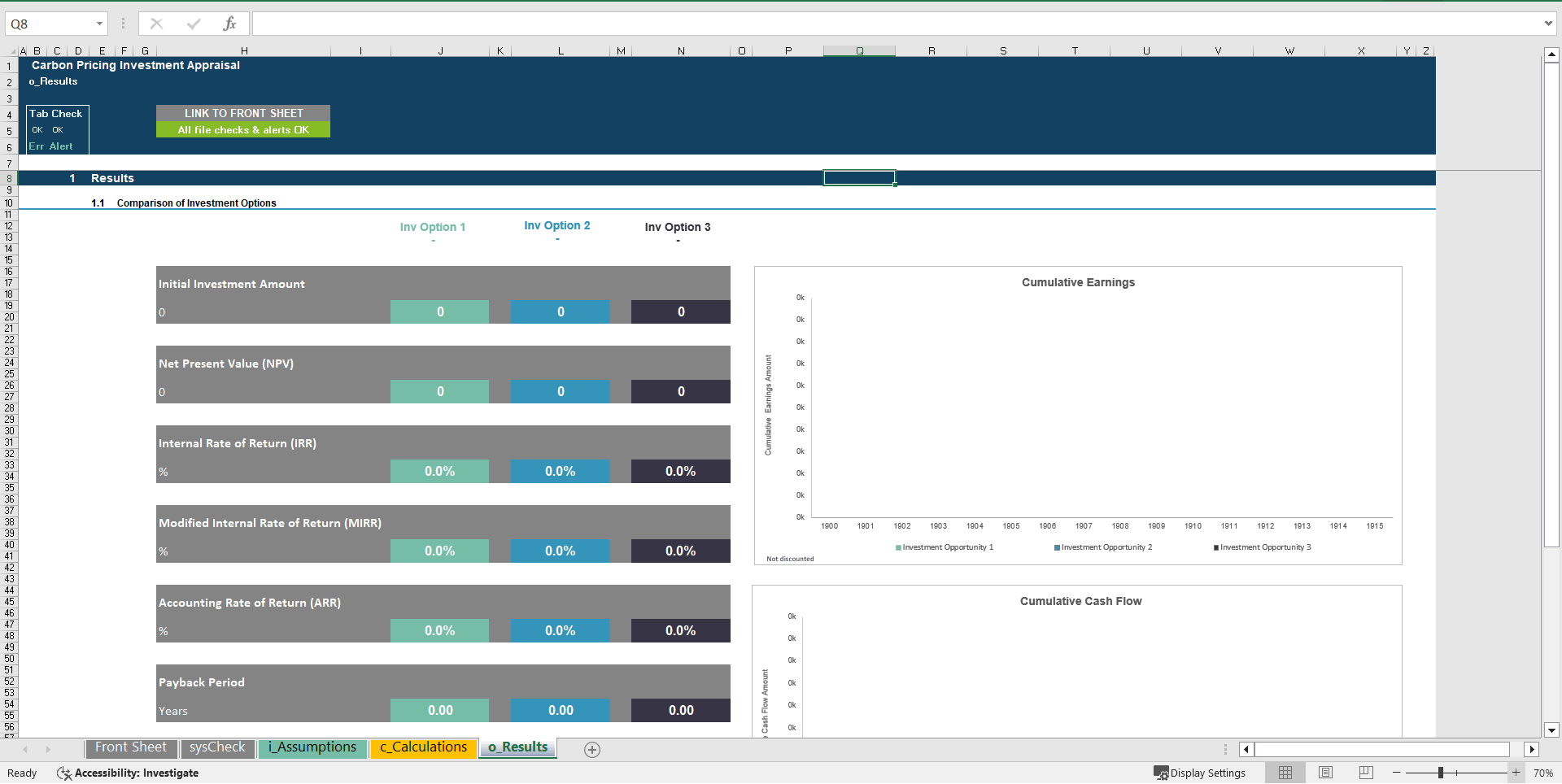
The model is generic and not industry-specific. It computes a number of key appraisal metrics for proposed project or investment including:
• Total one-off costs
• NPV
• IRR
• MIRR
• Accounting Rate of Return
• Payback
• Profitability Index
• Equivalent Annual Cost
Results also include tables showing the overall costs and benefits on a:
• Cash View – presents actual cash impacts of each investment option
• P&L View – presents P&L impacts of each investment option (eg depreciation for capitalizable investments rather than cash impact)
The Results tab also includes charts showing the cumulative net cash flow and net earnings over the investment period.
KEY INPUTS
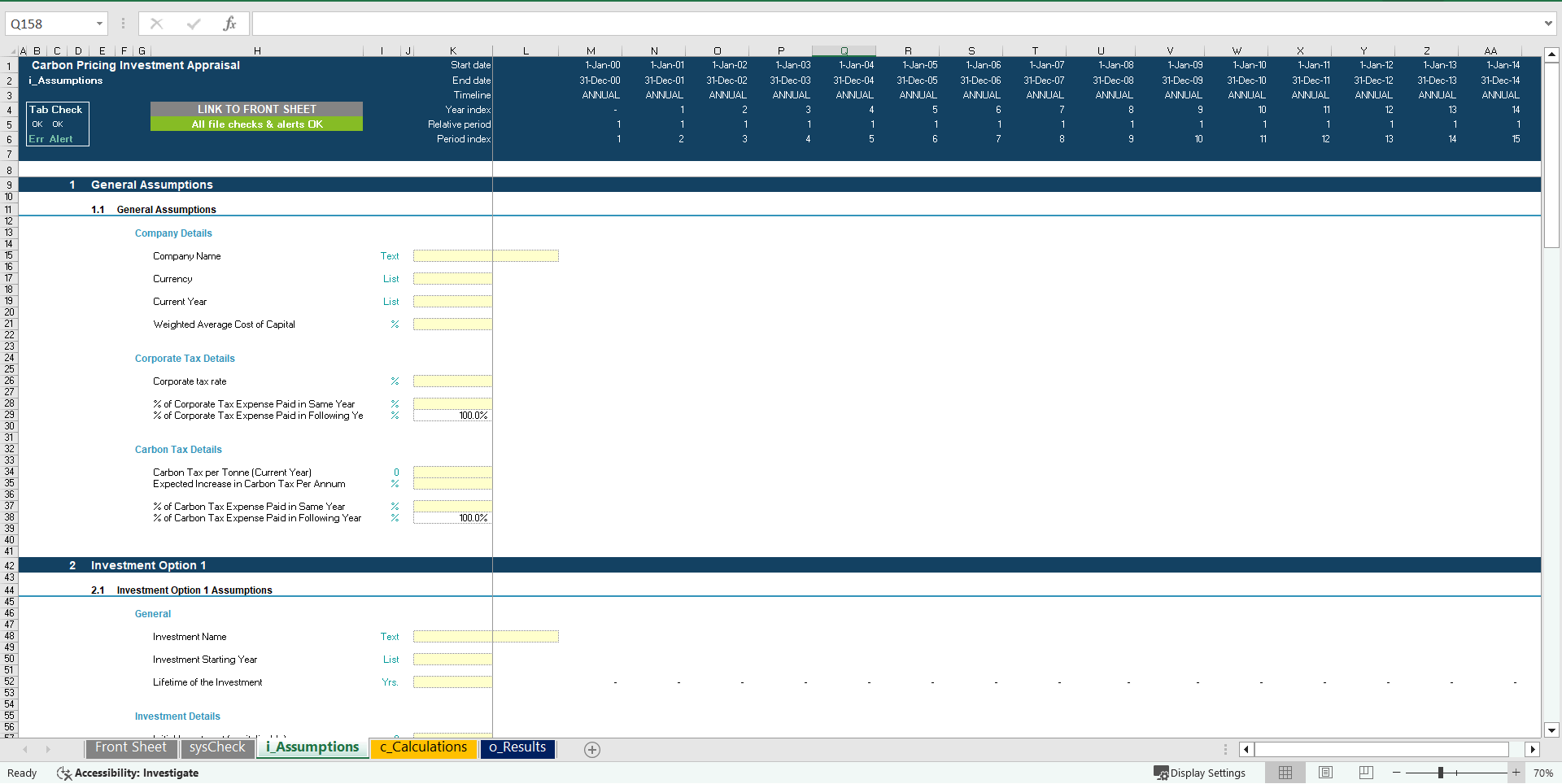
Inputs are split into general and investment related inputs.
General inputs are further split into:
• Company Name
• Currency
• Fist Projection Year
• Cost of Capital
• Corporate tax rate and payment assumptions
• Carbon tax details and payment assumptions
Investment Inputs for up to 3 separate investment options including:
• Investment Name
• Investment Starting period & Lifetime
• Initial investment amount (split into Capitalisable and Non-capitalisable)
• Impact of investment on Revenues
• Impact of investment on Costs
• Variable costs % of Revenues
• Working capital % of Revenue
• Carbon emissions and related details
MODEL STRUCTURE
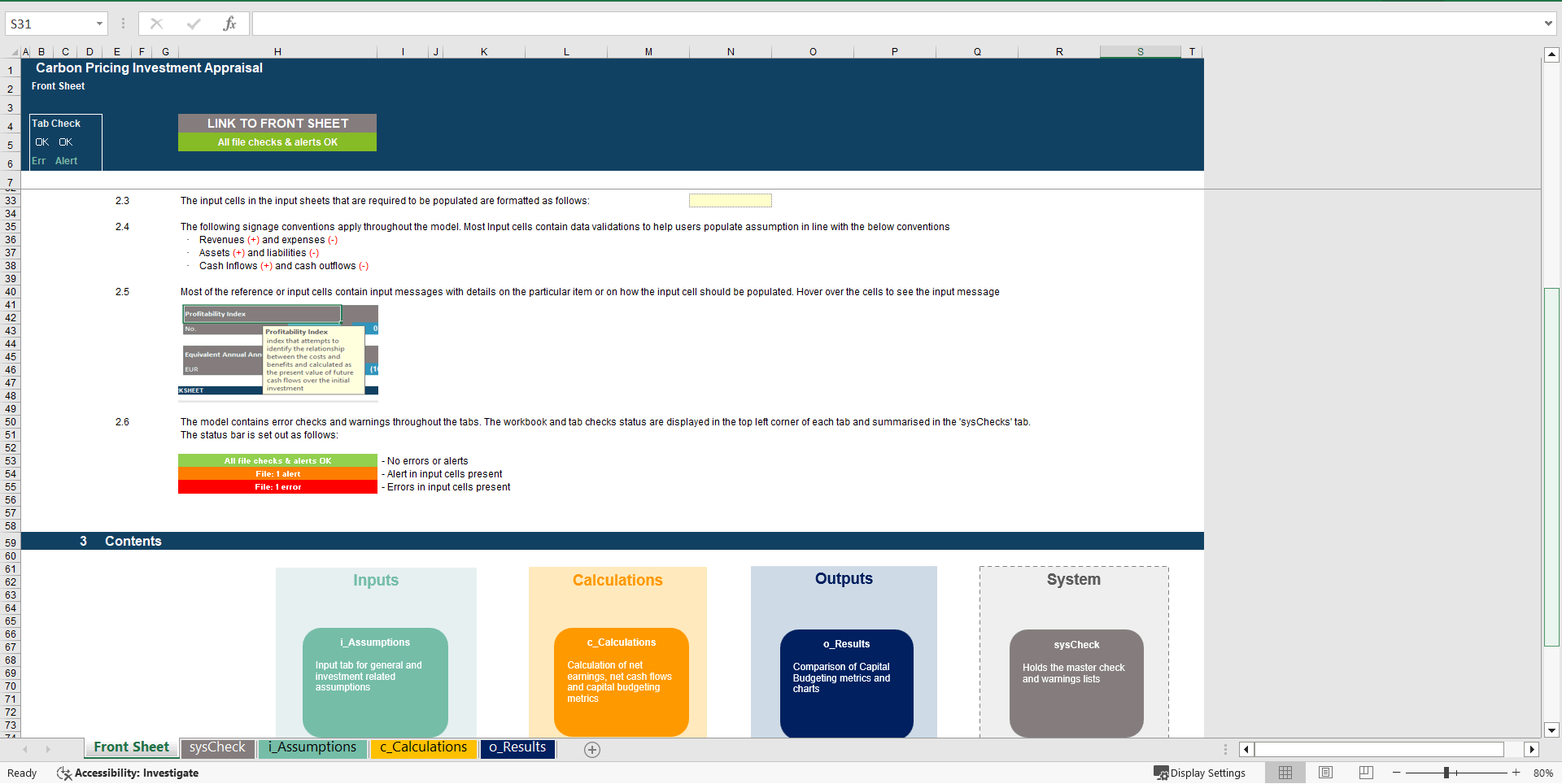
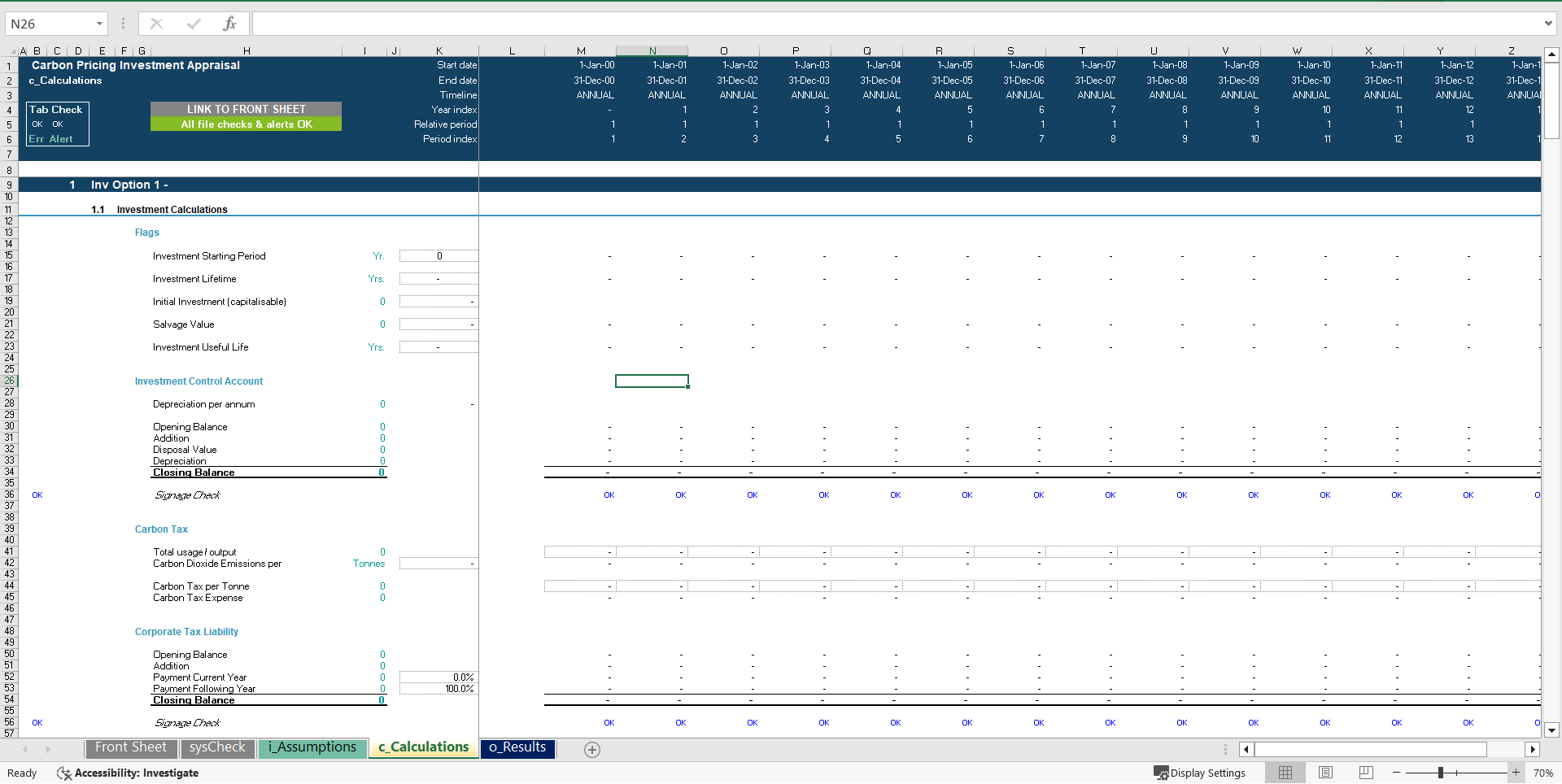
The model contains, 5 tabs split into input ('i_'), calculation ('c_'), output ('o_') and system tabs. The tabs to be populated by the user are the input tabs are the input tab ('i_Assumptions'). The calculation tab uses the user-defined inputs to calculate and produce the projection outputs which are presented in ‘o_Results' tab.
System tabs include the following:
• 'Front Sheet' containing a disclaimer, instructions and contents;
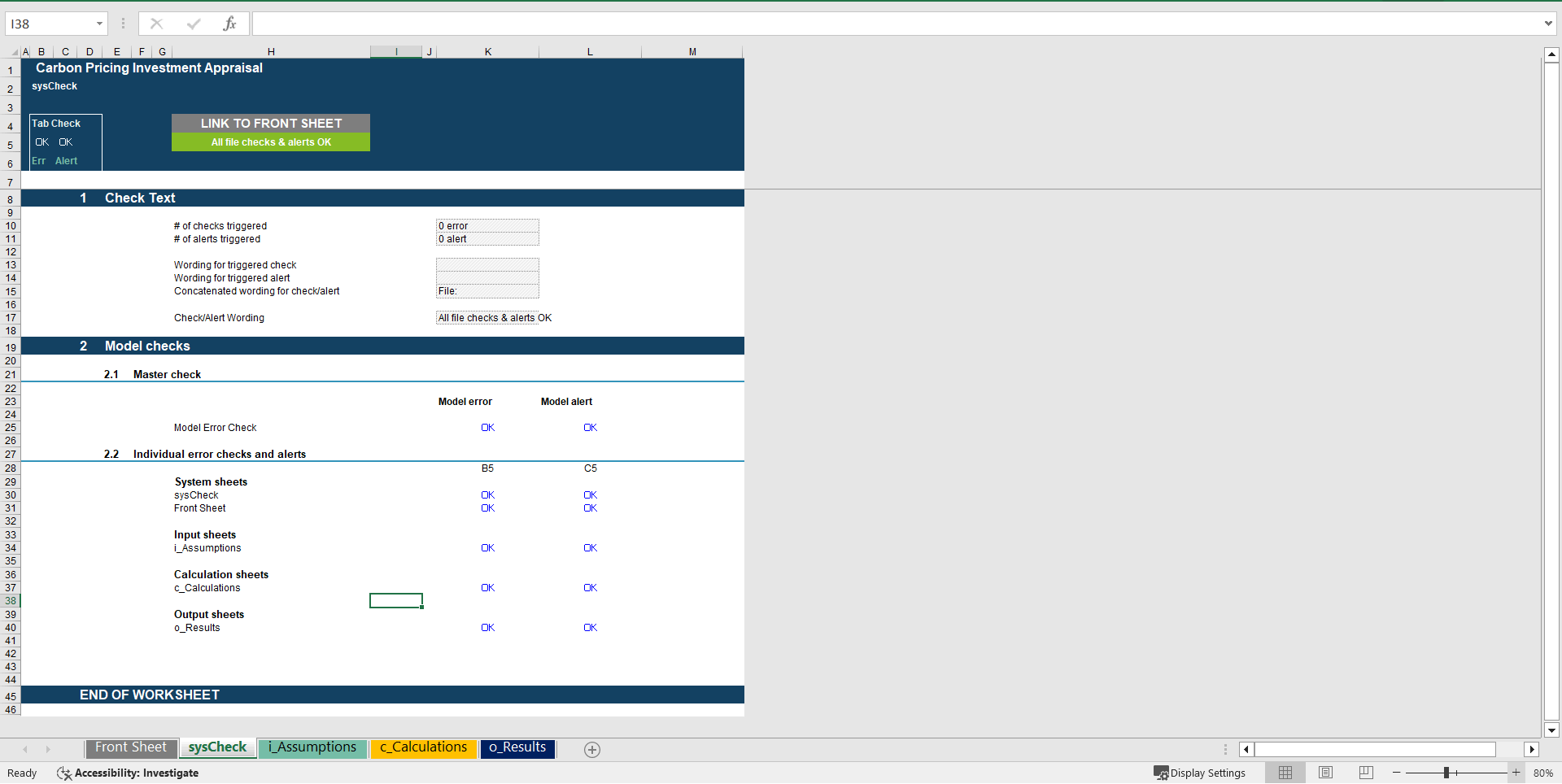
• Checks dashboard containing a summary of checks by tab.
KEY FEATURES
Other key features of this model include the following:
• The model follows best practice financial modelling guidelines and includes instructions, line item explanations, checks and input validations;
• The model is not password protected and can be modified as required following download;
• The model allows the user to model the cost and benefits for up to 3 investment options across a maximum of 15 years with annual inputs;
• Business name, currency and starting projection period are customisable;
• The model includes a checks dashboard which summarises all the checks included in the various tabs making it easier to identify any errors;
• The model includes checks and input validations to help ensure input fields are populated accurately.
Got a question about the product? Email us at support@flevy.com or ask the author directly by using the "Ask the Author a Question" form. If you cannot view the preview above this document description, go here to view the large preview instead.
TOPIC FAQ
What is carbon pricing and how should it be included in an investment appraisal?
Carbon pricing assigns a monetary cost to greenhouse gas emissions to reflect environmental externalities. In an appraisal, include carbon tax rates, emission volumes, and payment timing as input assumptions so the model converts emissions into cash or P&L impacts using the carbon tax details and payment assumptions.Which financial metrics should I focus on when evaluating investments that include carbon pricing?
Key appraisal metrics that capture investment viability and timing include NPV, IRR, MIRR, Accounting Rate of Return, Payback, Profitability Index, and Equivalent Annual Cost. Flevy's Investment Appraisal Model with Carbon Pricing computes these standard metrics for side-by-side comparison across options.How do Cash View and P&L View affect appraisal outcomes when carbon taxes are considered?
Cash View presents actual cash impacts including carbon tax payments as cash outflows, while P&L View shows accounting impacts such as depreciation that affect earnings, but not immediate cash. Presenting both views clarifies short-term cash burden versus accounting profitability for decision makers.What structure and error checks should a robust Excel appraisal model include?
A robust model separates inputs, calculations, and outputs, includes a front sheet with instructions, line-item explanations, input validations, and a checks dashboard summarizing tab-level checks. Flevy's model follows this approach, delivering a 5-tab structure and a checks dashboard for validation.How should budget, timeline, and team size influence my choice of an investment appraisal template?
Choose a template whose scope matches your project scale: number of options to compare, projection horizon, and level of validation required. Prefer templates that are editable, include instructions and checks, and support your projection length — for example, models that support up to 3 investment options across 15 years.Can a generic investment appraisal model be adapted to industry-specific projects, and what speeds adaptation?
Generic models can be adapted if they allow customizable inputs (business name, currency, start year) and annual data entry, and include clear instructions and unprotected worksheets for modification. Those features reduce friction when tailoring the model to sector-specific cash flows and assumptions.I need to compare 3 renewable projects with different carbon emissions—how can I structure the analysis?
Structure a side-by-side appraisal with separate investment inputs for each project: starting period and lifetime, initial capitalizable/non-capitalizable spend, revenue and cost impacts, variable-cost and working-capital percentages, plus emissions and carbon tax assumptions. Use a model that supports up to 3 separate investment options.How should I model carbon tax payments and timing in a cash flow projection?
Capture carbon taxes as explicit cash outflows by adding carbon emissions and the applicable carbon tax rate and payment schedule to the cash flow projection. Include related payment assumptions and tax timing so the Cash View reflects actual payments and the P&L view shows accounting treatment where relevant.Source: Best Practices in Energy Industry Excel: Investment Appraisal Model with Carbon Pricing Excel (XLSX) Spreadsheet, Projectify
ABOUT THE AUTHOR

We are financial modelling professionals, accountants and CFA charterholders with experience working within Deloitte supporting clients with their financial planning and decision support needs. Our aim is to provide robust and easy-to-use financial models that follow good practice financial modelling guidelines and assist individuals and businesses with key financial planning and analysis ... [read more]
Ask the Author a Question
You must be logged in to contact the author.