
Finance and Valuation Basics   42-slide PPT PowerPoint presentation slide deck (PPT)
$40.00

Finance and Valuation Basics (42-slide PPT PowerPoint presentation slide deck (PPT)) Preview Image
Log in to unlock full preview.
Finance and Valuation Basics (42-slide PPT PowerPoint presentation slide deck (PPT)) Preview Image
Arrow   Click main image to view in full screen.

Finance and Valuation Basics (PowerPoint PPT Slide Deck)

PowerPoint (PPT) 42 Slides

Top 1,000 Best Practice $40.00

Add to Cart


Immediate download
Free lifetime updates

M&A PPT DESCRIPTION

Editor Summary Finance and Valuation Basics is a 42-slide PowerPoint training module adapted from global consulting firm training, covering financial statement analysis, ratio analysis, capital markets, WACC, DCF valuation (four-step process), and comparable analysis. Read more

This document explains the basics of financial analysis. It explains financial statements, financial ratios/comparables, and capital markets. This training presentation has been adopted from the ones used at global consulting firms.

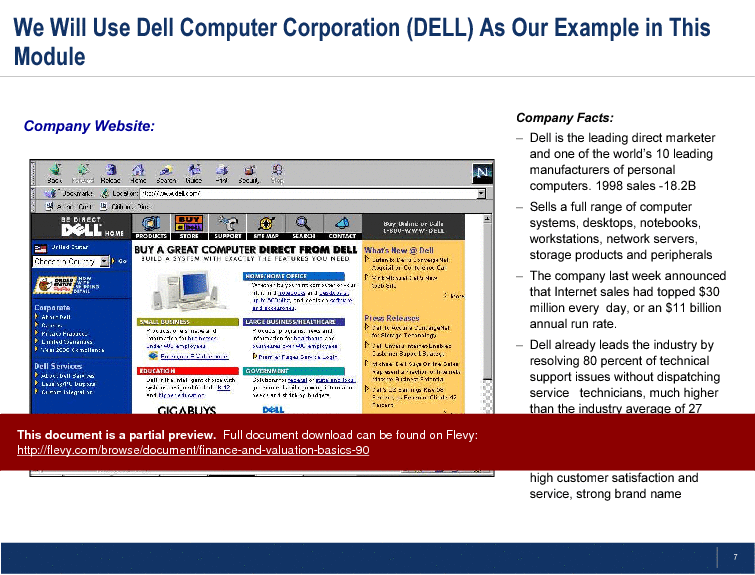
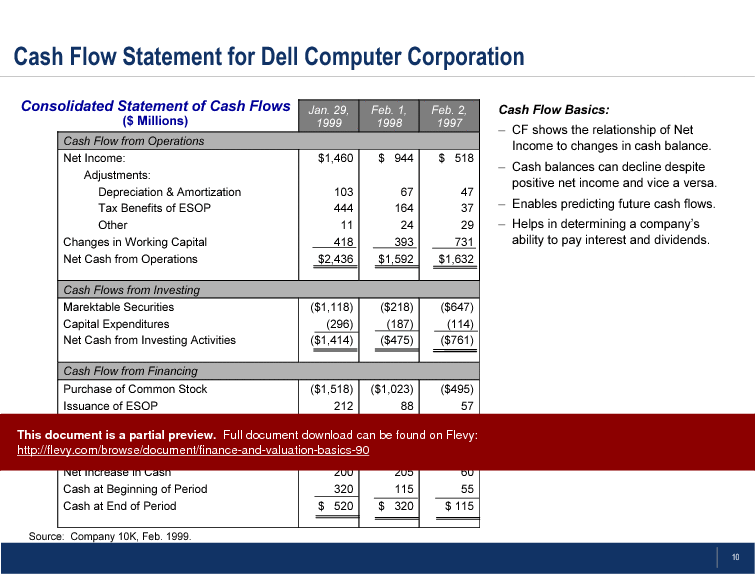
Dive deep into the intricacies of financial analysis with real-world examples from Dell Computer Corporation. This presentation meticulously dissects Dell's financial statements, offering a comprehensive look at their cash flow statements and key financial ratios. Gain insights into how Dell's strategic financial decisions have shaped their market position and operational efficiency.

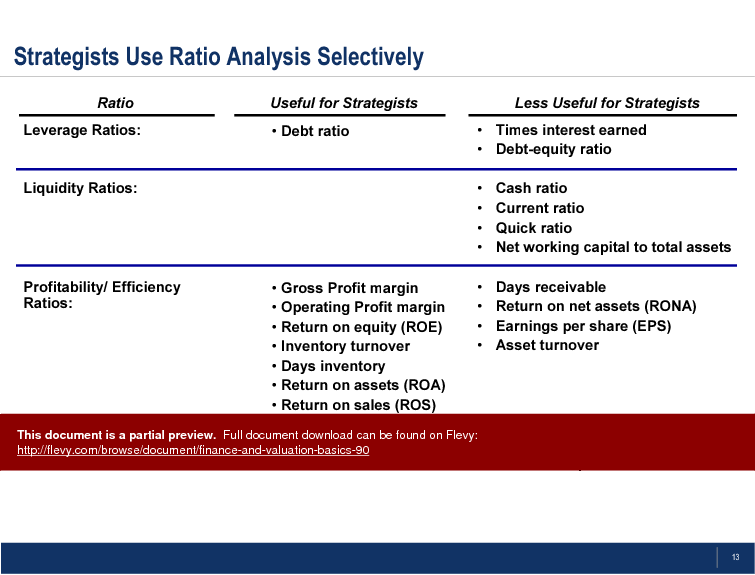
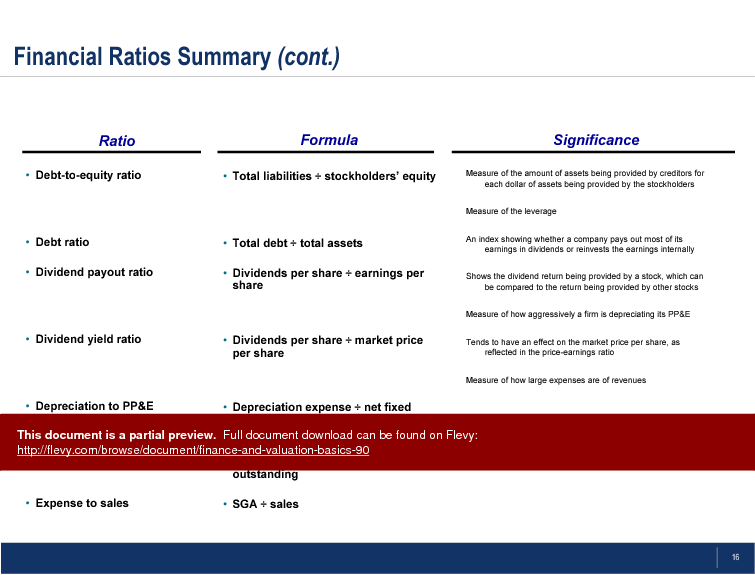
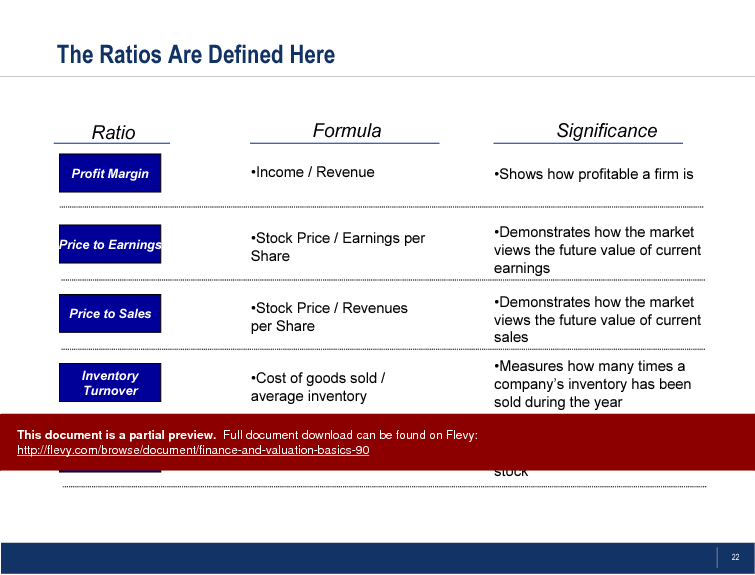
Understand the nuances of ratio analysis and its selective application for strategists. The document highlights the most impactful ratios, such as debt ratio and return on equity, and explains their significance in evaluating a company's financial health. This section is crucial for executives aiming to leverage financial metrics for strategic planning and decision-making.

Explore advanced valuation techniques, including the discounted cash flow (DCF) analysis, to estimate the intrinsic value of a company. The presentation covers the four-step DCF process, common pitfalls, and the importance of accurate cash flow forecasting. Equip yourself with the knowledge to make informed investment decisions and uphold shareholder value through rigorous financial analysis.

Got a question about the product? Email us at support@flevy.com or ask the author directly by using the "Ask the Author a Question" form. If you cannot view the preview above this document description, go here to view the large preview instead.

MARCUS OVERVIEW

This synopsis was written by Marcus [?] based on the analysis of the full 42-slide presentation.


Executive Summary
The "Finance and Valuation Basics" presentation is a comprehensive training module designed for professionals seeking to master financial analysis and valuation techniques. Drawing from the rigorous training methodologies of a leading global consulting firm, this presentation equips users with essential skills in financial statement analysis, ratio analysis, and valuation methods such as Discounted Cash Flow (DCF) and comparable analysis. Participants will gain insights into capital markets, the cost of capital, and the intricacies of firm valuation, using Dell Computer Corporation as a case study to illustrate key concepts.

Who This Is For and When to Use
•  Corporate finance professionals seeking to enhance their analytical skills
•  Strategy consultants involved in financial assessments and valuations
•  Investment analysts looking to refine their valuation techniques
•  Business leaders aiming to understand financial health through analysis

Best-fit moments to use this deck:
•  During financial training sessions for new analysts
•  In workshops focused on corporate valuation and investment strategies
•  When preparing for strategic planning and financial forecasting sessions

Learning Objectives
•  Define the importance of financial analysis in strategic decision-making
•  Analyze financial statements to assess a company's operational health
•  Calculate and interpret key financial ratios for performance evaluation
•  Apply valuation techniques, including DCF and comparable analysis
•  Understand the dynamics of capital markets and the cost of capital
•  Develop skills to forecast future cash flows and assess firm value

Table of Contents
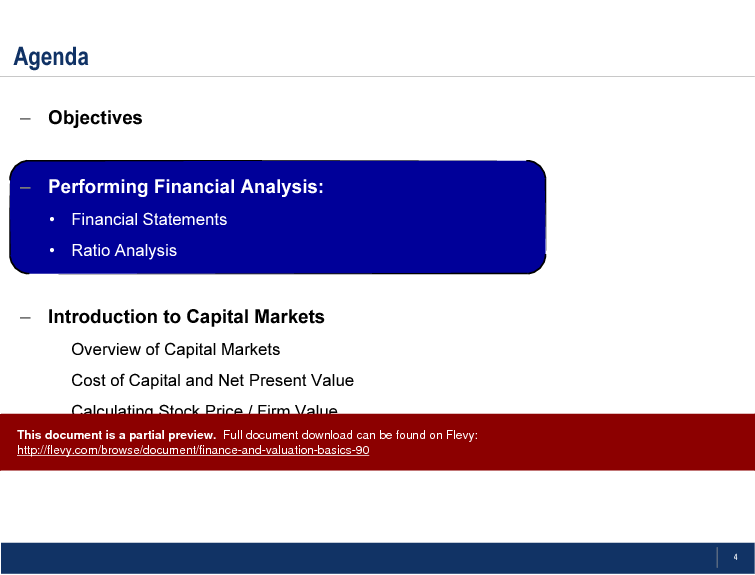
•  Objectives (page 2)
•  Performing Financial Analysis: Financial Statements (page 6)
•  Performing Financial Analysis: Ratio Analysis (page 11)
•  Introduction to Capital Markets (page 24)
•  Cost of Capital and Net Present Value (page 26)
•  Calculating Stock Price / Firm Value (page 35)
•  Comparable Analysis (page 39)
•  Key Lessons (page 41)
•  Recommended Books and Resources (page 42)

Primary Topics Covered
•  Financial Statements - Overview of the 3 major financial statements: income statement, balance sheet, and cash flow statement, detailing their roles in assessing a company's financial health.
•  Ratio Analysis - Introduction to key financial ratios, including leverage, liquidity, profitability, and market value ratios, and their significance in financial analysis.
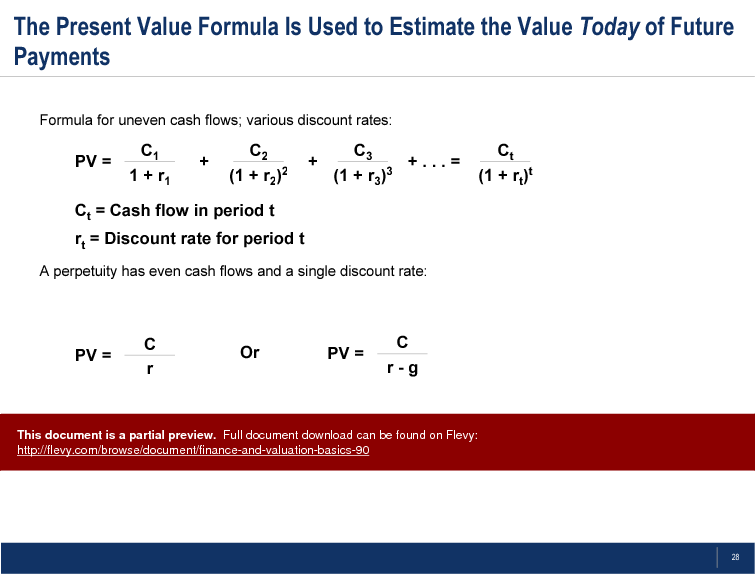
•  Cost of Capital - Explanation of the Weighted Average Cost of Capital (WACC) and its implications for investment decisions and valuation.
•  Discounted Cash Flow (DCF) - Methodology for calculating the present value of future cash flows to determine firm value.
•  Comparable Analysis - Techniques for evaluating a firm's performance relative to its peers in the industry.
•  Dell Case Study - Application of financial analysis concepts using Dell Computer Corporation as a practical example to illustrate key points.

Deliverables, Templates, and Tools
•  Financial statement analysis template for assessing operational health
•  Ratio analysis worksheet for calculating and interpreting key ratios
•  DCF model template for estimating firm value based on future cash flows
•  Comparable analysis framework for benchmarking against industry peers
•  Capital markets overview document for understanding funding mechanisms
•  Summary of key financial metrics for quick reference

Slide Highlights
•  Overview of financial statements and their interconnections
•  Detailed explanation of key financial ratios and their interpretations
•  Visual representation of the DCF methodology and its components
•  Comparative analysis of Dell against its competitors
•  Key lessons learned from financial analysis and valuation practices

Potential Workshop Agenda
Introduction to Financial Analysis (60 minutes)
•  Overview of financial statements and their importance
•  Introduction to financial ratios and their applications

Hands-on Ratio Analysis (90 minutes)
•  Calculation of key ratios using sample data
•  Group discussion on insights derived from ratio analysis

Valuation Techniques Workshop (120 minutes)
•  Deep dive into DCF and comparable analysis methodologies
•  Case study application using Dell Computer Corporation

Customization Guidance
•  Tailor the financial statement analysis template to reflect your specific industry metrics
•  Adjust the ratio analysis worksheet to include ratios relevant to your organization
•  Modify the DCF model to incorporate your company's unique cash flow projections
•  Update the comparable analysis framework with industry-specific competitors

Secondary Topics Covered
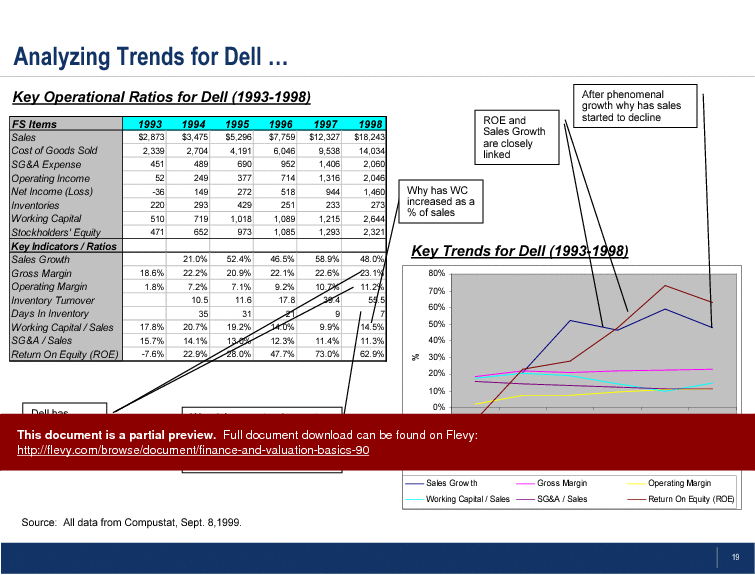
•  Trends in financial performance over time
•  The significance of cash flow in financial analysis
•  The role of economic value in investment decisions
•  Best practices for financial forecasting and analysis

Topic FAQ

What are the core steps in a DCF valuation that I should teach junior analysts?

A DCF valuation begins by forecasting operating cash flows, adjusting for working capital and capex, selecting an appropriate discount rate, and calculating present value to estimate firm value. The document describes this as a four-step DCF process with common pitfalls and forecasting emphasis, concluding with the four-step DCF process.

Which financial statements are essential for assessing a company's operational health?

The 3 essential statements are the income statement (profitability), the balance sheet (assets, liabilities, equity), and the cash flow statement (cash generation and uses). Each offers distinct insights for analysis and interconnects with ratio and valuation work, specifically the income statement, balance sheet, and cash flow statement.

How is WACC calculated and why does it matter for valuation?

WACC is calculated by weighting the after-tax cost of debt and the cost of equity according to the company’s capital structure, then averaging those costs. It serves as the discount rate in DCF valuations and affects investment and valuation decisions using the WACC calculation method.

What should I look for when buying a finance & valuation training deck for my team?

Prioritize decks that cover financial statements, focused ratio analysis, DCF and comparable valuation techniques, include editable templates, and offer a practical case study for hands-on exercises. Flevy's Finance and Valuation Basics explicitly lists templates, a DCF model, and a Dell case study to support workshops and training with concrete templates.

How can I structure a half-day workshop to teach ratio analysis and valuation basics?

Begin with a 60-minute overview of the 3 financial statements and key ratio definitions, follow with a 90-minute hands-on ratio calculation and interpretation session using sample data, and conclude with a 120-minute valuation workshop applying DCF and comparables to a case study like Dell, ending with the Dell case study.

Which financial ratios are most relevant for strategic decision-making?

Focus on leverage ratios (debt-related), liquidity ratios (short-term coverage), profitability ratios (gross, operating margins, ROE), and market-value ratios (P/E, market capitalization) because they link operational performance to capital structure and investor perspective — specifically debt ratio and return on equity are highlighted.

Are pre-built templates and models worth purchasing for a small finance team on a tight timeline?

Pre-built templates can reduce setup time, ensure consistent methodology, and provide workshop-ready materials; the deck lists editable deliverables including a financial statement analysis template, ratio worksheet, DCF model template, and comparable analysis framework that teams can customize for their industry and forecasts.

How do I perform a comparable company analysis to benchmark valuation?

Select peer firms in the same industry, collect equivalent financial metrics (margins, growth, leverage, market multiples), normalize for non-recurring items, and apply relevant multiples to your target’s metrics. The presentation includes a comparable analysis framework and an applied Dell peer comparison for guidance.

Document FAQ
These are questions addressed within this presentation.

What are the key financial statements?
The 3 key financial statements are the income statement, balance sheet, and cash flow statement, each providing unique insights into a company's financial health.

How do I calculate WACC?
WACC is calculated by taking the proportion of debt and equity in a company's capital structure, adjusting the cost of debt for taxes, and averaging the costs to determine the overall cost of capital.

What is the purpose of ratio analysis?
Ratio analysis helps assess a company's performance by comparing financial metrics over time or against industry benchmarks, providing insights into operational efficiency and financial health.

How is DCF used in valuation?
DCF is used to estimate the value of an investment based on its expected future cash flows, discounted back to their present value using the cost of capital.

What is comparable analysis?
Comparable analysis involves evaluating a company's financial metrics against those of similar firms in the industry to assess relative performance and valuation.

Why is cash flow important?
Cash flow is crucial as it indicates a company's ability to meet its obligations, invest in growth, and provide returns to shareholders, making it a key focus in financial analysis.

How can I apply these concepts in my role?
These concepts can be applied to enhance financial decision-making, improve investment analysis, and support strategic planning within your organization.

What resources are recommended for further learning?
Recommended resources include "Creating Shareholder Value" by Alfred Rappaport and "Valuation: Measuring and Managing the Value of Companies" by Copeland, Koller, and Murrin.

Glossary
•  WACC - Weighted Average Cost of Capital, the average rate of return a company is expected to pay its security holders.
•  DCF - Discounted Cash Flow, a valuation method used to estimate the value of an investment based on its expected future cash flows.
•  Financial Ratios - Metrics used to evaluate a company's financial performance and condition.
•  Comparable Analysis - A valuation method that compares a company's financial metrics to those of similar firms.
•  Net Present Value (NPV) - The difference between the present value of cash inflows and outflows over a period of time.
•  Liquidity Ratios - Ratios that measure a company's ability to cover its short-term obligations.
•  Profitability Ratios - Ratios that assess a company's ability to generate profit relative to its revenue, assets, or equity.
•  Market Value Ratios - Ratios that evaluate a company's share price relative to its earnings or book value.
•  Leverage Ratios - Ratios that measure the degree of a company's debt relative to its equity.
•  Cash Flow - The total amount of money being transferred into and out of a business.
•  Income Statement - A financial statement that reports a company's revenues and expenses over a specific period.
•  Balance Sheet - A financial statement that summarizes a company's assets, liabilities, and shareholders' equity at a specific point in time.
•  Statement of Cash Flows - A financial statement that provides aggregate data regarding all cash inflows and outflows a company receives.
•  Operating Income - Earnings before interest and taxes, a measure of a company's profitability from its core business operations.
•  EBITDA - Earnings Before Interest, Taxes, Depreciation, and Amortization, a measure of a company's overall financial performance.
•  Return on Equity (ROE) - A measure of financial performance calculated by dividing net income by shareholders' equity.
•  Gross Margin - A company's revenue minus its cost of goods sold, expressed as a percentage of revenue.
•  Operating Margin - A measure of profitability that indicates how much of a company's revenue is left over after paying for variable costs of production.
•  Price-to-Earnings Ratio (P/E) - A ratio used to value a company, calculated by dividing the current share price by its earnings per share (EPS).
•  Market Capitalization - The total market value of a company's outstanding shares of stock.
•  Shareholder Value - The value delivered to shareholders as a result of the management's ability to grow earnings, dividends, and share price.
•  Economic Value Added (EVA) - A measure of a company's financial performance that shows the net profit after deducting the cost of capital.

M&A PPT SLIDES

Understanding WACC and Its Impact on Capital Structure

Understanding Shareholder Value through Financial Metrics

Core Financial Statements for Business Health Assessment

Understanding the Stages of a Company's Life Cycle

Operational Performance Analysis of Dell (1993-1998)

Source: Best Practices in M&A, Valuation PowerPoint Slides: Finance and Valuation Basics PowerPoint (PPT) Presentation Slide Deck, alex


$40.00

Add to Cart
  

ABOUT THE AUTHOR

Author: alex
Additional documents from author: 3

Ask the Author a Question

You must be logged in to contact the author.

Click here to log in Click here register

Did you know?
The average daily rate of a McKinsey consultant is $6,625 (not including expenses). The average price of a Flevy document is $65.


Trusted by over 10,000+ Client Organizations
Since 2012, we have provided business templates to over 10,000 businesses and organizations of all sizes, from startups and small businesses to the Fortune 100, in over 130 countries.
AT&T GE Cisco Intel IBM Coke Dell Toyota HP Nike Samsung Microsoft Astrazeneca JP Morgan KPMG Walgreens Walmart 3M Kaiser Oracle SAP Google E&Y Volvo Bosch Merck Fedex Shell Amgen Eli Lilly Roche AIG Abbott Amazon PwC T-Mobile Broadcom Bayer Pearson Titleist ConEd Pfizer NTT Data Schwab


Read Customer Testimonials

 
"As a small business owner, the resource material available from FlevyPro has proven to be invaluable. The ability to search for material on demand based our project events and client requirements was great for me and proved very beneficial to my clients. Importantly, being able to easily edit and tailor "

– Michael Duff, Managing Director at Change Strategy (UK)
 
"One of the great discoveries that I have made for my business is the Flevy library of training materials.

As a Lean Transformation Expert, I am always making presentations to clients on a variety of topics: Training, Transformation, Total Productive Maintenance, Culture, Coaching, Tools, Leadership Behavior, etc. Flevy "

– Ed Kemmerling, Senior Lean Transformation Expert at PMG
 
"I like your product. I'm frequently designing PowerPoint presentations for my company and your product has given me so many great ideas on the use of charts, layouts, tools, and frameworks. I really think the templates are a valuable asset to the job."

– Roberto Fuentes Martinez, Senior Executive Director at Technology Transformation Advisory
 
"I have used Flevy services for a number of years and have never, ever been disappointed. As a matter of fact, David and his team continue, time after time, to impress me with their willingness to assist and in the real sense of the word. I have concluded in fact "

– Roberto Pelliccia, Senior Executive in International Hospitality
 
"Last Sunday morning, I was diligently working on an important presentation for a client and found myself in need of additional content and suitable templates for various types of graphics. Flevy.com proved to be a treasure trove for both content and design at a reasonable price, considering the time I "

– M. E., Chief Commercial Officer, International Logistics Service Provider
 
"Flevy is our 'go to' resource for management material, at an affordable cost. The Flevy library is comprehensive and the content deep, and typically provides a great foundation for us to further develop and tailor our own service offer."

– Chris McCann, Founder at Resilient.World
 
"FlevyPro provides business frameworks from many of the global giants in management consulting that allow you to provide best in class solutions for your clients."

– David Harris, Managing Director at Futures Strategy
 
"As a young consulting firm, requests for input from clients vary and it's sometimes impossible to provide expert solutions across a broad spectrum of requirements. That was before I discovered Flevy.com.

Through subscription to this invaluable site of a plethora of topics that are key and crucial to consulting, I "

– Nishi Singh, Strategist and MD at NSP Consultants


Customers Also Bought These Documents


Customers Also Like These Documents

Explore Templates on Related Management Topics


Your Recently Viewed Documents
Download our FREE Strategy & Transformation Framework Templates

Download our free compilation of 50+ Strategy & Transformation slides and templates. Frameworks include McKinsey 7-S, Balanced Scorecard, Disruptive Innovation, BCG Curve, and many more.