
 Click main image to view in full screen.
Daily Financial Liquidity Projection Excel Model – Excel XLSX
Excel (XLSX) + Excel (XLSX)


VIDEO DEMO
BENEFITS OF THIS DOWNLOADABLE EXCEL DOCUMENT
- Preparation of a cash flow forecast to manage and pre-empt liquidity requirements.
FINANCIAL ANALYSIS EXCEL DESCRIPTION
A Daily Financial Liquidity Projection Excel Model is essential for businesses to manage short-term cash flow. It forecasts daily income, expenses, and liquidity, enabling real-time financial decision-making. This tool supports proactive management of working capital, helps prevent cash shortages, and optimizes resource allocation. Accurate daily projections empower businesses to adapt swiftly to changing circumstances, secure financing when needed, and maintain financial stability. It's indispensable for both established companies and startups, ensuring their ability to meet daily financial obligations, avoid liquidity crises, and make informed decisions for sustained operational efficiency.
PURPOSE OF MODEL
User-friendly Excel model for the preparation of a 1-year daily cash flow forecast to manage / pre-empt liquidity requirements within a new or existing business.
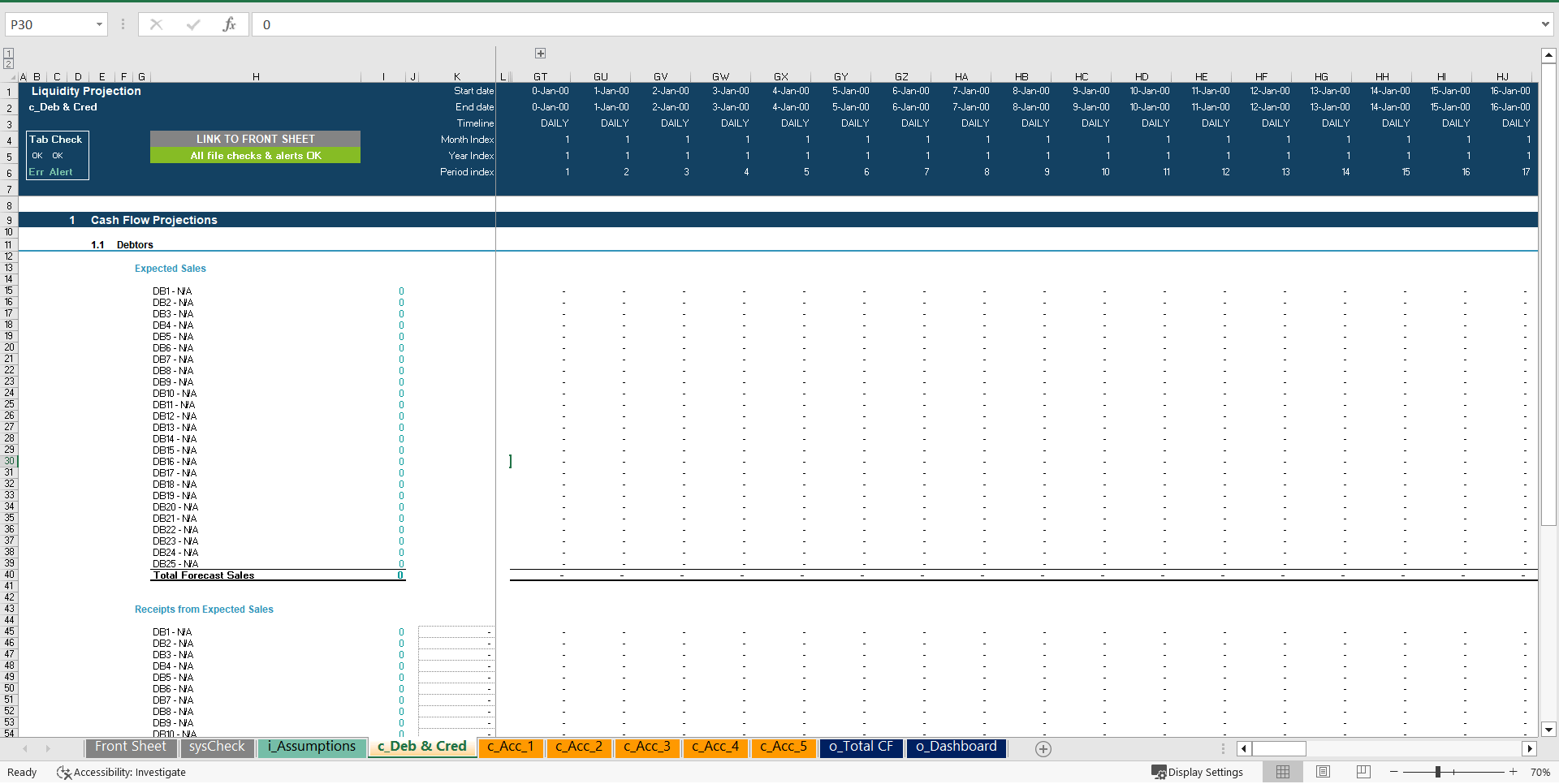
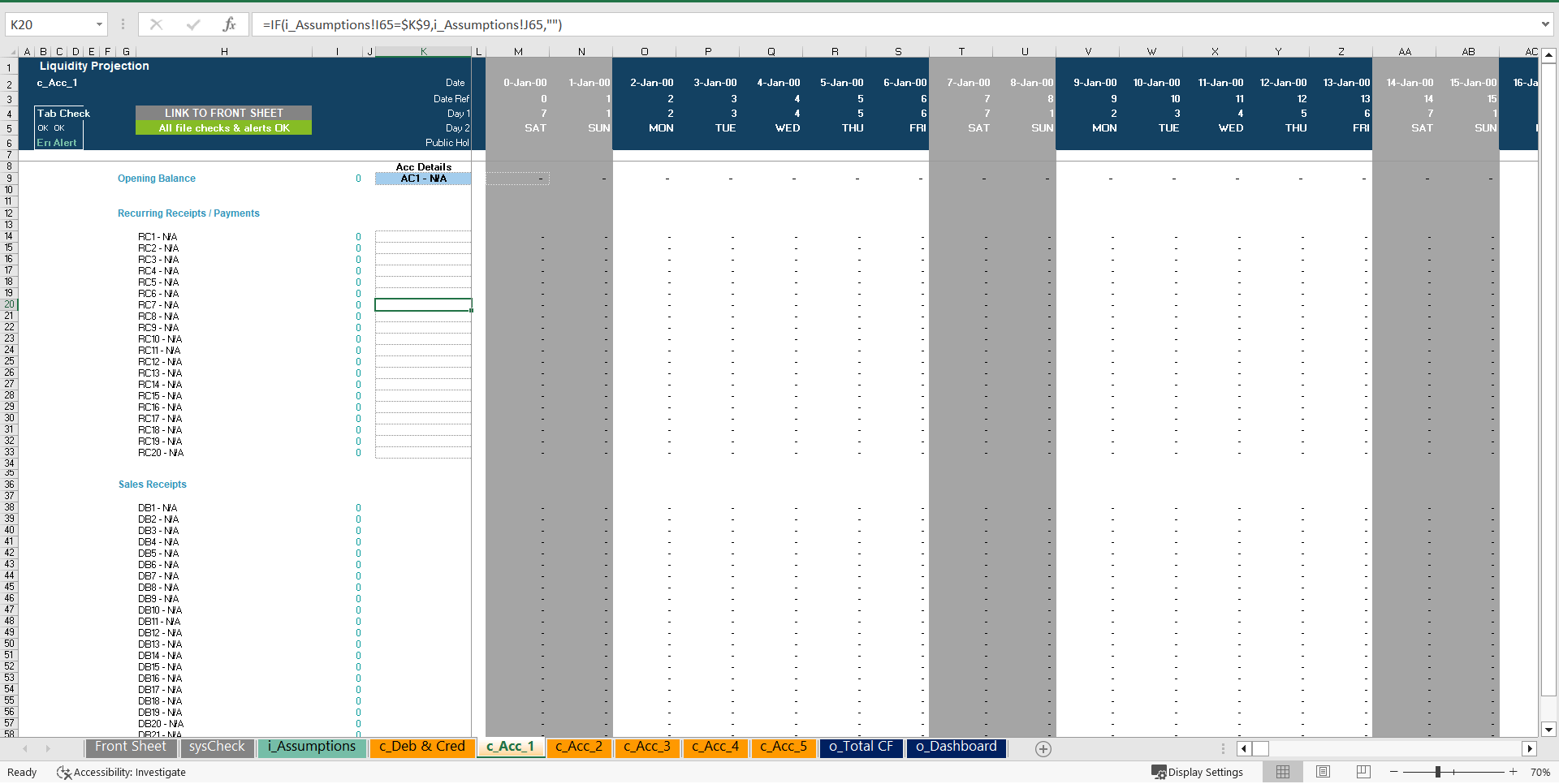
The model allows the user to project cash flow movements and balances across 5 bank/cash operating accounts, individually or on a total basis, with functionality to model recurring receipts and payments, settlement of aged debtors and creditors and receipts/payments from forecast purchases and sales in an automated manner.
The model follows best practice financial modelling principles and includes instructions, checks and input validations.
KEY OUTPUTS
The model is generic and not industry-specific. The key outputs include:
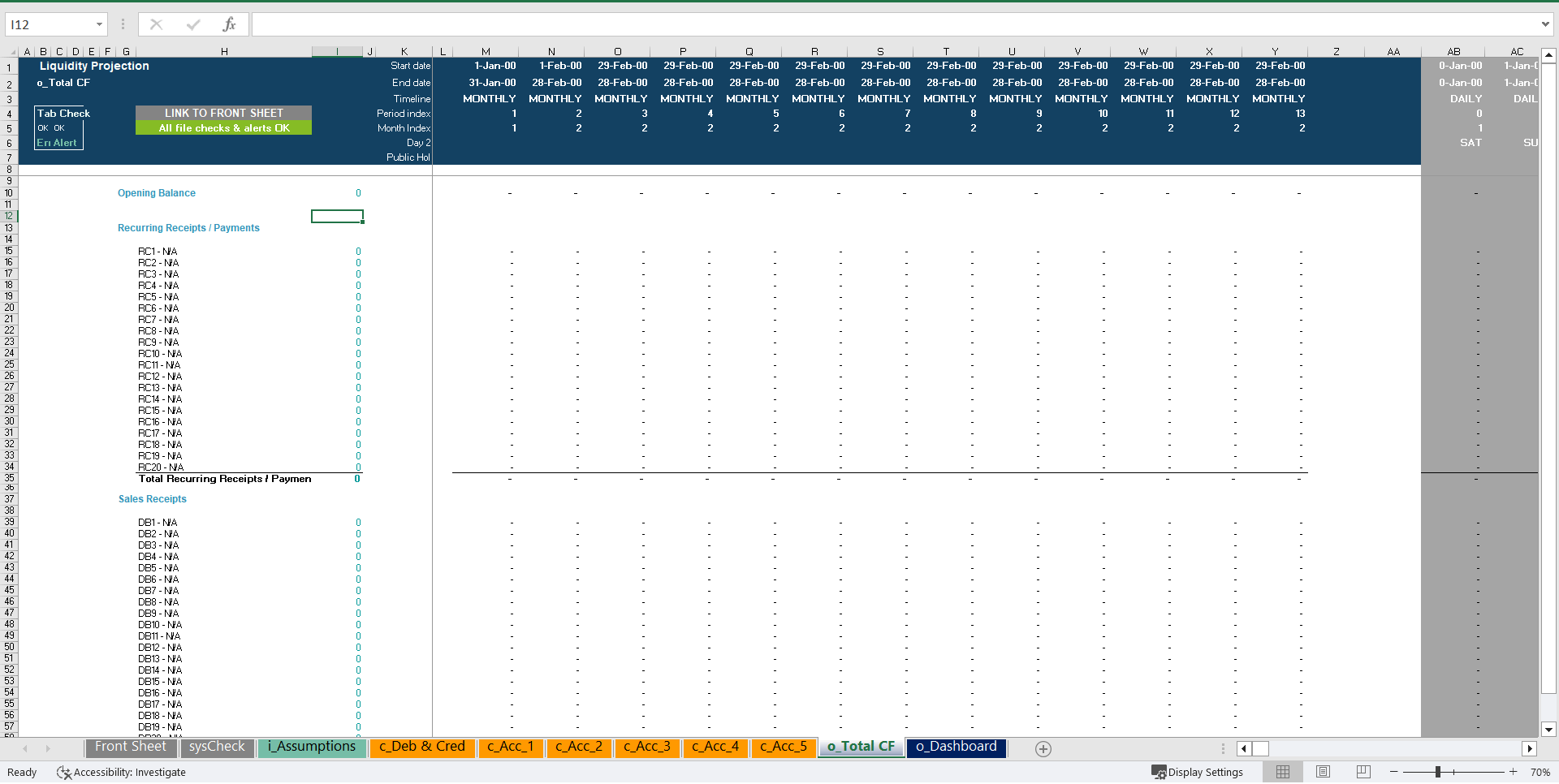
• Projected cash flow breakdown of balances and movements presented on a daily and monthly basis.
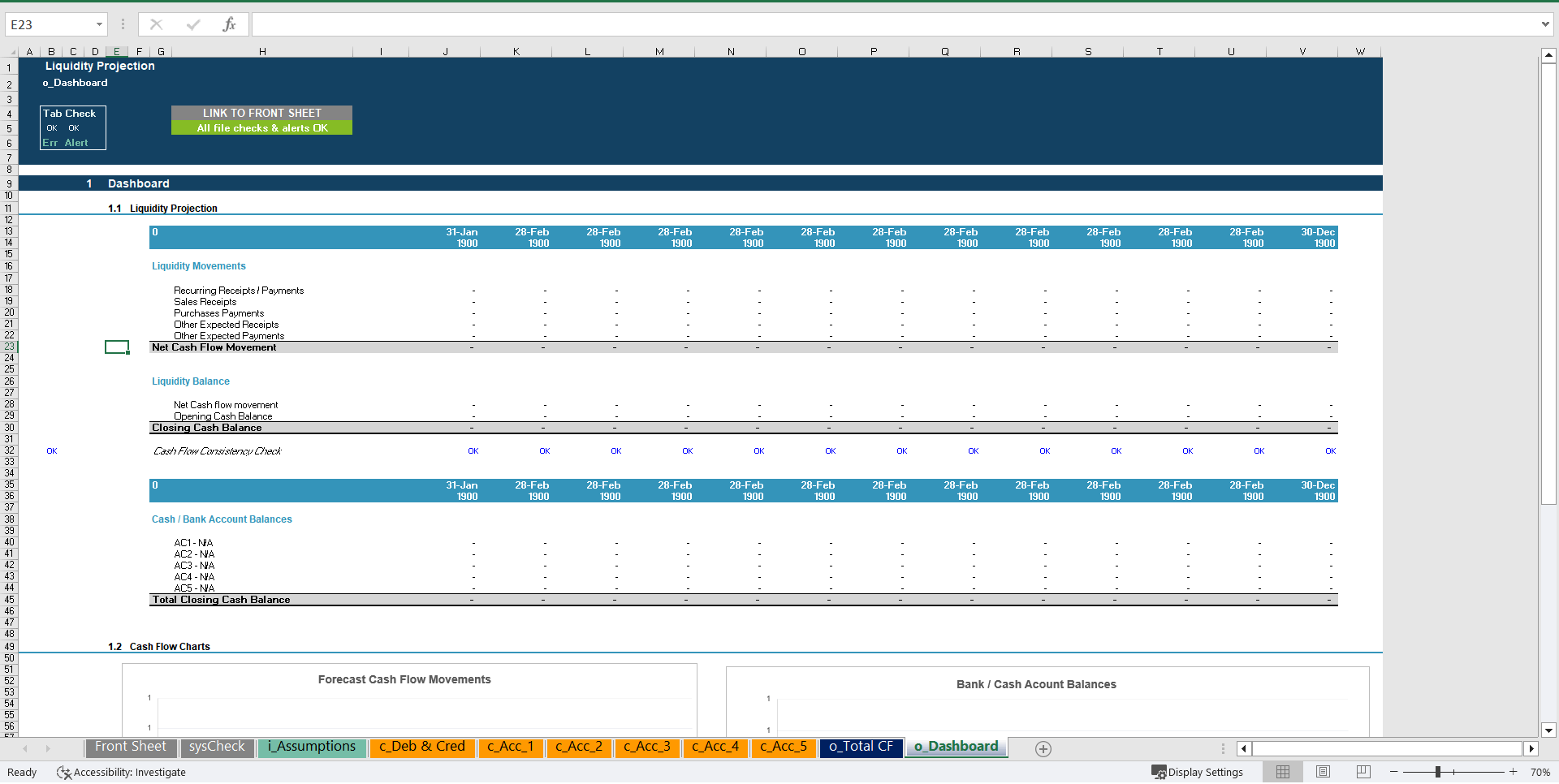
• Dashboard which includes the following:
Summarised projected cash flow movement and balances
Chart showing net cash movement by month by category
Line Graph showing cash balances on total basis and by account
KEY INPUTS
Assumption Inputs include:
• Name of business
• Currency
• First projection date
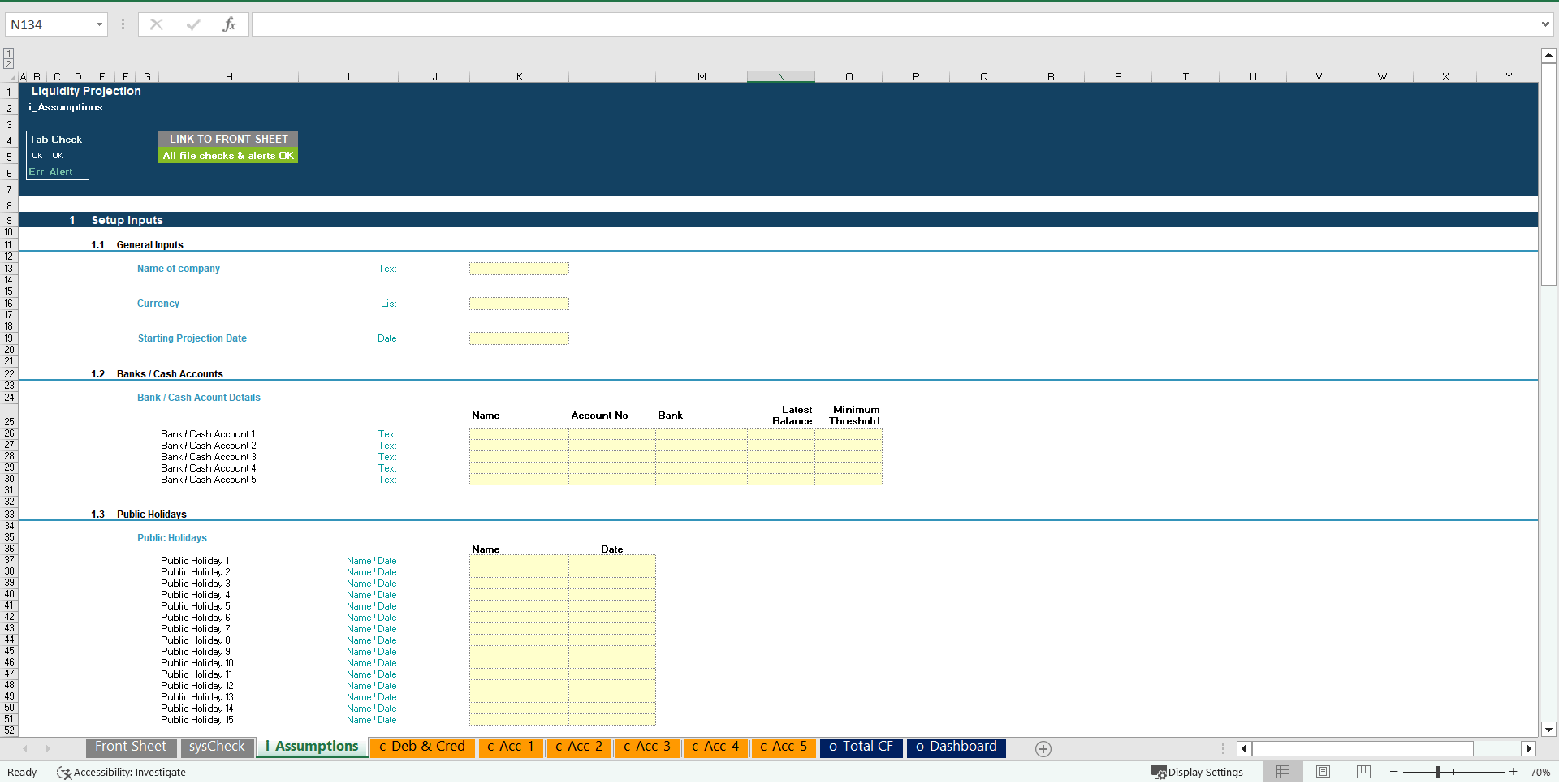
• Bank / Cash account details including Name, Account number, latest balance and minimum thresholds
• Public holidays
• Recurring receipt / payment details
• Debtor and creditor details including credit terms aged balances and forecast purchases and sales.
MODEL STRUCTURE
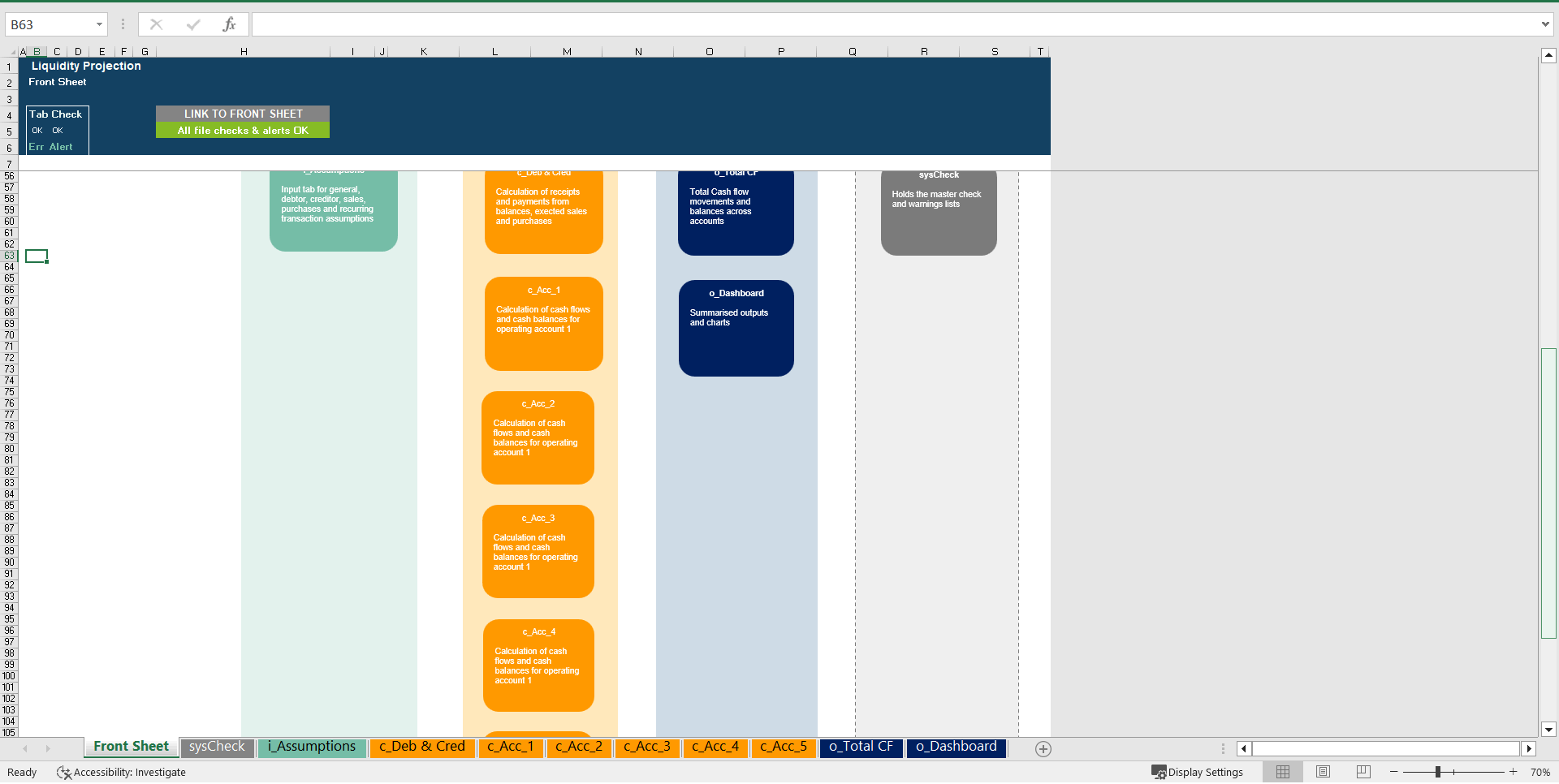
The model contains, 11 tabs split into input ('i_'), calculation ('c_'), output ('o_') and system tabs. The tabs to be populated by the user is the input tabs ('i_Assumptions'). The calculation tab uses the user-defined inputs to calculate and produce the projection outputs which are presented in 'o_Total CF' and ‘o_Dashboard'
System tabs include:
• A 'Front Sheet' containing a disclaimer, instructions and contents;
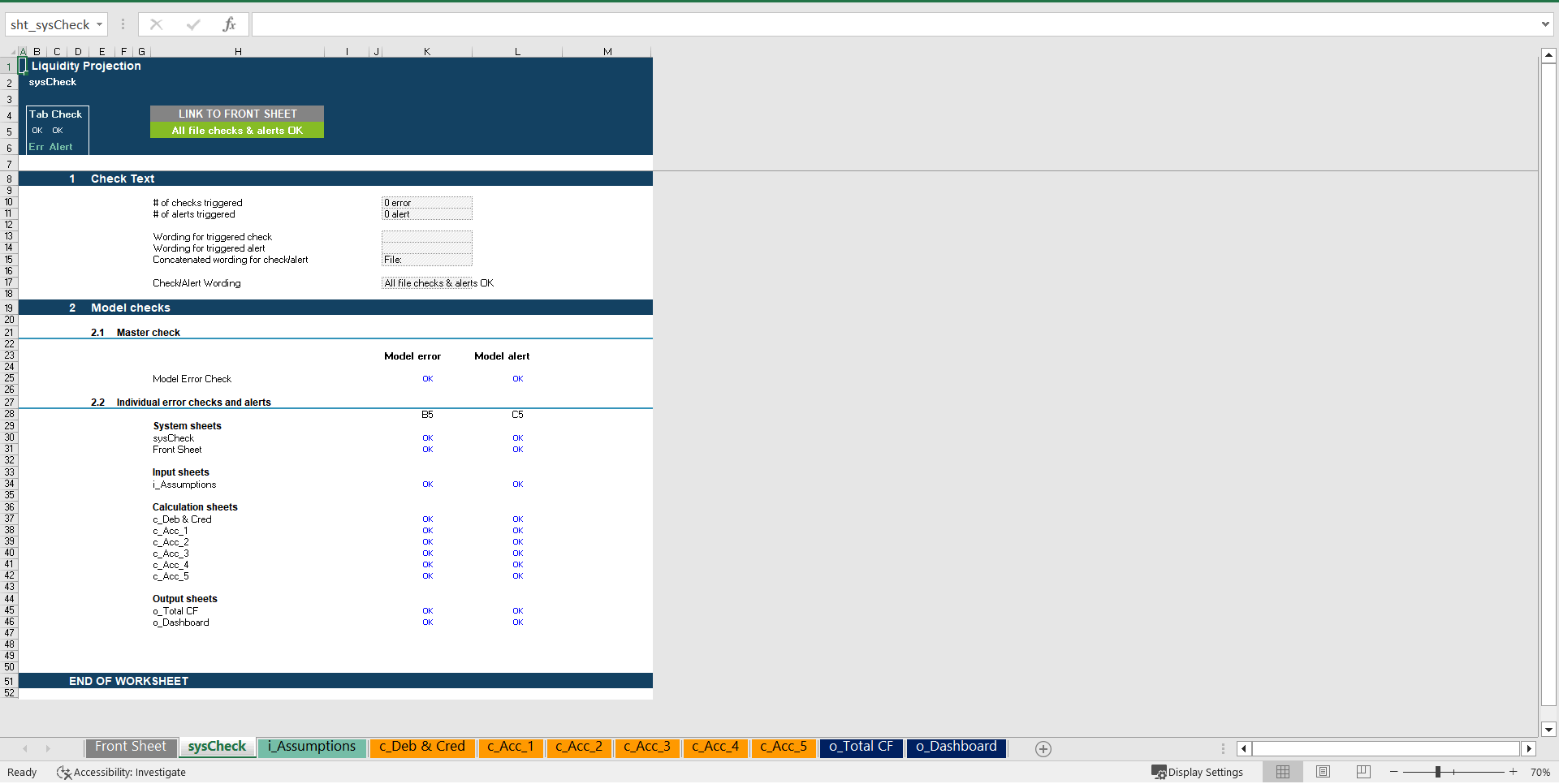
• A Checks dashboard containing a summary of checks by tab.
KEY FEATURES
Other key features of this model include the following:
• The model follows best practice financial modelling guidelines and includes instructions, checks and input validations to help ensure input fields are populated accurately;
• The model allows for a 12-month rolling projection on a daily basis and summarised on a monthly basis;
• The model is not password protected and can be modified as required following download;
• The model allows for the following number of categories for each line item (these can be easily expanded if required):
Bank/Cash accounts – 5 accounts
Recurring receipts and payments – 20 items on monthly, quarterly or yearly recurring basis.
Debtor categories – 25 categories;
Creditor categories – 25 categories;
• The model allows the user to model 3 separate revenue streams on a Price x Volume basis;
• Costs are split into: variable and other costs for better driver-based forecasting;
• Business Name, currency, starting projection period are fully customisable;
• Debtor, Creditor, recurring receipts and payments descriptions are fully customisable;
• The model includes a checks dashboard which summarises all the checks included in the various tabs making it easier to identify any errors.
Got a question about the product? Email us at support@flevy.com or ask the author directly by using the "Ask the Author a Question" form. If you cannot view the preview above this document description, go here to view the large preview instead.
TOPIC FAQ
What are the key components of a daily cash flow forecast?
A daily cash flow forecast tracks daily inflows, outflows, and aggregate liquidity positions, combining recurring receipts/payments with timing of debtor collections and creditor payments. Useful outputs include daily and monthly summaries plus visual charts to show net cash movement and balances over a 12-month rolling projection.How do I model debtor collections and creditor payments in a daily liquidity model?
Model aged balances and credit terms to time receipts and payments, include forecast purchases and sales as cash drivers, and separate receipts by category to reflect timing differences. Practical models allow categorised debtor and creditor inputs and map settlements to daily cash movements, for example using multiple debtor and creditor categories.What inputs are essential for accurate daily liquidity projections?
Essential inputs include business name, currency, first projection date, detailed bank/account balances and minimum thresholds, public holidays, recurring receipt/payment schedules, and debtor/creditor aged balances and credit terms. A disciplined model typically collects these on a consolidated input sheet such as an i_Assumptions input tab.How should I choose between buying an off-the-shelf model and building one internally?
Consider time to deployment, need for built-in checks and validations, ease of modification, and whether the template matches your account and category complexity. An off-the-shelf model that includes instructions, checks and input validations can reduce setup time; for example, some templates provide a structured 11-tab workbook.What features indicate a reliable cash flow model for short-term liquidity management?
Look for driver-based forecasting, clear input/ calculation/ output separation, input validations and error checks, ability to model multiple bank accounts and recurring items, and a dashboard with charts showing net cash movement and balances. Useful named elements include a checks dashboard and an o_Dashboard output.How can a startup use daily cash flow forecasting to manage runway?
Startups can use daily forecasts to detect emerging shortfalls, sequence payments, and time financing discussions by simulating scenarios and revenue trajectories. A template that supports multiple revenue streams and daily granularity helps assess runway under different assumptions, for example with 3 Price x Volume revenue streams.What level of granularity is practical for daily liquidity models used by SMEs?
Daily granularity is practical when cash timing materially affects operations; summarising to monthly for reporting is common. A template that supports detailed categories and multiple accounts—such as 5 bank accounts, 20 recurring items, and up to 25 debtor/25 creditor categories—balances detail and usability.What are the main value considerations when purchasing a template cash flow model?
Value considerations include setup time saved, presence of built-in checks/validations, modifiability, and whether the model supports your account and categorisation needs. Also check whether the file is editable and not password protected; useful templates typically support a 12-month rolling projection.Source: Best Practices in Financial Analysis, Financial Ratio Analysis Excel: Daily Financial Liquidity Projection Excel Model Excel (XLSX) Spreadsheet, Projectify
ABOUT THE AUTHOR

We are financial modelling professionals, accountants and CFA charterholders with experience working within Deloitte supporting clients with their financial planning and decision support needs. Our aim is to provide robust and easy-to-use financial models that follow good practice financial modelling guidelines and assist individuals and businesses with key financial planning and analysis ... [read more]
Ask the Author a Question
You must be logged in to contact the author.