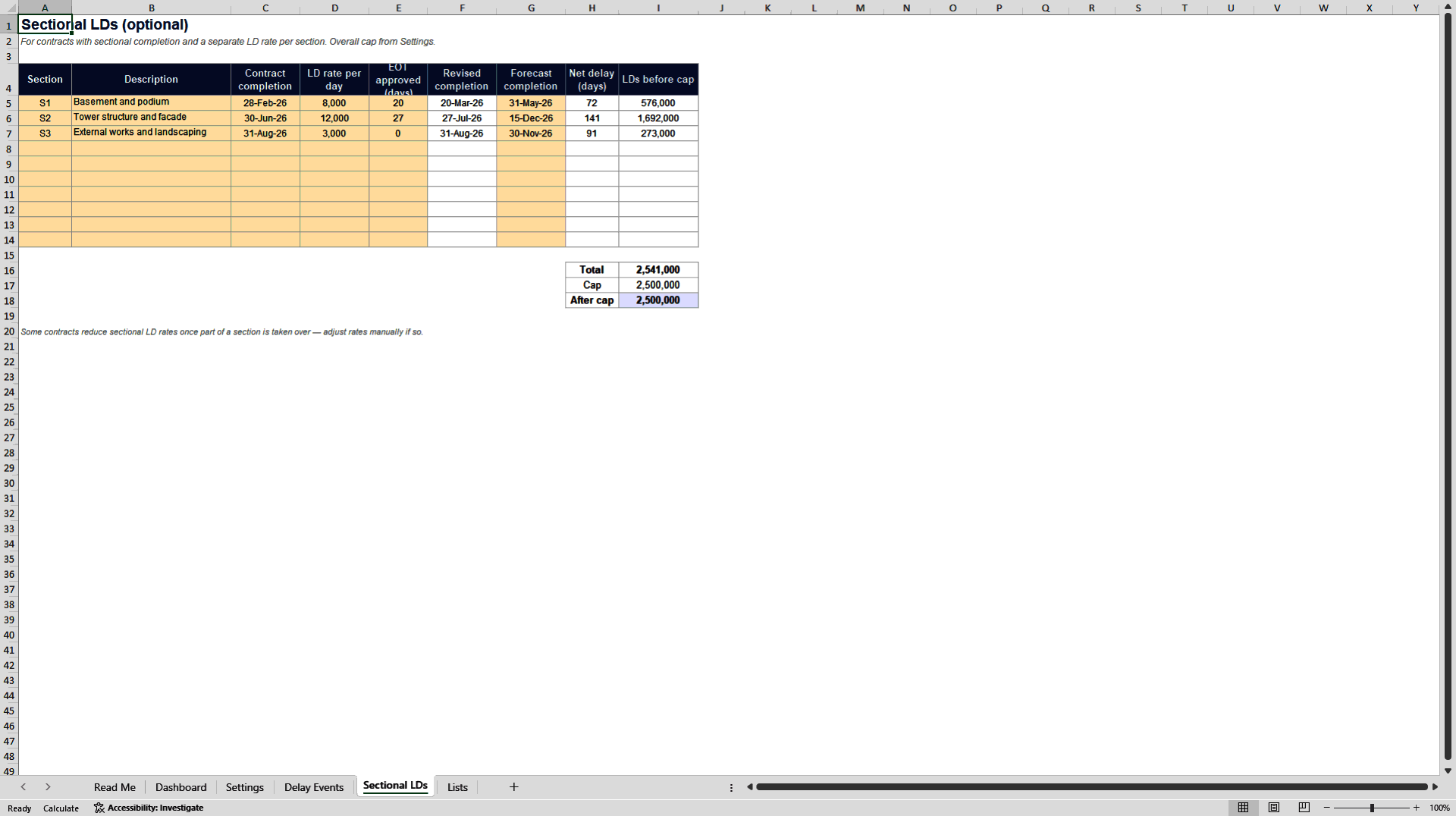

 Click main image to view in full screen.


BENEFITS OF THIS DOWNLOADABLE EXCEL DOCUMENT
- See LD exposure in worst, expected and best case from one EOT register
- Flag late or overdue delay notices before they become time-barred
- Estimate recoverable prolongation cost and your net position
CONTRACT EXCEL DESCRIPTION
On most construction projects, the question everyone asks at the monthly meeting is the same: if we finish on the forecast date, how much are we going to pay in liquidated damages? The answer usually sits across a programme, a claims log and someone's memory of which EOT requests were approved. This workbook pulls that into one place.
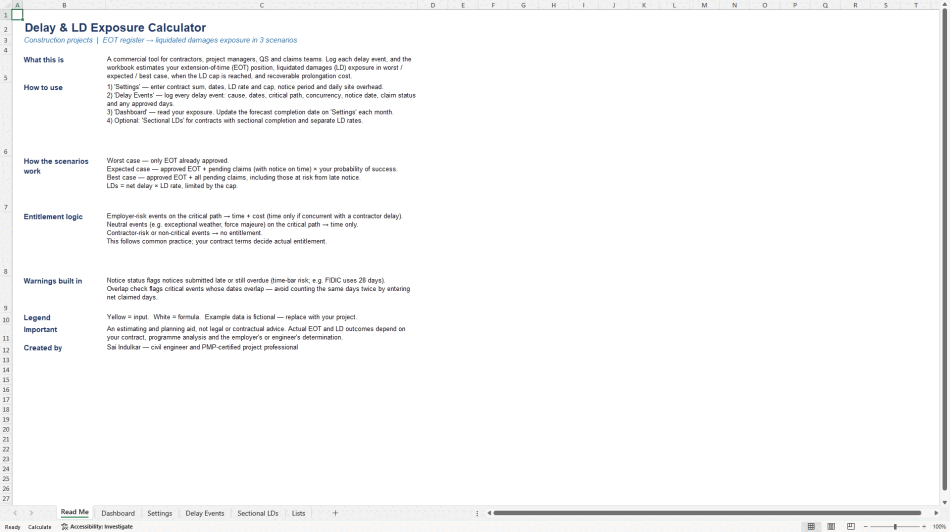
The Delay & LD Exposure Calculator is an Excel tool for contractors, project managers, quantity surveyors and claims teams. You log each delay event in an EOT register, and the workbook works out your LD exposure under three scenarios, flags notice and time-bar risks, and estimates the prolongation cost you may be able to recover.
What is inside
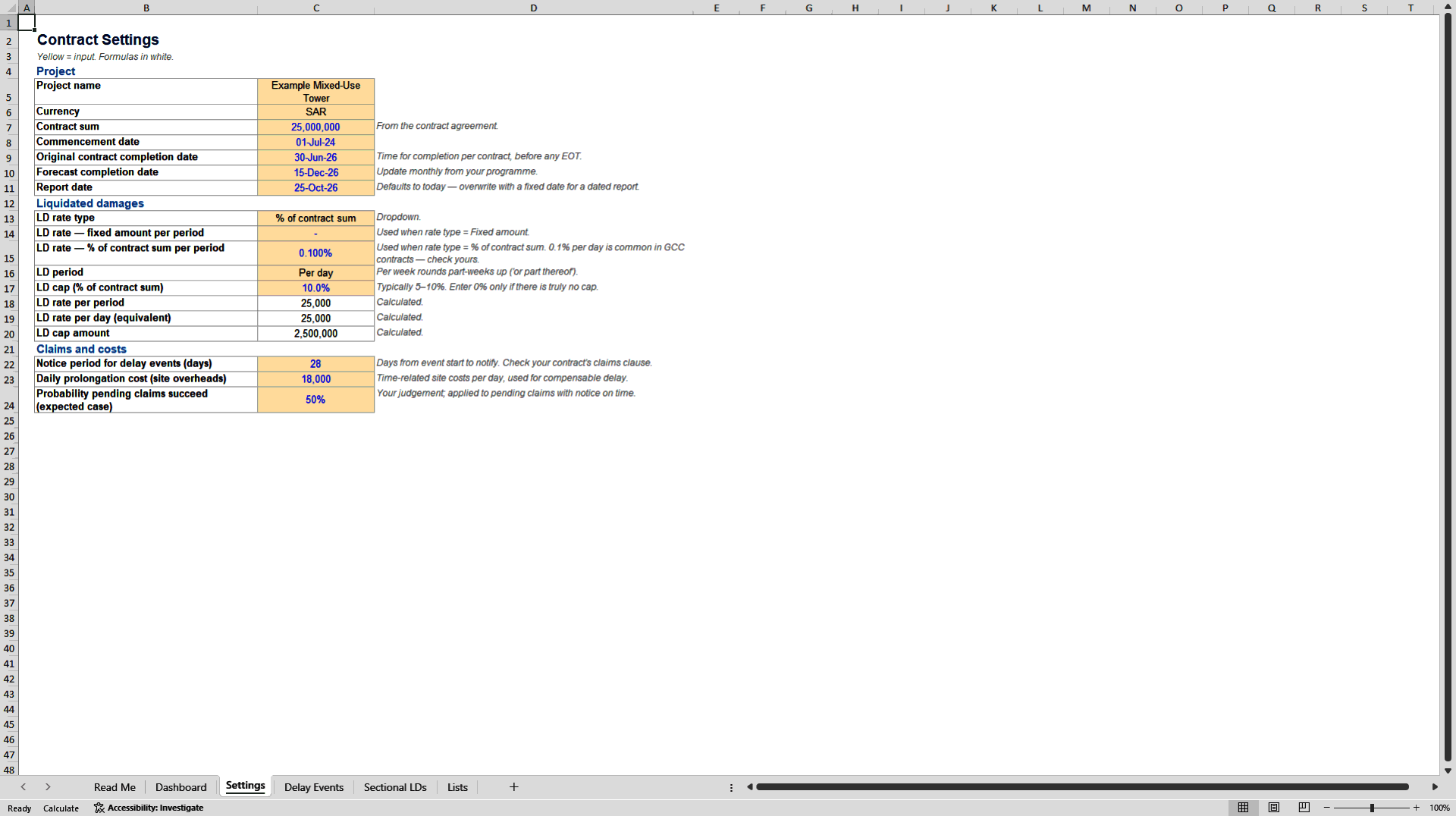
Settings sheet. Enter the contract sum, commencement, original and forecast completion dates, LD rate (fixed amount or percentage of contract sum, per day or per week with part-weeks rounded up), LD cap, contractual notice period and daily site overheads.
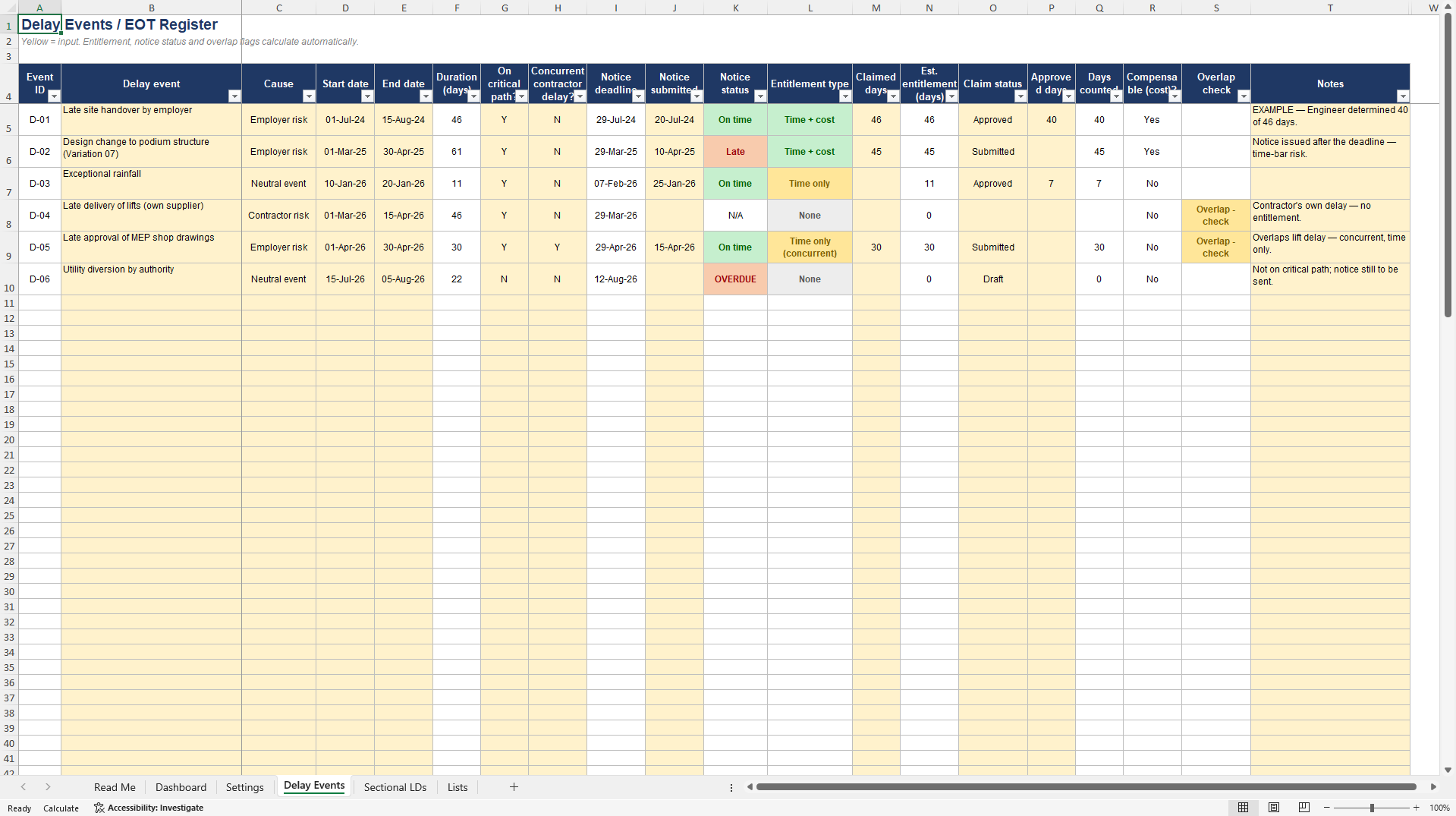
Delay Events register. Up to 100 events. For each one you record the cause (employer risk, neutral event or contractor risk), dates, whether it sits on the critical path, whether there is concurrent contractor delay, notice date, claimed and approved days. The sheet then calculates the notice deadline and status, entitlement type (time and cost, time only, or none), estimated entitlement, and checks for overlapping critical events so the same days are not counted twice.
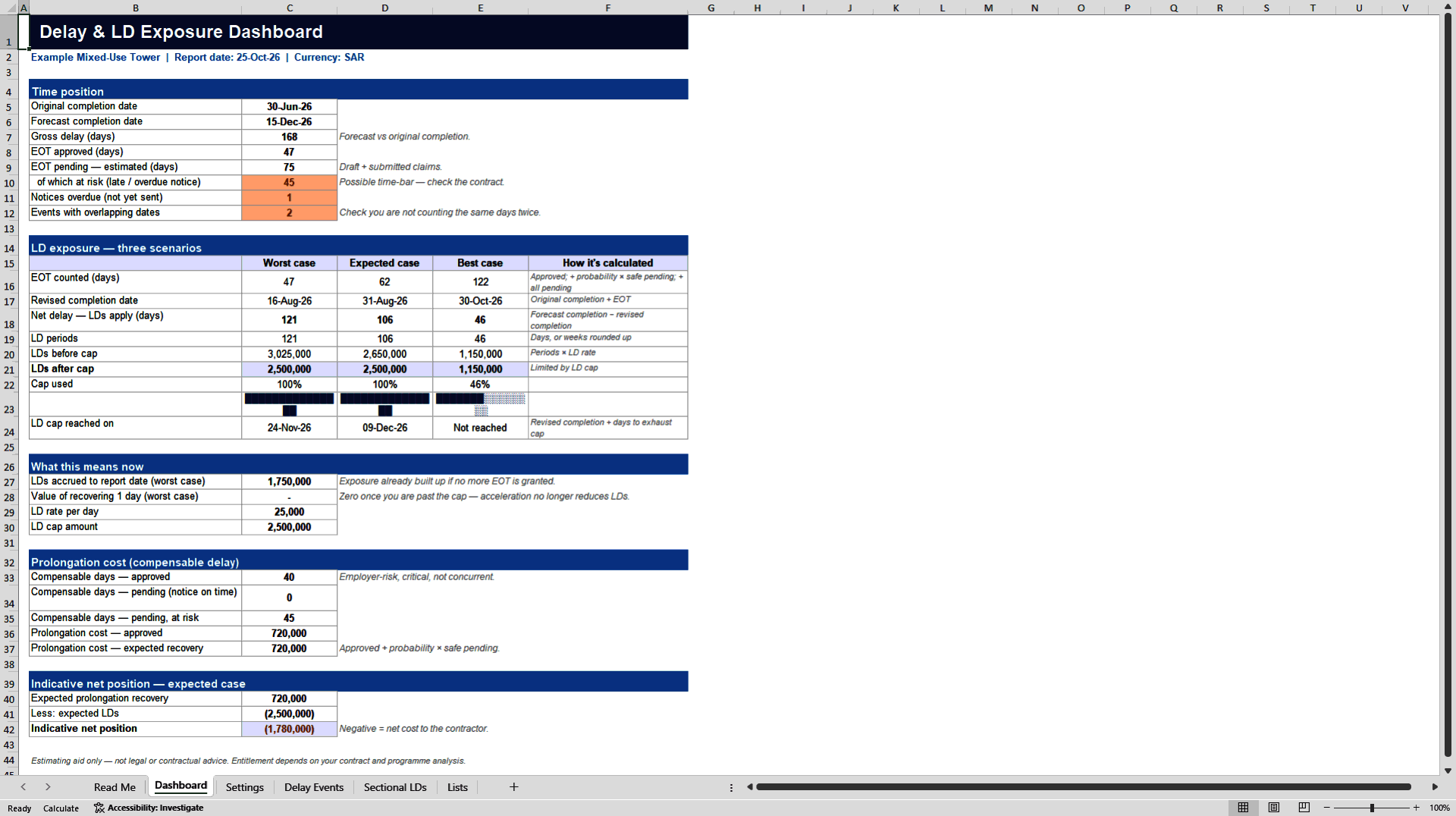
Dashboard. Gross delay, approved and pending EOT, claims at risk because of late or overdue notices, and LD exposure in a worst, expected and best case. For each scenario you see the revised completion date, net delay, LDs before and after the cap, percentage of cap used and the date the cap is reached. It also shows LDs already accrued to the report date, the value of recovering one day, prolongation cost on compensable delay, and an indicative net position.
How the scenarios work
Worst case counts only approved EOT. Expected case adds pending claims with notice on time, weighted by your own probability of success. Best case assumes all pending claims are granted.
Yellow cells are inputs and everything else is formula driven. The file comes with fictional example data so you can see how it behaves before replacing it with your project. No macros.
This is an estimating and planning aid, not legal or contractual advice. Actual EOT and LD outcomes depend on your contract, programme analysis and the Engineer's determination.
Got a question about the product? Email us at support@flevy.com or ask the author directly by using the "Ask the Author a Question" form. If you cannot view the preview above this document description, go here to view the large preview instead.
Source: Best Practices in Contract, Construction Excel: Construction Delay & LD Exposure Calculator Excel (XLSX) Spreadsheet, gx76468