
 Click main image to view in full screen. Unlock all 19 preview images:
Book Publisher Financial Model - Titles, Returns & Rights – Excel XLSX
Excel (XLSX) + supplemental PDF


BENEFITS OF THIS DOWNLOADABLE EXCEL DOCUMENT
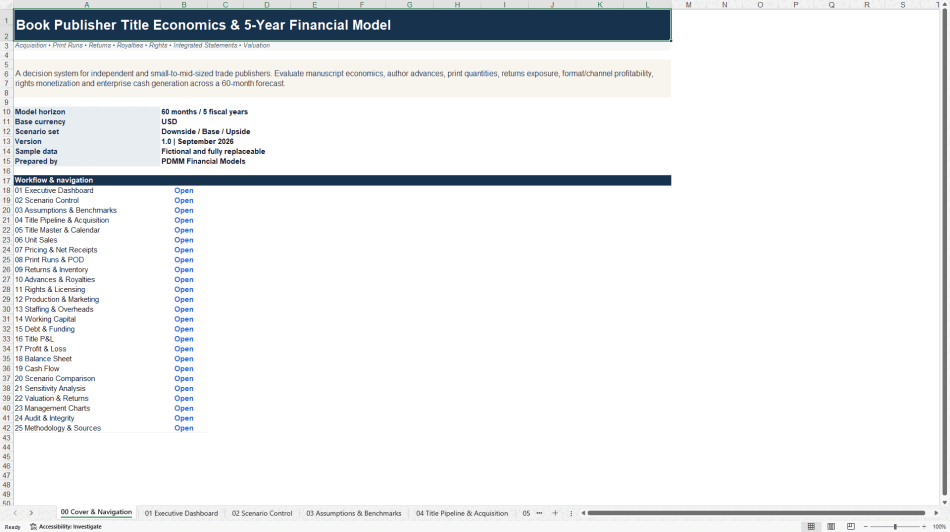
- Connects title acquisition, advances, monthly unit demand, returns, print and POD decisions, royalties, rights, working capital and five-year financial statements in one editable publishing model.
- Provides decision-ready Downside, Base and Upside scenarios plus EBITDA and DCF sensitivity matrices to evaluate operating uncertainty and valuation range.
- Delivers title-level profitability, integrated cash-flow planning, DCF valuation, 10 native charts and built-in integrity checks for publisher management and advisory work.
FINANCIAL MODELING EXCEL DESCRIPTION
Book Publisher Financial Model – Titles, Returns & Rights is a fully editable Excel financial and operating model for independent and small-to-mid-sized trade publishers. It is designed for a decision problem that a generic five-year forecast does not solve: how manuscript acquisitions, author advances, release timing, print quantities, channel discounts, book returns, royalties, rights income, inventory and working capital combine to create or consume cash across a publishing portfolio.
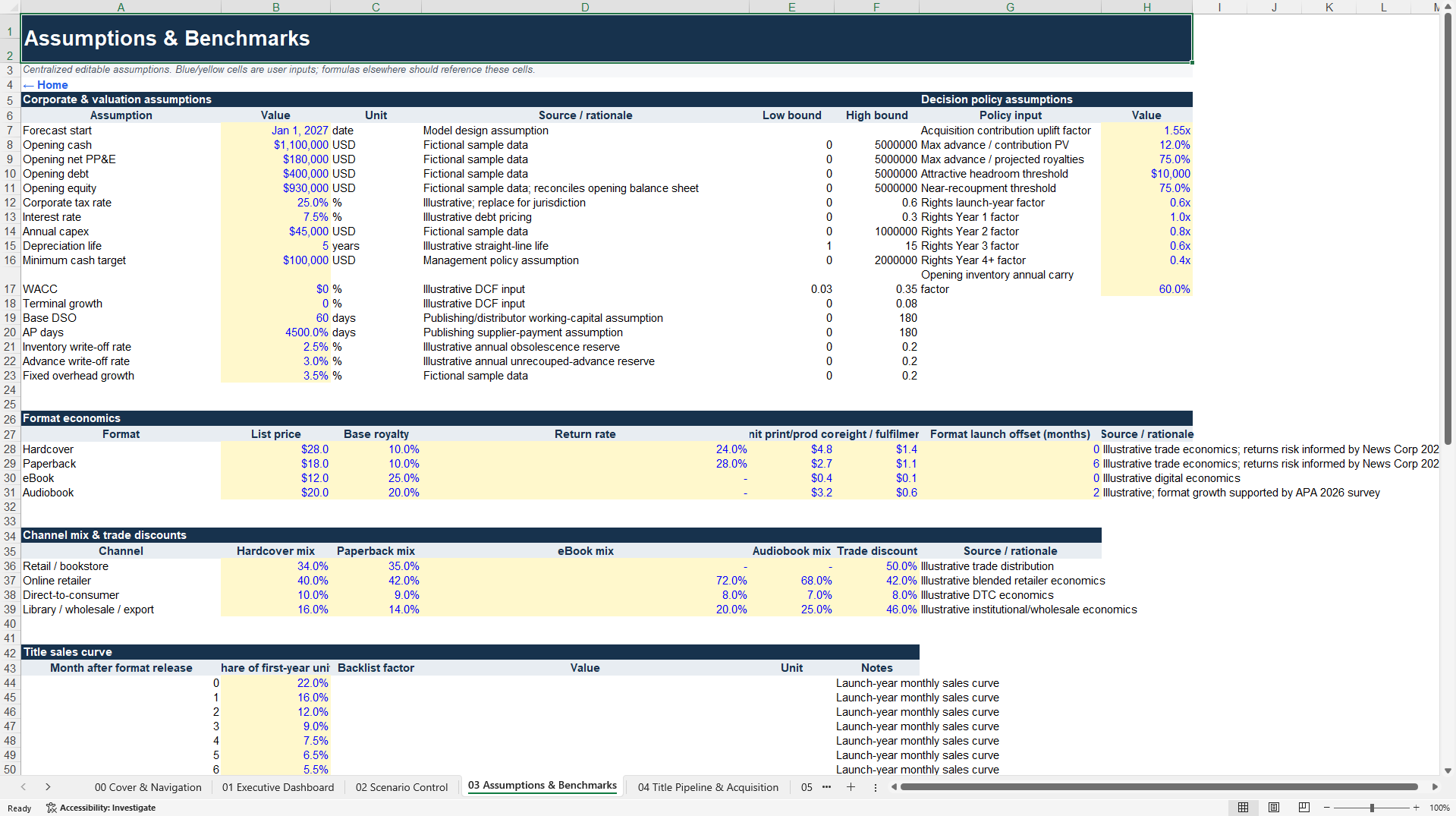
The workbook contains a 60-month forecast covering five fiscal years and is populated with 10 fictional, replaceable sample titles. Each title can be modeled across Hardcover, Paperback, eBook and Audiobook formats. A centralized assumptions structure covers corporate and valuation inputs, format prices and costs, royalties, print return rates, channel mix and discounts, title launch curves, backlist behavior, print policies, working-capital assumptions and portfolio cost drivers.
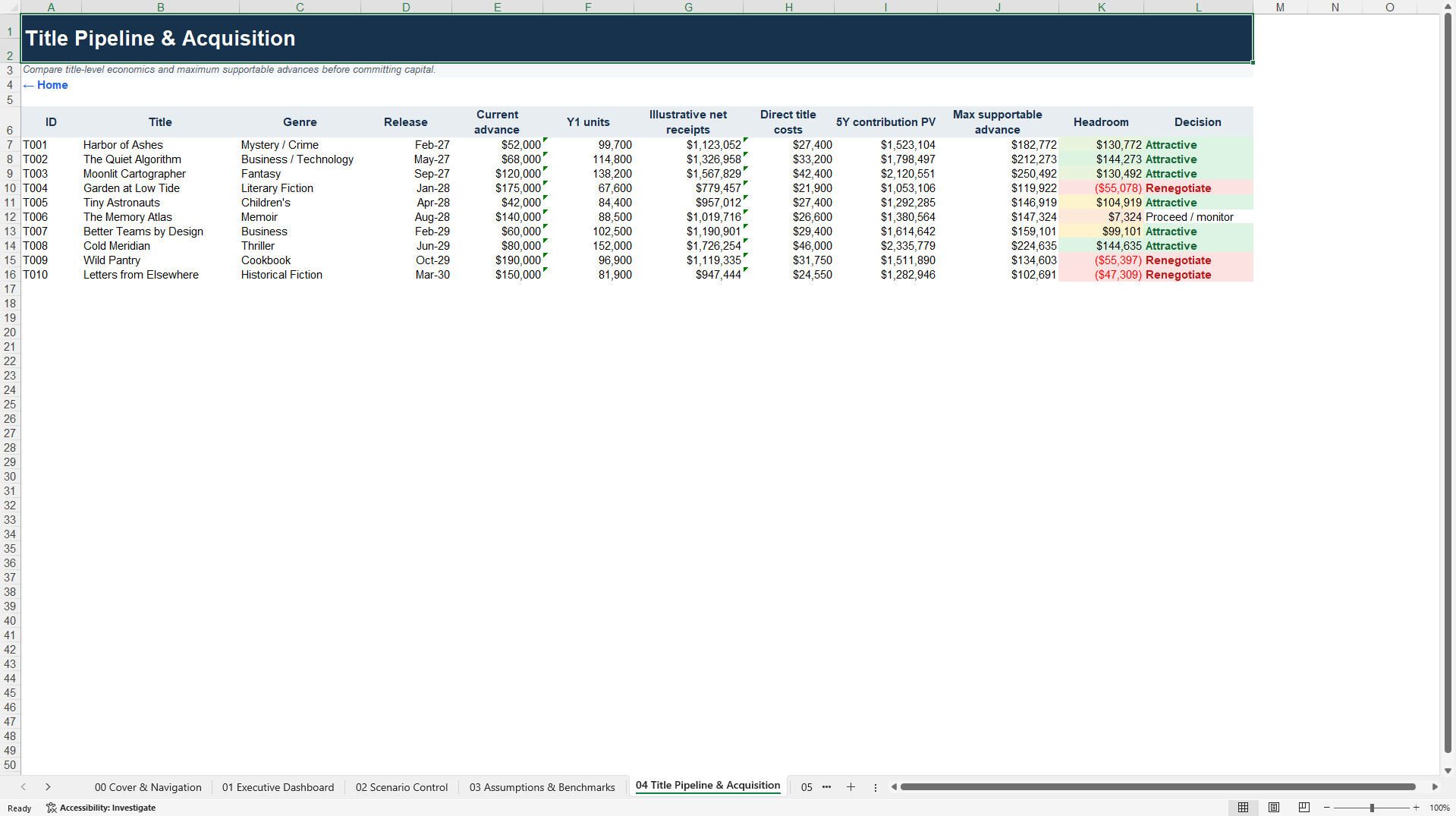
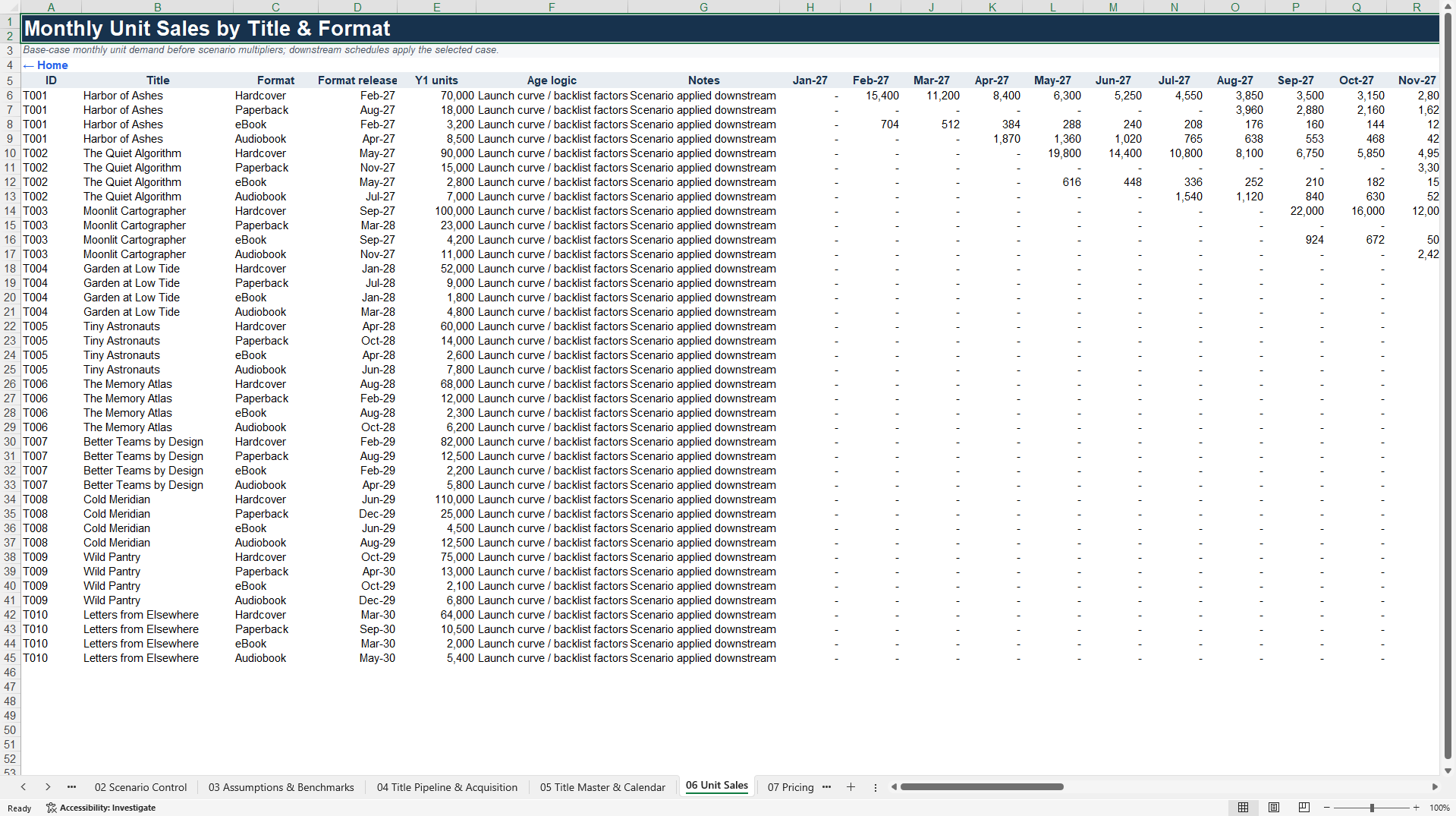
The title acquisition schedule estimates five-year contribution present value, maximum supportable author advance, advance headroom and an acquisition decision status. The title master controls base release dates, format-specific unit expectations, editorial and design costs, launch marketing, audio production and rights potential. Monthly unit schedules then phase demand according to release timing, launch-month concentration and backlist factors.
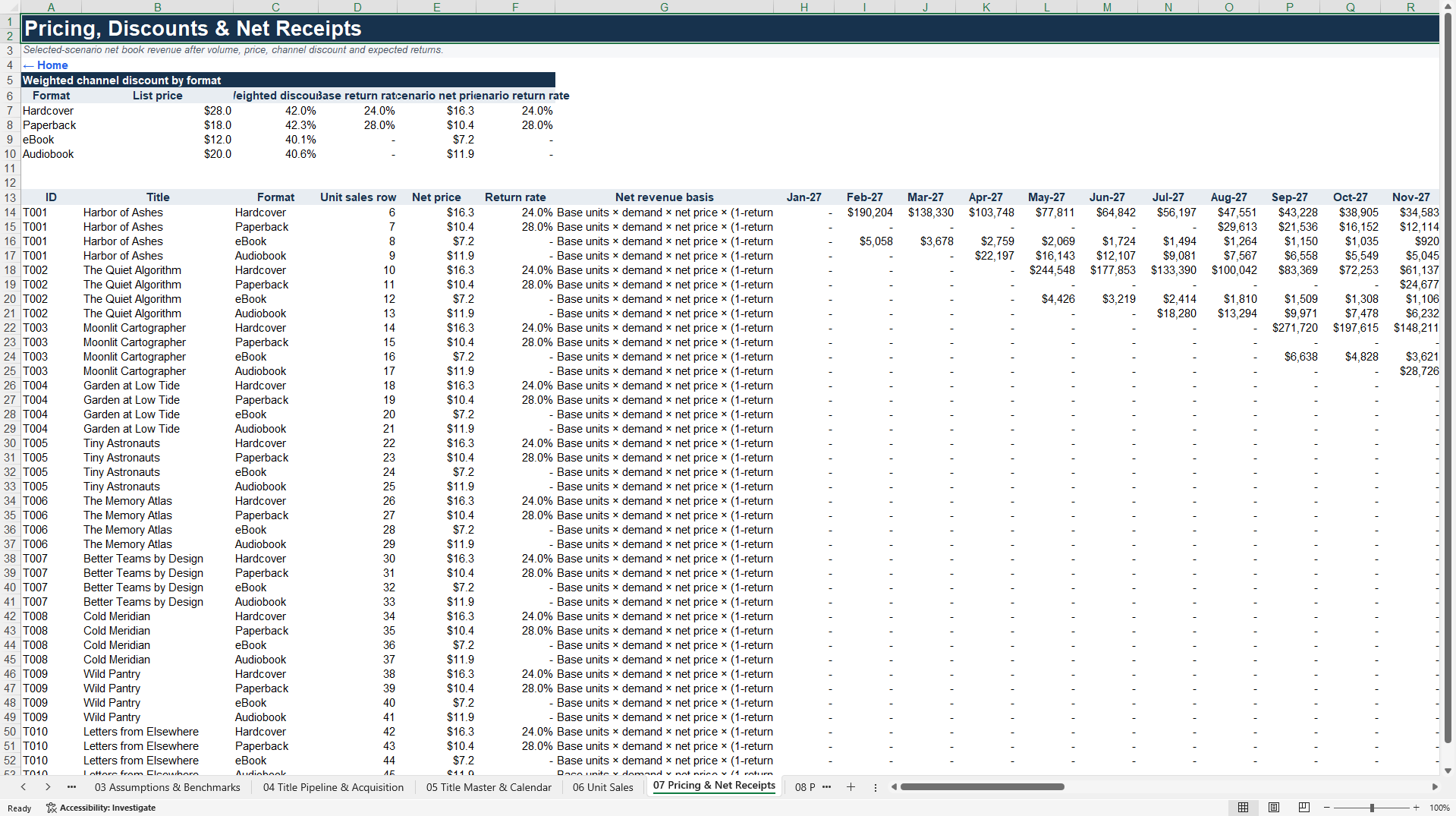
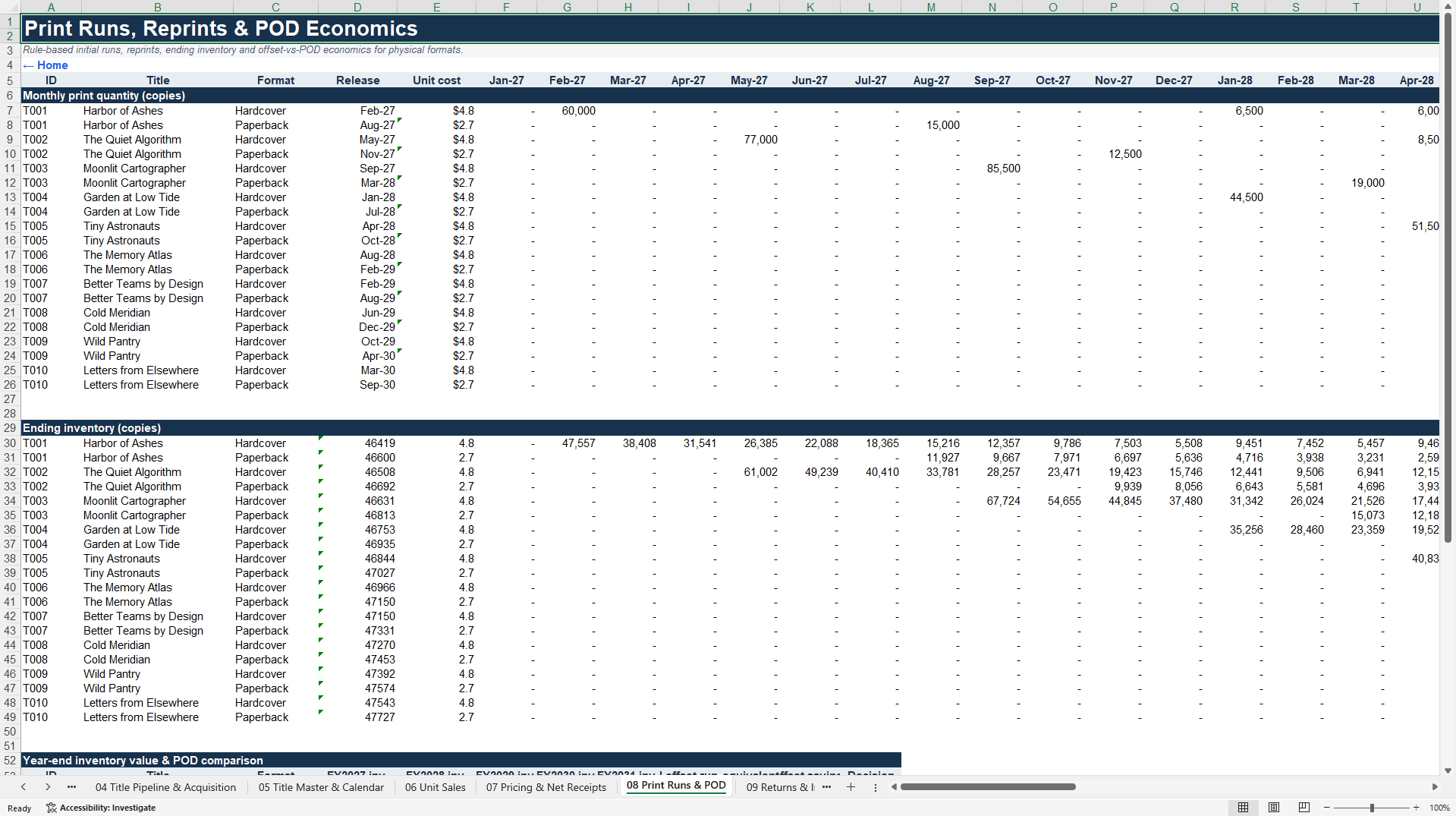
Publishing operating schedules translate units into net receipts and expected returns, calculate physical print quantities and reprints, roll ending inventory, and compare offset print economics with a print-on-demand equivalent. Separate schedules track earned royalties, author advance recoupment and remaining unrecouped balances. Rights and licensing revenue is modeled by title with an editable mix across translation, territory, film or television, and other rights categories.
The operating model also includes production and marketing costs, staffing and overheads, accounts receivable, inventory, author advances, accounts payable, net working capital, scheduled debt repayment and interest. These schedules feed integrated annual Profit and Loss, Balance Sheet and Cash Flow statements for FY2027 through FY2031.
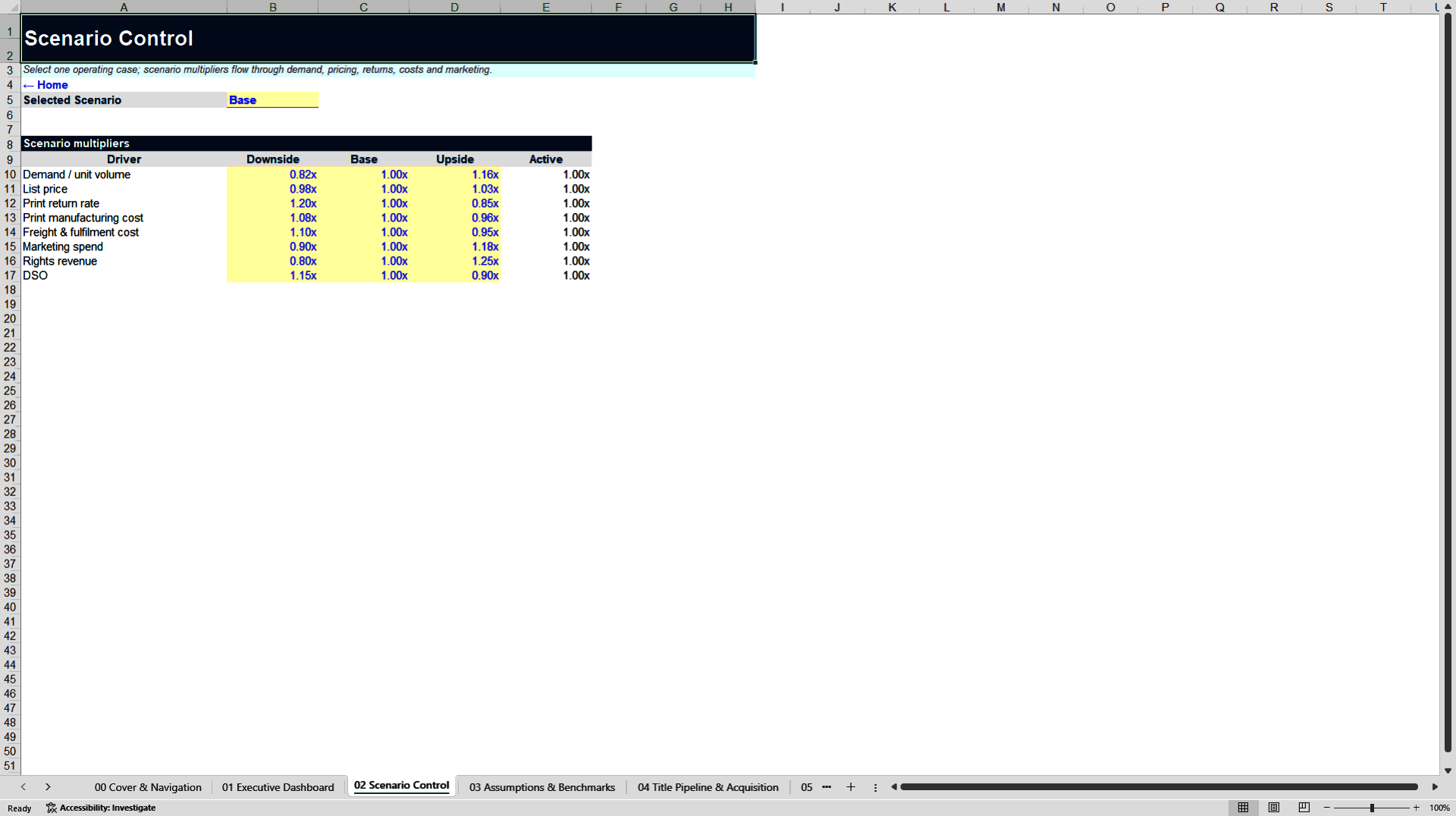
Management can compare title-level profitability using net book sales, rights revenue, direct title cost, royalties, production and marketing spend, contribution, contribution margin and revenue-to-advance metrics. Downside, Base and Upside scenarios vary demand, list price, print return rate, manufacturing cost, freight and fulfilment, marketing spend, rights revenue and DSO. A dedicated scenario comparison shows revenue, EBITDA, EBITDA margin and revenue growth across all three cases.
Two explicit sensitivity matrices provide additional decision support. One tests FY2029 EBITDA against demand and print-return multipliers. The other tests DCF equity value against WACC and terminal growth. The valuation schedule calculates unlevered free cash flow, present values, terminal value, enterprise value, opening net debt and equity value.
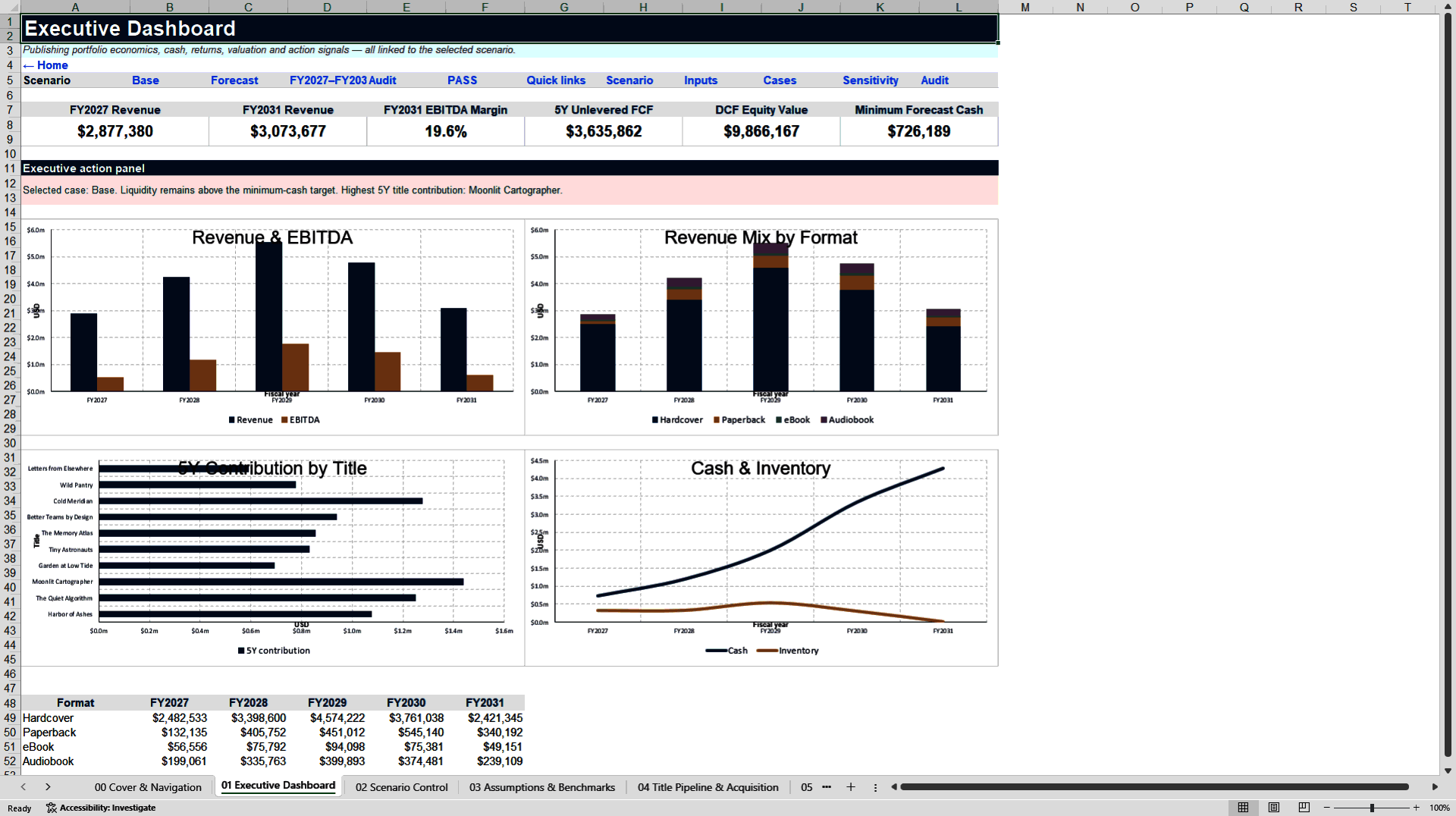
The Executive Dashboard presents KPI cards, a concise action panel and four native Excel charts covering revenue and EBITDA, revenue mix by format, five-year contribution by title, and cash and inventory. A Management Charts page adds returned units, royalties versus unrecouped advances, rights revenue, staffing and overheads, scenario EBITDA and DCF equity-value sensitivity. Built-in integrity checks reconcile the balance sheet, cash, title revenue, author advances, debt roll-forward, channel mixes, launch curve, rights mix, scenario outputs and the sensitivity center point.
This model is suited to publisher founders, finance teams, acquisition and commercial teams, publishing consultants, business-plan advisers and investors who need a structured tool for budgeting, acquisition screening, print planning, profitability analysis, liquidity planning, scenario analysis and valuation. The sample portfolio demonstrates the complete workflow and can be replaced with the user's own publishing assumptions and title data.
Got a question about the product? Email us at support@flevy.com or ask the author directly by using the "Ask the Author a Question" form. If you cannot view the preview above this document description, go here to view the large preview instead.
Source: Best Practices in Financial Modeling Excel: Book Publisher Financial Model - Titles, Returns & Rights Excel (XLSX) Spreadsheet, PDMM Financial Models
ABOUT THE AUTHOR

PDMM Financial Models develops professional, decision-ready Excel models for business owners, entrepreneurs, investors, consultants, analysts, and finance teams. Our objective is to transform complex business assumptions into clear, structured analysis that supports better planning and investment decisions.
Our models cover business planning, forecasting, budgeting, feasibility analysis,
... [read more]
Ask the Author a Question
You must be logged in to contact the author.




























