
 Click main image to view in full screen. Unlock all 9 preview images:
AI Workflow Design & Control Process Document – Word DOCX
Word (DOCX) 30 Pages


BENEFITS OF THIS DOWNLOADABLE WORD DOCUMENT
- Provides a framework for designing, securing, deploying, and governing enterprise AI workflows fitting your organization.
- Provides a framework for turning AI initiatives into controlled, production-ready workflows across your organization.
- Provides a framework for managing AI risks, controls, and performance from initial design through ongoing operations.
ARTIFICIAL INTELLIGENCE WORD DESCRIPTION
Curated by McKinsey-trained Executives
Enterprise AI Workflow Design & Control Standard Operating Procedure (SOP)
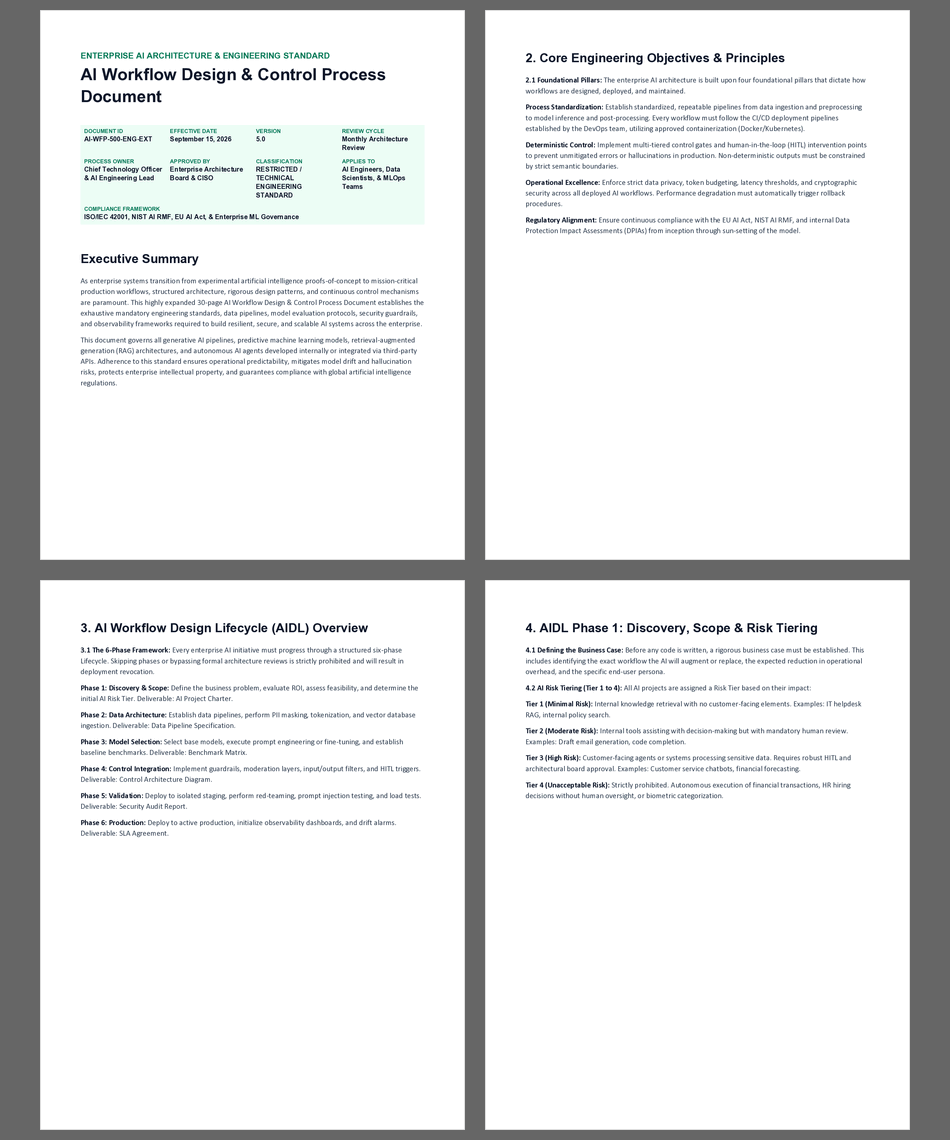
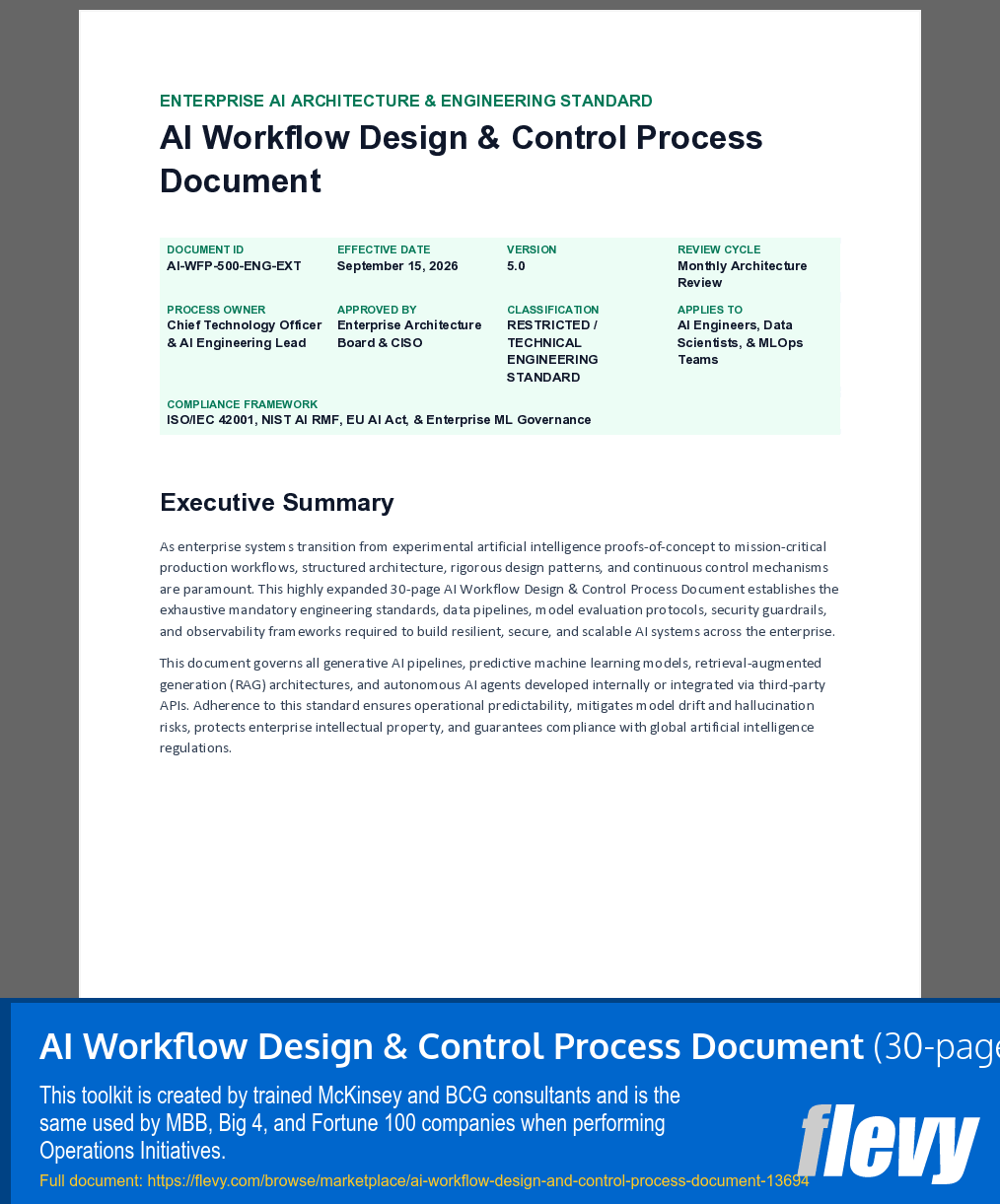
This downloadable Microsoft Word document provides an institutional-grade, end-to-end Enterprise AI Workflow Design & Control Governance Framework covering AI architecture, generative AI workflows, machine learning pipelines, Retrieval-Augmented Generation (RAG), vector databases, model selection, prompt engineering, AI agents, human-in-the-loop controls, prompt-injection defense, PII protection, model evaluation, observability, FinOps, semantic drift detection, incident response, audit logging, disaster recovery, and AI regulatory governance.
Built specifically for AI Engineers, Machine Learning Engineers, Data Scientists, MLOps Teams, AI Architects, Enterprise Architects, CTO Organizations, CISOs, AI Product Leaders, Data Engineering Teams, Platform Engineering Teams, Risk Functions, Compliance Teams, and Technology Governance Boards, this comprehensive standard establishes a controlled methodology for designing, validating, deploying, monitoring, securing, and governing enterprise AI systems throughout their complete operational lifecycle.
Designed for organizations moving AI from experimentation into production, this AI engineering standard creates a repeatable framework for transforming prototypes, LLM applications, RAG systems, predictive models, and autonomous AI agents into secure, observable, scalable, auditable, and governance-ready enterprise workflows.
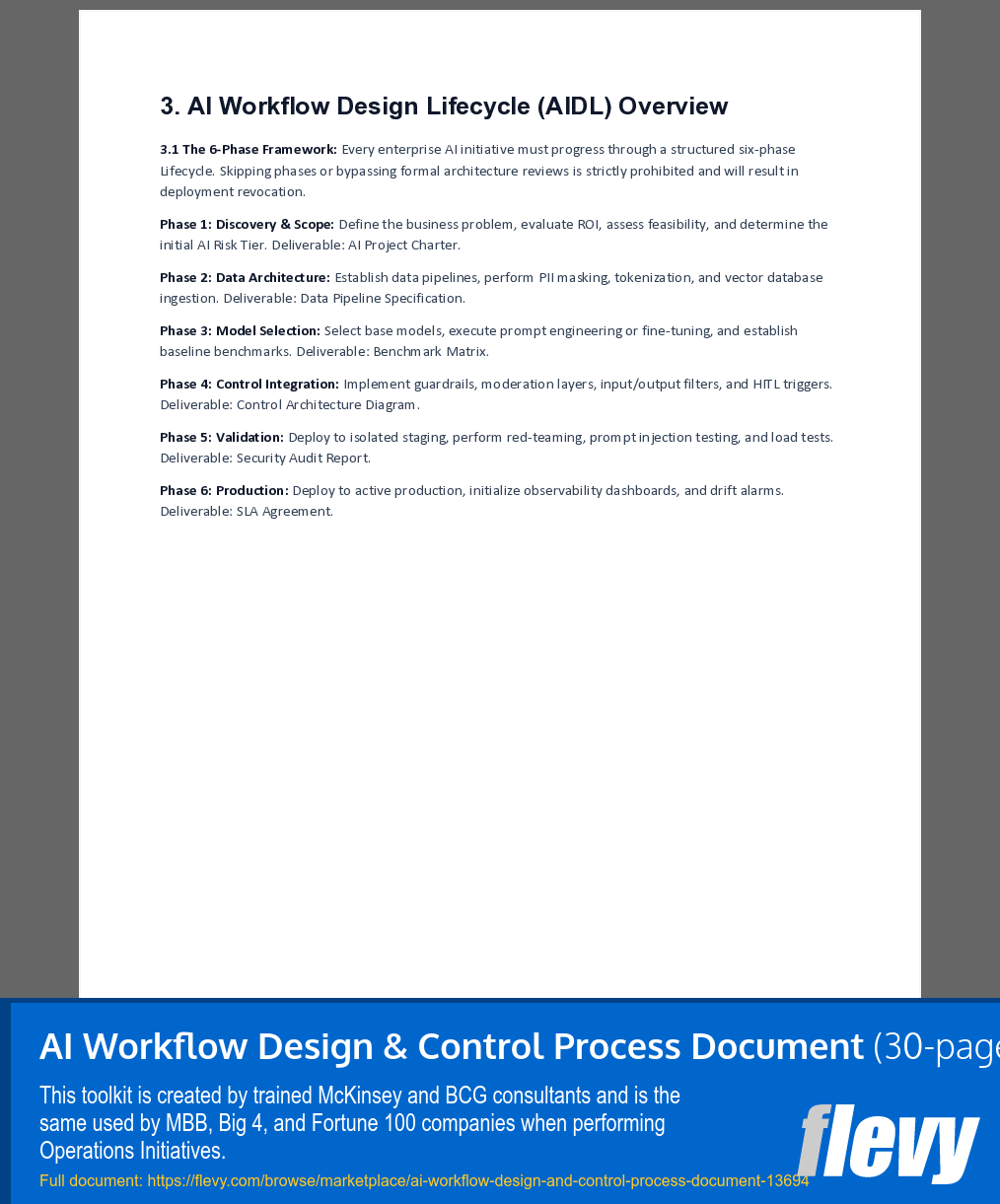
The framework covers the full AI Workflow Design Lifecycle (AIDL) from business discovery and AI risk classification through data architecture, model selection, control integration, security validation, production deployment, continuous evaluation, incident management, and eventual model retirement.
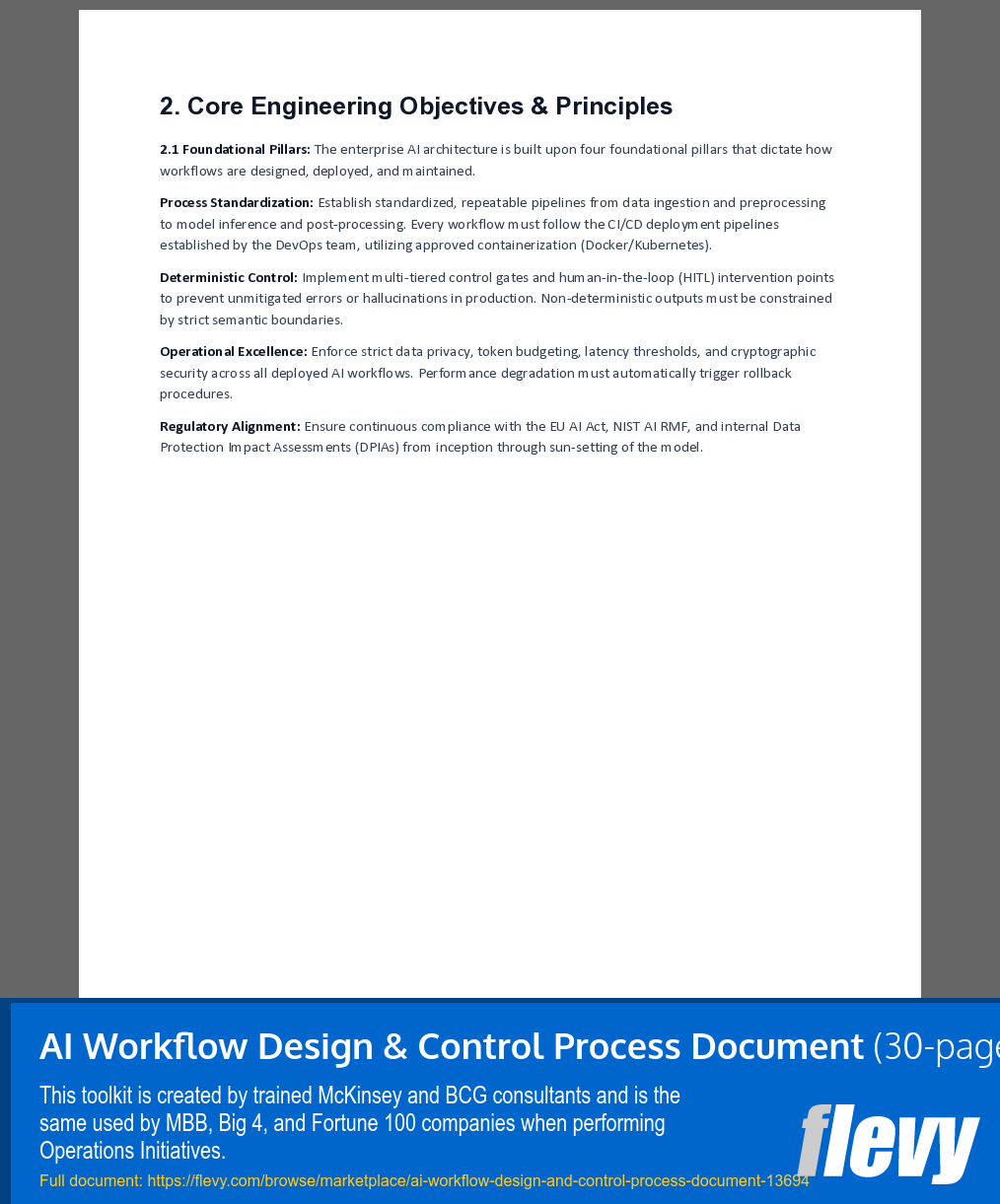
Section 1 – Enterprise AI Governance, Architecture Standards & Workflow Control
• Institutional Enterprise AI Architecture & Engineering Governance Framework designed to standardize the design, deployment, operation, monitoring, and retirement of enterprise AI systems.
• Mandatory AI Workflow Design Lifecycle (AIDL) establishing controlled progression from discovery and risk assessment through data architecture, model selection, security validation, production deployment, and continuous monitoring.
• Formal AI Engineering Governance Model defining responsibilities across AI Engineering, Data Science, MLOps, Security, Risk, Legal, Product, Enterprise Architecture, and executive governance functions.
• Mandatory architectural review gates preventing experimental AI systems from bypassing enterprise production controls.
• Standardized AI Project Charter requiring business objectives, expected ROI, workflow boundaries, user personas, data dependencies, AI risk classification, and operational requirements.
• Institutional AI Workflow RACI Framework assigning accountability for architecture, data pipelines, model selection, guardrails, security testing, deployment, monitoring, incident response, and model retirement.
• Formal version-control requirements governing model versions, prompts, system instructions, datasets, embeddings, evaluation suites, inference configurations, dependencies, and deployment artifacts.
• Mandatory documentation standards requiring architecture decisions, risk assessments, benchmark results, security findings, approvals, and production controls to remain traceable throughout the AI lifecycle.
• Enterprise-wide AI Change-Control Framework requiring material model, prompt, data, embedding, provider, or workflow changes to undergo controlled validation before production release.
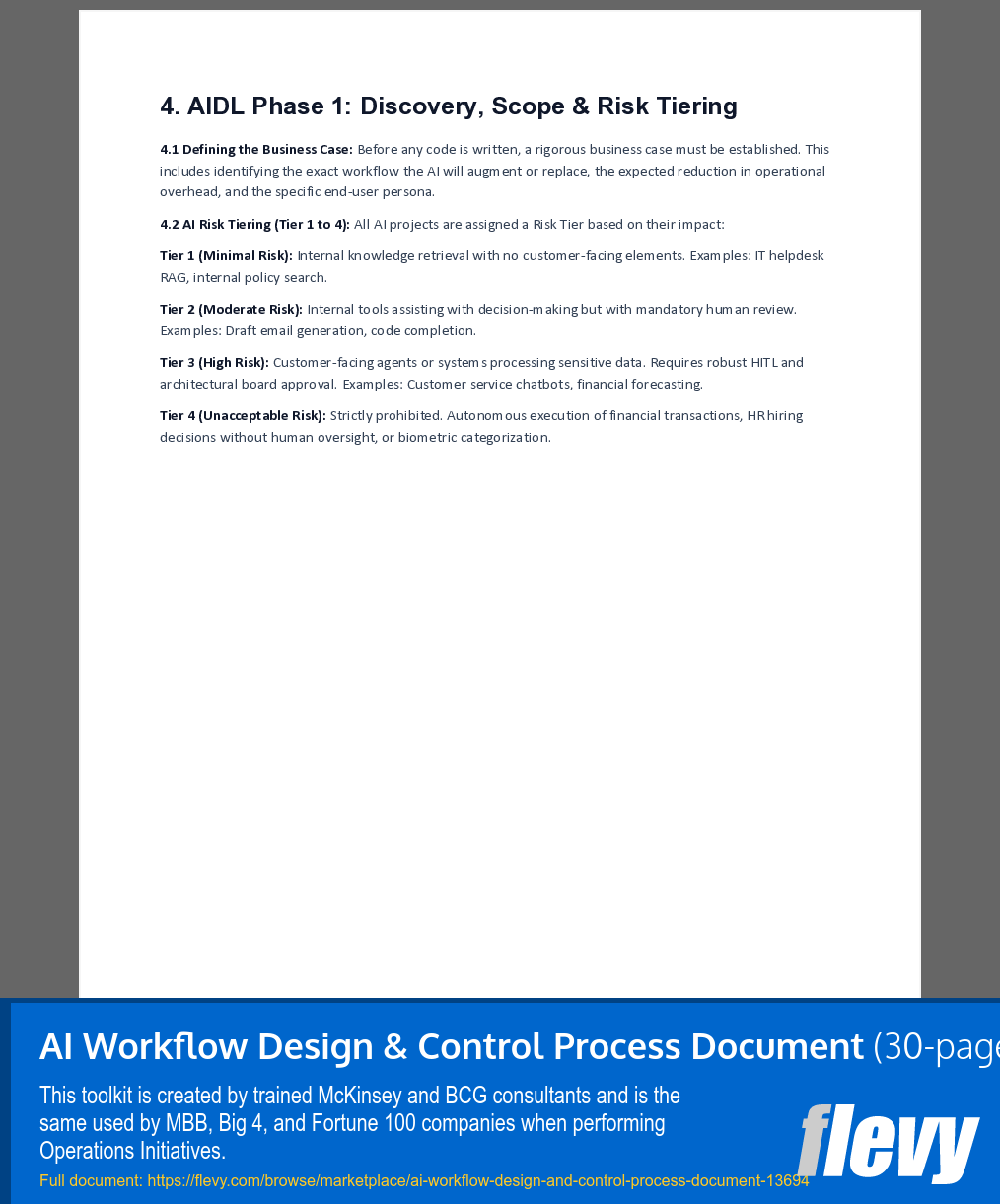
Section 2 – AI Risk Tiering, Business Case & Regulatory Classification
• Comprehensive AI Risk Tiering Framework categorizing enterprise AI workflows according to operational impact, customer exposure, data sensitivity, autonomy, and regulatory significance.
• Tier 1 Minimal-Risk Framework covering internal knowledge retrieval, enterprise search, and low-impact productivity applications.
• Tier 2 Moderate-Risk Framework covering decision-support systems, code-generation workflows, drafting systems, and employee-facing AI applications requiring human review.
• Tier 3 High-Risk Framework covering customer-facing AI agents, sensitive-data processing, material business decisions, and higher-impact automated workflows.
• Tier 4 Prohibited/Unacceptable-Risk Framework identifying AI use cases that must not be deployed without appropriate legal, regulatory, or governance authorization.
• Mandatory AI Business Case Assessment requiring teams to define the operational problem, expected productivity gains, financial impact, implementation costs, user population, and measurable success criteria.
• Formal AI feasibility assessment evaluating technical complexity, data availability, model capability, latency, cost, security, integration requirements, and operational dependencies.
• Institutional AI regulatory mapping framework aligning applicable workflows with enterprise governance obligations and relevant AI regulations.
• Mandatory escalation procedures for high-impact AI use cases requiring Architecture Board, Risk, Security, Legal, or executive approval.
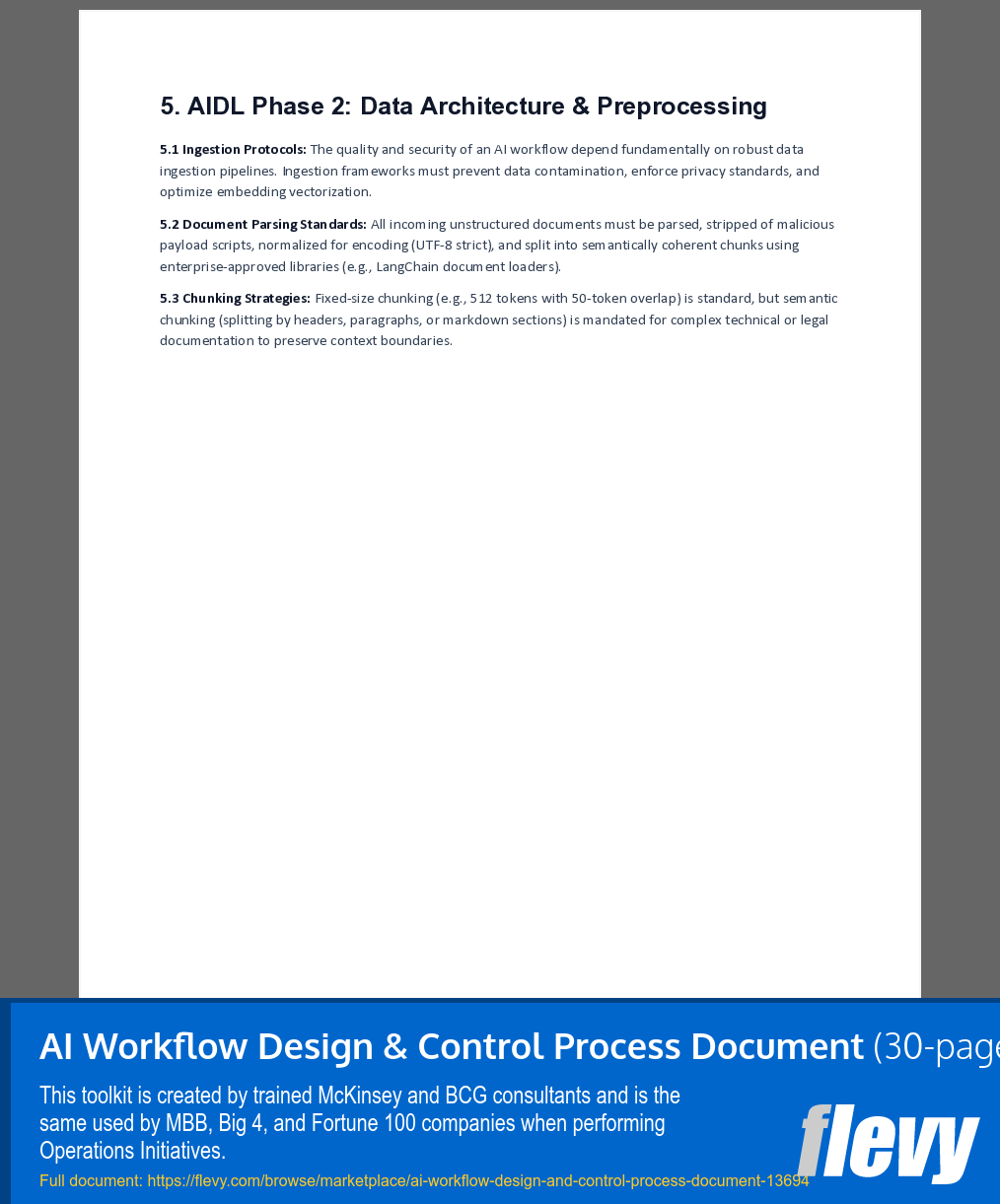
Section 3 – AI Data Architecture, Ingestion & Preprocessing
• Enterprise-grade AI Data Pipeline Architecture Framework governing ingestion, validation, normalization, preprocessing, enrichment, chunking, embedding, indexing, and retrieval.
• Mandatory controls designed to prevent data contamination, unauthorized data ingestion, malicious payloads, and uncontrolled information propagation into AI systems.
• Standardized document-processing requirements covering encoding normalization, malicious-content stripping, metadata preservation, parsing, structural analysis, and semantic segmentation.
• Enterprise Document Parsing Standard requiring incoming documents to be normalized and transformed into AI-ready representations before indexing or model consumption.
• Controlled Chunking Strategy Framework covering fixed-size, overlapping, semantic, hierarchical, heading-based, paragraph-based, and domain-specific chunking approaches.
• Mandatory semantic chunking for technical documentation, legal materials, policy documents, engineering specifications, and other context-sensitive enterprise knowledge.
• Data-quality validation gates designed to identify malformed documents, duplicate content, corrupted records, incomplete metadata, and ingestion anomalies.
• Formal Data Lineage Requirements establishing traceability from source document through transformation, embedding, vector indexing, retrieval, and final model response.
• Enterprise Data Pipeline Specification documenting source systems, transformations, security controls, retention policies, ingestion schedules, ownership, and failure-handling procedures.
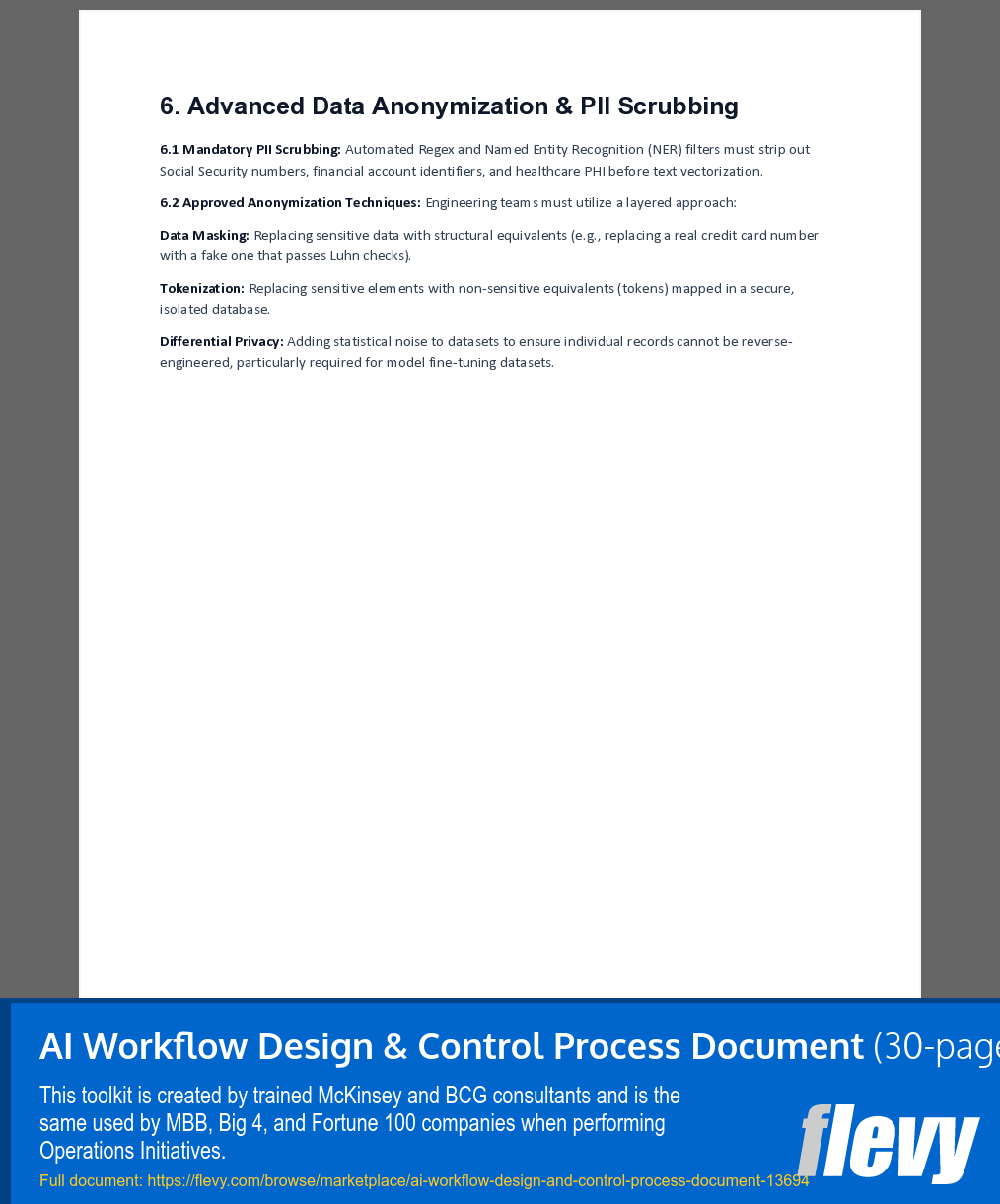
Section 4 – PII Protection, Data Anonymization & Privacy Engineering
• Mandatory PII Scrubbing Framework requiring sensitive information to be identified and controlled before vectorization, fine-tuning, training, or external model transmission.
• Automated detection mechanisms covering personal identifiers, financial information, account identifiers, credentials, healthcare information, and other regulated data classes.
• Layered AI Privacy Engineering Framework incorporating data masking, tokenization, pseudonymization, access controls, encryption, and privacy-preserving processing.
• Formal Tokenization Architecture allowing sensitive values to be replaced with controlled tokens while maintaining secure mappings outside the AI processing environment.
• Data Masking Standards designed to preserve data structure without exposing production-sensitive information.
• Differential Privacy Framework for appropriate statistical or analytical use cases requiring stronger protection against reconstruction or membership inference.
• Mandatory prohibition on unauthorized PII entering fine-tuning datasets, embeddings, vector databases, prompts, model logs, or third-party AI providers.
• Enterprise Privacy-by-Design Controls requiring data minimization, purpose limitation, retention controls, and access restrictions to be embedded into AI workflow architecture.
• Formal integration with DPIA and enterprise privacy-review processes for workflows processing sensitive or regulated information.
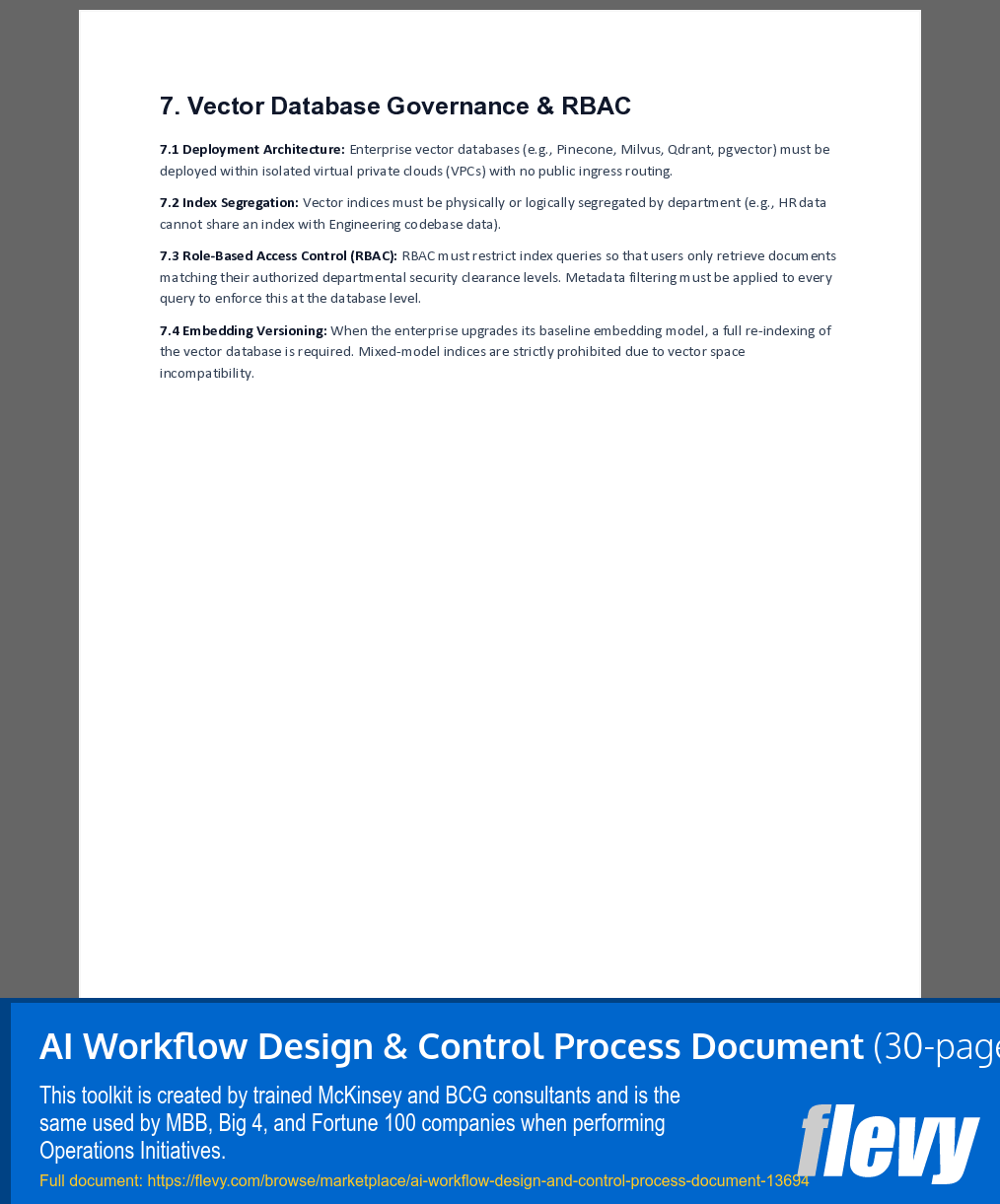
Section 5 – Vector Database Architecture, RAG Security & Retrieval Governance
• Institutional Enterprise Vector Database Governance Framework governing Pinecone, Qdrant, Milvus, pgvector, and other approved vector-storage architectures.
• Mandatory deployment of enterprise vector infrastructure within isolated network environments with controlled ingress and egress.
• Strict Vector Index Segregation Framework preventing unauthorized cross-department retrieval and uncontrolled information leakage.
• Departmental and role-based RBAC enforcement requiring users to retrieve only information authorized by their security classification.
• Mandatory Metadata Filtering Architecture applied to retrieval queries to enforce authorization at the data-access layer.
• Enterprise Embedding Version-Control Framework requiring embedding models to be tracked and controlled throughout the lifecycle.
• Mandatory re-indexing procedures following material embedding-model changes to prevent incompatible vector-space mixing.
• Comprehensive RAG Retrieval Governance Framework covering retrieval quality, document provenance, authorization, similarity thresholds, ranking, filtering, and fallback behavior.
• Formal Retrieval Relevance Controls designed to prevent generation when retrieved context is insufficiently relevant or adequately grounded.
• Mandatory source attribution and provenance requirements for high-value RAG workflows.
• Controlled RAG Architecture Standard designed to reduce hallucination risk by grounding model responses in enterprise-approved information sources.
Section 6 – Model Selection, Benchmarking & AI Model Governance
• Institutional Enterprise AI Model Selection Framework evaluating models across accuracy, latency, cost, context capacity, security, deployment requirements, licensing, privacy, and operational risk.
• Standardized Model Benchmark Matrix comparing candidate foundation models against enterprise-defined performance thresholds.
• Mandatory evaluation of model performance using relevant reasoning, coding, retrieval, instruction-following, safety, groundedness, and domain-specific benchmarks.
• Formal Open-Weight vs. Commercial API Decision Framework assessing data sensitivity, infrastructure requirements, economics, vendor risk, model performance, and regulatory considerations.
• Enterprise Foundation Model Approval Process requiring model provenance, licensing, security assessment, performance validation, and operational ownership.
• Controlled Prompt Engineering Framework governing system instructions, role definitions, context formatting, output schemas, tool-use policies, and model-specific prompt configurations.
• Standardized Fine-Tuning Governance Framework covering dataset validation, training configuration, evaluation, security, provenance, rollback, and approval.
• Mandatory baseline testing before introducing a new model into production.
• Formal Model Change Management Protocol preventing unvalidated vendor-side model changes from silently altering production behavior.
• Controlled model registry requirements covering model identity, version, provider, configuration, benchmark results, approval status, and deployment history.
Section 7 – Inference Configuration, Prompt Engineering & Cost Controls
• Standardized AI Inference Configuration Framework requiring temperature, Top-P, maximum output tokens, context limits, timeout thresholds, and retry behavior to be explicitly defined and version controlled.
• Controlled temperature ranges for factual RAG, coding, analytical, and creative AI workloads.
• Standardized Top-P governance designed to prevent uncontrolled variability in production model behavior.
• Mandatory Maximum Token Controls designed to prevent runaway generation, unexpected API expenditure, and denial-of-wallet attacks.
• Enterprise Token Budgeting Framework establishing per-workflow, per-user, and departmental consumption thresholds.
• Controlled prompt-template versioning ensuring material changes are evaluated before production deployment.
• Formal Prompt Regression Testing requiring critical prompt changes to pass automated evaluation suites before release.
• Standardized timeout, retry, circuit-breaker, and fallback behavior for model inference failures.
• Model-specific latency and throughput benchmarks supporting architecture decisions and SLA commitments.
Section 8 – RAG vs. Fine-Tuning & AI Architecture Decision Framework
• Institutional RAG vs. Fine-Tuning Decision Matrix designed to determine the correct architecture for enterprise knowledge, behavioral adaptation, domain specialization, and latency requirements.
• RAG-first Architecture Standard for rapidly changing enterprise knowledge requiring provenance, access control, and real-time updates.
• RAG is preferred where information requires source citations, dynamic updates, granular RBAC, or controlled retrieval from external enterprise systems.
• Fine-tuning framework for use cases requiring behavioral adaptation, domain-specific output formats, specialized corporate language, or proprietary DSL generation.
• Formal assessment of training-data availability, maintenance burden, model lifecycle, inference cost, security, and update frequency before approving fine-tuning.
• Enterprise Hybrid RAG + Fine-Tuning Framework for advanced applications combining behavioral specialization with controlled enterprise retrieval.
• Architecture review requirements for workflows combining multiple models, retrieval systems, agents, tools, and external APIs.
• Mandatory documentation of the rationale behind every major AI architecture decision.
Section 9 – Automated AI Control Gates & Guardrails
• Multi-layer AI Control Gate Architecture designed to intercept unsafe, unauthorized, malicious, irrelevant, or low-confidence workflow states before they reach production users or downstream systems.
• Gate 1 – Input Guardrails detecting suspicious instructions, prompt injection attempts, malicious syntax, restricted requests, and policy violations.
• Automated input sanitization, classification, rejection, and security logging for suspicious requests.
• Gate 2 – Retrieval Relevance Validation evaluating whether retrieved enterprise context is sufficiently relevant to the user request before generation proceeds.
• Configurable semantic similarity and retrieval-quality thresholds preventing unsupported responses when context quality falls below defined requirements.
• Mandatory fallback responses when the system cannot establish sufficient evidence to answer reliably.
• Gate 3 – Output Moderation scanning generated responses for PII exposure, harmful content, unsupported claims, policy violations, and other defined risks.
• Secondary critic or evaluator models may be deployed to provide independent output validation for higher-risk workflows.
• Formal Guardrail Failure Logging requiring every blocked, modified, or escalated AI response to be recorded for analysis.
• Enterprise Fail-Safe Architecture requiring unsafe or uncertain workflow states to terminate safely rather than continue autonomously.
Section 10 – Human-in-the-Loop, AI Agents & Autonomous Action Controls
• Institutional Human-in-the-Loop (HITL) Governance Framework for AI workflows capable of taking consequential actions.
• Mandatory human approval for high-impact operations including database writes, external communications, financial actions, privileged system changes, and other controlled transactions.
• Formal Agent Authorization Framework separating reasoning permissions from execution permissions.
• Least-privilege tool access requirements preventing AI agents from receiving unnecessary system privileges.
• Mandatory action confirmation checkpoints before irreversible or externally visible operations.
• HITL Escalation Architecture integrating approved enterprise collaboration and workflow platforms.
• Defined approval timeouts requiring high-risk actions to be automatically aborted when supervisory approval is not received within the approved window.
• Comprehensive Agent Action Logging capturing requested action, authorization state, tool invocation, human decision, execution result, and final status.
• Autonomous-loop protection preventing uncontrolled recursive tool use, excessive API calls, runaway reasoning chains, or repeated failed actions.
• Enterprise Agent Kill-Switch Framework enabling authorized personnel to immediately suspend high-risk autonomous workflows.
Section 11 – Prompt Injection, AI Threat Modeling & Adversarial Defense
• Comprehensive AI Threat Modeling Framework covering prompt injection, data poisoning, insecure outputs, model denial of service, supply-chain vulnerabilities, sensitive-information disclosure, excessive agency, and other AI-specific attack surfaces.
• Mandatory Prompt Injection Defense Architecture using privilege separation, instruction hierarchy, input classification, contextual isolation, and tool authorization controls.
• System instructions must remain logically separated from untrusted user content and retrieved documents.
• Formal Adversarial Input Testing Framework covering direct prompt injection, indirect prompt injection, role-play attacks, instruction overrides, encoded payloads, and contextual manipulation.
• Mandatory testing for Base64 and other encoding-based obfuscation attacks where relevant to the workflow.
• Indirect Prompt Injection Controls protecting AI systems from malicious instructions embedded within websites, documents, emails, tickets, knowledge bases, and retrieved enterprise content.
• Defense-in-depth controls designed to ensure retrieved content is treated as untrusted data rather than executable instructions.
• Mandatory red-team testing before production release of high-risk AI workflows.
Section 12 – OWASP LLM Security Controls & AI Application Security
• Enterprise implementation framework aligned with the OWASP Top 10 for Large Language Model Applications.
• Prompt Injection Mitigation Framework covering privilege separation, input controls, intent analysis, instruction hierarchy, and adversarial testing.
• Insecure Output Handling Controls requiring every model response to be treated as untrusted content before rendering, executing, storing, or passing downstream.
• Defensive controls against XSS, SQL injection, command injection, unsafe deserialization, and other downstream execution vulnerabilities.
• Training Data Poisoning Controls requiring provenance verification, source validation, anomaly detection, and controlled dataset ingestion.
• Model Denial-of-Service Protection using rate limiting, token limits, queue controls, concurrency restrictions, and resource quotas.
• AI Supply-Chain Security Framework requiring Software Bills of Materials (SBOMs), dependency scanning, package verification, and vulnerability management.
• Sensitive Information Disclosure Controls covering model outputs, prompts, logs, training datasets, vector stores, and external API traffic.
• Mandatory AI application penetration testing for production-facing workflows and high-risk integrations.
Section 13 – API Security, Secrets Management & Enterprise Identity
• Strict AI Secret Management Standard prohibiting hardcoded API keys, provider credentials, database passwords, tokens, and connection strings.
• Dynamic runtime retrieval of secrets through approved enterprise vault and secrets-management platforms.
• Mandatory encryption of credentials and sensitive configuration at rest and in transit.
• Formal API Key Rotation Framework requiring periodic credential rotation and immediate revocation following suspected compromise.
• Automated security escalation for compromised credentials and anomalous provider activity.
• Enterprise Identity & Access Management Framework applying least privilege to AI applications, services, agents, databases, APIs, and model endpoints.
• Mandatory service-account segregation preventing shared credentials across unrelated AI workflows.
• Comprehensive API gateway controls covering authentication, authorization, rate limiting, quota enforcement, request validation, logging, and traffic inspection.
• Zero-trust principles applied to AI infrastructure, model endpoints, vector databases, and supporting services.
Section 14 – AI Observability, Telemetry & Production Monitoring
• Institutional AI Observability Framework providing continuous visibility into latency, errors, token consumption, model behavior, retrieval quality, drift, cost, and user feedback.
• Mandatory Time-to-First-Token (TTFT) monitoring for streaming AI applications.
• Comprehensive generation-latency tracking across model inference, retrieval, tool calls, orchestration, and downstream services.
• Enterprise AI Performance Dashboard covering availability, latency, throughput, error rates, token expenditure, retrieval performance, and model-quality indicators.
• Continuous monitoring for model degradation, semantic drift, abnormal token consumption, provider changes, and infrastructure failures.
• User feedback mechanisms supporting explicit and appropriately governed implicit quality signals.
• Centralized telemetry integration with enterprise observability and incident-management platforms.
• Formal AI SLA Monitoring Framework linking technical metrics to application-level service commitments.
• Automated threshold monitoring designed to trigger escalation before AI workflow degradation becomes a material business incident.
Section 15 – AI FinOps, Token Economics & Cost Governance
• Enterprise AI FinOps Framework controlling the rapidly escalating infrastructure and API costs associated with production AI adoption.
• Real-time tracking of input tokens, output tokens, model usage, API calls, inference costs, storage, vector operations, and departmental consumption.
• Mandatory departmental and user-level AI spending quotas.
• Automated alerts for unusual consumption patterns, budget overruns, and potential denial-of-wallet attacks.
• Semantic Caching Framework designed to reduce unnecessary model calls, improve response latency, and lower inference expenditure.
• Cost-aware model routing allowing appropriate workloads to use lower-cost models where enterprise quality thresholds are satisfied.
• Mandatory AI Unit Economics Monitoring connecting model consumption to business outcomes and application-level ROI.
• Cost-per-request and cost-per-workflow analytics for enterprise AI portfolio management.
• Formal escalation process for applications consistently exceeding approved AI operating budgets.
Section 16 – Semantic Drift, Model Evaluation & Continuous AI Quality
• Institutional AI Evaluation & Semantic Drift Detection Framework designed to identify degradation in model performance caused by changing data, prompts, retrieval sources, user behavior, or model-provider updates.
• Mandatory Golden Dataset Framework containing curated test cases representing critical enterprise workflows.
• Continuous automated regression testing against approved benchmark datasets.
• Production evaluation covering groundedness, relevance, factuality, safety, instruction adherence, retrieval quality, and task completion.
• LLM-as-a-Judge evaluation frameworks may be used alongside deterministic and domain-specific evaluation methodologies.
• Mandatory human validation for evaluation dimensions where automated scoring is insufficient.
• Formal Model Drift Detection Protocol requiring investigation of material performance deterioration.
• Prompt and workflow changes must undergo regression evaluation before deployment.
• Vendor model changes must be treated as potential production changes requiring impact assessment and validation.
• Enterprise AI Quality Scorecard enabling comparison of model versions, prompts, retrieval configurations, and production releases.
Section 17 – Incident Management, Alerting & AI Failure Response
• Comprehensive AI Incident Management Framework defining severity levels, ownership, escalation, containment, remediation, and post-incident review.
• Automated alerting for material increases in error rates, latency, token consumption, retrieval failures, model-quality degradation, and security events.
• Critical AI incidents must route directly to designated on-call AI Engineering, MLOps, Security, or Platform Engineering personnel.
• Medium-severity events may be escalated to AI Product, Engineering Management, or designated business owners.
• Formal AI Incident Runbooks defining immediate containment and recovery procedures.
• Mandatory Fallback Architecture enabling controlled failover to secondary models, providers, or degraded-service modes where technically and contractually appropriate.
• Circuit breakers preventing repeated calls to unavailable or malfunctioning model providers.
• Automated rollback procedures for releases producing unacceptable performance degradation.
• Formal Root Cause Analysis (RCA) requirements following material AI incidents.
• Post-incident evaluation must feed lessons learned back into architecture, testing, guardrails, and governance processes.
Section 18 – Regulatory Compliance, AI Governance & Risk Management
• Enterprise AI Regulatory Compliance Framework aligned with applicable global AI governance requirements.
• Structured mapping to the NIST AI Risk Management Framework, including Govern, Map, Measure, and Manage functions.
• Formal EU AI Act Readiness Framework supporting risk classification, documentation, transparency, human oversight, monitoring, and prohibited-practice controls where applicable.
• Mandatory documentation demonstrating that AI workflows have been assessed against relevant legal, regulatory, contractual, and enterprise requirements.
• AI Governance Documentation Framework covering system purpose, capabilities, limitations, risks, datasets, models, evaluation results, human oversight, and operational controls.
• Data residency and sovereignty requirements for regulated or geographically restricted information.
• Formal DPIA integration for AI systems involving applicable personal or sensitive data.
• Enterprise AI risk-register integration enabling material risks to be tracked from design through production.
• Continuous compliance review throughout the AI lifecycle rather than relying solely on pre-production approval.
Section 19 – Audit Logging, Traceability & Immutable Records
• Institutional AI Audit Logging Standard requiring production workflows to maintain comprehensive, tamper-resistant records.
• Mandatory logging of relevant timestamps, anonymized identifiers, request hashes, model versions, prompt metadata, retrieval references, workflow events, tool actions, and response hashes.
• RAG workflows must maintain traceability to retrieved documents and associated metadata where required.
• AI agents must maintain detailed records of tool calls, authorization states, human approvals, execution results, and downstream actions.
• Formal Immutable AI Audit Trail Architecture supporting regulatory review, security investigations, operational debugging, and legal discovery.
• Controlled retention policies aligned with applicable regulatory, contractual, security, and corporate requirements.
• WORM or equivalent immutable-storage mechanisms may be required for designated high-risk records.
• Audit logs must be protected against unauthorized alteration, deletion, or privilege escalation.
• Formal audit-log access controls ensuring sensitive operational and security data is available only to authorized personnel.
Section 20 – AI Explainability, Transparency & Provenance
• Enterprise AI Explainability Framework designed to improve transparency across model outputs, retrieval decisions, automated actions, and human approvals.
• RAG systems must provide appropriate source provenance and citation mechanisms for workflows where factual traceability is required.
• Formal Retrieval Transparency Standard identifying the source material used to support AI-generated responses.
• Documentation of model limitations, confidence boundaries, known failure modes, and intended use cases.
• Human reviewers must be provided with sufficient contextual information to understand the proposed AI action before approving high-risk workflows.
• Explainability controls must be tailored to the risk and purpose of the AI application rather than assuming identical transparency requirements for every model.
• High-risk systems require enhanced documentation of decision pathways, evaluation methodology, limitations, and governance controls.
• Enterprise AI Transparency Records must remain synchronized with material changes to models, prompts, datasets, retrieval systems, and agent permissions.
Section 21 – Bias Testing, Fairness & Responsible AI Controls
• Institutional AI Bias & Fairness Evaluation Framework for applicable high-impact and customer-facing AI systems.
• Periodic testing across relevant demographic, geographic, linguistic, operational, and user segments.
• Mandatory documentation of material performance disparities and remediation actions.
• Diverse red-team participation designed to identify cultural, linguistic, demographic, accessibility, and contextual failure modes.
• Fairness assessments must be appropriate to the intended use case and supported by measurable evaluation criteria.
• Formal escalation procedures for material bias findings.
• Continuous monitoring where changing data, user behavior, or model updates could alter fairness outcomes.
• Responsible AI requirements integrated directly into architecture, testing, deployment, and operational governance.
Section 22 – Cross-Functional AI Engineering Operating Model
• Enterprise AI Team Topology Framework connecting AI Engineering, MLOps, Data Science, Data Engineering, Cybersecurity, Product, Legal, Risk, Compliance, and Enterprise Architecture.
• Formal engineering responsibilities covering AI pipelines, orchestration, model integrations, vector databases, inference infrastructure, CI/CD, continuous evaluation, and production reliability.
• MLOps ownership of deployment automation, model lifecycle management, observability, rollback, performance monitoring, and operational readiness.
• Data Science responsibility for experimentation, evaluation design, model behavior analysis, statistical validation, and quality measurement.
• Product ownership of user requirements, workflows, success metrics, adoption, feedback, and business ROI.
• Security ownership of threat modeling, penetration testing, identity controls, secret management, and security monitoring.
• Legal and Risk ownership of applicable regulatory, contractual, privacy, intellectual-property, and enterprise-risk requirements.
• Mandatory cross-functional review for Tier 3 and other designated high-impact AI systems.
Section 23 – Legal, Risk, Security & Third-Party AI Provider Governance
• Institutional Third-Party AI Vendor Risk Framework assessing model providers, API vendors, hosted inference platforms, vector databases, orchestration platforms, and AI observability providers.
• Mandatory review of applicable Data Processing Agreements (DPAs), privacy terms, security commitments, retention policies, intellectual-property provisions, and contractual protections.
• Formal assessment of vendor data usage and whether customer prompts, documents, outputs, or metadata may be used for provider training or other purposes.
• Enterprise AI Provider Due-Diligence Checklist covering security certifications, data residency, breach notification, availability, model lifecycle, service continuity, and contractual commitments.
• Mandatory identification of vendor concentration and model-provider dependency risks.
• Formal exit planning for critical third-party AI dependencies.
• Legal review of applicable copyright, licensing, model-use restrictions, and intellectual-property considerations.
• Security review of all externally connected AI services before production deployment.
Section 24 – Disaster Recovery, Business Continuity & AI Resilience
• Comprehensive AI Disaster Recovery & Business Continuity Framework addressing model-provider outages, API deprecation, vector database failures, infrastructure loss, data corruption, catastrophic drift, and security incidents.
• AI-specific Recovery Time Objective (RTO) and Recovery Point Objective (RPO) requirements based on application criticality.
• Vector database backup and recovery procedures designed to preserve approved knowledge states.
• Model artifact backup covering approved model versions, prompts, configurations, evaluation datasets, embeddings, infrastructure definitions, and deployment manifests.
• Formal AI Failover Architecture supporting secondary providers or locally deployed fallback models where justified.
• Enterprise Vendor Lock-In Mitigation Framework using abstraction layers and standardized model interfaces where appropriate.
• Regular disaster-recovery testing validating actual recovery capability rather than relying solely on documented procedures.
• Mandatory degraded-service behavior for situations where full AI functionality cannot be safely restored.
• Business continuity procedures covering both technical recovery and human operational fallback.
Section 25 – CI/CD, MLOps Automation & Production Release Governance
• Enterprise AI CI/CD/CT Framework integrating code validation, security scanning, model evaluation, prompt regression testing, dependency analysis, infrastructure testing, and deployment controls.
• Mandatory automated testing before AI workflows progress between environments.
• Controlled Development → Staging → Production Promotion Framework preventing direct unvalidated production deployment.
• Automated security and dependency scanning across AI application libraries and infrastructure.
• Model artifact and container integrity verification.
• Formal approval gates for high-risk model and workflow releases.
• Automated rollback mechanisms for failed deployments or material production degradation.
• Continuous evaluation pipelines monitoring model quality after deployment.
• Infrastructure-as-code requirements for reproducible AI environments.
• Enterprise Production Readiness Review validating security, performance, cost, monitoring, DR, ownership, and support procedures before go-live.
Section 26 – Approved AI Models, Platforms & Engineering Tooling
• Controlled Enterprise AI Technology Catalog defining approved models, orchestration frameworks, vector databases, observability platforms, secrets-management solutions, and infrastructure components.
• Approved-model governance covering commercial APIs, enterprise-hosted models, and approved open-weight models.
• Controlled evaluation process for introducing new foundation models or AI providers.
• Approved orchestration technologies may include enterprise-supported frameworks such as LangChain, LlamaIndex, and Haystack, subject to security, architecture, and lifecycle requirements.
• Approved vector technologies may include Pinecone, Qdrant, pgvector, and other platforms approved through enterprise architecture governance.
• AI observability may utilize approved platforms such as LangSmith, Arize AI, Datadog, or equivalent enterprise-approved tooling.
• Technology exceptions require formal architecture and security review.
• Experimental AI frameworks must not enter production without appropriate governance, supportability, security, and operational assessments.
• Vendor and tooling approvals must be periodically reviewed as the enterprise AI technology landscape evolves.
Section 27 – Production Architecture Checklist & AI Governance Sign-Off
• AI Workflow Lifecycle Documentation: Discovery, data architecture, model selection, control integration, validation, and production documentation completed and approved.
• AI Risk Tier: Formal risk classification assigned and appropriately approved.
• Data Security: PII detection, masking, access controls, encryption, data lineage, and retention requirements implemented.
• RAG Architecture: Retrieval quality, metadata filtering, authorization, provenance, and embedding versioning validated.
• Model Governance: Approved model, version, configuration, benchmarks, limitations, and change-control process documented.
• Security Controls: Prompt injection defenses, output handling, dependency scanning, secret management, and penetration testing completed where required.
• HITL Controls: High-risk actions require tested human approval and fail-safe timeout procedures.
• Observability: Latency, errors, token consumption, model quality, drift, and cost monitoring operational.
• FinOps: Departmental and user-level quotas, cost alerts, and budget controls configured.
• Evaluation: Golden datasets, regression tests, quality metrics, and production evaluation mechanisms validated.
• Incident Response: Alert routing, escalation, rollback, fallback, and AI-specific incident runbooks tested.
• Auditability: Required audit trails and immutable retention mechanisms operational.
• Disaster Recovery: RTO/RPO targets established and recovery procedures tested.
• Governance Sign-Off: Required Engineering, Security, Risk, Architecture, Product, and executive approvals obtained before production release.
Section 28 – AI Production Readiness & Operational Certification
• Formal Enterprise AI Production Readiness Assessment required before high-impact AI systems enter live operation.
• Architecture certification covering security, scalability, resilience, data governance, model quality, observability, cost, compliance, and operational ownership.
• Mandatory evidence package containing architecture diagrams, data-flow diagrams, model cards, evaluation results, security testing, risk assessments, runbooks, and rollback procedures.
• Production deployment prohibited where critical security, privacy, reliability, or governance controls remain unresolved.
• Formal Go-Live Approval Matrix assigning final approval authority based on AI risk classification.
• Post-launch stabilization period requiring heightened monitoring of performance, cost, security events, user feedback, and unexpected model behavior.
• Formal transition from project implementation into BAU AI Operations / MLOps ownership.
• Continuous control validation following production release.
Section 29 – AI Lifecycle Review, Continuous Improvement & Model Retirement
• Monthly or risk-appropriate AI Architecture Review Cycle evaluating model performance, infrastructure changes, vendor updates, security events, regulatory developments, cost trends, and emerging risks.
• Mandatory reassessment following significant model-provider changes, material prompt modifications, architecture changes, new data sources, or changes in intended use.
• Formal AI Model Retirement Framework governing decommissioning, data retention, audit preservation, dependency removal, access revocation, and documentation closure.
• Controlled replacement process ensuring successor models are benchmarked against incumbent production systems.
• Historical model artifacts and governance records must remain accessible where required for auditability and regulatory purposes.
• Continuous optimization of model quality, inference cost, latency, security posture, retrieval accuracy, and user experience.
• Enterprise AI portfolio governance designed to identify redundant systems, uncontrolled AI proliferation, obsolete models, and excessive vendor dependencies.
Section 30 – AI Workflow Engineering Glossary & Governance Reference
• RAG (Retrieval-Augmented Generation): AI architecture in which a model retrieves external information before generating a response.
• MLOps: Operational discipline for deploying, monitoring, maintaining, evaluating, and governing machine-learning systems.
• Vector Embedding: Numerical representation of information enabling semantic similarity search.
• Semantic Drift: Degradation in AI performance caused by changes in data, behavior, prompts, retrieval sources, or model characteristics.
• Prompt Injection: Attack technique designed to manipulate an AI system into disregarding intended instructions or security boundaries.
• Human-in-the-Loop (HITL): Controlled workflow requiring human review or authorization before designated AI actions proceed.
• AI Guardrail: Technical control designed to constrain model inputs, outputs, retrieval, tool use, or actions.
• Model Evaluation: Systematic measurement of AI performance against defined quality, safety, reliability, and business criteria.
• LLM-as-a-Judge: Evaluation methodology using a language model to assess another model's outputs against predefined criteria.
• AI FinOps: Financial governance discipline focused on controlling AI infrastructure, inference, token, storage, and API costs.
• Prompt Shielding: Architecture that separates trusted system instructions from untrusted user or retrieved content.
• AI Agent: AI-driven workflow capable of reasoning, invoking tools, interacting with systems, or executing designated actions.
• Model Drift: Change in model behavior or performance resulting from changes to models, data, operating environments, or upstream providers.
• AI Observability: Continuous measurement of technical, operational, financial, and behavioral characteristics of AI systems.
• Golden Dataset: Curated evaluation dataset used for repeatable regression and production-quality testing.
Why Enterprise AI Teams Need This Standard
This is not simply an AI architecture checklist, prompt-engineering guide, RAG tutorial, or MLOps reference document.
It is a comprehensive Enterprise AI Workflow Design & Control Standard designed to establish the engineering, security, governance, compliance, operational, and financial controls required to move AI systems from prototype to production without sacrificing control.
The framework brings together AI architecture, RAG engineering, vector database governance, foundation-model selection, prompt engineering, fine-tuning, AI agents, human-in-the-loop controls, prompt-injection defense, OWASP LLM security, PII protection, secrets management, observability, AI FinOps, semantic drift detection, automated evaluations, incident response, regulatory governance, audit logging, bias testing, disaster recovery, CI/CD, MLOps, vendor governance, and production certification into one controlled enterprise methodology.
It is built to help organizations:
• Standardize AI engineering across teams
• Reduce hallucination and uncontrolled-model behavior
• Protect enterprise data and intellectual property
• Control AI agents and autonomous actions
• Detect prompt injection and AI-specific security threats
• Reduce unnecessary token and inference expenditure
• Improve RAG accuracy, provenance, and authorization
• Monitor model drift and production degradation
• Create auditable AI workflows
• Strengthen AI regulatory readiness
• Reduce vendor lock-in
• Accelerate safe AI production deployment
• Establish repeatable AI governance at enterprise scale
Whether the organization is deploying enterprise RAG, internal copilots, customer-facing LLM applications, predictive machine-learning systems, AI agents, automated decision-support tools, fine-tuned foundation models, or multi-model AI platforms, this standard provides a structured framework for controlling the entire AI lifecycle.
Built for serious enterprise AI engineering—not experimental notebooks.
Built for production—not prototypes.
Built for governed AI—not uncontrolled model access.
Built to help organizations operationalize AI at scale while maintaining security, reliability, financial discipline, auditability, and executive control.
Keywords: Process Audit SOPs, Internal Audit Standard Operating Procedures, Process Audit Framework, Control Testing Procedures, Risk Assessment Methodologies, Audit Governance, Process Audit Strategy, Audit Evidence Collection, Compliance Audit SOPs, Continuous Auditing, Process Mapping, Audit Documentation Standards, Audit Quality Assurance, Process Risk Management, Operational Risk Audit, Enterprise Audit Management, Audit Committee Reporting, Audit Analytics, Process Mining, AI-Assisted Auditing, Audit Technology SOPs, Global Process Audit, Audit Playbooks, Audit Templates, Audit Training Programs, Audit Remediation Management, Audit Excellence, Process Audit Toolkit, McKinsey Audit Framework, Audit Best Practices, Enterprise Governance, Internal Control Assessment, Audit Procedures Manual, Audit Program Design, Audit Resource Planning, Audit Scheduling, Audit Efficiency, Audit Effectiveness, Audit Performance Metrics, Audit KPIs, Audit ROI, Audit Value Creation, Process Optimization, Operational Excellence, Business Process Audit, Functional Audit, Departmental Audit, Transactional Audit, Service Audit, Administrative Process Audit, Supply Chain Process Audit, Finance Process Audit, IT Process Audit, HR Process Audit, Procurement Process Audit, Sales Process Audit, Customer Service Audit, Production Audit, Quality Audit, Compliance Testing, Regulatory Audit, Policy Compliance, Procedure Audit, Documentation Audit, Audit Trail Review, Exception Management, Control Design, Control Effectiveness, Control Testing, Preventive Controls, Detective Controls, Corrective Actions, Root Cause Analysis, Finding Classification, Audit Report Writing, Executive Summaries, Audit Communication, Stakeholder Engagement, Process Owner Engagement, Management Accountability, Audit Committee Governance, Audit Charter, Audit Independence, Auditor Ethics, Professional Skepticism, Audit Competency, Audit Training, Audit Certification, Audit Standards (IIA, IAASB), Audit Best Practices, Audit Methodology, Audit Framework, Audit Operating Model, Process Audit Excellence, Audit Mastery, Fortune 500 Audit, Enterprise Audit Operations, Corporate Audit Function, Strategic Audit Planning, Transformation Audit, Digital Audit, Innovation Audit, Benchmarking Audit, Maturity Assessment, Audit Scaling, Audit Outsourcing, Co-Sourcing Models, Vendor Management, Audit Technology Stack, Audit Tools, Audit Software, Continuous Monitoring, Predictive Analytics, Anomaly Detection, Data Quality, Process Intelligence, Workflow Analytics, Business Process Management, Process Automation, RPA Audit, AI Governance, Responsible AI Audit, Cybersecurity Audit, Data Governance Audit, Privacy Audit, Information Security, Audit Evidence Standards, Working Papers, Audit Documentation, Audit File Management, Audit Records Retention, Audit Trail Integrity, Audit Report Confidentiality, Multi-Site Audit Coordination, Global Audit Strategy, International Audit Standards, Regional Audit Compliance, Cultural Considerations in Audit, Localization of Audit Procedures, Process Transformation Audit, Business Reengineering Audit, Change Audit, Operational Change, Audit Change Management, Audit Communication Plan, Audit Stakeholder Communication, Audit Performance Review, Audit Function Review, Strategic Review Process, Audit Leadership Development, Audit Team Development, Audit Coaching, Audit Supervision, Audit Career Progression, Audit Knowledge Management, Audit Playbook Development, Audit Template Library, Audit Standards Documentation, Audit Policy Manual, Lessons Learned Capture, Best Practice Sharing, Audit Continuous Improvement, Audit Methodology Enhancement, Audit Process Optimization, Audit Efficiency Improvement, Audit Effectiveness Enhancement, Audit Quality Improvement, Audit Risk Management, Audit Risk Register, Audit Issue Management, Audit Action Tracking, Audit Metrics Dashboard, Audit Performance Dashboard, Audit Scorecard, Audit Balanced Scorecard, KPI Framework for Audit, Audit Success Factors, Critical Success Factors in Audit, Audit Strategic Objectives, Audit Vision Statement, Audit Mission Statement, Audit Values and Ethics, Audit Culture, Audit Maturity Model, Audit Capability Model, Audit Competency Framework, Professional Development in Audit, Audit Certification Programs, Internal Audit Standards, Audit Best Practices Guide, Audit Reference Manual, Audit Operating Manual, Audit Procedures Manual, Audit Program Manual, McKinsey Audit Excellence, Deloitte Audit Framework, EY Audit Approach, KPMG Audit Methodology, Big 4 Audit Standards, Audit Industry Benchmarks, Audit Industry Standards, Audit Thought Leadership, Audit Innovation, Audit Transformation Program, Audit Digital Transformation, Audit Process Transformation, Audit Service Transformation, Audit Operating Model Transformation, Audit Function Evolution, Audit Future-Proofing, Emerging Trends in Audit, Audit 2025 Roadmap, Audit Strategic Priorities, Audit Strategic Planning, Audit Strategic Execution, Audit Implementation Plan, Audit Deployment Strategy, Audit Rollout Plan, Audit Quick-Start Guide, Audit Implementation Guide, Audit User Guide, Audit Handbook, Audit Manual, Audit Documentation Standard, Audit Work Standards, Audit Quality Standards, Audit Performance Standards, Audit Excellence Standards, Enterprise Audit Excellence, Audit Mastery Program, Audit Excellence Initiative, Audit Excellence Framework, Audit Excellence Culture, Audit Excellence Mindset, Strategic Audit Excellence, Operational Audit Excellence, Financial Audit Excellence, Compliance Audit Excellence, Quality Audit Excellence, Process Audit Excellence, Audit Excellence ROI, Audit Excellence Value Creation, Audit Excellence Competitive Advantage, Audit Excellence Strategic Advantage, Audit Excellence Performance Advantage, Audit Excellence Organizational Advantage, Inventory Management, Demand Planning, Inventory Optimization, Inventory Control, Supply Chain Management, Warehouse Operations, Replenishment Strategy, Inventory Analytics, WIP Reduction, Inventory Accuracy, Distribution Network, Inventory Forecasting, Supply Chain Excellence, Working Capital, Inventory KPIs, Procurement Strategy, Inventory Governance, Inventory SOPs, Continuous Improvement, Supply Chain Transformation, GenAI deployment SOPs, generative AI operating model, enterprise AI governance framework, AI Center of Excellence, responsible AI, AI risk management, AI use case prioritization, GenAI implementation roadmap, AI vendor selection, prompt engineering standards, AI compliance, AI adoption strategy, generative AI across value chain, AI strategy, enterprise transformation, AI implementation, AI scaling framework
Strategy & Transformation, Growth Strategy, Strategic Planning, Strategy Frameworks, Innovation Management, Pricing Strategy, Core Competencies, Strategy Development, Business Transformation, Marketing Plan Development, Product Strategy, Breakout Strategy, Competitive Advantage, Mission, Vision, Values, Strategy Deployment & Execution, Innovation, Vision Statement, Core Competencies Analysis, Corporate Strategy, Product Launch Strategy, BMI, Blue Ocean Strategy, Breakthrough Strategy, Business Model Innovation, Business Strategy Example, Corporate Transformation, Critical Success Factors, Customer Segmentation, Customer Value Proposition, Distinctive Capabilities, Enterprise Performance Management, KPI, Key Performance Indicators, Market Analysis, Market Entry Example, Market Entry Plan, Market Intelligence, Market Research, Market Segmentation, Market Sizing, Marketing, Michael Porter's Value Chain, Organizational Transformation, Performance Management, Performance Measurement, Platform Strategy, Product Go-to-Market Strategy, Reorganization, Restructuring, SWOT, SWOT Analysis, Service 4.0, Service Strategy, Service Transformation, Strategic Analysis, Strategic Plan Example, Strategy Deployment, Strategy Execution, Strategy Frameworks Compilation, Strategy Methodologies, Strategy Report Example, Value Chain, Value Chain Analysis, Value Innovation, Value Proposition, Vision Statement, Corporate Strategy, Business Development, Business plan pdf, business plan, PDF, Business Plan DOC, Business Plan Template, PPT, Market strategy playbook, strategic market planning, competitive analysis tools, market segmentation frameworks, growth strategy templates, product positioning strategy, market execution toolkit, strategic alignment playbook, KPI and OKR frameworks, business growth strategy guide, cross-functional strategy templates, market risk management, market strategy PowerPoint doc, guide, ebook, e-book ,McKinsey Change Playbook, Organizational change management toolkit, Change management frameworks 2025, Influence model for change, Change leadership strategies, Behavioral change in organizations, Change management PowerPoint templates, Transformational leadership in change, supply chain KPIs, supply chain KPI toolkit, supply chain PowerPoint template, logistics KPIs, procurement KPIs, inventory management KPIs, supply chain performance metrics, manufacturing KPIs, supply chain dashboard, supply chain strategy KPIs, reverse logistics KPIs, sustainability KPIs in supply chain, financial supply chain KPIs, warehouse KPIs, digital supply chain KPIs, 1200 KPIs, supply chain scorecard, KPI examples, supply chain templates, Corporate Finance SOPs, Finance SOP Excel Template, CFO Toolkit, Finance Department Procedures, Financial Planning SOPs, Treasury SOPs, Accounts Payable SOPs, Accounts Receivable SOPs, General Ledger SOPs, Accounting Policies Template, Internal Controls SOPs, Finance Process Standardization, Finance Operating Procedures, Finance Department Excel Template, FP&A Process Documentation, Corporate Finance Template, Finance SOP Toolkit, CFO Process Templates, Accounting SOP Package, Tax Compliance SOPs, Financial Risk Management Procedures.
NOTE: Our digital products are sold on an "as is" basis, making returns and refunds unavailable post-download. Please preview and inquire before purchasing. Please contact us before purchasing if you have any questions! This policy aligns with the standard Flevy Terms of Usage.
Got a question about the product? Email us at support@flevy.com or ask the author directly by using the "Ask the Author a Question" form. If you cannot view the preview above this document description, go here to view the large preview instead.
Source: Best Practices in Artificial Intelligence, Workflow Word: AI Workflow Design & Control Process Document Word (DOCX) Document, SB Consulting
ABOUT THE AUTHOR

SB Consulting is dedicated to empowering businesses to communicate their ideas with impact. This consulting firm specializes in teaching organizations how to create effective corporate and management presentations. With training from top-tier global consulting firms, including McKinsey, BCG, and Porsche Consulting, extensive expertise in presentation design and ... [read more]
Ask the Author a Question
You must be logged in to contact the author.




























