
Quality & Reliability Presentation   101-slide PPT PowerPoint presentation slide deck (PPTX)
$44.00

Quality & Reliability Presentation (101-slide PPT PowerPoint presentation slide deck (PPTX)) Preview Image
Log in to unlock full preview.
Quality & Reliability Presentation (101-slide PPT PowerPoint presentation slide deck (PPTX)) Preview Image
Arrow   Click main image to view in full screen.

Quality & Reliability Presentation (PowerPoint PPTX Slide Deck)

PowerPoint (PPTX) + Zip archive file (ZIP) 101 Slides

$44.00
This presentation is developed by a pioneer in Lean and certified LSS Master Black Belt who has trained over 5,000+ students globally, from Directors, CEOs, GMs, to shop floor staff. He's endorsed by CMI Consortium, NZTE, HERA, NZPICS, CBAFF.
Add to Cart


Immediate download
Fully editable PowerPoint
Free lifetime updates

BENEFITS OF THIS POWERPOINT DOCUMENT

  1. Build quality at source
  2. Analyze where things can go wrong to take proactive steps
  3. Find the root cause rather than addressing symptoms

RCA PPT DESCRIPTION

Editor Summary The Quality & Reliability Presentation is a 101-slide PowerPoint training resource (PPTX) with a supplemental ZIP of 41 Lean documents, developed by OpEx Academy NZ and a Lean pioneer / certified LSS Master Black Belt who has trained over 5,000 students and is endorsed by CMI Consortium, NZTE, HERA, NZPICS, and CBAFF. Read more

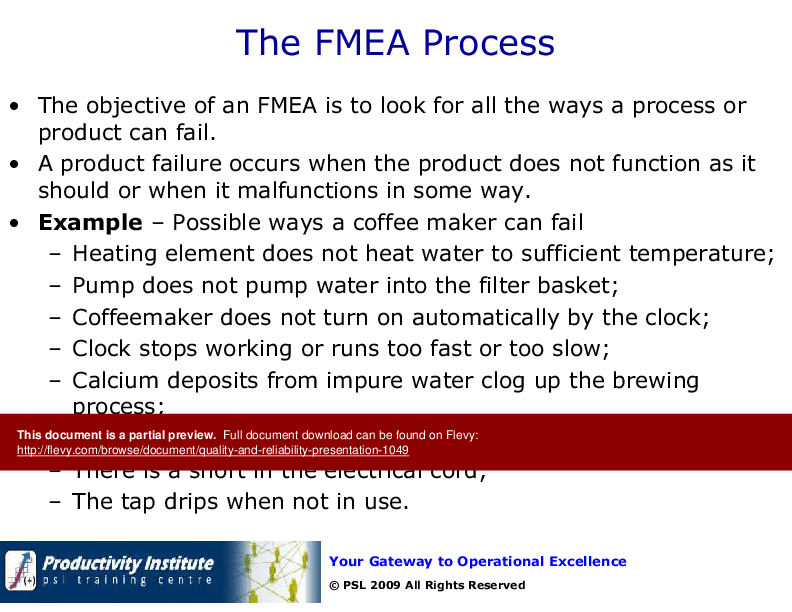
This presentation comprises of 101 slides and discusses three main topics, FMEA (Failure Modes & Effects Analysis), RCA (Root Cause Analysis) and Error Proofing to improve quality of products and build in reliability.
Contents:
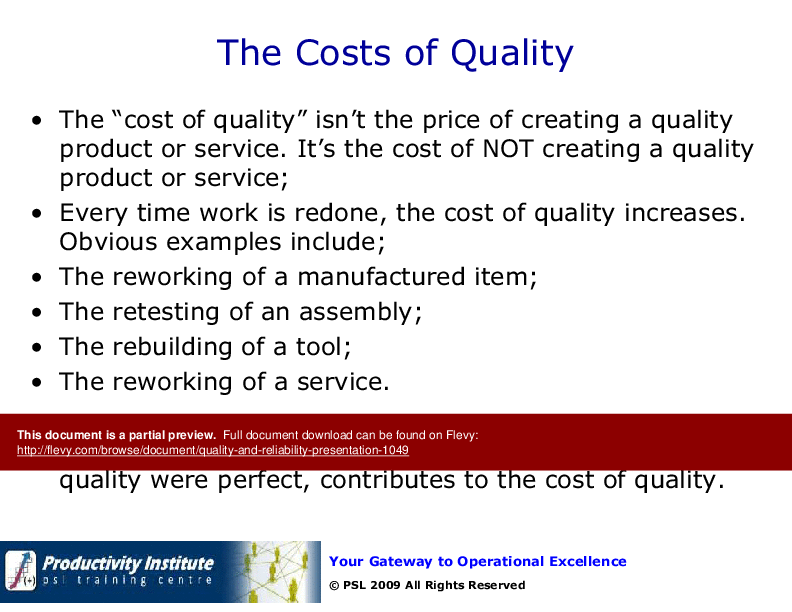
Costs of Quality
Failure Mode Effects Analysis and the 10 steps
Problem Solving
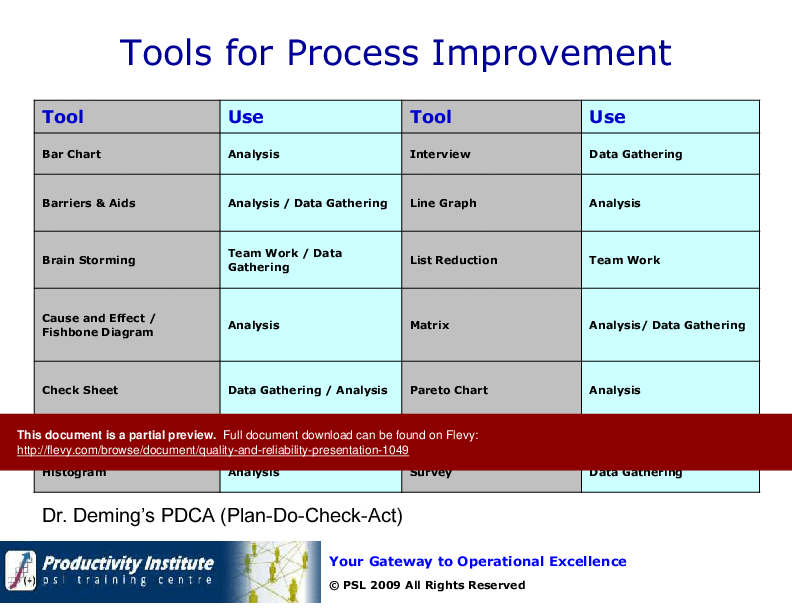
Tools for Process Improvements
PDCA (Plan-Do-Check-Act)
7 Quality Tools
Brain Storming
RCA (Root Cause Analysis)
ZQC – Zero Quality Control
Poka-Yoke (Error Proofing)
Project using DMAIC

Also included with this document is a bonus zip of 41 Lean documents (includes templates, case studies, articles, posters, charts, and more).

Got a question about the product? Email us at support@flevy.com or ask the author directly by using the "Ask the Author a Question" form. If you cannot view the preview above this document description, go here to view the large preview instead.

MARCUS OVERVIEW

This synopsis was written by Marcus [?] based on the analysis of the full 101-slide presentation.


Executive Summary
The Quality & Reliability Presentation is a comprehensive training resource designed to enhance operational excellence through the application of quality management principles. Developed by a Lean pioneer and certified LSS Master Black Belt, this presentation equips corporate executives, integration leaders, and consultants with essential tools and methodologies such as FMEA (Failure Modes and Effects Analysis), RCA (Root Cause Analysis), and Poka-Yoke (Error Proofing). By leveraging these frameworks, users can drive process improvements, reduce defects, and achieve zero quality control, thereby fostering a culture of continuous improvement and customer satisfaction.

Who This Is For and When to Use
•  Quality Assurance Managers focused on reducing defects and improving processes
•  Operations Executives aiming for enhanced reliability in production
•  Lean Practitioners implementing continuous improvement initiatives
•  Project Managers overseeing quality improvement projects
•  Training and Development Leaders responsible for staff education on quality tools

Best-fit moments to use this deck:
•  During quality improvement workshops to introduce foundational concepts
•  When initiating process improvement projects that require structured methodologies
•  For training sessions aimed at enhancing team capabilities in quality management

Learning Objectives
•  Define the costs of quality and their impact on business performance
•  Build a comprehensive FMEA to identify and prioritize potential failures
•  Establish effective root cause analysis techniques to address quality issues
•  Implement the PDCA (Plan-Do-Check-Act) cycle for continuous improvement
•  Utilize Poka-Yoke systems to eliminate defects at the source
•  Apply the 7 Quality Tools for effective problem-solving and process analysis

Table of Contents
•  Introduction to Quality & Reliability (page 1)
•  Costs of Quality (page 3)
•  Failure Modes & Effects Analysis (FMEA) Overview (page 5)
•  Root Cause Analysis (RCA) Techniques (page 10)
•  Tools for Process Improvement (page 15)
•  Zero Quality Control (ZQC) Principles (page 20)
•  Poka-Yoke Systems for Error Proofing (page 25)
•  Case Studies and Practical Applications (page 30)
•  Project Guidelines Using DMAIC (page 35)
•  Conclusion and Next Steps (page 40)

Primary Topics Covered
•  Costs of Quality - Understanding the financial impact of defects and the importance of quality assurance in reducing unnecessary expenses.
•  Failure Modes & Effects Analysis (FMEA) - A systematic approach to identifying potential failures in processes and products to enhance safety and customer satisfaction.
•  Root Cause Analysis (RCA) - Techniques for identifying the underlying causes of quality issues to prevent recurrence.
•  PDCA Cycle - A structured methodology for implementing continuous improvement in processes.
•  Poka-Yoke (Error Proofing) - Strategies to design processes that prevent errors before they occur.
•  Zero Quality Control (ZQC) - A proactive approach to achieving zero defects through effective process control and inspection methods.

Deliverables, Templates, and Tools
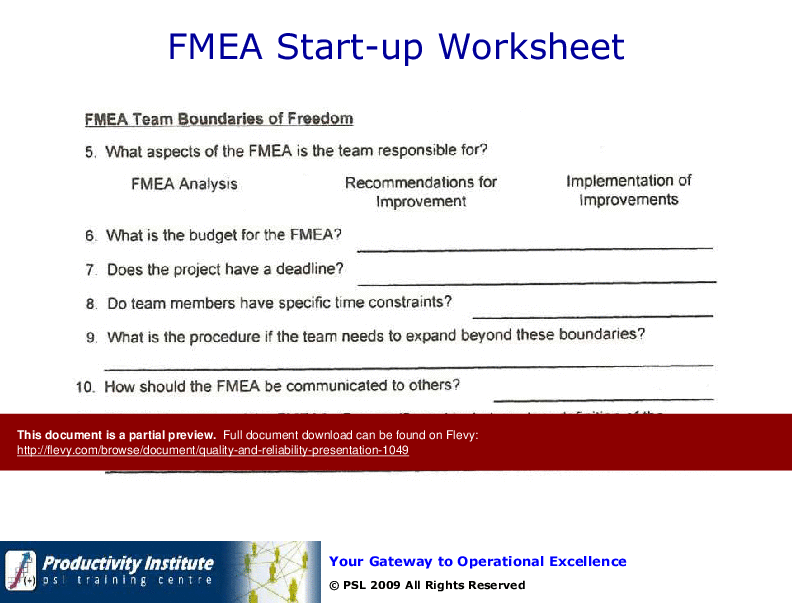
•  FMEA worksheets for systematic failure analysis
•  RCA templates for identifying and documenting root causes
•  PDCA cycle templates for project planning and execution
•  Poka-Yoke implementation checklists for error-proofing processes
•  Case study examples illustrating successful quality improvement initiatives
•  Project guidelines for applying DMAIC in quality management

Slide Highlights
•  Overview of the costs associated with poor quality and the benefits of investing in quality systems
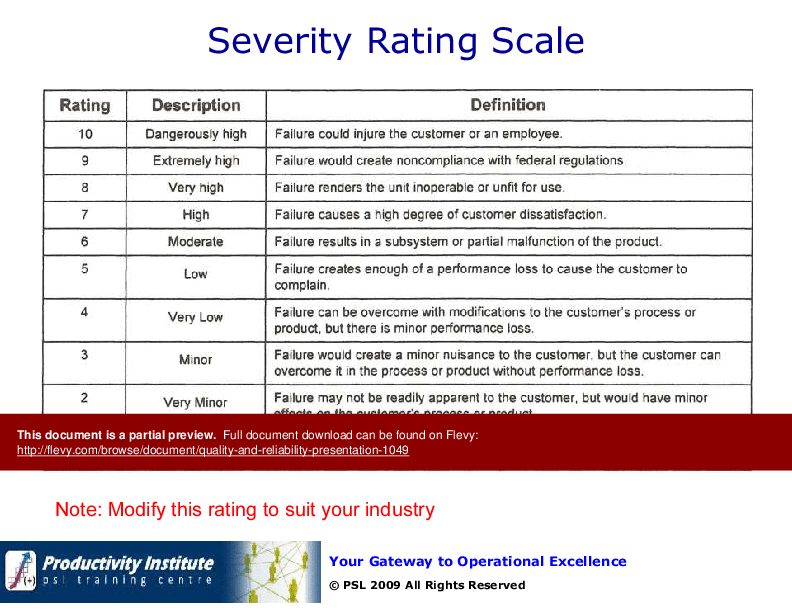
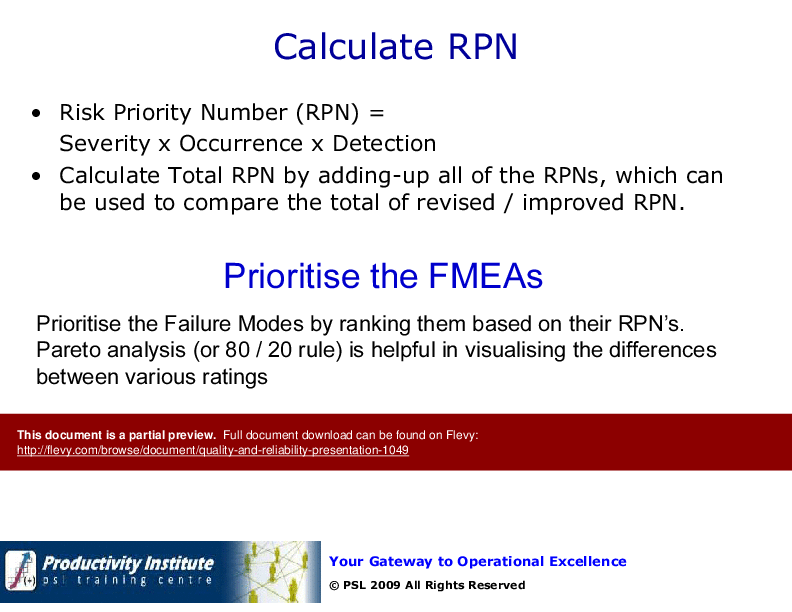
•  Detailed steps for conducting an FMEA, including severity, occurrence, and detection ratings
•  Visual representations of the PDCA cycle and its application in continuous improvement
•  Examples of Poka-Yoke systems in action, demonstrating effective error-proofing techniques
•  Case studies showcasing real-world applications of quality tools and their impact on business outcomes

Potential Workshop Agenda
Introduction to Quality Concepts (30 minutes)
•  Overview of quality principles and their importance
•  Discussion on the costs of quality and their implications

FMEA and RCA Workshop (60 minutes)
•  Hands-on activity to develop an FMEA for a selected process
•  Group discussion on root cause analysis techniques

Implementing PDCA and Poka-Yoke (45 minutes)
•  Interactive session on applying the PDCA cycle in quality projects
•  Brainstorming session on Poka-Yoke applications in participants' processes

Customization Guidance
•  Tailor the FMEA and RCA templates to fit specific industry requirements and terminology
•  Adjust the PDCA cycle examples to reflect organizational processes and goals
•  Incorporate company-specific case studies to enhance relevance and engagement

Secondary Topics Covered
•  The role of quality assurance in operational excellence
•  Techniques for effective brainstorming and problem-solving
•  The importance of training and employee engagement in quality initiatives
•  Strategies for measuring and sustaining quality improvements

Topic FAQ

What are the core components of a Failure Modes & Effects Analysis (FMEA) used in quality management?

FMEA is a structured, proactive method to identify potential failures, assess their effects and prioritize mitigation based on severity, occurrence and detection. The Quality & Reliability Presentation outlines detailed steps for conducting an FMEA, including severity, occurrence and detection ratings within a 10-step approach, ending with 10 steps.

How does Root Cause Analysis (RCA) help prevent recurring quality issues?

RCA focuses on identifying the fundamental reasons behind observed defects so corrective actions address the root cause rather than symptoms. By documenting causes and corrective actions, teams can reduce recurrence and sustain improvements; the presentation covers RCA techniques for identifying and addressing underlying causes, using RCA techniques.

What is Poka-Yoke and when should I apply error-proofing in a process?

Poka-Yoke refers to design features or controls that prevent errors or catch mistakes before they become defects. Apply Poka-Yoke where human or process variability leads to recurring defects, and use checklists and design changes to eliminate errors at the source, demonstrated via Poka-Yoke systems.

Which are the 7 Quality Tools and how are they typically used in problem solving?

The 7 Quality Tools are cause-and-effect diagrams, check sheets, control charts, histograms, Pareto charts, scatter diagrams and stratification techniques; they are used to characterize problems, identify root causes, monitor process behavior and prioritize improvement efforts using those 7 tools.

How should I choose a quality management training deck for my team if I have a limited budget and short timeline?

Prioritize decks that include step-by-step methods, editable templates, a workshop agenda and supplemental materials so you can run sessions quickly and adapt content. The Quality & Reliability Presentation provides a 101-slide deck plus a bonus ZIP of 41 Lean documents to support fast deployment and customization, including 41 Lean documents.

What deliverables and templates are useful to expect from a quality and reliability presentation?

Useful deliverables include FMEA worksheets, RCA templates, PDCA cycle templates, Poka-Yoke implementation checklists, case studies and project guidelines for DMAIC so teams can apply methods directly; the Quality & Reliability Presentation lists FMEA worksheets and PDCA templates among its deliverables, including FMEA worksheets.

I need to run a half-day workshop on reducing defects—what structure and activities should I follow?

A practical half-day structure begins with a 30-minute introduction to quality concepts and cost of quality, a 60-minute FMEA and RCA hands-on session, and a 45-minute PDCA and Poka-Yoke implementation segment, allowing group work and discussion; use the suggested FMEA and RCA Workshop (60 minutes).

How can Zero Quality Control (ZQC) be integrated into an existing continuous improvement program?

Integrate ZQC by embedding error-prevention (Poka-Yoke), using PDCA cycles to pilot changes, applying DMAIC for structured projects, and training teams to build quality into processes rather than relying on inspection; the presentation links ZQC with PDCA and DMAIC project guidelines, referencing DMAIC project guidelines.

Document FAQ
These are questions addressed within this presentation.

What is the goal of Zero Quality Control (ZQC)?
ZQC aims to achieve zero defects by preventing errors in processes before they occur, ensuring that quality is built into every step of production.

How can FMEA improve product reliability?
FMEA systematically identifies potential failure modes and their effects, allowing teams to prioritize risks and implement corrective actions before failures reach customers.

What are the 7 Quality Tools?
The 7 Quality Tools include cause and effect diagrams, check sheets, control charts, histograms, Pareto charts, scatter diagrams, and stratification techniques, all designed to facilitate problem-solving and process analysis.

When should I use the PDCA cycle?
The PDCA cycle is ideal for continuous improvement projects, new process designs, and when implementing changes to existing processes.

How does Poka-Yoke contribute to quality assurance?
Poka-Yoke systems are designed to prevent errors by incorporating mechanisms that catch mistakes before they result in defects, thus enhancing overall product quality.

What is the significance of root cause analysis?
Root cause analysis identifies the fundamental reasons for quality issues, enabling organizations to address and eliminate these causes, leading to sustained improvements.

How can I implement these quality tools in my organization?
Start by training your teams on the principles and methodologies outlined in this presentation, then apply the tools in real projects to build competence and confidence.

Glossary
•  FMEA - Failure Modes and Effects Analysis; a risk management tool for identifying potential failures.
•  RCA - Root Cause Analysis; a method for identifying the underlying causes of problems.
•  PDCA - Plan-Do-Check-Act; a continuous improvement cycle.
•  Poka-Yoke - Error-proofing techniques to prevent defects.
•  ZQC - Zero Quality Control; a strategy aimed at achieving zero defects.
•  7 Quality Tools - A set of fundamental tools for quality control and improvement.
•  DMAIC - Define, Measure, Analyze, Improve, Control; a structured problem-solving methodology.
•  Continuous Improvement - Ongoing efforts to enhance products, services, or processes.
•  Cost of Quality - The total cost of ensuring quality, including prevention, appraisal, and failure costs.
•  Defect - A deviation from the expected quality standard.
•  Process - A series of actions or steps taken to achieve a particular end.
•  Quality Assurance - Activities aimed at ensuring that quality requirements are met.
•  Customer Satisfaction - A measure of how products and services meet or exceed customer expectations.
•  Lean Principles - Methodologies focused on minimizing waste and maximizing value.
•  Statistical Process Control (SPC) - A method of quality control using statistical methods.
•  Quality Management System (QMS) - A formalized system that documents processes, procedures, and responsibilities for achieving quality policies and objectives.
•  Benchmarking - Comparing business processes and performance metrics to industry bests.
•  Value Stream Mapping - A lean-management method for analyzing the flow of materials and information.
•  Process Improvement - The proactive task of identifying, analyzing, and improving existing business processes.

Source: Best Practices in RCA, Error Proofing, FMEA PowerPoint Slides: Quality & Reliability Presentation PowerPoint (PPTX) Presentation Slide Deck, OpEx Academy NZ


$44.00
This presentation is developed by a pioneer in Lean and certified LSS Master Black Belt who has trained over 5,000+ students globally, from Directors, CEOs, GMs, to shop floor staff. He's endorsed by CMI Consortium, NZTE, HERA, NZPICS, CBAFF.
Add to Cart
  

ABOUT THE AUTHOR

Author image
Additional documents from author: 88

Vishnu Rayapeddi is an experienced management consultant and trainer specializing in implementing continuous process improvements. Vishnu is a pioneer in Lean Management which combines the power of Lean Thinking, TOC, Six Sigma, TQM, TWI, Balanced Scorecard, cGMP and other best-class methodologies such as, DMAIC, Value Stream Mapping, Root Cause Analysis, 5S, Quick Changeovers, Quality and ... [read more]

Ask the Author a Question

You must be logged in to contact the author.

Click here to log in Click here register

Did you know?
The average daily rate of a McKinsey consultant is $6,625 (not including expenses). The average price of a Flevy document is $65.


Trusted by over 10,000+ Client Organizations
Since 2012, we have provided business templates to over 10,000 businesses and organizations of all sizes, from startups and small businesses to the Fortune 100, in over 130 countries.
AT&T GE Cisco Intel IBM Coke Dell Toyota HP Nike Samsung Microsoft Astrazeneca JP Morgan KPMG Walgreens Walmart 3M Kaiser Oracle SAP Google E&Y Volvo Bosch Merck Fedex Shell Amgen Eli Lilly Roche AIG Abbott Amazon PwC T-Mobile Broadcom Bayer Pearson Titleist ConEd Pfizer NTT Data Schwab


Read Customer Testimonials

 
"Last Sunday morning, I was diligently working on an important presentation for a client and found myself in need of additional content and suitable templates for various types of graphics. Flevy.com proved to be a treasure trove for both content and design at a reasonable price, considering the time I "

– M. E., Chief Commercial Officer, International Logistics Service Provider
 
"FlevyPro provides business frameworks from many of the global giants in management consulting that allow you to provide best in class solutions for your clients."

– David Harris, Managing Director at Futures Strategy
 
"As a niche strategic consulting firm, Flevy and FlevyPro frameworks and documents are an on-going reference to help us structure our findings and recommendations to our clients as well as improve their clarity, strength, and visual power. For us, it is an invaluable resource to increase our impact and value."

– David Coloma, Consulting Area Manager at Cynertia Consulting
 
"I have used FlevyPro for several business applications. It is a great complement to working with expensive consultants. The quality and effectiveness of the tools are of the highest standards."

– Moritz Bernhoerster, Global Sourcing Director at Fortune 500
 
"My FlevyPro subscription provides me with the most popular frameworks and decks in demand in today’s market. They not only augment my existing consulting and coaching offerings and delivery, but also keep me abreast of the latest trends, inspire new products and service offerings for my practice, and educate me "

– Bill Branson, Founder at Strategic Business Architects
 
"One of the great discoveries that I have made for my business is the Flevy library of training materials.

As a Lean Transformation Expert, I am always making presentations to clients on a variety of topics: Training, Transformation, Total Productive Maintenance, Culture, Coaching, Tools, Leadership Behavior, etc. Flevy "

– Ed Kemmerling, Senior Lean Transformation Expert at PMG
 
"As a consulting firm, we had been creating subject matter training materials for our people and found the excellent materials on Flevy, which saved us 100's of hours of re-creating what already exists on the Flevy materials we purchased."

– Michael Evans, Managing Director at Newport LLC
 
"I have used Flevy services for a number of years and have never, ever been disappointed. As a matter of fact, David and his team continue, time after time, to impress me with their willingness to assist and in the real sense of the word. I have concluded in fact "

– Roberto Pelliccia, Senior Executive in International Hospitality


Customers Also Bought These Documents


Customers Also Like These Documents

Explore Related Management Topics

5S


Your Recently Viewed Documents
Receive our FREE presentation on Operational Excellence

This 50-slide presentation provides a high-level introduction to the 4 Building Blocks of Operational Excellence. Achieving OpEx requires the implementation of a Business Execution System that integrates these 4 building blocks.