
Lean Shop Floor YB Series - 6. Apply JIT Principles   63-slide PPT PowerPoint presentation slide deck (PPT)
$30.00

Lean Shop Floor YB Series - 6. Apply JIT Principles (63-slide PPT PowerPoint presentation slide deck (PPT)) Preview Image
Log in to unlock full preview.
Lean Shop Floor YB Series - 6. Apply JIT Principles (63-slide PPT PowerPoint presentation slide deck (PPT)) Preview Image
Arrow   Click main image to view in full screen.

Lean Shop Floor YB Series - 6. Apply JIT Principles (PowerPoint PPT Slide Deck)

PowerPoint (PPT) 63 Slides

#2 in Shop Floor $30.00
This presentation is developed by a pioneer in Lean and certified LSS Master Black Belt who has trained over 5,000+ students globally, from Directors, CEOs, GMs, to shop floor staff. He's endorsed by CMI Consortium, NZTE, HERA, NZPICS, CBAFF.
Add to Cart


Immediate download
Fully editable PowerPoint
Free lifetime updates

BENEFITS OF THIS POWERPOINT DOCUMENT

  1. Educate your staff in the principles of JIT to minimize wastes

JIT PPT DESCRIPTION

Editor Summary Lean Shop Floor YB Series - 6. Read more

The Lean Shop Floor Yellow Belt Series are designed and developed in a very simple way so that the shop floor staff with little or no formal education can understand. When a staff member completes all the 8 modules he / she can be awarded a certificate.
There are 8 modules namely:
1. Apply Lean Practices
2. Apply 5S Pinnciples
3. Undertake Root Cause Analysis
4. Apply Cost Factors
5. Apply Quick Changeovers
6. Apply JIT Principles
7. Apply TPM Principles
8. Sustain Process Improvements

This module Apply JIT Principles covers the following topics:
What JIT is
Basic concepts of JIT
Support techniques
Process improvements
Standardization
Streamlined production
Uniform-leveled production
Support techniques of Just in Time manufacturing.
Principles and reasons for standardizing work.

*Total number of slides = 63
You can also buy all the 8 modules at a discounted price. Pl look for "Shop Floor Series – All in 1"

Got a question about the product? Email us at support@flevy.com or ask the author directly by using the "Ask the Author a Question" form. If you cannot view the preview above this document description, go here to view the large preview instead.

MARCUS OVERVIEW

This synopsis was written by Marcus [?] based on the analysis of the full 63-slide presentation.


Executive Summary
This presentation, "Lean Shop Floor Series - Course 6: Apply Just in Time Concepts," provides a comprehensive overview of Just in Time (JIT) manufacturing principles. It equips participants with the knowledge to implement JIT techniques effectively, focusing on waste reduction, improved efficiency, and enhanced customer responsiveness. By the end of the course, attendees will understand how to streamline production processes, standardize operations, and foster a culture of continuous improvement.

Who This Is For and When to Use

•  Operations managers seeking to enhance production efficiency
•  Lean practitioners aiming to implement JIT methodologies
•  Quality control teams focused on reducing defects and waste
•  Production staff looking to improve workflow and responsiveness

Best-fit moments to use this deck:
•  During training sessions for new employees on JIT principles
•  As a refresher for teams involved in lean manufacturing initiatives
•  In workshops aimed at process improvement and standardization

Learning Objectives

•  Define Just in Time (JIT) and its significance in manufacturing
•  Describe the basic concepts and key differences of JIT compared to traditional methods
•  Identify support techniques that enhance JIT implementation
•  Analyze process improvements that lead to streamlined production
•  Establish the importance of standardization in operational processes
•  Implement continuous improvement practices using the PDCA cycle

Table of Contents

•  Introduction to Just in Time (page 2)
•  Definition and Key Differences (page 4)
•  How JIT Delivers Value (page 12)
•  Production Leveling Concepts (page 18)
•  Kanban and Its Applications (page 22)
•  Support Techniques for JIT (page 30)
•  Process Improvements and Layout (page 40)
•  Work Standardization Principles (page 50)
•  Continuous Improvement Framework (page 60)

Primary Topics Covered

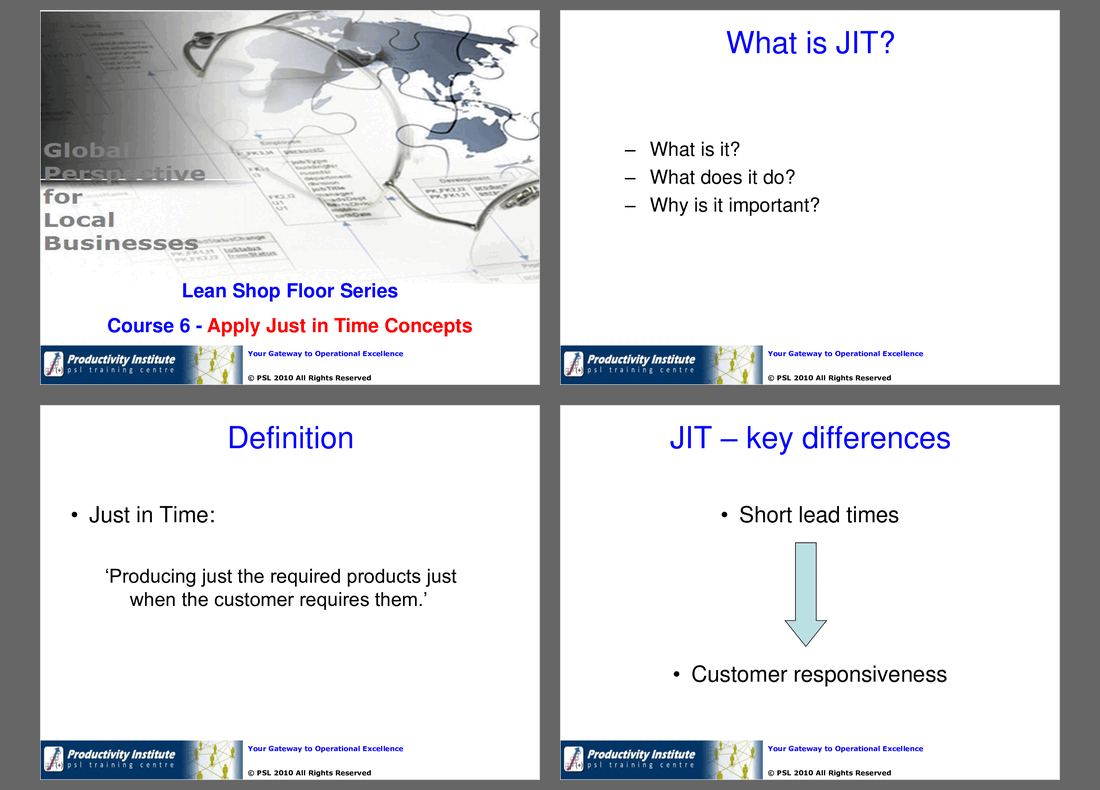
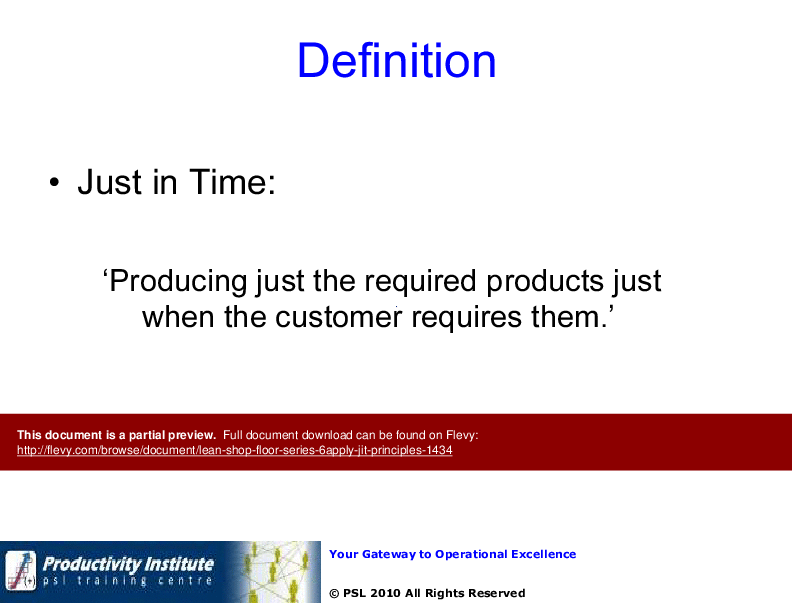
•  Definition of JIT - JIT is defined as producing just the required products when the customer requires them, emphasizing efficiency and responsiveness.
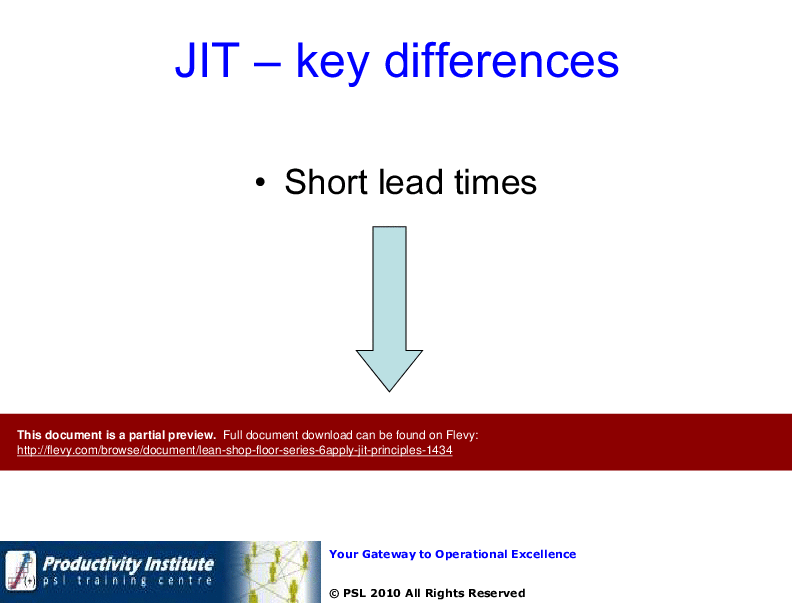
•  Key Differences from Traditional Manufacturing - JIT focuses on stockless production, short lead times, and customer responsiveness, contrasting with traditional methods that rely on high inventory levels.
•  Value Delivery Mechanisms - JIT delivers value through waste control, standard operations, efficient layouts, and continuous improvement practices.
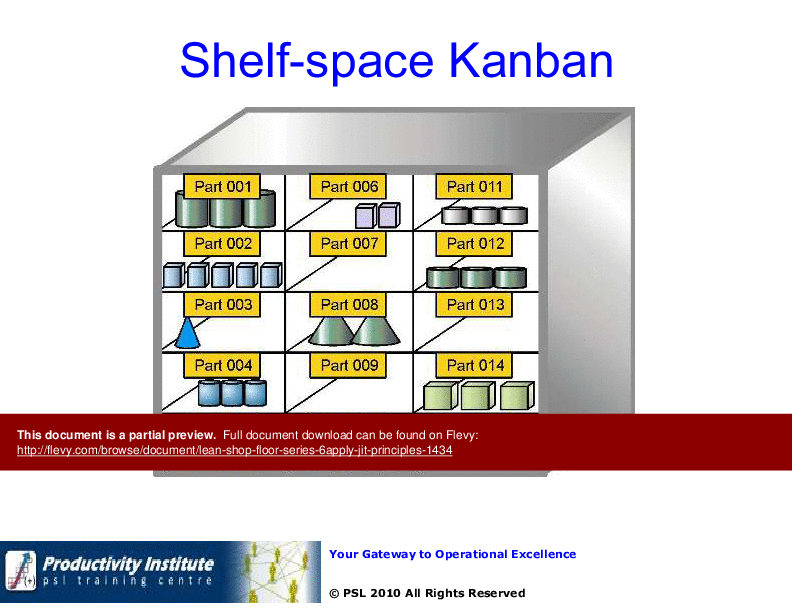
•  Kanban System - Kanban serves as a visual signal to control production, facilitating pull production based on actual demand rather than forecasts.
•  Support Techniques - Techniques such as workplace organization (5S), visual management, quick changeover, and total productive maintenance support JIT implementation.
•  Process Improvements - Emphasizes the elimination of waste and the importance of physical layout and linking processes for efficiency.

Deliverables, Templates, and Tools

•  JIT implementation checklist template
•  Kanban board example for visual management
•  5S workplace organization guide
•  Process mapping template for linking operations
•  Standard operating procedure (SOP) template for standardized work
•  Continuous improvement tracking sheet

Slide Highlights

•  Overview of JIT principles and their significance in modern manufacturing
•  Comparison of push vs. pull production methods with visual examples
•  Detailed explanation of the Kanban system and its types
•  5S methodology for workplace organization illustrated with diagrams
•  PDCA cycle for continuous improvement with clear action steps

Potential Workshop Agenda

Introduction to JIT Concepts (60 minutes)
•  Define JIT and its importance in manufacturing
•  Discuss key differences from traditional methods

Kanban and Production Leveling (90 minutes)
•  Explore Kanban types and their applications
•  Analyze production leveling techniques and benefits

Support Techniques for JIT (60 minutes)
•  Review workplace organization and visual management strategies
•  Discuss quick changeover and total productive maintenance

Process Improvements and Standardization (90 minutes)
•  Identify process improvement opportunities
•  Establish the principles of work standardization

Customization Guidance

•  Tailor the JIT implementation checklist to reflect specific operational needs
•  Adjust Kanban examples to fit the unique production environment
•  Incorporate company-specific terminology in the standard operating procedures
•  Modify the workshop agenda to focus on particular challenges faced by the team

Secondary Topics Covered

•  Waste reduction strategies in manufacturing
•  The role of workforce ownership in JIT success
•  Techniques for maintaining high quality and low defect rates
•  Importance of teamwork and multi-skilling in JIT environments

Topic FAQ

What are the core principles of Just in Time (JIT) manufacturing?

JIT is a manufacturing philosophy that produces only what is required when the customer requires it, emphasizing reduced inventory, short lead times, and responsiveness to demand. It focuses on waste control, standard operations, efficient layouts, and continuous improvement to align production with actual customer needs, such as stockless production and short lead times.

How does a Kanban system support JIT on the shop floor?

Kanban provides visual signals to control production and inventory, enabling pull production based on actual demand rather than forecasts. It links upstream and downstream processes, reduces overproduction, and supports production leveling; practical examples include Kanban board implementations and different Kanban types explained in training, such as a Kanban board example.

What support techniques are commonly used to implement JIT?

Support techniques that enable JIT include workplace organization (5S), visual management, quick changeover methods, and total productive maintenance (TPM). These practices reduce waste, shorten setup times, and maintain equipment reliability to sustain flow and responsiveness on the shop floor, for example 5S workplace organization and quick changeover methods.

How can I measure whether JIT implementation is successful?

Success metrics for JIT include reductions in lead time, improvements in inventory turnover, lower defect rates, and enhanced customer responsiveness. Monitoring these indicators helps determine if waste has been reduced and processes have been streamlined, using specific measures such as lead time reduction and inventory turnover rates.

What should I look for when choosing a JIT training deck or toolkit?

Choose materials that define JIT and contrast it with traditional methods, cover Kanban and production leveling, explain support techniques (5S, TPM, quick changeover), and provide practical templates like checklists, Kanban boards, process maps, SOPs, and continuous improvement trackers—elements included in Flevy’s Lean Shop Floor YB Series - 6. Apply JIT Principles, such as a JIT implementation checklist template.

How long should a JIT workshop for shop floor teams typically run?

A structured JIT workshop can be delivered in a multi-hour session; a suggested agenda from training materials breaks sessions into modules such as 60 minutes for JIT concepts, 90 minutes for Kanban and leveling, 60 minutes for support techniques, and 90 minutes for process improvements and standardization—totaling about 5 hours.

Which shop floor roles should receive JIT training and what activities should they learn?

Operations managers should learn production leveling and layout linking; lean practitioners should design Kanban and visual systems; quality teams should apply standard operating procedures and PDCA; production staff should practice 5S, quick changeovers, and Kanban operation to improve workflow and responsiveness, for example using a Kanban board example and 5S guidance.

How do standardization and the PDCA cycle help sustain JIT gains?

Standardization ensures consistent methods and repeatable quality, reducing variation and defects, while the PDCA (Plan-Do-Check-Act) cycle provides a continuous improvement framework to test changes, measure results, and institutionalize improvements. Together they maintain streamlined production and ongoing improvement using the PDCA cycle for continuous improvement.

Document FAQ
These are questions addressed within this presentation.


What is Just in Time (JIT)?
JIT is a manufacturing philosophy that emphasizes producing only what is needed, when it is needed, to reduce waste and improve efficiency.

How does JIT differ from traditional manufacturing methods?
JIT focuses on stockless production, shorter lead times, and customer responsiveness, whereas traditional methods often rely on high inventory levels and longer production runs.

What are the key benefits of implementing JIT?
Benefits include reduced inventory costs, improved quality, increased efficiency, and enhanced customer satisfaction through timely delivery.

What is the Kanban system?
Kanban is a visual management tool that signals when to produce or replenish items, facilitating a pull production system based on actual demand.

How can workplace organization support JIT?
Effective workplace organization, such as the 5S methodology, helps eliminate waste, improve efficiency, and create a safer work environment.

What is the PDCA cycle?
The PDCA cycle stands for Plan, Do, Check, Act, and is a framework for continuous improvement in processes and operations.

How can I measure the success of JIT implementation?
Success can be measured through key performance indicators such as lead time reduction, inventory turnover rates, defect rates, and overall customer satisfaction.

What role does employee training play in JIT?
Training ensures that employees understand JIT principles, support techniques, and their roles in maintaining efficient and responsive production processes.

Glossary

•  Just in Time (JIT) - A manufacturing philosophy focused on producing only what is needed when it is needed.
•  Kanban - A visual signal used to control production and inventory levels.
•  5S - A workplace organization method that includes Sort, Set, Shine, Standardize, and Sustain.
•  Continuous Improvement - An ongoing effort to improve products, services, or processes.
•  PDCA Cycle - A four-step management method for continuous improvement: Plan, Do, Check, Act.
•  Pull Production - A production strategy that initiates production based on actual demand rather than forecasts.
•  Standard Operating Procedure (SOP) - A document that outlines the steps necessary to perform a task consistently.
•  Work Standardization - The process of establishing consistent methods for performing tasks to ensure quality and efficiency.
•  Total Productive Maintenance (TPM) - A maintenance approach aimed at preventing equipment breakdowns and ensuring operational efficiency.
•  Waste - Any activity that does not add value to the product or service.
•  Process Layout - An arrangement of equipment based on the sequence of operations.
•  Cellular Layout - A layout that groups together machines and workstations to facilitate smooth workflow and reduce transport time.
•  Visual Management - The use of visual cues to communicate information about processes and performance.
•  Quality Management - The act of overseeing all activities and tasks needed to maintain a desired level of excellence.
•  Defect Rate - The percentage of defective items produced in a manufacturing process.
•  Customer Responsiveness - The ability of a company to respond quickly to customer needs and demands.
•  Efficiency - The ability to produce a desired output with minimal waste of resources.
•  Team Spirit - The feeling of camaraderie and cooperation among team members.
•  Flexibility - The ability to adapt to changing conditions or requirements in the production process.
•  Productivity - The measure of output per unit of input in a production process.

Source: Best Practices in JIT, Shop Floor PowerPoint Slides: Lean Shop Floor YB Series - 6. Apply JIT Principles PowerPoint (PPT) Presentation Slide Deck, OpEx Academy NZ


$30.00
This presentation is developed by a pioneer in Lean and certified LSS Master Black Belt who has trained over 5,000+ students globally, from Directors, CEOs, GMs, to shop floor staff. He's endorsed by CMI Consortium, NZTE, HERA, NZPICS, CBAFF.
Add to Cart
  

ABOUT THE AUTHOR

Author image
Additional documents from author: 88

Vishnu Rayapeddi is an experienced management consultant and trainer specializing in implementing continuous process improvements. Vishnu is a pioneer in Lean Management which combines the power of Lean Thinking, TOC, Six Sigma, TQM, TWI, Balanced Scorecard, cGMP and other best-class methodologies such as, DMAIC, Value Stream Mapping, Root Cause Analysis, 5S, Quick Changeovers, Quality and ... [read more]

Ask the Author a Question

You must be logged in to contact the author.

Click here to log in Click here register

Did you know?
The average daily rate of a McKinsey consultant is $6,625 (not including expenses). The average price of a Flevy document is $65.
Bundle and save! You can save up to % with bundles!

View bundle(s)


Trusted by over 10,000+ Client Organizations
Since 2012, we have provided business templates to over 10,000 businesses and organizations of all sizes, from startups and small businesses to the Fortune 100, in over 130 countries.
AT&T GE Cisco Intel IBM Coke Dell Toyota HP Nike Samsung Microsoft Astrazeneca JP Morgan KPMG Walgreens Walmart 3M Kaiser Oracle SAP Google E&Y Volvo Bosch Merck Fedex Shell Amgen Eli Lilly Roche AIG Abbott Amazon PwC T-Mobile Broadcom Bayer Pearson Titleist ConEd Pfizer NTT Data Schwab


Read Customer Testimonials

 
"As an Independent Management Consultant, I find Flevy to add great value as a source of best practices, templates and information on new trends. Flevy has matured and the quality and quantity of the library is excellent. Lastly the price charged is reasonable, creating a win-win value for "

– Jim Schoen, Principal at FRC Group
 
"As a small business owner, the resource material available from FlevyPro has proven to be invaluable. The ability to search for material on demand based our project events and client requirements was great for me and proved very beneficial to my clients. Importantly, being able to easily edit and tailor "

– Michael Duff, Managing Director at Change Strategy (UK)
 
"As a niche strategic consulting firm, Flevy and FlevyPro frameworks and documents are an on-going reference to help us structure our findings and recommendations to our clients as well as improve their clarity, strength, and visual power. For us, it is an invaluable resource to increase our impact and value."

– David Coloma, Consulting Area Manager at Cynertia Consulting
 
"One of the great discoveries that I have made for my business is the Flevy library of training materials.

As a Lean Transformation Expert, I am always making presentations to clients on a variety of topics: Training, Transformation, Total Productive Maintenance, Culture, Coaching, Tools, Leadership Behavior, etc. Flevy "

– Ed Kemmerling, Senior Lean Transformation Expert at PMG
 
"My FlevyPro subscription provides me with the most popular frameworks and decks in demand in today’s market. They not only augment my existing consulting and coaching offerings and delivery, but also keep me abreast of the latest trends, inspire new products and service offerings for my practice, and educate me "

– Bill Branson, Founder at Strategic Business Architects
 
"If you are looking for great resources to save time with your business presentations, Flevy is truly a value-added resource. Flevy has done all the work for you and we will continue to utilize Flevy as a source to extract up-to-date information and data for our virtual and onsite presentations!"

– Debbi Saffo, President at The NiKhar Group
 
"As a consultant requiring up to date and professional material that will be of value and use to my clients, I find Flevy a very reliable resource.

The variety and quality of material available through Flevy offers a very useful and commanding source for information. Using Flevy saves me time, enhances my expertise and ends up being a good decision."

– Dennis Gershowitz, Principal at DG Associates
 
"[Flevy] produces some great work that has been/continues to be of immense help not only to myself, but as I seek to provide professional services to my clients, it gives me a large "tool box" of resources that are critical to provide them with the quality of service and outcomes they are expecting."

– Royston Knowles, Executive with 50+ Years of Board Level Experience


Save with Bundles

This document is available as part of the following discounted bundle(s):


Customers Also Bought These Documents


Customers Also Like These Documents

Explore Templates on Related Management Topics


Your Recently Viewed Documents
Receive our FREE presentation on Operational Excellence

This 50-slide presentation provides a high-level introduction to the 4 Building Blocks of Operational Excellence. Achieving OpEx requires the implementation of a Business Execution System that integrates these 4 building blocks.