



 Click main image to view in full screen. Unlock all 15 preview images:
Flood Resilience Capital Shift™ – PDF
PDF document 42 Pages


BENEFITS OF THIS DOWNLOADABLE PDF DOCUMENT
- Provides a practical capital-allocation framework for right-sizing urban flood infrastructure against risk, lifecycle cost, and municipal constraints.
- Translates complex flood-control technologies and resilience approaches into an actionable portfolio architecture, escalation pathway, and phased investment strategy.
- Enables decision-makers to evaluate CAPEX, OPEX, land, financing, maintenance, residual risk, and avoided losses before committing to major infrastructure.
SUSTAINABILITY PDF DESCRIPTION
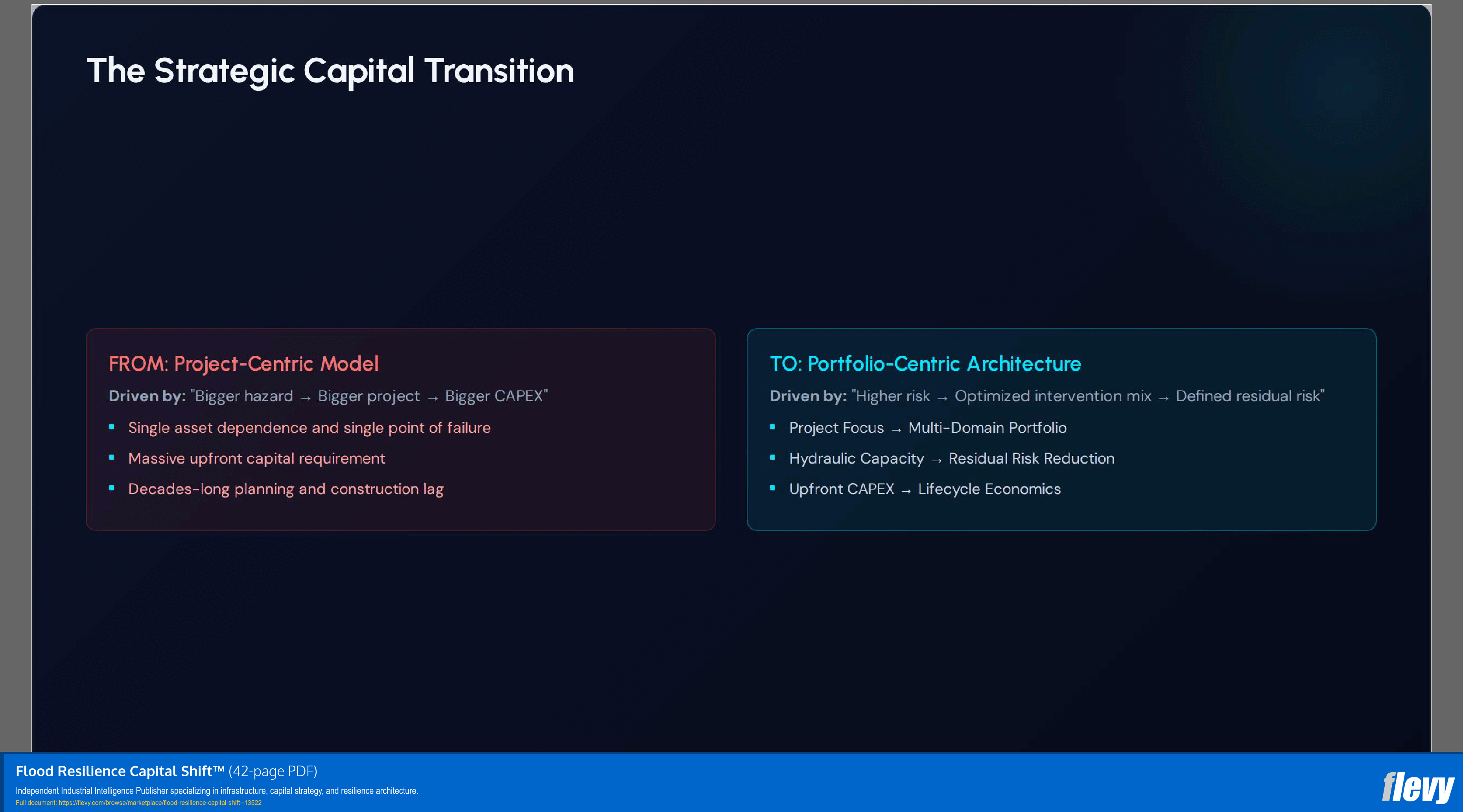
The Flood Resilience Capital Shift™ is an executive intelligence playbook for city leaders, infrastructure decision-makers, development authorities, investors, and advisors navigating a fundamental question: how should scarce capital be allocated to reduce urban flood risk without automatically defaulting to large-scale infrastructure megaprojects?
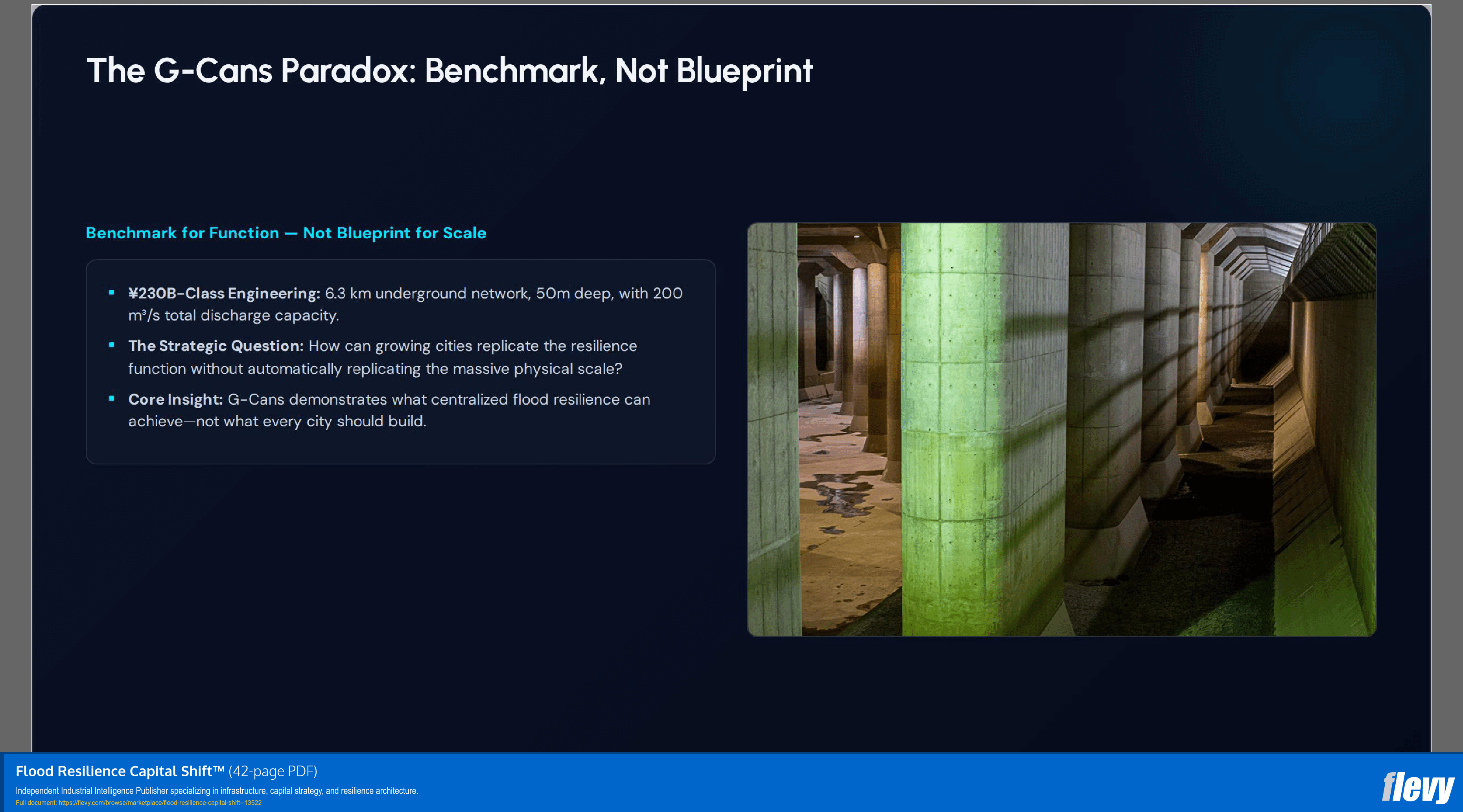
The playbook reframes flood resilience from an isolated engineering-project problem into a portfolio architecture and capital-allocation problem. Using Tokyo's G-Cans system as a benchmark—not a blueprint—it examines how cities can replicate the functional logic of high-performance flood protection through appropriately scaled combinations of prevention, capture, buffering, conveyance, discharge, control, and critical-asset protection.
Inside, you will find:
• The Flood Resilience Architecture™ – a structured seven-function model covering Prevent, Capture, Buffer, Convey, Discharge, Control, and Protect.
• The Flood Risk Diagnostic Engine – a practical sequence for identifying hazard typology, systemic failure points, exposure, and acceptable residual-risk requirements.
• The Intervention Trade-Off Matrix – compares intervention families across risk role, CAPEX, OPEX, land requirements, deployment speed, technical complexity, scalability, and best-fit conditions.
• Six Strategic Portfolio Archetypes – Low-CAPEX Distributed, Dense Modular, Blue-Green Hybrid, Grey-Dominant, Hybrid Escalation, and Mega-Scale.
• Minimum Viable Resilience™ – a decision principle for determining the minimum intervention portfolio required to achieve an explicit resilience target.
• The Resilience Efficiency Curve – a framework for evaluating incremental resilience benefits against lifecycle investment and diminishing returns.
• The Flood Resilience Escalation Ladder™ – a disciplined pathway from existing-system optimization through distributed and modular interventions to strategic and mega-scale infrastructure when justified.
• Lifecycle Investment Logic – integrating CAPEX, OPEX, land, financing, disruption, maintenance, residual risk, and avoided economic losses.
• Capital Sequencing & Decision Gates – a phased approach for moving from early action to distributed retention, targeted structural intervention, and escalation only when required.
• O&M and Governance Framework – addressing ownership, operation, maintenance, funding, monitoring, and failure contingencies.
• Global and Emerging-Market Case Proof – including G-Cans, Chicago TARP, Singapore ABC Waters, Shenzhen, Guangzhou, Indonesia NUFReP, and ADB urban resilience initiatives.
• Executive Toolkit Framework – Diagnostic Canvas, Escalation Decision Tree, Investment Scorecard, and O&M Governance Matrix.
The central thesis is simple: cities do not need to replicate G-Cans; they need to understand what G-Cans teaches. The objective is not maximum infrastructure or minimum spending, but a right-sized resilience portfolio that aligns flood risk, capital capacity, lifecycle economics, implementation constraints, and acceptable residual risk.
Got a question about the product? Email us at support@flevy.com or ask the author directly by using the "Ask the Author a Question" form. If you cannot view the preview above this document description, go here to view the large preview instead.
Source: Best Practices in Sustainability, Capital Budgeting PDF: Flood Resilience Capital Shift™ PDF (PDF) Document, Wisnu Pandega Wardana
ABOUT THE AUTHOR

I am an independent Industrial Intelligence and Strategic Innovation Publisher focused on developing structured business intelligence, innovation frameworks, and opportunity-oriented research for decision-makers.
My work focuses on translating emerging technologies, industrial transformation, sustainability, resource efficiency, and market shifts into structured intelligence assets that
... [read more]
Ask the Author a Question
You must be logged in to contact the author.




























