
 Click main image to view in full screen. Unlock all 16 preview images:
EV Charging Station Financial Model – Excel XLSX
Excel (XLSX)


BENEFITS OF THIS DOWNLOADABLE EXCEL DOCUMENT
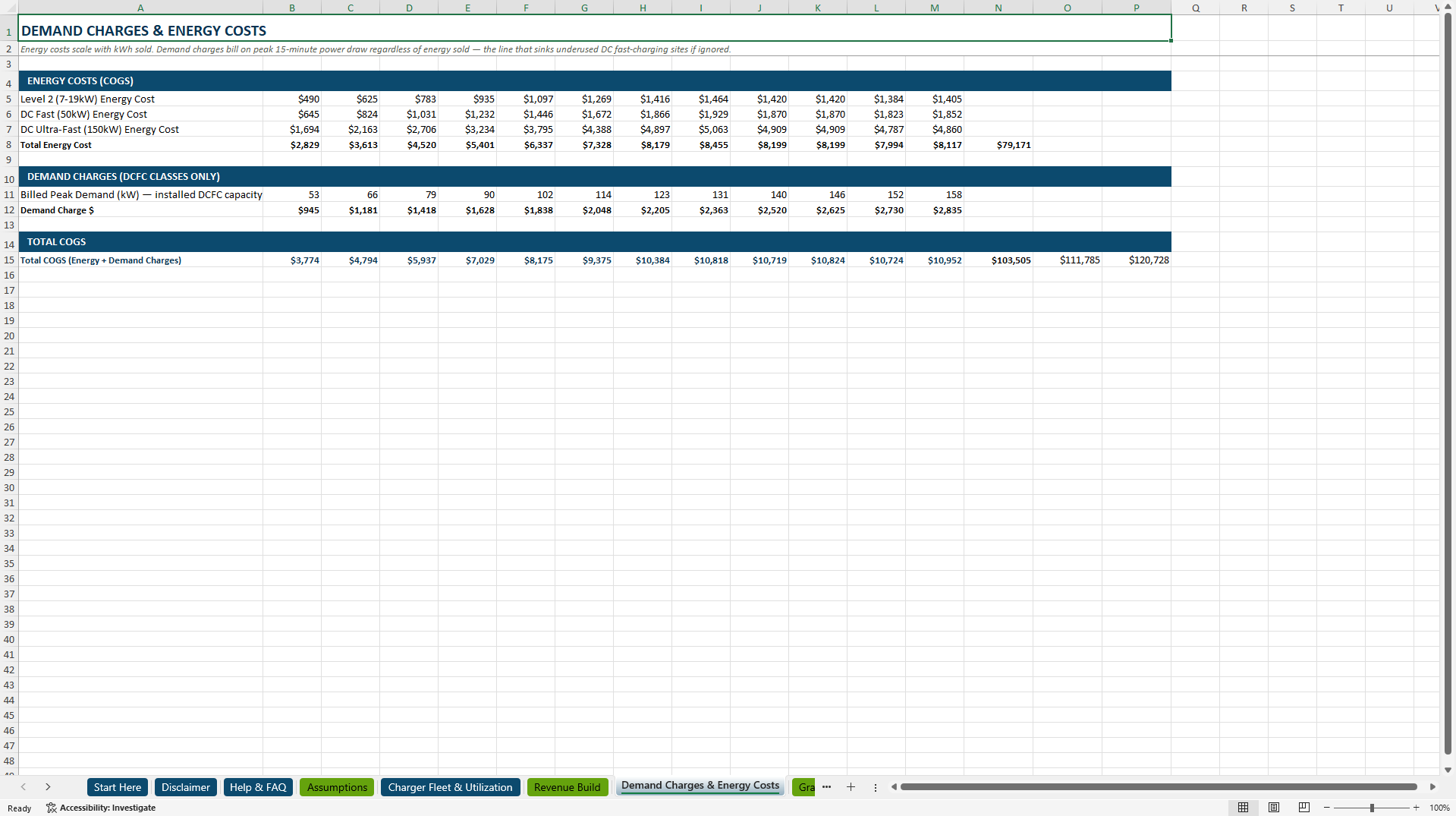
- Gives demand charges -- the #1 reason charging pro formas turn out wrong -- their own explicit modeled tab.
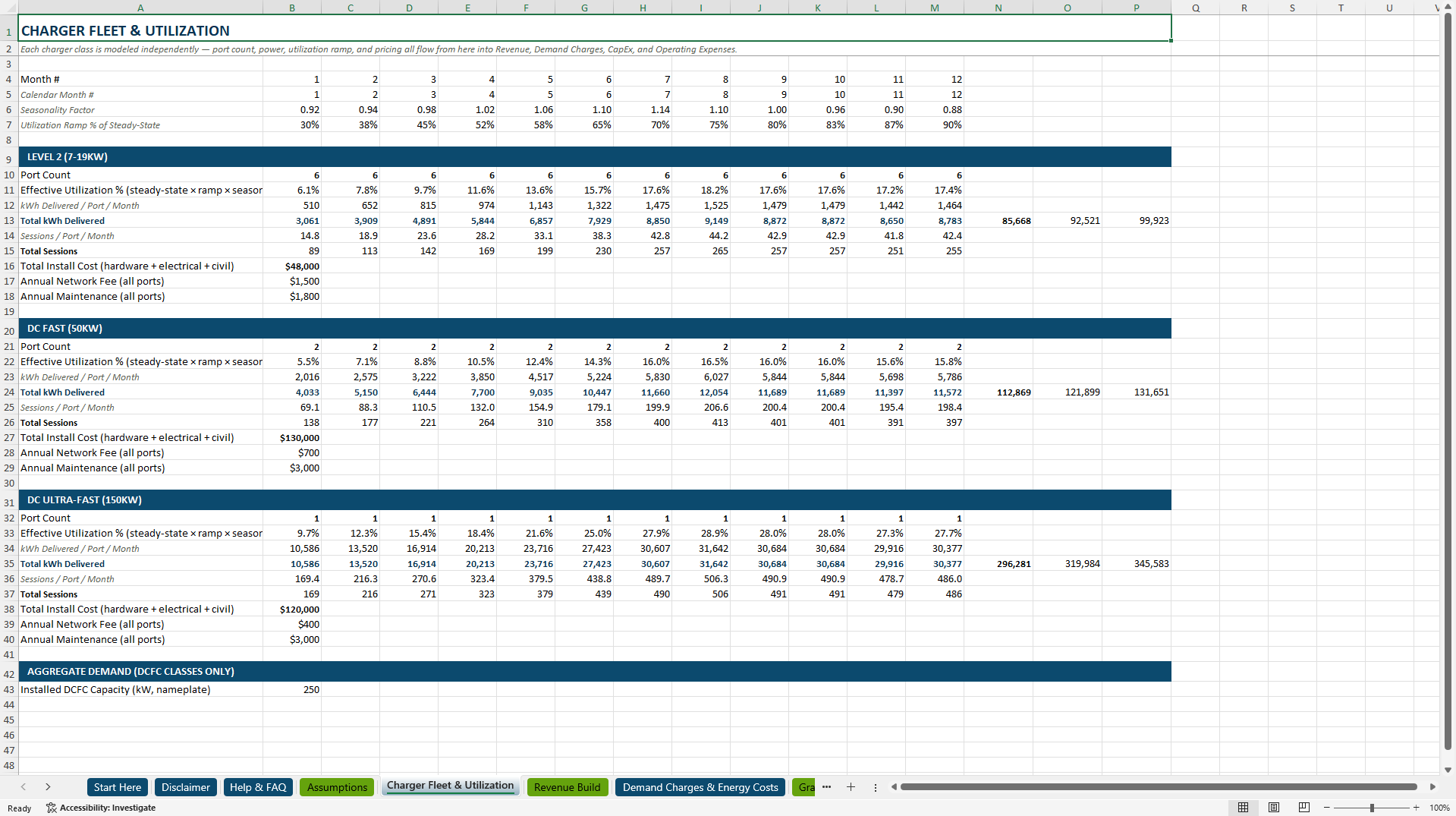
- Models 3 charger classes (Level 2, DC Fast 50kW, DC Ultra-Fast 150kW) independently with real utilization ramps.
- DSCR clears 1.25x in Year 1 at 3.14x and holds above it through Year 3, computed from the actual cost structure.
FINANCIAL MODELING EXCEL DESCRIPTION
Demand charges – the fee a utility bills on a site's single highest 15-minute power draw, regardless of how much energy it actually sold – are the single most common reason DC fast-charging financial projections turn out wrong. Most templates fold them into a generic "utilities" line and hope for the best. This model gives demand charges their own dedicated tab, with a real coincidence factor and an optional battery-storage offset, so the cost structure that actually breaks charging-station economics is visible instead of hidden.
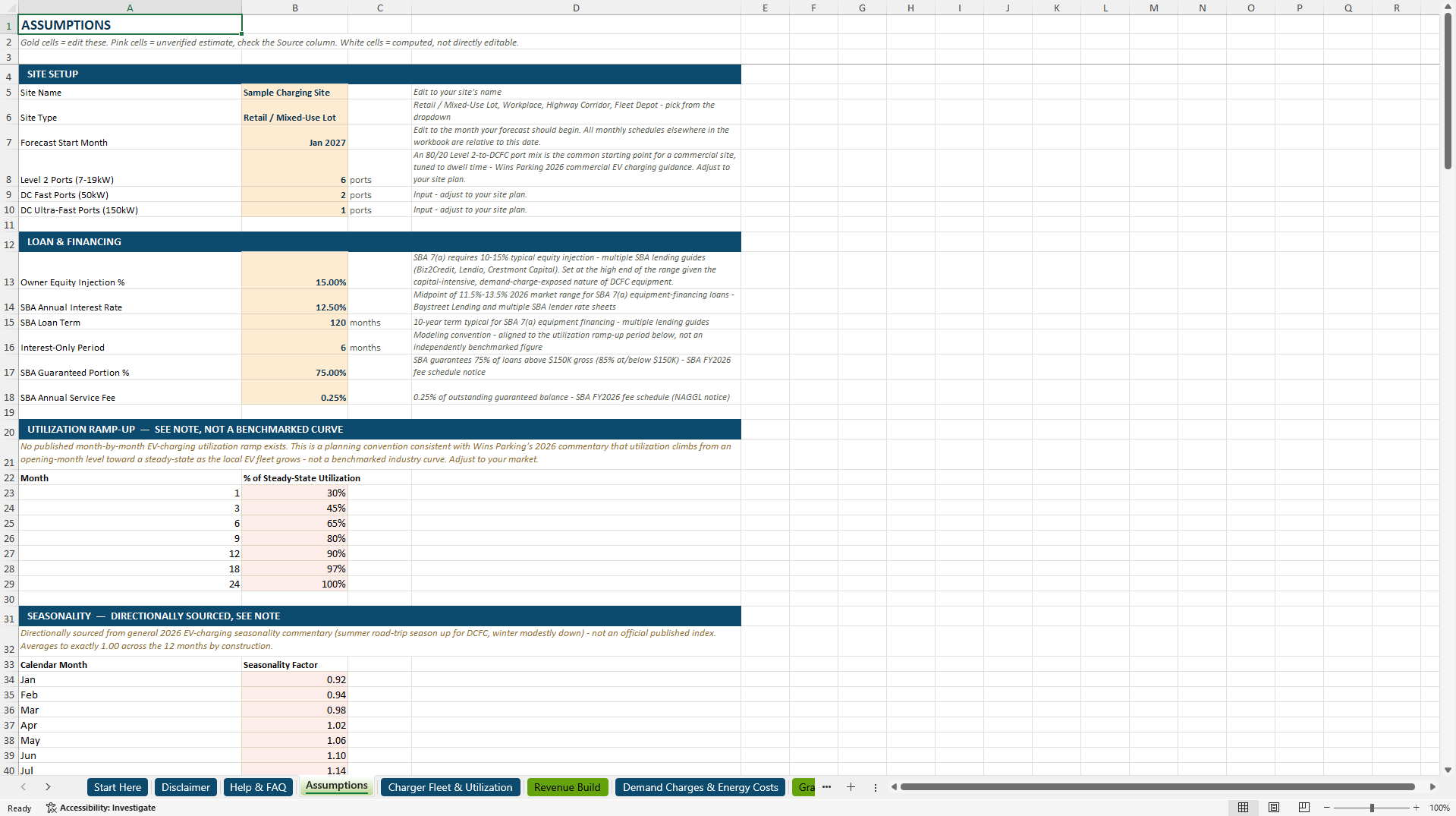
Three charger classes – Level 2, DC Fast 50kW, and DC Ultra-Fast 150kW – are modeled independently, each with its own real utilization ramp-up curve, and revenue is built separately by charger class from energy, idle-fee, and session-fee income. Grants & Incentives captures real 2026 Section 30C federal tax credit terms (30% of cost, capped at $100,000 per item) and NEVI corridor grant terms, plus a utility make-ready rebate line, so the capital stack reflects programs that actually exist today.
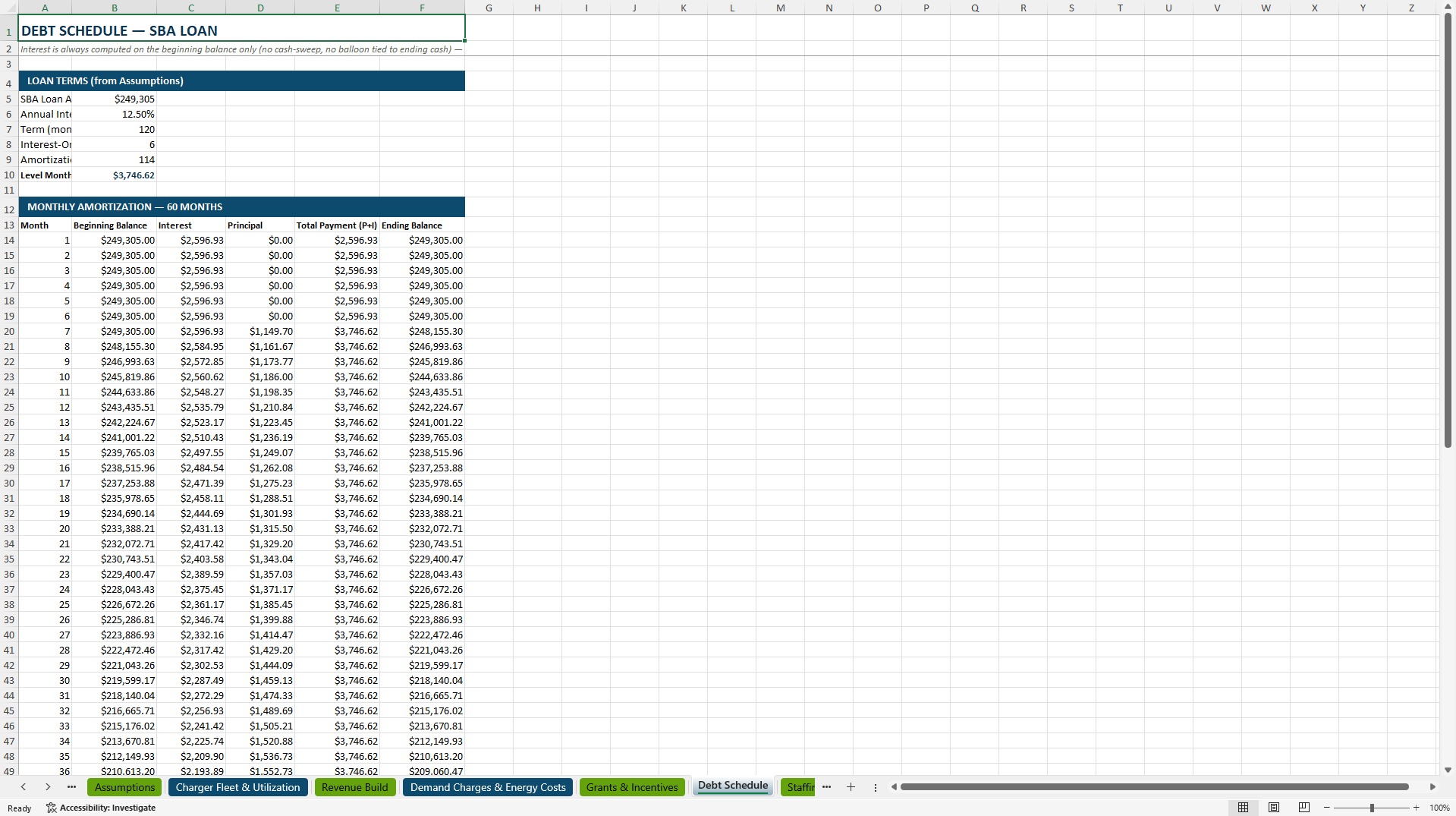
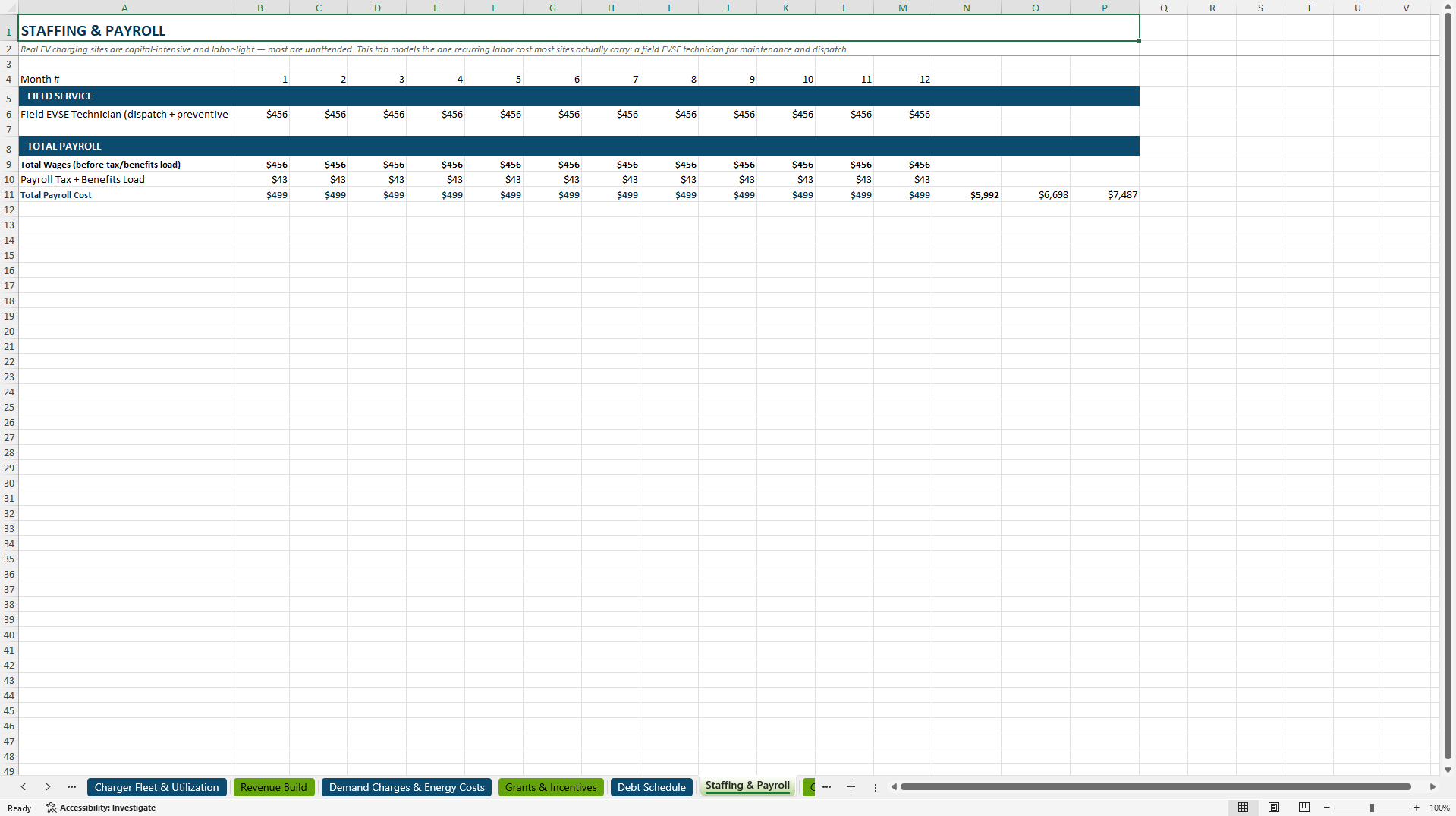
The Debt Service Coverage Ratio clears the 1.25x SBA 7(a) minimum in Year 1 at 3.14x, and stays above it through Year 3 (2.83x, then 3.02x) – computed from the demand-charge-adjusted revenue and Debt Schedule, not a static number. Staffing is sized the way real unattended charging sites actually run: capital-intensive and labor-light, not padded with a management layer the business doesn't need.
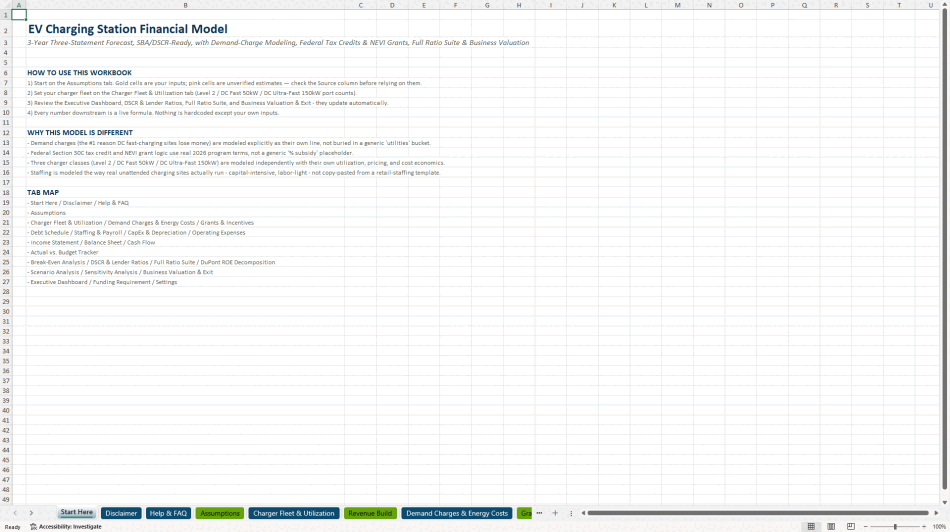
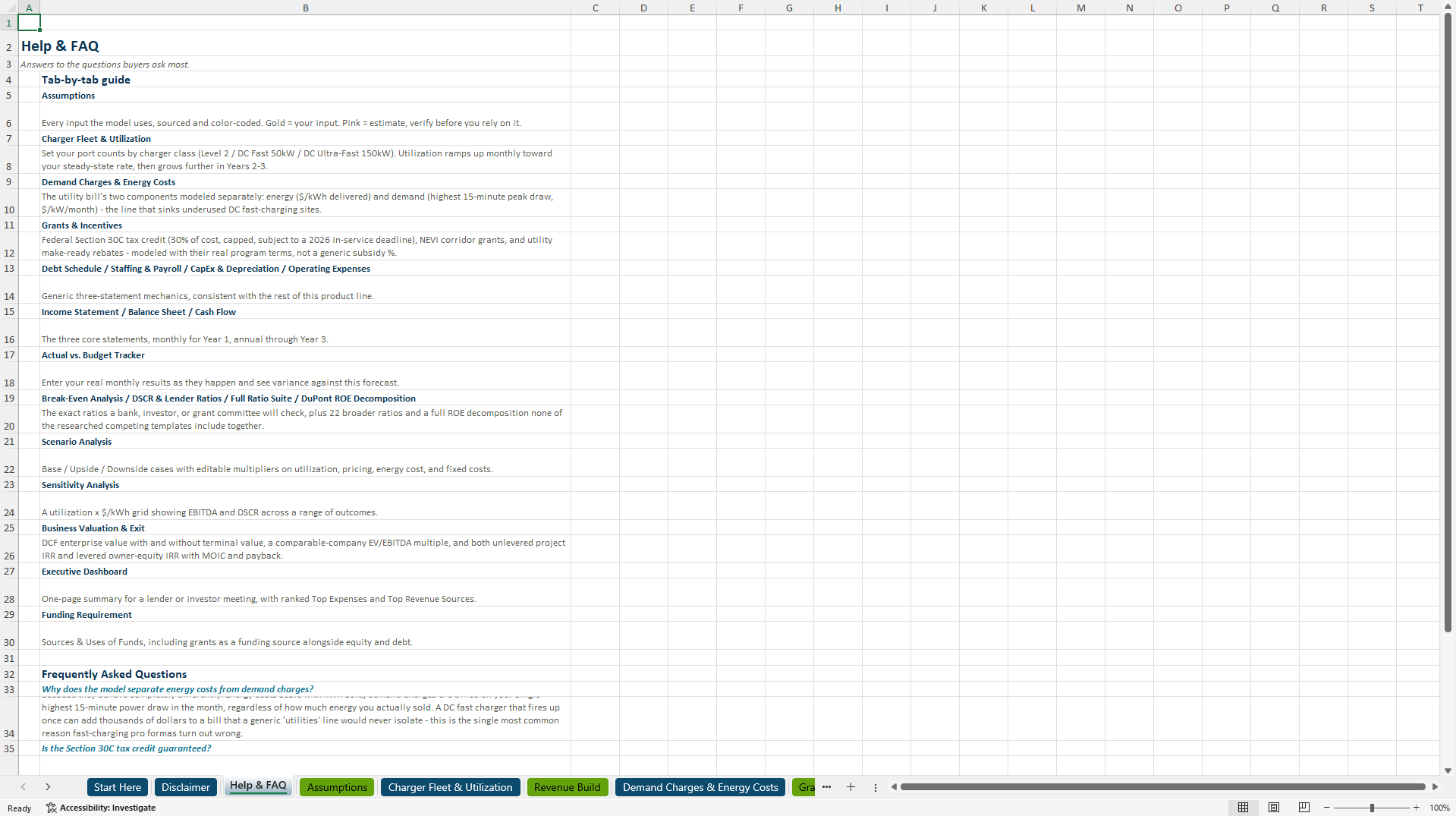
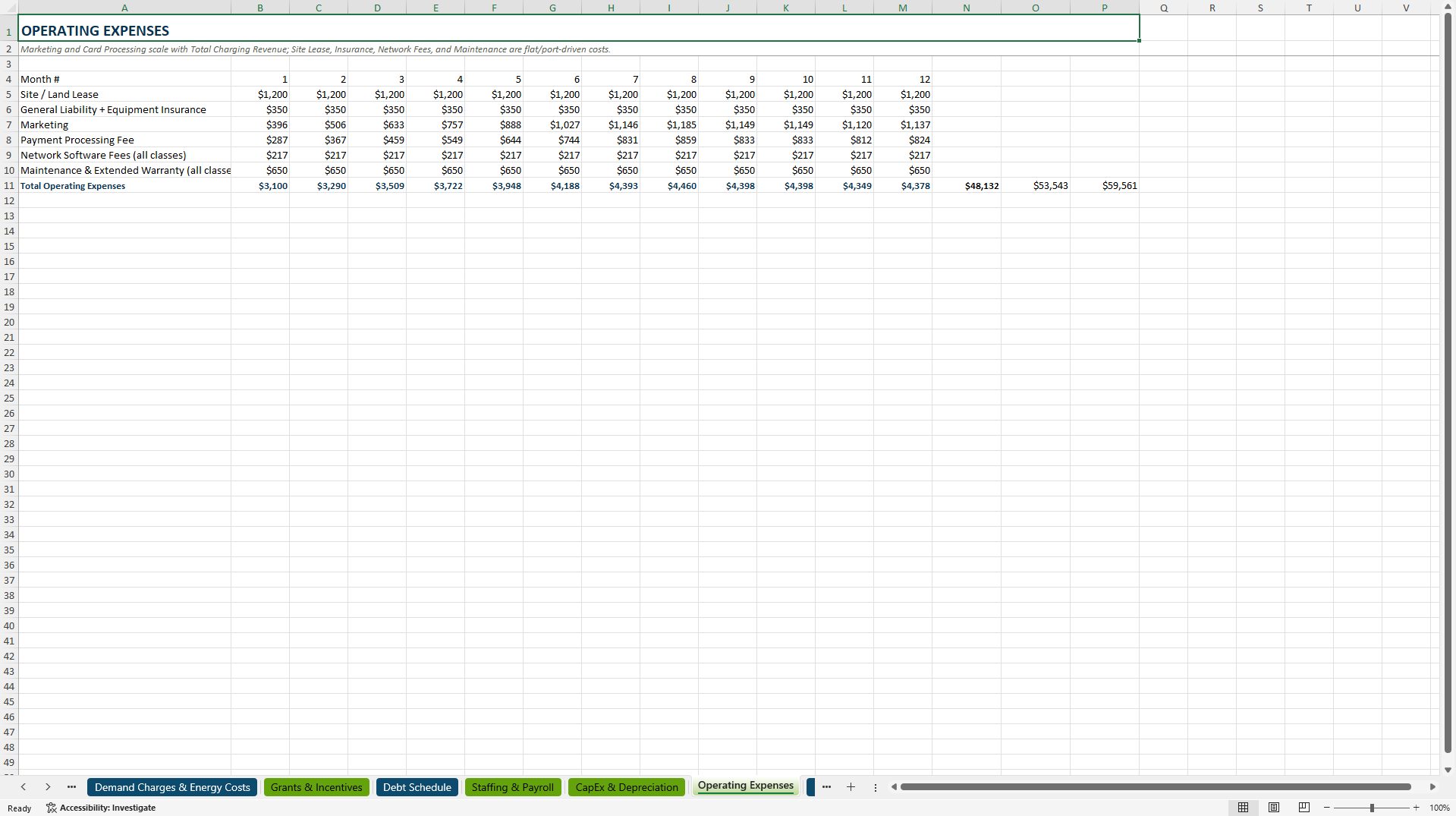
Twenty-six tabs: Start Here, Disclaimer, Help & FAQ, Assumptions, Charger Fleet & Utilization, Revenue Build, Demand Charges & Energy Costs, Grants & Incentives, Debt Schedule, Staffing & Payroll, CapEx & Depreciation net of grants, Operating Expenses, the three financial statements, an Actual vs. Budget Tracker, Break-Even Analysis, DSCR & Lender Ratios, a 22-ratio Full Ratio Suite, a DuPont ROE Decomposition, Scenario Analysis, Sensitivity Analysis, a Business Valuation & Exit tab with both an unlevered project IRR and a levered owner-equity IRR, an Executive Dashboard with revenue-per-port and cost-per-kWh KPIs, Funding Requirement, and Settings.
Built as a native .xlsx with standard formulas only, verified across Excel, Google Sheets, LibreOffice, WPS, and ONLYOFFICE. A planning tool built from sourced 2026 data, not tax, legal, or engineering advice.
Got a question about the product? Email us at support@flevy.com or ask the author directly by using the "Ask the Author a Question" form. If you cannot view the preview above this document description, go here to view the large preview instead.
Source: Best Practices in Financial Modeling, Electric Vehicle Excel: EV Charging Station Financial Model Excel (XLSX) Spreadsheet, WebsiteGeek
ABOUT THE AUTHOR

WebsiteGeek offers free website tools, SEO suites, file converters, browser extensions, calculators, and image utilities built to supercharge your productivity.
We also builds practical digital tools and templates for small business owners -- real formulas and sourced data.
Ask the Author a Question
You must be logged in to contact the author.




























