 Click main image to view in full screen.


BENEFITS OF THIS DOWNLOADABLE PDF DOCUMENT
- Provides a simple problem solving tool
- Develops the individual parts of the A3 process in greater detail
A3 PDF DESCRIPTION
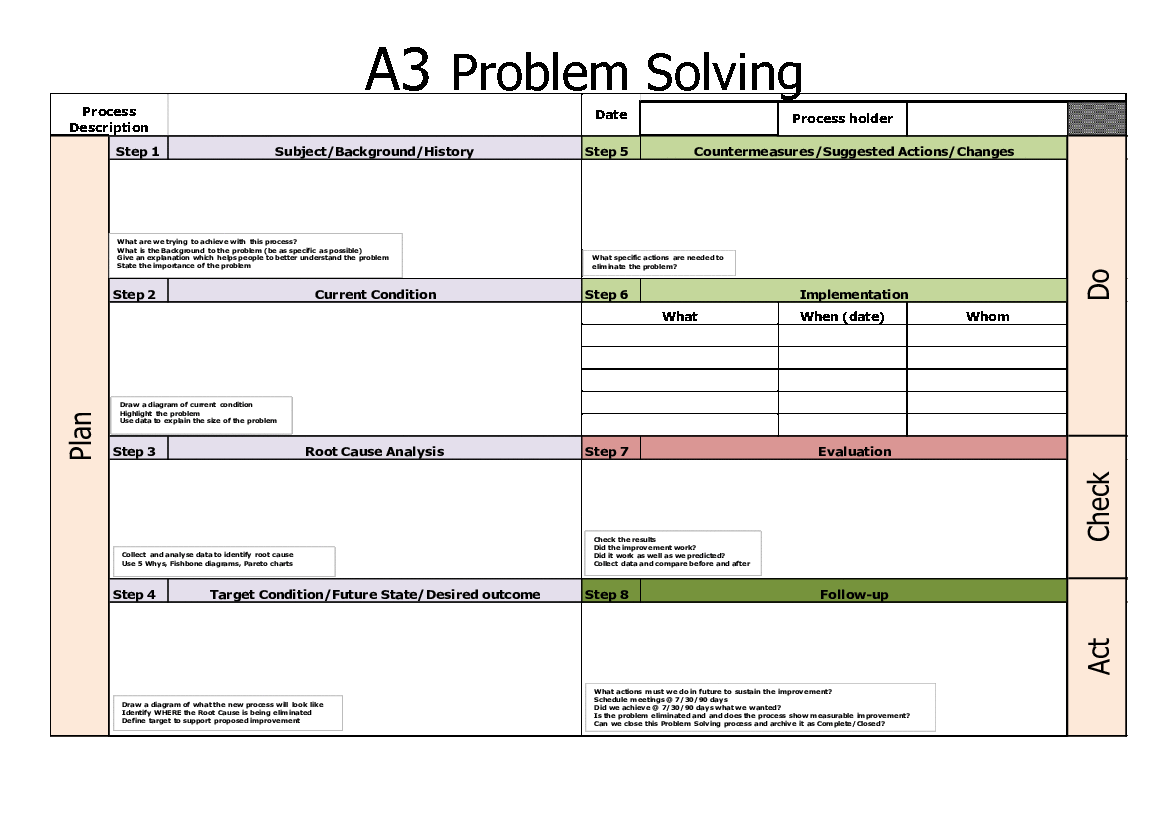
A simple A3 problem Solving sheet working through the Plan, Do, Check, Act (PDCA) cycle. This is also known as the Deming Cycle after W, Edwards Deming.
William Edwards Deming was an American engineer, statistician, professor, author, lecturer, and management consultant. He is famous for his legacy in opening the way for quality control by means of statistical methods in Japan.
The Japanese government showed its appreciation for this work by honouring him with an imperial award and, more important, establishing an award in his name.
The origin of A3 thinking is Toyota. They would conduct Problem Solving exercises using the biggest commonly available piece of paper – A3.
A3 thinking works logically through a process ands structure which prevents jumping forward to what we think we know.
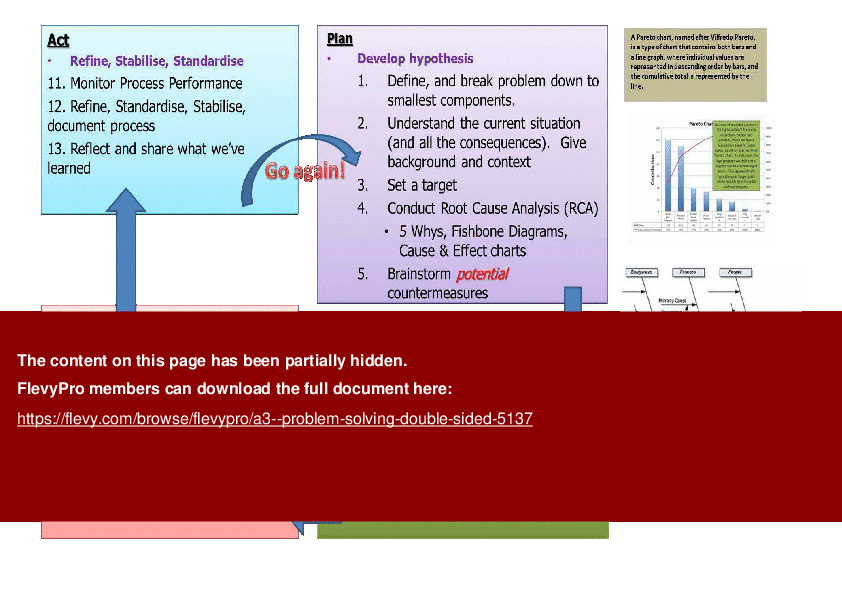
The sheet provides prompts on both sides designed to move the user(s) in a logical direction and takes then through a 13 step process in as much detail as is needed to arrive at potential solutions, then to test, and iterate until a stable state is found.
A3 brings together many individual tools such as 5-Whys, Ishikawa (Fishbone diagrams), cause and effect diagrams and brainstorming.
Personally, I have used this technique on large and small problems with great results, this is why i have developed my own version in order to help others and provide more depth and detail on how-to.
The A3 Problem Solving Sheet is meticulously designed to guide users through a comprehensive problem-solving journey, from hypothesis development to root cause analysis. It emphasizes breaking down complex issues into manageable components, ensuring a thorough understanding of the current situation and its consequences. The sheet incorporates essential tools like the 5 Whys and Fishbone Diagrams to facilitate effective brainstorming of potential countermeasures. By following this structured approach, users can refine, stabilize, and standardize processes, ultimately leading to sustainable solutions and continuous improvement. This PDF is an invaluable asset for any executive aiming to drive efficiency and quality within their organization.
Got a question about the product? Email us at support@flevy.com or ask the author directly by using the "Ask the Author a Question" form. If you cannot view the preview above this document description, go here to view the large preview instead.
TOPIC FAQ
What is A3 problem solving and where did it come from?
A3 problem solving is a structured, logical approach to diagnosing and solving problems that originated at Toyota, where problem-solving was done on A3-sized paper. It emphasizes working through a sequence of steps to avoid jumping ahead and to document analysis and countermeasures on an A3-sized paper.How does the PDCA cycle relate to A3 thinking?
PDCA (Plan, Do, Check, Act) underpins A3 thinking by providing a four-step experimental cycle: plan interventions, run tests, check results, and act on learnings. The A3 sheet explicitly works through the PDCA/Deming Cycle to guide hypothesis testing and iteration using the PDCA cycle.What root-cause tools are commonly used in A3 problem solving?
Common tools incorporated into A3 problem solving include the 5-Whys for causal questioning, Ishikawa or Fishbone diagrams for cause-and-effect visualization, and brainstorming to generate potential countermeasures, with cause-and-effect analysis used to structure findings around root causes such as 5 Whys and Fishbone.How detailed is an A3 process and how does it guide problem resolution?
An A3 process structures work into a sequence of prompts and steps to ensure logical progression from current-state analysis to countermeasures, testing, and standardization. The referenced sheet guides users through a 13-step process with prompts on both sides to prevent premature conclusions and ensure thorough documentation of the 13-step process.How should teams test and iterate solutions using A3?
Teams use the A3 format to document hypotheses, design small-scale Do experiments, capture Check results, and adjust before wider rollout. The method emphasizes testing, iterating, and stabilizing work until a stable state is reached, following repeated PDCA cycles to refine and standardize solutions using the PDCA cycle.What features matter when choosing an A3 problem-solving template?
Look for templates that guide users through PDCA, include prompts to structure thinking on both sides of the sheet, and integrate common root-cause tools like 5-Whys and Ishikawa diagrams. File format and length matter for workshop use; the Flevy A3 Problem Solving Sheet is a 2-page PDF that documents a 13-step process.If my department experienced a quality defect spike, how would A3 help my team?
A3 helps break down complex defects into manageable components, documents the current situation and consequences, and guides teams to generate and test countermeasures using tools like 5-Whys and Fishbone diagrams, then iterate until processes are stabilized and standardized using the 13-step process.What knowledge or skills are needed to start using A3 problem solving?
Familiarity with PDCA thinking and basic root-cause tools such as 5-Whys and Fishbone diagrams enables effective use; the A3 sheet provides prompts and a logical 13-step sequence to guide users who apply these methods and the PDCA cycle.Source: Best Practices in A3 PDF: A3 Problem Solving Sheet PDF (PDF) Document, lean4business